Kathmandu
Wednesday, July 22, 2026





The word ‘green’ has become popular in many industries lately, not just in fashion. I have cared about the environment since I was young, so I have noticed how common this term has become. When it comes to cement, green cement means producing it more sustainably, using low-carbon methods rather than the traditional process. Urbanization is a major factor in rising global carbon dioxide levels. My parents were in environmentally friendly cement in the early 2000s, so I have been aware of its impact for a long time. Because Nepal lies between China and India, two major economies, green cement could give Nepal a real advantage. That is why I am certain that green cement is the future for Nepal’s cement industry.
The global cement crisis and Nepal’s resource advantage
The UNDP reports that cement accounts for roughly 8% of global carbon dioxide emissions. Today, environmental sustainability is more important than ever. Policymakers around the world aim to align with net-zero targets by 2050. Therefore, it is beneficial to focus on carbon-neutral cement now. It is vital to start sowing the seeds early. If industries continue developing without sustainable practices, the damage could become irreversible. Nepal reportedly has more than 1.07 billion tons of limestone. This resource is essential and serves as a feedstock for cement production. Limestone with thin layers could enable the production of low-clinker cement. Using less clinker means materials like ash, slag, and pozzolans would substitute. This substitution emits less carbon dioxide and reduces kiln energy use. As a result, fewer greenhouse gases would be produced. Small and micro changes will inevitably create a macro difference in the cement industry.
Urbanization and economic significance
The Governance and Social Development Resource Center has reported that urbanization rates have risen significantly, from 17 per cent in 2011 to 66 per cent in 2021. The Gen Z revolution has shown that youth in Nepal are in favor of planned infrastructure development for a better society; hence, the cement and steel industries won’t decline, as they are integral to the country’s ethos. As of 2025, cement generates an estimated turnover of a billion dollars, which may not seem like a lot, but due to the current political climate and the jitters I know are still with the rise of new infrastructural development required for future generations, it is vital that they aren’t ignored and worked around.
Why carbon-neutral cement matters for Nepal
It is vital since cement is integral for Nepal. For the industrial sector, it is worth recognizing that carbon emission is the major carbon footprint within the total CO2 emission being roughly 3.45 million metric tons. This has caused ecological degradation. For example, the nitrogen dioxide emission is double which is lethal for air quality for humans to breathe in. It inevitably worsens human health. On the other hand, the old strategy of limestone mining in Nepal has caused soil erosion and ground water depletion which, in turn, has increased the chances of a disaster such as landslides.
All these could be minimized by using carbon-neutral cement and by following modern engineering practices that will benefit future generations. It is quite common, from an observational point of view that adopting new practices can be challenging in Nepal, as in any country. Change is difficult, but there have been multiple examples of private companies and PPP partnership projects not being approved by the local community where projects were to occur, causing disagreement and peaceful protests among stakeholders.
Furthermore, carbon capture machinery will be expensive in the beginning, which will cause financial strain. But I strongly believe that if the companies that own green cement explain the project to locals and focus groups, it will help, and the social trade-off will no longer be the focus. In addition to minimizing the economic trade-off, a green cement project would be necessary for quantity surveyors, civil engineers, and accountants to assess the project’s ROI and calculate when they can start generating income. Initially, there might be an economic trade-off. But I strongly believe that, in the long-term, the benefits of green cement, will enable Nepal to export cement at premium prices and actually benefit the economy.
Addressing skepticism around green cement
Some scientists and engineers may argue that decarbonized cement is just a new trend and a buzzword in the industry. But as a Gen Z enthusiast of infrastructure development, I would wholeheartedly disagree. Low carbon cement indeed has a high start-up cost which I will discuss further down, and I do agree with the statement cement requires processes where energy is needed for the intensive production but since Nepal’s hydropower industry is growing and as of now, engineering bodies across Nepal want to adhere to ESG principle, it is the best time to roll up to begin this new idea of carbon-friendly cement production. ESG principles are essential in the current financial climate, as investors seek alignment. ESG (Environmental, Social and Governance) principles are essentially a framework that ensures a company and a project adhere to it and a guide for businesses to minimize environmental harm and manage social conduct and business ethics. Green cement must align with ESG principles, as it benefits employees and the communities of Nepal. With this alignment, possibly more investors may invest in Nepal in other projects.
According to the NUS Institute of South Asian Studies, Nepal’s hydropower sector installed capacity has grown from roughly 700–800 MW in the early 2010s to over 3,400 MW at present, with multiple large-scale projects under construction. This growing hydropower energy can be used for producing green cement.
Setting up a green cement plant would mean producing low‑carbon cement. This could require retrofitting kilns for alternative fuels. Installing a carbon capture and storage system would also be necessary. Additionally, investing in an LC3 production facility for calcined clay units will be required. Most importantly, researching alternative cement blends will be essential. Grid upgrades for electrification will also be needed. Last but not the least, workforce training will be required. They will all cost a lot of money, but it’s vital to acknowledge they are all capital-intensive; they aren’t overruns. Hence, yes, the initial cost will be hefty, but the income Nepal can make from green cement will outweigh the capital cost.
Some critics still may question:
To that I would say
Since Nepali youth have a demand for change and a different framework to position our country, I strongly believe this is the greatest time to focus on green. Sustainability in any sector is essential for Nepali youth!
Learning from Norway’s experiences
Norway is a pioneer in green cement. Brevik CCs (Heidelberg Materials) is a carbon-capture cement project that is also part of the Norwegian government’s efforts. The industry was established in 2005, but did not begin operations until 2025. This means it took roughly two decades of intense research and development to develop LC3 technologies and carbon capture.
Luckily, Norway has done the heavy lifting in this sector, meaning Nepal is well-positioned. Nepal can learn from Norway’s Brevik CC project and implement green cement in a way that Nepal can adapt. For instance, the project began with a small pilot before expanding to the massive infrastructure at the Brevik plant. Norway has had a carbon tax since 1991, demonstrating that it is the best nation to learn from, as the concept of green is taught throughout schools. Means the country’s population would approve of green plants and green investments. Nepal may need to start by revising the inception plan for the large-scale green cement infrastructure.
Nepal doesn’t need to copy Norway; it just needs to develop its own natural resources. For example, Nepal has an abundant supply of LC3 stones, which would approximately reduce carbon dioxide emissions by 45% if used. However, Nepal could learn from Norway, understanding and avoiding the mistakes the Norwegian government made while setting the carbon tax, the constraints they face in the project of carbon capture, and how they plan to reduce transportation carbon emissions.
Nepal doesn’t need to copy and paste everything Norway does because Nepal and Norway are at opposite ends of the sector. The challenges Nepal and Norway face geographically, economically, and socially are not aligned; however, green cement enthusiasts and engineers can study the green cement industry in Norway and implement ideas Nepal could adopt. The example of Norway shows that one has to invest heavily at the beginning; the initial capital costs are high, but the benefits outweigh the initial costs.
Renewable energy as a competitive edge
In contrast to China and India, where coal accounts for about 70 per cent of electricity generation, Nepal is prioritizing renewable energy sources such as hydropower. This focus provides a competitive advantage for Nepal’s cement industry. Although sustainable cement production may involve higher initial costs, Nepali companies can justify premium pricing domestically and for exports.
With Nepal’s goal of being carbon-free by 2045, introducing a “carbon tax” will be challenging. By adopting sustainable practices, the cement industry can avoid these costs and achieve environmental and social benefits. Carbon tax is a real obstacle, according to the Tax Foundation. As of 2025, over 37 nations have implemented carbon taxes. We know that, and recent evidence shows that enterprises based in Nepal do not want to pay additional tax. Hence, it would be beneficial to reduce future taxes that businesses are required to pay. If they start laying foundations now, using green cement rather than traditional Portland cement, it would be a better economic prospect for them in the future.
Example of sustainable innovation in the early 2000s
When I first thought of this topic, I asked my father what steps he had taken to ensure the cement factory he was involved in was environmentally friendly. He told me that in the early 2000s, he developed an environmentally friendly cement production process. He installed a dust extractor to capture and reintegrate dust into production, improved energy efficiency, and managed waste to reduce heat and optimize drying. At the time, dust pollution was a significant concern. When I asked why he pursued these costly changes, he explained that true visionaries look beyond immediate expenses to create lasting positive impact.
Turning potential into legacy: Nepal’s green cement future
Nepal has all the right ingredients for the green cement pilot project to succeed. The country currently possesses abundant limestone quarries in the central region and western region (Udaypur, Dhankuta, Sindhuli, Makwanpur, Lalitpur, Dhading, etc.), growing hydropower and a new generation (generations Z and alpha) eager for sustainable infrastructure and even the current generation who now want infrastructure that will outlast them and do not jeopardize the environment.
All of these are factors that could enable Nepal to become South Asia’s testbed for green cement. Considering that we live between two nations with giant economies that attract green investments and enable Nepal to foster regional cooperation, and in the global market, having green cement could give us a competitive advantage as the world goes green.
By adopting green cement, Nepal can significantly reduce emissions, thereby protecting future generations. It can do so by adopting carbon-sequestering techniques to produce cement. We want the next generation to be proud of the infrastructure we created without jeopardizing their health, as embodied carbon is harmful financially, economically and environmentally and most importantly, to health.
For the Nepali diaspora, this is the moment to support innovation at home through knowledge sharing, advocacy, and financial investment. It is vital that the wider Nepali diaspora is transparent about their support and leads Nepal toward sustainable construction, as that’s the future. We must adopt the positive lessons we have learnt abroad. Hence, we need to adopt fresh techniques and new lenses for our innovative projects, and one of these would be green cement. By adopting this, we will differentiate ourselves from China and India, which are among the world’s largest producers of cement. Hence, I urge all to begin this project immediately.
We now have new leaders who care about youth and the environment, which means it’s the perfect time to begin an environmentally friendly project like green cement.
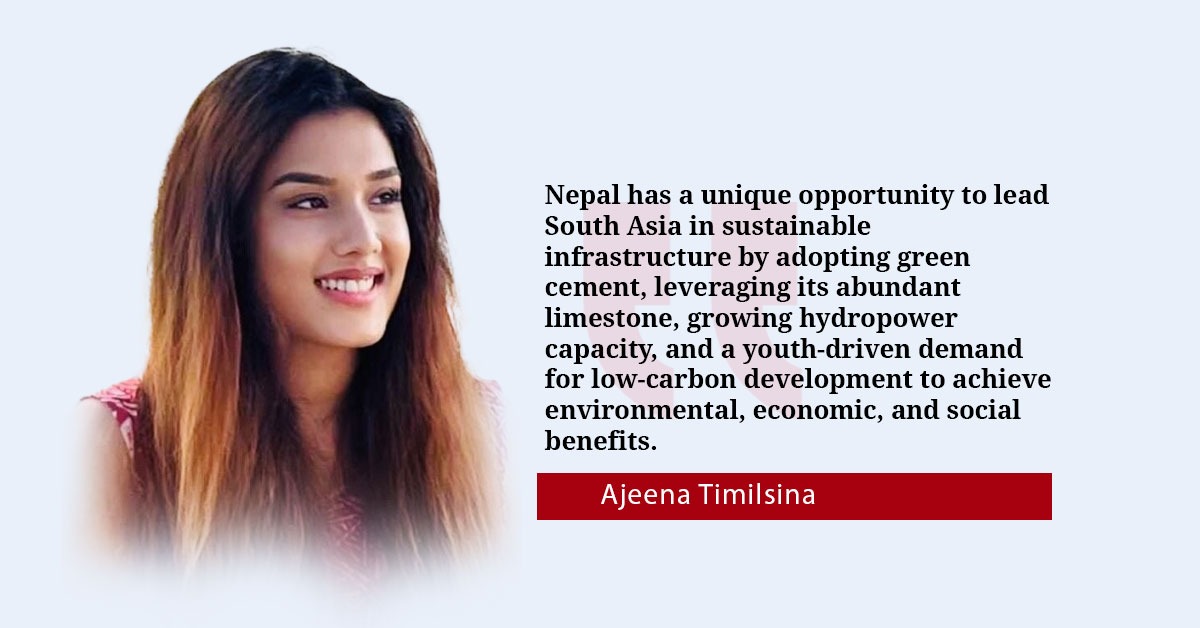
Author Ajeena Timilsina is based in London.