Kathmandu
Wednesday, June 24, 2026





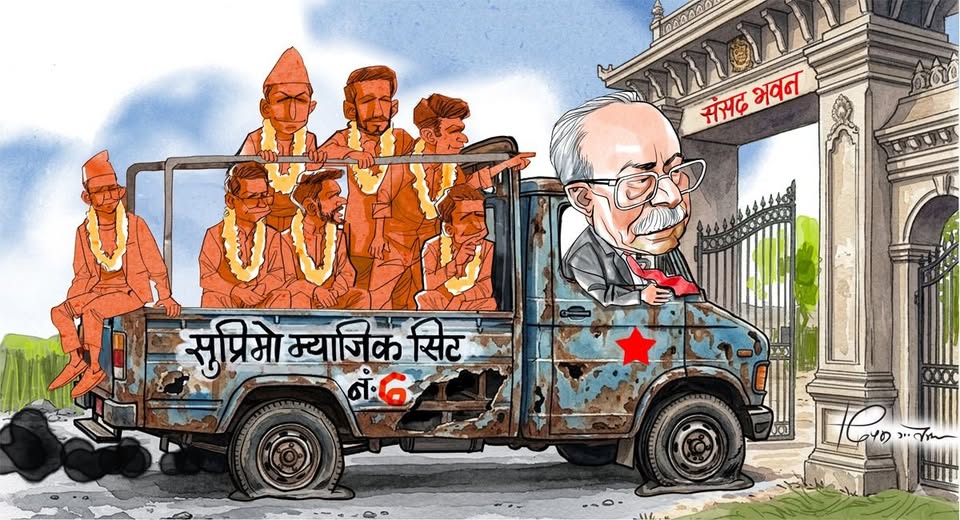
KATHMANDU: For more than three decades after the 1990 People’s Movement in Nepal, communist parties stood at the center of Nepali politics. Today they face an unprecedented crisis of party relevancy. The Nepali Communist Party previous Maoists-once the country’s most powerful force, first through insurgency and later through electoral dominance after the armed insurgency (13 February 1996-21 November 2006) and the 2006 People’s Movement in Nepal-now appear to be struggling for survival.
Ahead of the latest election, the Nepali Communist Party previous Maoist Centre tried to revive its fortunes by rebranding and merging with nearly two dozen smaller leftist factions, parties and groups. The effort aimed to consolidate Nepal’s fractured communist camp. Instead, the election exposed the scale of the left’s decline.
A wave of anti-establishment politics-fueled by the rise of the Rastriya Swatantra Party under Rabi Lamichhane and the popularity of Balendra Shah-has shaken the communist old order. Once-dominant communist strongholds are crumbling, and dozens of factions, including the Maoists, now face an existential crisis.
For four decades, Maoist supremo Pushpa Kamal Dahal has been the center of Nepali politics, navigating success and failure with uncanny skill. Known for surprise decisions and relentless survival instincts, he has adapted to every context-whether leading a violent insurgency or maneuvering through peaceful politics-always turning instability into opportunity.
NCP’s suffer their sharpest electoral blow in two Decades
Nepal’s once-formidable Maoist force-now the principal component of the Communist bloc Nepali Communist party -has suffered its sharpest electoral setback in nearly two decades. In the elections held on March 05, the party entered the fray as part of a broad alliance of 25 groups, including the CPN (Unified Socialist). Yet the final results published by the Election Commission tell a stark story: the party secured just 17 seats in total-8 under the first-past-the-post system and 9 through proportional representation.
After the 2022 election, even as the third-largest force, Pushpa Kamal Dahal ‘Prachanda’ sought to turn arithmetic into leverage. Elevating “32” to the status of a magic number, he alternated alliances-at times with the Nepali Congress, at others with the CPN-UML-to lead the government for nearly 18 months. But after formed a Congress-UML coalition came together to form a new government, pushing the Maoists into opposition for the first time in 12 years.
The longer arc is one of steady erosion. In 2008, the Maoists commanded 38.10% of the vote, a high-water mark that has since receded with each successive election. Following their unification with the CPN Unity Centre-Masal in 2009, their parliamentary vote share briefly rose to 39.60%. At the time, the party secured 3,144,204 proportional votes-29.28% of the total.
By the second Constituent Assembly elections in 2013, however, their position had sharply weakened. Their seat share fell to 13.81%, winning just 83 seats in the 601-member assembly and slipping to third place. Their proportional vote tally dropped to 1,609,145, or 15.21%.
An alliance with the largest leftist force, CPN-UML, in the 2017 elections failed to reverse the trend. In the 275-member House of Representatives, the Maoists won 53 seats-19.27%-while their proportional vote shrank further to 1,303,721 (13.66%).
In 2022, they pivoted again, this time aligning with the Nepali Congress. Yet the benefits of coalition politics accrued largely to their partner. The Maoists secured 32 seats-11.63%-and garnered 1,175,684 proportional votes, or 11.13%, remaining confined to third place.
The latest results suggest not merely a bad cycle, but a structural decline. Once the dominant force of Nepal’s post-conflict politics, the Maoists now find themselves grappling with a more fragmented electorate, diminishing returns from alliances, and a political center of gravity that has steadily shifted away from them.
From Strategic Brilliance to Post-Conflict Drift
The origins of the Maoist movement in Nepal lie in the late twentieth century. At a time when armed communist revolutions around the world were fading-particularly after setbacks throughout the mid-twentieth century-the Maoists in Nepal charted a different course. On 13 February 1996, the party launched a decade-long insurgency aimed at dismantling the feudal monarchy and establishing a revolutionary state.
The context was paradoxical. Globally, the communist movement was retreating, while left-wing insurgencies elsewhere were faltering. In Nepal, communist politics appeared resurgent during the 1990s. The Maoist insurgency expanded rapidly, eventually forcing the political establishment into negotiations.
During the insurgency, the Communist Party of Nepal (Maoist Centre) achieved notable successes despite numerous operational weaknesses. By carefully developing ideology, policy, and organizational methods, the party managed in many instances to deliver extraordinary results. Its decision to enter a decade-long armed struggle was informed by a careful assessment of domestic conditions, international circumstances, and the interests of both the population and the party itself.
When the national and global context shifted, the Maoists adapted. Through a series of internal meetings, the party steered the armed conflict toward a negotiated peace, preserving organizational cohesion while achieving qualitative gains. At that moment, the movement demonstrated strategic foresight and unity that few expected from a relatively young insurgent organization.
The movement reached its political zenith after the 2006 peace process. In the first Constituent Assembly elections of 2008, the Maoists emerged as the largest party in parliament, a result that stunned both critics and scholars of revolutionary movements. For many on the global left-then facing ideological retreat-the victory seemed to inject fresh energy into an otherwise defensive movement.
The post-peace era, however, told a different story. Freed from the immediacy of armed struggle, the party became increasingly entangled in routine administration and day-to-day politics. Debate over ideology, policy, and method-once the movement’s lifeblood-gave way to self-interest and opportunism. Encircled by critics and internal rivals, the Maoists struggled to preserve their revolutionary identity.
Electoral performance illustrated this decline. The party enjoyed overwhelming public support in the first Constituent Assembly elections, winning 120 of 240 directly elected seats. Yet it failed to resist internal factionalism or successfully complete the constitution. By the second Constituent Assembly election, the Maoists were reduced to just 26 directly elected seats-a sharp decline that continued in subsequent contests.
What had once been a disciplined and adaptive revolutionary organization now faced the challenges of maintaining cohesion, credibility, and relevance in a democratic political landscape. The contrast between the party’s wartime acumen and post-conflict drift underscores the difficulty insurgent movements often face when transitioning to governance.
Power brought new possibilities. Parliamentary dominance opened doors to influence, prestige and access to state resources. Yet critics argue that the government led by Prachanda struggled to translate revolutionary legitimacy into effective governance. Instead of consolidating public trust through institutional discipline and reform, it often appeared erratic-energetic but unpredictable-leaving its historic ascent to power marked as much by controversy as by triumph.
From revolutionary vanguard to political decline
Once the vanguard of Nepal’s political transformation, the Communist Party of Nepal (Maoist Centre) now finds itself at perhaps the weakest point in its history. From a decade-long insurgency to negotiating the Comprehensive Peace Accord, ushering in a republic, drafting a constitution, and implementing federalism, the Maoists played a central role in shaping modern Nepal. Yet in the years since the peace process began in 2008, the party’s trajectory has been one of gradual decline.
In the 2008 Constituent Assembly elections, the Maoists emerged as the largest party with 229 seats, positioning Pushpa Kamal Dahal, known as Prachanda, as the country’s first post-monarchy prime minister. Over the next 15 years, party leaders held the premiership multiple times-Prachanda himself serving thrice-cementing the movement’s centrality in Nepalese politics. Despite this, the party’s electoral fortunes began to wane.
By the second Constituent Assembly election, the Maoists had slipped to the third-largest party, securing just 80 seats-26 through first-past-the-post and 54 proportionally. In the 2017 legislative elections, the party won only 52 seats, including 36 in the direct contests. In 2022, even after entering elections as part of a coalition, the Maoists were limited to 32 seats, with only 18 from first-past-the-post constituencies. Despite holding third-party status in parliament, they continue to lead governments at both federal and provincial levels.
The party’s internal fragmentation predates the insurgency. Splits within the Maoist movement began before the decade-long conflict and persisted throughout the war, intensifying after the peace process. Loyalists of Prachanda-the so-called ‘Yes-men’-gradually defected, leaving the leadership increasingly personalized and insular.
Critics argue that the problem is institutional as much as personal. “Prachanda has been in power for 40 years. The constitution should allow leadership renewal and provide opportunities for others to rise. Generational change is necessary,” says one observer. The party’s eighth general convention failed to conduct democratic elections; instead, Prachanda handpicked the leadership slate. In a modern 21st-century democracy, such practices fall short of the standards expected for internal party governance.
The trajectory of the Maoists illustrates a paradox: a movement that once commanded revolutionary legitimacy now struggles to maintain democratic credibility. From leading the country’s historic transformations to facing electoral decline and internal factionalism, the party’s current predicament reflects the challenge of translating insurgent momentum into sustainable democratic politics.
Why NCP lost the public’s trust
The decline of the Nepali Communist Party previous (Maoist Centre) cannot be explained only by electoral arithmetic or shifting alliances. A deeper transformation occurred within the movement itself. The roots of its crisis lie in the birth of a new political class inside the party-one that gradually drifted away from the egalitarian ideals that once fueled the Maoist insurgency.
When the Maoists moved from the countryside into the cities and entered mainstream politics, a new culture took hold: consumerism. During the years of insurgency, the movement was built on collective sacrifice. Fighters and leaders lived much like the rural communities that supported them. The lives of Maoist cadres and ordinary villagers were not markedly different. This shared hardship fostered trust; many supporters saw the movement as a reflection of their own lives and aspirations.
That moral economy collapsed after the transition to peace. As consumerist lifestyles spread within the leadership, the Maoists began to resemble the very capitalist elite they had once condemned. The public, meanwhile, saw little change in its own circumstances. While ordinary citizens remained where they were, Maoist leaders and influential cadres increasingly appeared to prosper. The ideological erosion of the movement began there.
At first the shift was subtle. Party leaders could have halted it. Instead, critics say, the leadership itself became entangled in the new culture. To avoid scrutiny, it tolerated-or even encouraged-similar behavior among second-tier leaders. Gradually a new privileged class emerged within a party that had once pledged to dismantle class hierarchy altogether.
The consequences were felt most sharply among rank-and-file fighters of the insurgency. Many former combatants who had sacrificed their health or livelihoods felt abandoned. The story of injured war veteran Kamala Tamang-who lost a limb during the conflict yet struggled to survive without meaningful support from the party-became emblematic of a wider grievance. While some leaders lived comfortably, many war victims faced poverty, despair or even suicide.
The contrast extended beyond the battlefield generation. Large numbers of former Maoist supporters have migrated for labor to Gulf countries, while political influence and wealth have concentrated in the hands of a small circle of party elites and their relatives. Opportunists and strongmen have filled the vacuum within party structures. Under such conditions, it is hardly surprising that the movement’s credibility eroded.
Another factor is organizational decay. The Maoists once prided themselves on collective leadership and disciplined structures. Over time, however, decision-making became increasingly personalized. The party began to revolve around individual authority rather than institutional process. Critics argue that from the local level to the central leadership, personal loyalty often matters more than collective deliberation. Such personalization inevitably breeds factionalism and distrust.
Financial transparency-or the lack of it-has further undermined credibility. Many party leaders now live lifestyles comparable to business magnates, yet the sources of their income remain opaque. For a movement that claims to represent the poor, such ambiguity is politically corrosive. Citizens do not necessarily demand asceticism from their leaders, but they do expect honesty about wealth and its origins.
Equally damaging has been the abandonment of core political issues. During the insurgency the Maoists mobilized support around concrete demands: land reform, access to education, healthcare and employment for the marginalized. Over time those agendas faded from the party’s priorities. Critics note the irony that the children of many Maoist leaders now study in elite private schools and receive treatment in expensive hospitals-institutions far removed from the public systems the party once championed.
The result is a widening moral distance between leaders and supporters. Voters who once risked social stigma-or worse-to support the insurgency have increasingly turned away. Many no longer see the party as a vehicle for social change but as another faction within Nepal’s competitive political marketplace.
Why NCP has declined so rapidly
Prachanda transformed his party into a factory of power, producing prime ministers, ministers, and positions, while becoming synonymous with political maneuvering, scandals, and controversies. Even as the Maoist vote base has eroded, Dahal’s “power-bargaining”-switching alliances between the Congress and the UML-has kept him relevant.
With both Sher Bahadur Deuba and K.P. Sharma Oli in the latter stages of their careers, Dahal’s ambition to reclaim the prime ministership may remain his political lifeline for the foreseeable future. Few political careers in Nepal are as complex-or as controversial-as that of Pushpa Kamal Dahal ‘Prachanda’. Since entering parliamentary politics, the Communist Party of Nepal (Maoist Centre) has adopted numerous tactics and maneuvers that would be difficult to catalogue in a short account. Among the most damaging episodes was a financial scandal involving roughly fifty million rupees during the integration of the Maoist Insurgents cantonment scandals. The affair not only tarnished the party’s public reputation but also provoked sharp criticism from within its own ranks.
Successful political parties typically rest on three pillars: credible pro-people ideas, strong institutions and behavior that resonates with the electorate. Yet the Maoist Centre often appeared to rely instead on a different formula-an ideological legacy rooted in Maoist revolutionary doctrine, a fragile organization built around the authority of a single leader, and a political culture sometimes accused by critics of opportunism. As Nepal’s society evolved, the party struggled to fully grasp changing social expectations, economic aspirations and contemporary political thinking.
Its external posture has often been equally inconsistent. The Maoists have oscillated between confrontation with and accommodation toward India-from threatening rhetoric to negotiated agreements-reflecting a broader pattern of political volatility that has puzzled both observers and allies.
The Gen-Z uprising in September 08-09, 2025 did not spare the Maoists. Angry protesters vandalized the homes of senior Maoist leaders, including Pushpa Kamal Dahal ‘Prachanda’, and ransacked party offices. Riding that wave, on September 13, former chief justice Sushila Karki became interim prime minister, dissolved parliament and called elections-moves strongly backed by the Maoists.
Their gamble misfired. Expecting anger to sweep aside Nepali Congress and CPN-UML and elevate them as a decisive force, the Maoists instead slipped to fourth place. Vote shares fell sharply, and beyond a few strongholds they failed to defend their base.
The decline reflects a deeper paradox. Once a rebel force of marginalized groups, the party-led by Prachanda and later Baburam Bhattarai-spent years in power, often alongside former rivals. That proximity to government eroded its insurgent appeal. In this election, reduced to 17 seats and facing new competition from the Rastriya Swatantra Party, the Maoists’ long slide appears firmly entrenched.
The party has struggled to reintegrate its own activists. During the war it maintained thousands of full-time cadres. In the peace process, however, systematic support for those fighters proved limited. Some successful figures prospered; many others were left to fend for themselves. Honest but less connected activists drifted into migrant labor or modest small businesses, while local leadership often passed to newcomers with little connection to the movement’s original struggle.
For the Maoists, the challenge is therefore not merely electoral. It is existential. Unless the party confronts corruption, restores internal democracy and reconnects with the social agenda that once defined it, its decline may continue. The question facing its leadership is stark: whether to revive the ideals that once animated the movement-or to accept its transformation into just another political machine within Nepal’s fractious democracy.
Nepali Communist Party once the insurgent force that remade the state, now cuts a diminished figure. The results of the March 5 elections confirm a dramatic fall-from the commanding heights of 2008 to a distant fourth, with only a modest parliamentary presence. For a movement that once claimed history’s momentum, the verdict is stark.
Its leader Prachanda has long shown a deft grasp of Nepal’s transactional, numbers-driven politics. Yet that fluency has not translated into public trust. The Maoists, having traded revolution for participation, now operate squarely within a capitalist democratic system they once vowed to overturn. In doing so, they have struggled to reconcile promise with performance. The structural inequalities and service failures they pledged to end remain stubbornly intact.
The deeper problem is estrangement. The party’s ideological core has thinned as voters, once mobilized by insurgent zeal, have drifted away-disillusioned with what they see as a slide from radicalism into routine patronage. Expectations remain high, but the party’s capacity to meet them appears limited to incremental reform rather than transformative change.
As a younger generation of Nepali political and economic historians revisits this era, it will confront an uncomfortable gap between Maoist rhetoric, lived reality and service delivery. The movement that once spoke in the language of emancipation now appears entangled in the familiar vices of nepotism, corruptions, scandals and overall poor governance. That drift has been compounded by the failure of rivals such as the Nepali Congress and the Communist Party of Nepal (Unified Marxist–Leninist) to mount a coherent ideological challenge, leaving the political field curiously unclarified.
The electoral trend suggests the Maoists’ decline is not yet at its nadir. Lacking both a compelling intellectual renewal and a credible programmed of delivery, the party’s downward trajectory appears set to continue. Revival, at least in its old insurgent mould, looks increasingly implausible.
![Ministers and party leaders join dancing and singing inside convention hall ahead of election [Photo Feature]](https://english.nepalnews.com/wp-content/uploads/2026/06/Rasopa-general-convention-day-4-Nepal-photo-library-12.jpg)