Kathmandu
Wednesday, June 24, 2026





The latest FATF review shows Nepal still has not solved the problem that has haunted it since 2008: an ability to draft laws and action plans, but a persistent failure to translate them into prosecutions, seizures and credible enforcement.
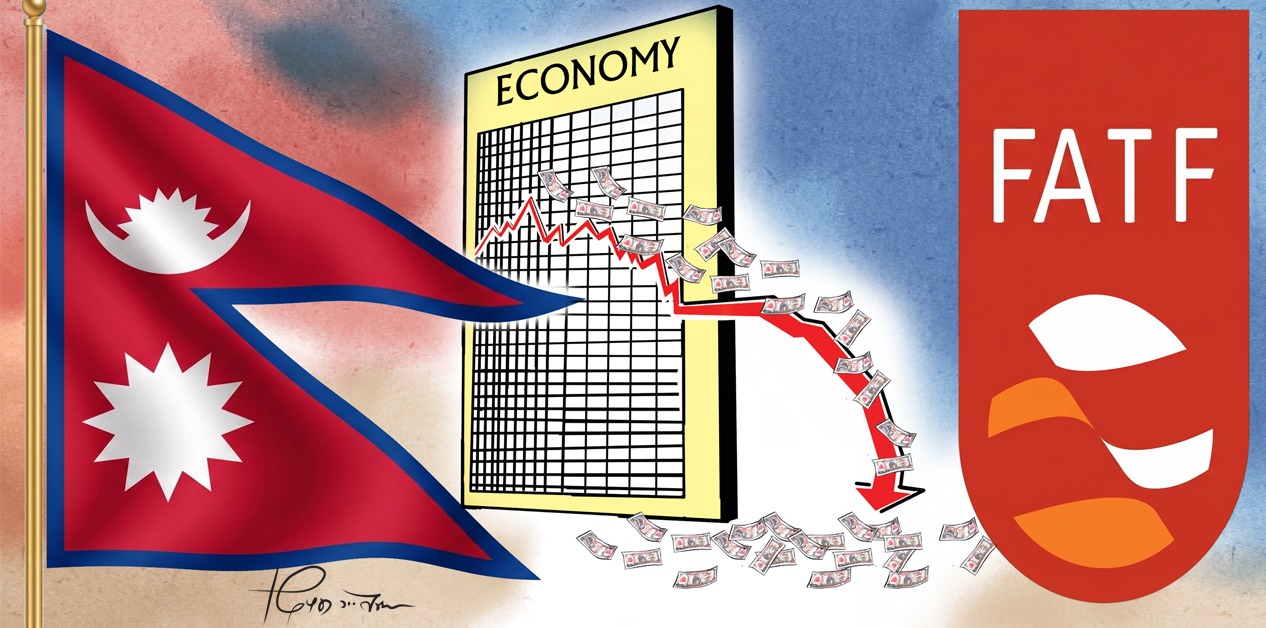
KATHMANDU: Nepal’s return to the Financial Action Task Force’s list of jurisdictions under increased monitoring should not have surprised anyone who has followed the country’s long and uneven relationship with global financial oversight.
At the Paris Plenary held between June 17 and 19, FATF chose to keep Nepal on the grey list, issuing yet another action plan that looks, in substance, remarkably similar to the ones that came before it. The decision was not punitive in any dramatic sense. Nepal was not blacklisted, no sanctions were imposed, and the country was not singled out as a uniquely dangerous actor in the global financial system.
Yet the outcome carries a quieter and arguably more troubling message: Nepal knows what is wrong, has been told repeatedly what needs fixing, and still has not closed the gap between writing rules and actually enforcing them.
This is the real story behind the grey listing, and it deserves a closer look than the headline news cycle typically gives it.
The pattern of legislation without enforcement
If there is one thread that runs through every FATF review of Nepal since its initial listing in 2008, it is this: Nepal is reasonably good at producing laws, directives, and policy statements, but consistently weak at translating them into prosecutions, convictions, and recovered assets. The June 2026 review reaffirmed this exact diagnosis.
FATF acknowledged that Nepal has shown political commitment since February 2025, has amended the Assets Laundering Prevention Act, and has had Nepal Rastra Bank issue updated directives for banks and financial institutions. On paper, this looks like progress. In practice, FATF’s evaluators were not convinced, because the metrics that matter most to them, namely how many money laundering cases are actually investigated, how many are prosecuted, and how much illicit wealth is actually seized, remain stubbornly low.
This is not a new problem invented in 2025. It is the same structural weakness that kept Nepal on the grey list from 2008 to 2014, a six year stretch during which the country built its foundational legal architecture almost from nothing, including the Financial Information Unit, but apparently failed to institutionalize those gains permanently.

File Photo
The on-site mutual evaluation conducted in December 2022 found that many of the improvements from the earlier period had eroded or simply proved insufficient against tightening global standards, which is precisely why Nepal found itself back on the list in February 2025. In other words, Nepal treated its first exit as the finish line rather than the beginning of an ongoing commitment, and that failure to sustain reform momentum is now repeating itself in a different form.
The deeper question this raises is whether Nepal’s political and bureaucratic culture is even structurally capable of sustaining long-term institutional reform across changes in government. Nepal has seen frequent shifts in ruling coalitions, shifting policy priorities, and a tendency for each new government to treat inherited commitments as someone else’s unfinished business rather than a continuous national obligation.
FATF’s June 2026 statement specifically noted a lack of visible improvement under the newer government despite earlier pledges, which suggests that whatever momentum existed at the start of this listing cycle has already begun to stall. If history is any guide, this is a dangerous sign, because Nepal’s first grey-list stint nearly ended in outright blacklisting in 2012 before the country managed to pull back. The risk of repeating that near miss cannot be dismissed lightly.
Where the gaps actually lie
It is worth being specific about where FATF says Nepal is failing, because the criticism is not vague or generic. The fresh six point action plan focuses on risk based supervision of banks, cooperatives, casinos, and real estate, a crackdown on illegal hundi operators, and stronger investigation capacity. Each of these areas reflects a distinct and identifiable failure mode within Nepal’s financial oversight system.
Start with cooperatives. Nepal’s cooperative sector has expanded rapidly over the past decade, often filling gaps left by formal banking in rural and semi urban areas, but this growth has consistently outpaced the regulatory capacity needed to supervise it properly. Several cooperative scandals involving misused or unaccounted deposits have already surfaced domestically, and these are not isolated incidents but symptoms of a sector that has been allowed to grow faster than the institutions meant to watch over it.
When FATF singles out cooperatives as a high risk sector requiring stronger supervision, it is pointing at a problem Nepali depositors and policymakers already know intimately, since the country has had to set up an inquiry commission domestically to deal with cooperative irregularities even outside the FATF context.
Then there is hundi, the informal and largely undocumented system of transferring money outside the banking system. Hundi exists in Nepal for practical reasons, since it is often faster and cheaper than formal banking channels, particularly for migrant workers and their families navigating remittances across borders. But its very informality is exactly what makes it attractive for capital flight, tax evasion, and potentially for laundering illicit proceeds.
Because hundi transactions leave no clear paper trail, they are nearly impossible for regulators to trace, and this directly undermines the transparency that FATF’s standards demand. The challenge for Nepal is that hundi cannot simply be banned or aggressively suppressed without risking serious harm to the very households who rely on remittances for survival, which is precisely why FATF explicitly cautioned Nepal against disrupting legitimate remittance flows or financial inclusion while it pursues hundi operators. This is a delicate balancing act that requires precision rather than blunt enforcement, and precision is not historically Nepal’s strongest administrative trait.
Real estate and casinos round out the high risk sectors named by FATF, both because they involve large cash transactions and asset transfers that can easily be exploited to disguise illicit proceeds when oversight is lax.
Commercial banking in Nepal has made comparatively more progress on compliance, with banks implementing Know Your Customer norms and reporting obligations, but the broader ecosystem beyond banking, the cooperatives, the casinos, the property markets, remains far less monitored.
FATF’s emphasis on these specific sectors essentially reflects an assessment that Nepal’s banking sector, while imperfect, is not the country’s biggest blind spot. The real vulnerabilities sit in the parts of the financial system that have grown without matching regulatory infrastructure.
Finally, there is the institutional coordination problem, which may be the most fundamental of all. Nepal’s enforcement apparatus involves multiple agencies, including the Department of Money Laundering Investigation, the Financial Information Unit housed within Nepal Rastra Bank, and various law enforcement bodies.
FATF has repeatedly flagged weak coordination among these agencies as a structural weakness, and the International Monetary Fund’s own Article IV assessment has echoed this concern, noting capacity constraints and fragmented institutional coordination that limit effective implementation.
When multiple agencies are nominally responsible for catching and prosecuting financial crime but do not share information efficiently or work from a unified strategy, the result is precisely what Nepal is now experiencing: laws exist, mechanisms exist, but outcomes remain thin.
Low caseloads relative to the scale of suspected financial crime are not simply a matter of insufficient staffing, though that is certainly part of it. They are also a product of agencies operating in silos, each doing its own narrow piece of the puzzle without an integrated system pulling the pieces together into actual convictions and asset recovery.
The economic stakes, underappreciated but real
It would be easy to dismiss grey listing as a bureaucratic technicality that ordinary Nepalis barely notice in their daily lives, and to some extent that perception is not wrong. FATF has explicitly urged member states not to disrupt remittance flows or humanitarian transfers because of Nepal’s listing, which should, in theory, protect the channel that millions of Nepali households depend on for income sent home by family members working abroad. Ordinary banking activities like deposits, withdrawals, and domestic transfers remain largely unaffected.
But the economic cost of grey listing is not about sudden shocks. It is about slow, compounding friction that accumulates quietly over time, the kind of cost that does not make headlines on any single day but adds up significantly over months and years. Nepali banks face heightened scrutiny from the foreign correspondent banks that facilitate cross border wire transfers, trade finance, and foreign currency transactions.
These foreign partners may demand more detailed documentation, conduct enhanced due diligence on Nepali clients, or in the more severe cases simply reduce the scope of services offered to Nepali financial institutions altogether, a defensive practice known as de-risking that protects the foreign bank’s own compliance exposure at Nepal’s expense. Some smaller correspondent banking relationships could even be discontinued entirely if the perceived risk outweighs the perceived benefit of maintaining them.
This translates into real costs for the Nepali economy that depends heavily on imports, foreign aid, remittances, and a banking sector tied into the global financial system. Importers and exporters dealing in larger transaction volumes are likely to feel this most acutely, since their dealings draw more scrutiny and face additional layers of verification before letters of credit or fund transfers can clear.
In a country heavily reliant on imported goods, this kind of friction can quietly add inflationary pressure, since the additional compliance costs absorbed by banks tend to trickle down eventually to consumers and businesses. Foreign direct investment, something Nepal desperately needs as it pursues an ambitious seven percent growth target for the current fiscal year, becomes harder to attract when international compliance teams treat grey listed jurisdictions with extra caution before approving investments, joint ventures, or loans. This lengthens approval timelines, raises legal and compliance costs on both sides, and in some cases simply pushes capital toward fully compliant regional competitors such as Bangladesh or Vietnam instead of Nepal.
The reputational dimension compounds these direct financial costs. Nepal is trying to position itself as an attractive destination for hydropower investment, tourism infrastructure, and manufacturing, while simultaneously navigating the broader challenge of its deferred graduation from least developed country status.
Carrying a grey list designation at the same time sends a signal to the world that Nepal’s institutions are not yet trustworthy enough to police its own financial system effectively, a signal that compounds existing investor concerns about political instability and bureaucratic delay rather than offsetting them. None of this is a single dramatic blow. It is death by a thousand small frictions, each one modest in isolation but cumulatively significant over the two to three years, or potentially longer, that this listing cycle could last.
A comparative lens that should worry, and reassure, Nepal in equal measure
It is genuinely useful to place Nepal’s situation against other countries currently on the grey list, because the comparison cuts in two directions simultaneously. On one hand, Nepal’s profile is meaningfully different from countries like Syria, Yemen, Haiti, or South Sudan, all of which face armed conflict, state fragility, or active political collapse alongside their financial compliance failures.
Nepal’s deficiencies are administrative and institutional rather than rooted in war or governmental breakdown, which in principle should make reform considerably more achievable than it is for those conflict affected states. There is no fundamental reason Nepal cannot fix coordination problems between its enforcement agencies or build out asset confiscation capacity, since the obstacles are technical and bureaucratic rather than existential.
On the other hand, Nepal shares an uncomfortable pattern with countries like Vietnam, Cameroon, and Haiti, all of which received separate warnings at the same June 2026 Plenary for missing their own reform deadlines. The common thread across all of these cases is exactly the gap that defines Nepal’s predicament: passing laws without matching enforcement capacity.
This suggests that having relatively favorable underlying conditions, as Nepal does compared to conflict zones, is not automatically sufficient to guarantee a faster exit. Political will has to translate into sustained, visible enforcement action, and several countries with arguably easier starting positions than active war zones have nonetheless struggled to make that translation happen.
Then there are the success stories that Nepal could learn from directly. Algeria and Namibia exited the grey list at this very same Plenary, joining the Philippines as recent examples of countries that managed to work their way out. Bulgaria, Cote d’Ivoire, the Democratic Republic of Congo, and Monaco have substantially completed their action plans and are simply awaiting final on site verification before potential delisting.
What separates these successful or nearly successful cases from Nepal’s repeated struggles is not the existence of good laws, since most countries on any version of this list eventually pass adequate legislation.
What separates them is sustained political commitment that survives changes in government, dedicated and properly funded enforcement units, measurable increases in actual investigations and convictions, and a demonstrated ability to freeze and confiscate criminal assets rather than simply talking about the intention to do so.
Successful exits also tend to involve close and continuous engagement with the relevant regional FATF style body, which in Nepal’s case is the Asia Pacific Group on Money Laundering, treating each review cycle as an opportunity to show real evidence of progress rather than a box ticking exercise to survive until the next deadline.
Nepal’s own history actually proves it has the underlying capacity to exit, since it managed to do exactly that in 2014 after a six year stint. The frustrating irony is that the same country apparently lacked the institutional memory or political continuity to keep those gains intact afterward, leading directly to its return to the list in 2025.
This is perhaps the single most important lesson buried in Nepal’s FATF story: building compliance once is necessary but nowhere near sufficient. Compliance has to be treated as a permanent operating standard rather than a temporary fix engineered to satisfy a particular evaluation cycle, and that requires institutional resilience that survives well beyond any single government’s term in office.
What genuine progress would actually require
If Nepal is serious about exiting the grey list within a reasonable timeframe rather than drifting through another multi year cycle, the path forward is fairly clear, even if walking it has proven difficult in practice.
FATF’s own action plan effectively spells out the priorities: a sharper, sector specific understanding of where money laundering and terrorist financing risks actually concentrate within the economy, stronger and more consistent supervision of the cooperative, casino, and real estate sectors that have lagged behind banking in regulatory rigor, a more targeted and carefully calibrated crackdown on hundi operators that does not collaterally damage legitimate remittance flows, tighter coordination and shared capacity across the Department of Money Laundering Investigation, the Financial Information Unit, and law enforcement bodies, and most critically, a substantial and sustained increase in the number of investigations, prosecutions, and successful asset confiscations.
None of these are abstract or impossible demands. They are concrete, measurable benchmarks that FATF reviews three times a year, in February, June, and October, giving Nepal multiple checkpoints to demonstrate real movement.
The federal budget for the current fiscal year has explicitly named exiting the grey list as a policy priority, which suggests the political establishment understands the stakes at least rhetorically.
The genuine test, though, is whether that rhetorical priority survives contact with Nepal’s characteristic pattern of shifting coalitions, competing short term priorities, and a historic reluctance to enforce rules vigorously against politically connected individuals operating in exactly the sectors FATF has flagged, namely cooperatives and real estate.
This last point deserves particular emphasis because it cuts closer to the real obstacle than technical capacity ever could. Nepal does not lack lawyers capable of drafting adequate legislation, and it has already shown, with assistance from the International Monetary Fund’s legal department, that it can produce reasonably sound amendments to its Assets Laundering Prevention Act.
What Nepal has historically lacked is the political appetite to pursue financial crime cases vigorously when the trail leads toward well connected figures in politics, cooperatives, or real estate. Enforcement against ordinary citizens is rarely the issue FATF is concerned about.
The issue is whether Nepal’s investigative and prosecutorial machinery can function independently enough to pursue cases regardless of who is implicated, and whether asset confiscation can actually happen even when the assets in question belong to people with political protection. Until that question is answered convincingly through actual prosecutions and actual seizures rather than promises, Nepal’s grey list status is likely to remain a recurring rather than a resolved problem.
The road ahead, realistically
Given the trajectory FATF has signaled, with an action plan extending toward mid 2027, Nepal should brace for at least another year, and quite possibly longer, of grey list status. This is not catastrophic in the way a blacklisting would be, since blacklisting remains a distant risk reserved for countries demonstrating sustained failure to engage or severe ongoing non compliance, a description that does not currently fit Nepal’s pattern of partial, acknowledged progress.
But distant does not mean impossible, and Nepal’s own history shows it once came uncomfortably close to that more severe outcome in 2012 before recovering.
The more realistic and immediate concern is simply economic drag accumulating quietly in the background of Nepal’s broader development ambitions. Every additional review cycle that ends in continued monitoring rather than exit extends the period during which foreign banks remain cautious, investors remain hesitant, and the cost of participating in international trade and finance stays elevated relative to what it could be.
For a country trying to grow its economy at an ambitious pace while also managing political instability, infrastructure gaps, and a deferred graduation from least developed country status, this is not a problem Nepal can afford to treat as secondary or merely technical.
The honest assessment is that Nepal possesses nearly everything it needs on paper to exit the grey list within a reasonable horizon. What it has consistently lacked, both in this listing cycle and the one before it, is the discipline to convert paper commitments into the unglamorous, sustained, often politically uncomfortable work of actual enforcement.
Until that changes in a durable and verifiable way, Nepal is likely to keep finding itself in the same position it occupies today, acknowledged for trying, but kept under watch for not yet succeeding.