Kathmandu
Wednesday, June 24, 2026





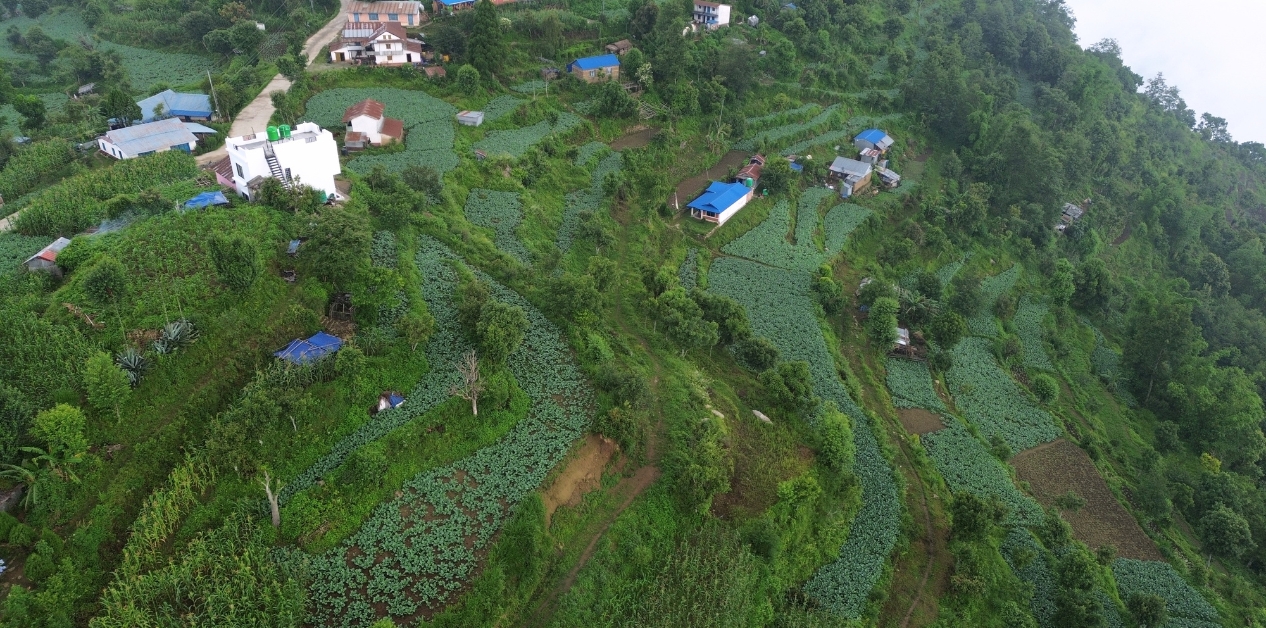
Commercial vegetable farming is transforming the income and lifestyle of farmers in Dandabazar, Dhankuta.
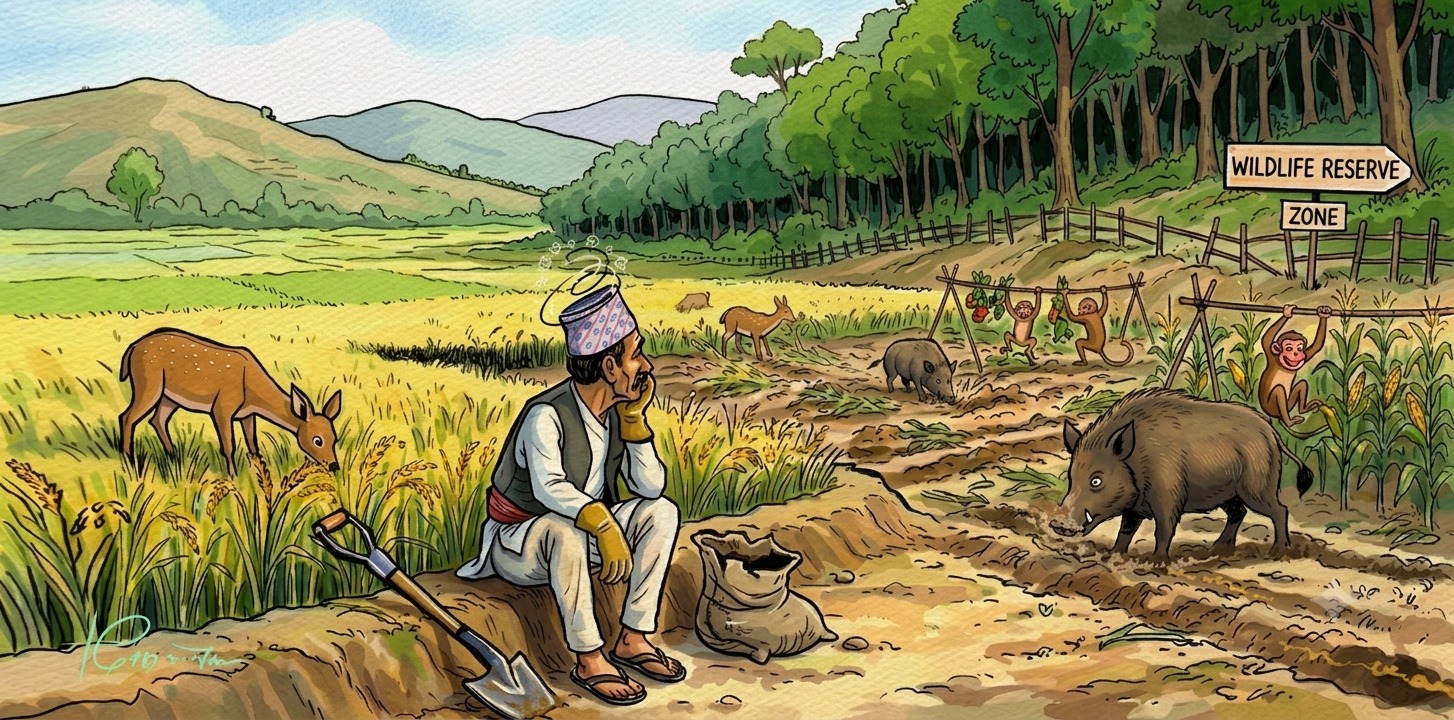
KATHMANDU: Thaneshwor Neupane (60) of Khayardhari, Bharatpur Metropolitan City-26, Chitwan, still feels a sharp pang in his heart when he recalls how birds completely destroyed the lentil seeds he sowed on his one-and-a-half bigha field a year ago. “After the birds wiped out the sown seeds, an entire season’s income slipped through my fingers,” he says. “While campaigns to protect wild animals and birds are actively running, who is there to understand the pain of us farmers?”
Since Khayardhari falls within the Kalabanjar buffer zone of Chitwan National Park—the country’s first national park—Poudel and other residents have been suffering losses of life and property to wildlife. They face torment not only from large animals like elephants, tigers, and rhinos, but equally from monkeys, wild boars, deer, barking deer, blue bulls (nilgai), porcupines, and birds. Local experiences and scientific studies both show that farmers in settlements near the park suffer from economic losses to sheer difficulties in feeding themselves due to wildlife destroying agricultural yields. The rate of human and material loss in this area is higher than elsewhere.
There are 13 national parks, one wildlife reserve, one hunting reserve, and six conservation areas across the country. When wildlife and birds from these 21 protected areas enter settlements and destroy crops, farmers in the buffer zones bear massive economic losses. Crop damage by wildlife is a distinct manifestation of human-wildlife conflict.
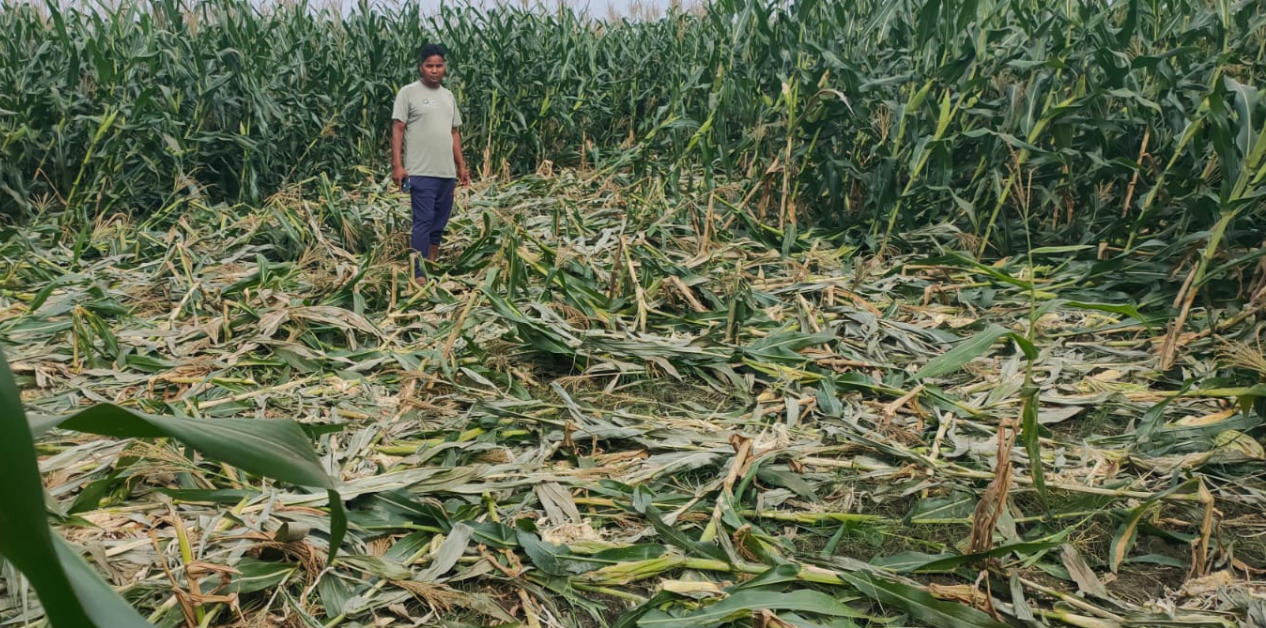
Damage caused by wild boars in Jit Lal Garau’s maize field in Sisai, Bharatpur-26 on May 9, 2026 AD. Photo: Kalabanjar Buffer Zone Consumer Committee
According to the data of the Department of National Parks and Wildlife Conservation for the fiscal year 2024/25, out of 8,595 incidents of wildlife damage, more than half are related to crop damage. Among the total registered incidents, 53.63 percent, or 4,610 incidents, involve crop damage. This record spans across all protected areas.
This statistic highlights that consumers in the buffer zones suffer not only from human casualties but also extensively from crop losses. Unregistered incidents and details of damage caused by birds are not included in this record.
Farmers in the Kalabanjar buffer zone are constantly troubled by rhinos, deer, barking deer, and wild boars. Local resident Basudev Mahato (70) has to herd and guard against rhinos every single night during the farming season. If he doesn’t, rhinos can wipe out the crops on his 3,386.3 square meters of sharecropped land in a single night. Exhausted from working the fields all day, he keeps watch from a machan (watchtower) to protect his crops from rhinos. “Sometimes I fall fast asleep, and taking advantage of that moment, the rhinos wreck the farm,” he says. “Last March, a rhino entered the paddy field and caused such damage that I harvested only two quintals from a field that usually yields 25 quintals.”
After the rhino caused the damage, he submitted an application to the buffer zone consumer committee seeking relief. However, he complains that he has not received it even after months have passed.
Nominal relief
The government provides monetary relief to farmers for damage caused by wildlife. To claim this, the victimized farmer must submit 12 types of documents—including photos of the damage site, ward recommendations, a damage assessment report (muchulka), and land ownership certificates—to the buffer zone consumer committee as per the ‘Guidelines for Distribution of Relief for Damage Caused by Wildlife, 2023 AD’. The committee then submits the application along with evidence to the office of the respective national park, reserve, hunting reserve, or conservation area. Only after an investigation committee evaluates the submitted documents and makes a decision is the path cleared for the victim to receive relief.
However, the relief money received after navigating a tedious process and waiting for months does not truly compensate for the actual loss.
According to Section 4, Subsection 3 (b) and (c) of the guidelines, when crops are damaged, relief is provided at most once per crop and up to a maximum of Rs 10,000 only. Farmers can receive relief money for a maximum of two crops a year. If the damaged crop is insured, the relief is provided only after deducting the amount received from insurance.
Farmers sow crops to feed themselves year-round by investing in expensive fertilizers, plowing, and labor, often using borrowed money. Yet, when crops are ruined, receiving a maximum of Rs 10,000 in relief fails to compensate for their actual losses.
Tikaram Mahato, Chairman of the Divyagunj Buffer Zone Savings and Credit Cooperative in Kalabanjar, terms this as the government’s ‘impractical policy’. A former secretary of the buffer zone consumer committee and a retired teacher, he says, “If paddy cultivated on 1354.52 square meters is damaged, the relief money provided is barely enough to buy seeds for that area. This is not fair at all.” Those without land ownership certificates cannot even claim relief after a loss.
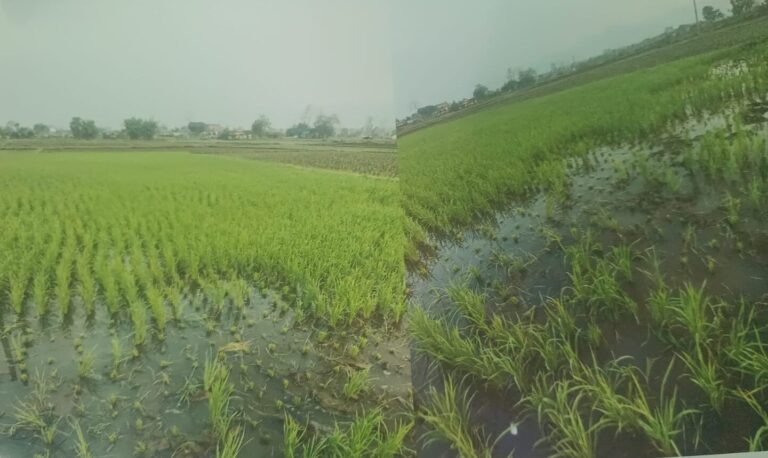
Damage caused by a rhino in Babu Ram Adhikari’s paddy field in Bhagadi, Bharatpur-26 on March 16, 2026 AD. Photo: Kalabanjar Buffer Zone Consumer Committee
Tikaram mentions that farmers are often left in tears when they do not receive relief proportional to their losses. As an example, he shares the story of his neighbor Basudev, who faced severe trouble when a rhino ruined his paddy field. “The 70-year-old man would come to my house in the evening leaning on his walking stick, crying as he told me about the destroyed paddy. What could I do either? I would speak to the park officials. No matter how much he cried, there was no way to fully compensate for his loss,” he says. However, Basudev has still not received even the Rs 10,000 promised by the government.
Bishnu Prasad Shrestha, Chief Conservation Officer of the Shivapuri Nagarjun National Park in Kathmandu, also admits their inability to provide relief equal to the crop damage suffered by locals. Among the protected areas nationwide, Shivapuri records the highest number of crop damage incidents. In the fiscal year 2024/25, 48.80 percent of the total crop damage incidents across the country—amounting to 2,250 incidents—were registered in this park alone. Most crop damage incidents here are related to monkeys and wild boars. Mulkharka, Okhreni, Chisapani, Kakani, and Ramkot are among the areas facing higher damage. Shrestha says, “We are unable to provide relief equivalent to the community’s losses because the allocated budget is limited.”
National Assembly Member Renu Chand, who was involved in studying the status of national parks, states that public grievances regarding low crop damage relief are justified. She says, “The public demand that the relief money provided for crop damage is too low and needs re-evaluation is entirely genuine.”
According to the guidelines, the victim or their nearest rightful heir must receive the relief within a maximum of one month from the date the park’s investigation committee evaluates the documents submitted by the buffer zone and decides to provide it. Because the process to receive relief is cumbersome, delayed, and fails to recover the total loss even when received, some affected individuals in the Kalabanjar buffer zone have stopped making claims altogether. Tara Bahadur BK, a member of the buffer zone consumer committee, says, “Consumers just scold us, saying we did nothing for them.”
Incomplete guidelines
The guidelines mention that relief will be provided to those affected by human, livestock, and crop damage caused by 16 species of wildlife. Among these, crop damage relief is provided only for damage caused by seven species: elephants, rhinos, bears, wild boars, wild buffaloes (arna), blue bulls, and monkeys. Previously, the 2012 guidelines only accommodated relief for damage caused by elephants, rhinos, and wild buffaloes. Bears, wild boars, blue bulls, and monkeys were added in the 2023 guidelines. However, it still does not cover damage caused by deer and birds.
Consequently, farmers like Thaneshwor of Khayardhari toll do not receive even the minimum relief for damage caused by birds. Thaneshwor voiced this exact grievance during a meeting of the Narayani Community Forest on June 20, 2026. Targeting the officials of the buffer zone consumer committee, he said, “As you sit on the committee, I hope you perceive the damage caused by birds, evaluate it, and help us secure relief.”
Having planned to manage household expenses by growing and selling lentils on one and a half bighas of land, he hasn’t dared to sow lentils on such a large area since last year’s loss.
Hari Bhadra Acharya, Senior Ecologist at the Department of National Parks and Wildlife Conservation, however, states that damage caused by deer and birds to crops could be addressed through relief mechanisms in the future.
Shailendra Mahato, a local from Kalabanjar, hints that a human-bird conflict situation has emerged because birds consume crops and no relief is provided. Farmers are being forced to adopt measures like setting traps for birds and putting pesticides on the crops they consume to minimize damage. “If we do not pay timely attention to resolving human-bird conflict, I foresee a crisis for birds,” he says.
A research article titled ‘Human-wildlife conflict and livelihood risks in protected areas of the Terai’ published on December 13, 2025 AD in the Global Ecology and Conservation journal mentions that conflict situations induce a retaliatory mindset in humans to harm wildlife, thereby putting wildlife at risk.
Torment inflicted by wildlife
Buffer zone residents must spend their time and energy monitoring crops and wrestling with wildlife from the time seeds are sown until the harvest is brought home. Rhinos come and eat up the entire paddy seedling lot the night before plantation. Tikaram says, “You spend the whole day hiring laborers to build mud bunds (ali), and the next day wild boars plow and shatter it with their snouts. You store seeds, they eat the seeds. They consume and decimate growing paddy in a single night.” He shares that he, too, goes out late at night to guard the fields from a watchtower. He explains that communities with no other means of income besides agriculture face additional food insecurity.
Farmers grow furious at wildlife when a year’s worth of food is consumed in a single night. “On one hand, we have to protect wild animals; on the other hand, the crops. Protecting both simultaneously is extremely challenging,” Tikaram says. Established in 1973 AD, Chitwan National Park is among the highest revenue-generating protected areas in the country. Spanning an area of 952.63 sq km, the park has collected revenue worth Rs 338,623,000 from its inception up to the fiscal year 2024/25 under headings such as forest product sales, ecotourism, and fines/penalties. On average, around 250,000 tourists visit and observe the park annually.
While buffer zone residents are conserving dense forests and wild animals that attract tourists eager to see elephants, tigers, and rhinos, they themselves continue to endure losses in their agricultural fields.
The issue of wild animals destroying crops and the lack of fair relief from the government is escalating human-wildlife conflict in the buffer zones. Consequently, there are situations where people lose their lives, get injured and maimed, or face legal punishments. On July 23, 2024, a rhino died after coming into contact with an electric wire fence installed by a family in the Kalabanjar area to protect their crops from wild animals. Found guilty in this incident, one member of that family was sent to prison. Locals of Kalabanjar have been demanding amendments to the relief system to provide compensation equal to the actual loss. Similarly, they demand concrete-reinforced electric fencing to prevent wildlife from leaving the forest area. “The situation where unarmed citizens have to suffer must end,” Tikaram says.
Avinash Thapa Magar, Information Officer of Chitwan National Park, states that the park is carrying out concrete-reinforced electric fencing work based on budget availability. He says, “The park covers a massive area; concrete-reinforced electric fencing will happen progressively.”
He mentions that he has been bringing up the locals’ demand for compensation equal to the damage during discussions and interactions at the department and ministry levels. Regarding the cumbersome process of submitting 12 types of documents while claiming relief, he says, “There are also people who come to claim relief even if an elephant takes just four steps. To prevent the misuse of relief funds, documents are requested; it is not out of an intention to harass.”
Bishnu Prasad Shrestha, Senior Conservation Officer of Shivapuri Nagarjun, also states that they have been informing the department and ministry about the locals’ demands.
However, Acharya, Senior Ecologist at the Department of Wildlife Conservation, argues that the community’s demand to receive full compensation instead of relief is impractical. “The state provides relief as a temporary bandage so that people do not entirely abandon farming and grow overly dependent on compensation,” he says.
He adds that relief cannot be provided to affected individuals who do not possess land ownership certificates. He explains, “Providing it that way would look like promoting land encroachment. We cannot go against government policies aimed at curbing encroachment.”
Causes of human-wildlife conflict
The study published on December 13, 2025 in the Global Ecology and Conservation journal mentions that human-wildlife conflict has emerged as a serious challenge in low-income countries like Nepal. ‘This challenge is particularly prominent in places where protected areas and human settlements are close to each other; conflict affects both biodiversity and human life. Such situations bring economic loss and food insecurity,’ notes the study conducted across 92 local units around protected areas in the Terai region.
To mitigate human-wildlife conflict, the Department of National Parks and Wildlife Conservation, provincial governments, local levels, the Nepali Army, the National Trust for Nature Conservation, and non-governmental and international donor agencies have been making economic, physical, and technical investments for years. However, instead of being resolved, this problem seems to be emerging and growing in newer forms.
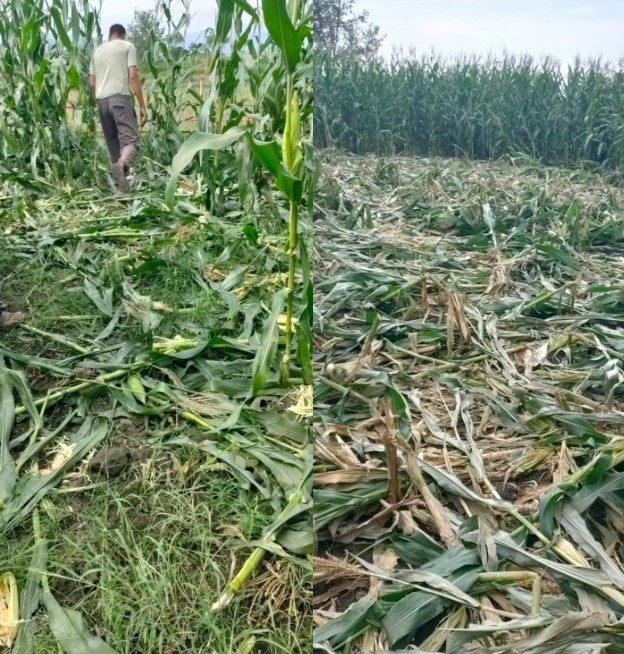
Damage caused by wild boars in Jit Kumar Garau’s maize field in Sisai, Bharatpur-26 on May 9, 2026. Photo: Kalabanjar Buffer Zone Consumer Committee
Acharya, Senior Ecologist of the department, explains that human-wildlife conflict is increasing because wildlife populations are growing due to conservation campaigns like habitat improvement, while humans are encroaching on forest areas to build settlements, farm, and construct roads. “Even when we conserve wild animals by keeping them inside the forest, an increase in their population becomes a problem. This is because habitat cannot be expanded in proportion to the population growth, so they inevitably wander out,” he says. “When wildlife and humans are close to each other, clashes will keep happening.”
Similarly, changes in farming practices have also heightened the conflict. Previously, it was customary to farm on almost all plots of land. In recent decades, leaving arable land fallow has become a rising trend. Acharya notes that as farming areas shrink, the growing wildlife population concentrates its damage. “In the past, because crops were grown everywhere, wild animals scattered to gather food. Now, since farming happens in limited patches, they wipe out the entire crop. For this reason, the volume of damage inflicted by wildlife on agriculture has increased compared to the past,” he says.
Nevertheless, some progress has been made in recent years in reducing human casualties under human-wildlife conflict management. The rate of untimely deaths and minor injuries from wildlife attacks is gradually decreasing. In the fiscal year 2021/22, the mortality rate from wildlife attacks in protected areas stood at 58 people, which dropped to 14 by the fiscal year 2024/25. Similarly, minor injuries dropped from 72 people in the fiscal year 2021/22 to 15 in 2024/25. Severe injuries stood at 124 in the fiscal year 2022/23, which became 53 in 2023/24 and 57 in 2024/25. However, the figure for crop damage remains high.
The nature of conflict varies according to wildlife species and habitat. Tigers and leopards attack livestock and humans, causing injuries or deaths; elephants and rhinos cause damage to humans and agriculture; while monkeys and boars destroy crops.
“Measures must be adopted according to the species; concrete walls should be built for elephants, rhinos, and tigers, while technology suited for leopards must be adopted since they can enter settlements even by leaping over walls,” Acharya says. He adds that installing walls and electric fences cannot reduce the rate of wildlife entering settlements to zero.
Yet, the government has been adopting fencing as the primary method of conflict mitigation. In the initial phases, barbed wire was used to prevent wildlife from leaving protected areas. When wild animals began getting scratched and bloodied while pushing through it, mesh nets and solar fencing were introduced. “Fencing for large wildlife requires substantial expenditure, and we will continue to scale this up,” Acharya says.
Information Officer Magar of Chitwan National Park states that relief distribution does not solve human-wildlife conflict, and communities and stakeholders should focus on conflict mitigation instead. “We must move forward through coexistence, ensuring we do not harm each other and that humans accept the existence of wildlife,” he says.
A study article titled ‘Human-wildlife conflict and crop damage in the buffer zone of Banke National Park’ published in December 2020 in the Asian Journal of Biology also suggests electric fencing, proper compensation schemes, and active local participation in conservation.
Traditional local methods to deter wildlife from human settlements and crops—such as making loud noises, throwing stones, and scaring them with fire—have ceased to be effective. Bishnu Prasad Shrestha, Senior Conservation Officer of Shivapuri Nagarjun National Park, mentions that efforts are currently based on incident reporting, but this approach cannot provide a long-term solution to the conflict. He says, “To achieve a long-term solution, we must map out conflicts arising species by species. There is also a lack of clear policies and laws. A national action plan on human-wildlife conflict resolution needs to be drafted.”
Suggestions from parliamentary committee
The Public Policy and Delegated Legislation Committee of the National Assembly included human-wildlife conflict while studying policy problems related to national parks. Formed on April 7, 2024 under the coordination of National Assembly Member Madan Kumari Shah (Garima), the committee spent nearly two years preparing the ‘Study Report on Policy Problems Related to National Parks, 2025’ and presented it to parliament on February 6, 2026.
The report pointed out problems in rapid relief and rehabilitation post-damage. The report suggested creating legal frameworks to incorporate buffer zone residents into insurance systems for wildlife damage compensation, and extending relief even to victims who do not hold land ownership certificates.
During the study, the committee conducted on-site observations in Langtang National Park, Shuklaphanta National Park, Banke National Park, Bardiya National Park, Parsa National Park, Chitwan National Park, and Shivapuri Nagarjun National Park. It also covered the remaining five national parks—Khaptad National Park, Sagarmatha National Park, Makalu Barun National Park, Rara National Park, and Shey Phoksundo National Park—within its study scope.
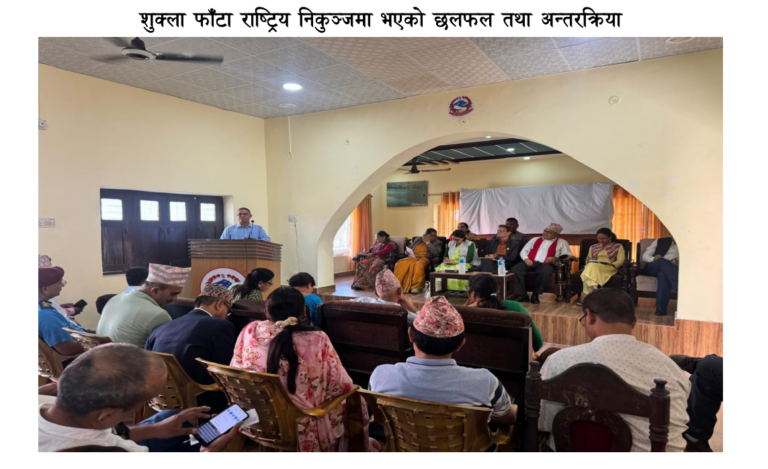
Discussion and interaction held at Shuklaphanta National Park
Acharya, who also serves as the information officer for the park department, states that the actionable suggestions of the parliamentary committee are in the implementation phase. “Policy reform works are ongoing. Based on the government’s capacity, a decision will have to be made on whether to increase the relief amount or keep it as it is,” he says.
Government initiatives
The new government has shown increased interest in resolving human-wildlife conflict. The Ministry of Agriculture, Forestry, and Environment has formed a technical task force for human-wildlife conflict management, comprising representatives from various government bodies, conservationists, researchers, and other experts.
Formed by Forest Minister Gita Chaudhary on May 17, 2026, the task force issued a public call on June 5, 2026 to collect opinions and suggestions aimed at minimizing crop damage caused by monkeys, wild boars, blue bulls, and porcupines. Similarly, for the upcoming fiscal year 2026/27, it has allocated Rs 411,100,000 to mitigate human-wildlife conflict and improve the livelihoods of affected communities.
Chiranjibi Prasad Pokharel, Member Secretary of the National Trust for Nature Conservation, states that they plan to mitigate human-wildlife conflict by rescuing and managing problematic wild animals. According to him, the government has put forward a plan to construct a ‘Tiger Sanctuary’ across an area of 500,000 square meter in Devnagar, Chitwan. “Going with a sanctuary model allows us to conserve aggressive and injured tigers while gradually developing ecotourism,” he says.
“There are talks about making a Monkey Park for monkeys. Plans to mitigate human-wildlife conflict through electric fencing are also in place.”
Rajaram Basnet, Information Officer of the Nepali Army, states that more than 8,000 army personnel are deployed for the security of national parks, reserves, and hunting reserves. “We have been working alongside the park department and partner agencies to mitigate human-wildlife conflict for 50 years now,” he says. He notes that they conduct regular patrolling alongside monitoring via drone technology. He adds that they allocate budgets from internal resources to manage grasslands and fencing.
Senior Conservation Officer Shrestha of Shivapuri Nagarjun National Park suggests that farmers should be encouraged to grow crops that are not affected or are less affected by wildlife. “Connecting farmers to cultivation that wildlife doesn’t damage and securing a market for it would be effective,” he says.
According to him, after elephants began damaging food crops in Bardiya, the practice of planting ginger and turmeric grew. Since a market to sell the produced ginger and turmeric was also secured, this alternative farming attempt succeeded. “This practice has become an effective method for conflict mitigation. If the market is secured, communities do not mind shifting from traditional crops,” Shrestha says.
Torment outside protected areas too
The problem of wildlife destroying crops and causing damage is not limited to protected areas. Farmers in settlements near other forest areas are equally exhausted by this. In all mid-hill districts, monkeys are tormenting farmers by destroying crops. This has forced some farming families to abandon agriculture and migrate elsewhere. Many are on the verge of giving up farming.
According to a study titled ‘Farmers’ perception on crop damage by wildlife in Palpa’ published on November 1, 2025 AD on the website of the Archives of Agriculture and Environmental Science journal, farmers in Palpa who used to cultivate maize and other crops are considering leaving agriculture after wildlife crop damage escalated. Nirajan Parajuli, who was involved in the research, states that 85 percent of the farmers participating in the survey reported that animals like monkeys, rabbits, and deer were primarily causing crop losses. Locals included in the study mentioned that methods adopted to scare away troublesome wildlife—like installing scarecrows and making noises—have become ineffective.
Researcher Parajuli suggests that to mitigate human-wildlife conflict outside protected areas, measures like installing solar fencing and helping farmers switch to alternative crops like ginger and chilies can be adopted. “Farmers must be linked to crop insurance schemes to minimize the risk of economic loss and encourage them to continue farming,” he says.