Kathmandu
Wednesday, June 24, 2026





RSP’s search for an ideology-and Nepal’s search for a new political centre
KATHMANDU: Every successful political movement eventually confronts the same question: what does it stand for when anger fades?
For three years, Nepal’s Rastriya Swatantra Party (RSP) thrived on a powerful political proposition. It was not the Nepali Congress. It was not the UML. It was not the Maoists. It was the vehicle for a generation frustrated by corruption, elite bargaining, institutional decay and the exhaustion of Nepal’s traditional political class.
RSP emerged from a convergence of anger, frustration and populist mobilisation, anchored in the personality politics of Rabi Lamichhane and reinforced by the late-breaking urban appeal associated with Balen Shah just before Hosue of representative election in March 2026.
That proposition proved electorally potent. Yet protest movements eventually encounter a difficult transition. Winning votes by opposing the establishment is easier than governing a country. At some point, every insurgent force must explain not merely what it rejects, but what it intends to build.
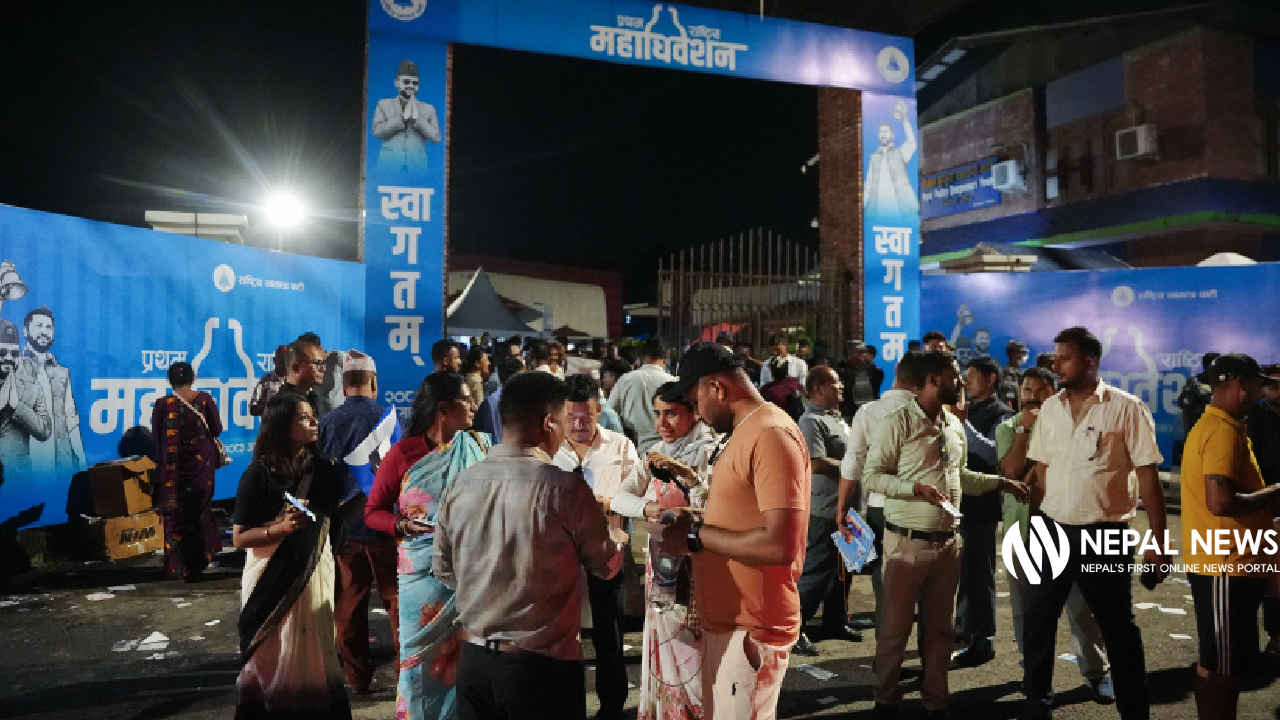
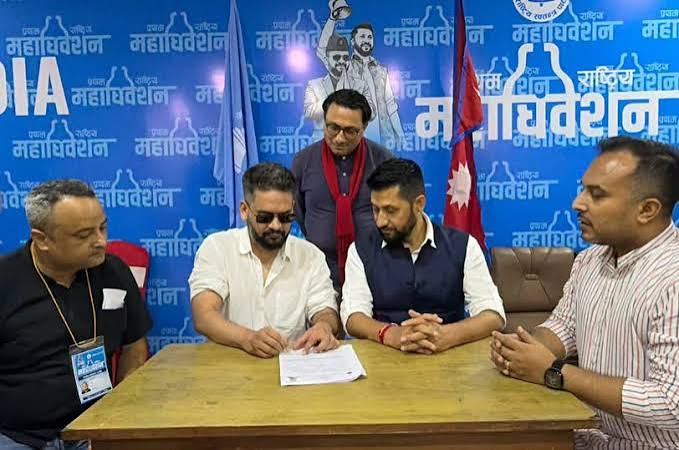
At its first national convention, RSP attempted to answer that question.
The party formally abandoned its long-standing but poorly defined doctrine of “constitutional socialism” and embraced “social democracy” as its official political philosophy. On the surface, the change may appear technical. In reality, it represents the most important intellectual development in the party’s short history.
The shift reveals how RSP sees itself, how it understands Nepal’s economic future, and how it hopes to occupy the increasingly vacant political centre.
More importantly, it exposes the challenge facing every anti-establishment movement: transforming public frustration into a coherent governing ideology.
A doctrine nobody could define
The first casualty of RSP’s ideological revision is constitutional socialism itself. For years the term occupied a curious position within Nepali politics. It sounded intellectually respectable.
It appeared compatible with Nepal’s constitution.
It avoided the ideological baggage associated with orthodox socialism. Yet it remained remarkably vague. Even RSP’s own leadership now implicitly acknowledges this problem.
The party argues that a constitution is a framework of governance rather than an ideology. Constitutions establish rules, institutions and rights. Political ideologies provide a vision of society, the economy and the state. The distinction matters.
If constitutions themselves become ideologies, every constitutional amendment risks becoming an ideological transformation. Political parties cease developing their own intellectual foundations and instead borrow legitimacy from constitutional language.
RSP’s rejection of constitutional socialism therefore represents more than semantic housekeeping. It is an admission that the party required a clearer philosophical foundation.
In effect, RSP is saying what many observers quietly believed from the beginning: constitutional socialism was a slogan, not a governing doctrine.
The rise of Nepal’s pragmatic centre
The ideology replacing it is revealing. Social democracy is hardly revolutionary. Across Europe it became the dominant governing philosophy of the post-war era. It accepts capitalism while attempting to soften its harsher consequences. It supports private enterprise but seeks social protection. It embraces markets but distrusts inequality.
The model produced many of the world’s most successful societies, particularly in Northern Europe.
What makes RSP’s adoption of social democracy noteworthy is not the ideology itself but the political space it seeks to occupy. Nepal’s traditional ideological map has become increasingly disconnected from reality.
Parties that describe themselves as communist oversee liberalised markets. Parties that claim to be democratic socialists frequently protect patronage networks rather than social welfare systems. Political labels remain frozen while economic realities evolve.
RSP is attempting to break this contradiction. Its political report effectively argues that the old left-right divide no longer provides useful answers to Nepal’s contemporary challenges.
Support private investment? Critics call it right-wing.
Support universal healthcare? Critics call it left-wing.
Defend entrepreneurship? One side complains.
Defend labour rights? The other side complains.
RSP’s response is straightforward: practical solutions matter more than ideological purity.
The metaphor used in the report is particularly telling. The party argues that one should make glasses to fit the eyes, not force eyes to fit the glasses.
The statement captures RSP’s broader intellectual ambition. It wants to position itself as a pragmatic rather than ideological force. Whether that is possible remains an open question.
Markets without apology
Perhaps the most striking aspect of the new doctrine is its unapologetic embrace of market economics.
Nepal’s political discourse has long displayed a curious discomfort with wealth creation. Politicians frequently speak about redistribution while paying less attention to production. Poverty alleviation often receives more attention than prosperity generation.
RSP seeks to reverse that emphasis. Its report repeatedly argues that nations become rich not by distributing poverty but by creating wealth.
That may sound obvious. Yet within Nepal’s political environment it represents a significant departure.
The party explicitly supports entrepreneurship, investment protection, private property rights, innovation and market competition. It views economic freedom not merely as a business issue but as an extension of individual liberty.
In doing so, RSP is positioning itself closer to modern European social democrats than to traditional South Asian socialist movements.
Its vision resembles a social market economy rather than a state-directed economy.
The state should establish rules.
Markets should generate growth.
Competition should create efficiency.
Entrepreneurs should create wealth.
Government should ensure fairness.
This framework offers an attractive alternative to Nepal’s long-standing cycle of state inefficiency and private-sector mistrust.
Yet implementing such a model would require institutional capacities that Nepal often lacks.
Competitive markets depend on regulators capable of enforcing competition. Investment protection requires predictable courts. Economic freedom requires bureaucratic reform.
The challenge is not philosophical. It is administrative.
A bigger state, but a different one
Despite its enthusiasm for markets, RSP is not advocating a minimalist state.
The party simultaneously endorses universal access to healthcare, education, housing support, food security and social protection.
This combination places it squarely within the social democratic tradition.
The logic is familiar.
Markets are efficient generators of wealth.
States are necessary guarantors of opportunity.
Economic freedom means little if citizens lack access to basic services.
The report therefore proposes a state that is smaller in production but stronger in protection.
Government should not necessarily run businesses.
It should ensure citizens possess the capabilities needed to participate in economic life.
This distinction is crucial.
Many Nepali political debates remain trapped between two extremes: excessive faith in state control and excessive faith in political patronage.
RSP is attempting to construct a middle path.
Whether Nepal can afford such ambitions remains another question.
Nordic-style welfare systems require Nordic-level tax compliance, institutional trust and administrative effectiveness.
Those foundations remain weak.
The danger is obvious. Political parties often promise Scandinavian outcomes while operating within South Asian governance realities.
The institutional revolution
If economics forms one pillar of RSP’s new ideology, institutions form another.
The party places unusual emphasis on rule of law, prosecutorial independence, judicial autonomy and institutional strength.
This focus reflects a broader diagnosis of Nepal’s problems.
Many traditional parties argue that Nepal suffers from policy failures.
RSP increasingly argues that Nepal suffers from institutional failures.
The distinction is important.
Policies can be changed through elections.
Institutional weaknesses are harder to repair.
Corruption persists not because anti-corruption laws do not exist but because enforcement remains inconsistent.
Public trust declines not because democratic structures are absent but because institutions frequently appear politicised.
RSP’s emphasis on institutional reform therefore reflects a recognition that governance failures often originate deeper than party politics.
The success of this agenda would depend on whether a future RSP government could resist the temptation that has consumed previous governments: using institutions for political advantage while promising institutional independence.
Constitutional revisionism
The party’s constitutional proposals may ultimately prove more controversial than its economic philosophy.
RSP supports a directly elected executive, a fully proportional electoral system and significant restructuring of provincial institutions.
Together these proposals would fundamentally alter Nepal’s political architecture.
The appeal is understandable.
Nepal has experienced chronic governmental instability, fragmented mandates and persistent coalition bargaining.
Direct election promises clarity.
Proportional representation promises inclusiveness.
Institutional restructuring promises efficiency.
Yet constitutional engineering often produces unintended consequences.
Directly elected executives can generate stronger leadership.
They can also generate stronger political polarisation.
Proportional systems increase representation.
They can also fragment politics further.
Institutional reforms may solve one problem while creating another.
RSP’s willingness to openly discuss constitutional change nevertheless signals growing confidence. The party no longer sees itself merely as a participant within the system. It increasingly presents itself as a designer of a future system.
The shadow of populism
Yet contradictions remain.
Throughout the report, RSP presents itself as a victim of a coordinated conspiracy involving major institutions and political rivals.
The language reflects the party’s continuing populist instincts.
This creates an interesting tension.
Social democracy traditionally relies on institutional trust.
Populism often relies on institutional distrust.
RSP seeks to embrace both simultaneously.
It wants stronger institutions while arguing those institutions have been weaponised against it.
It wants institutional legitimacy while positioning itself as an outsider fighting entrenched elites.
Managing this contradiction may become one of the party’s greatest challenges.
Anti-establishment energy helps movements rise.
Institutional responsibility helps parties govern.
The two impulses do not always coexist comfortably.
Beyond Rabi Lamichhane
Perhaps the most important section of the report concerns organisational reform.
Successful political parties outlive their founders.
Failed political movements become extensions of individual personalities.
RSP appears increasingly aware of this reality.
Its discussions of factionalism, personality politics, organisational discipline and leadership development suggest concern about institutional durability.
The proposed leadership academy and candidate development programmes reflect an effort to professionalise politics rather than personalise it.
This may ultimately prove more significant than any ideological declaration.
Political philosophies matter.
Political institutions matter more.
A party capable of producing competent leaders over decades possesses greater transformative potential than one dependent on a single charismatic figure.
Nepal’s most interesting political experiment
Ultimately, RSP’s ideological transformation reflects a broader evolution.
The party is no longer asking voters to trust its anger.
It is asking them to trust its ideas.
That transition marks a decisive moment.
The political report reveals a party attempting to move beyond protest politics toward governing philosophy. It seeks to combine liberal economics with social protection, market competition with social justice, institutional reform with democratic accountability.
In many respects, the vision resembles a distinctly Nepali version of European social democracy.
The attraction is obvious.
A large portion of Nepal’s electorate is weary of ideological battles inherited from the twentieth century. They want functioning institutions, economic opportunity and competent governance.
RSP is betting that this constituency is larger than traditional political elites recognise.
Whether the gamble succeeds remains uncertain.
Social democracy is not difficult to describe. It is difficult to implement.
Markets require institutions.
Welfare requires resources.
Reform requires patience.
And governing requires compromises that opposition parties rarely face.
For now, however, one conclusion is unavoidable.
RSP’s first convention has ended an important chapter in the party’s history. Constitutional socialism has quietly disappeared. Social democracy has taken its place.
The era of political rebellion is giving way to the era of ideological definition.
The question facing Nepal is whether RSP has discovered a governing philosophy-or merely a more sophisticated vocabulary for its ambitions.
Nepal’s democratic shift: from ideology to virality
Nepali politics is undergoing a structural shift: ideology is no longer the organizing principle. What matters now is speed of perception, delivery of outcomes, and the ability to sustain attention in a fragmented digital public sphere. In this environment, 30-second reels often carry more political weight than 300-page manifestos.
This change has rewritten the rules of political survival. Parties are no longer judged primarily by ideological coherence-left, right, socialist, or liberal-but by whether they can produce visible results in real time: either from viral video or jobs, stability, governance efficiency, and a sense of forward movement. The electorate has become impatient with historical narratives and increasingly transactional in its expectations.
The sucess of the Rastriya Swatantra Party (RSP) illustrates this transformation. Emerging outside traditional organizational structures, it benefited from a moment of public exhaustion with established parties. Its breakthrough in the March 05 House of Representatives election- under the broader wave of Gen-Z political mobilization-signaled not an ideological realignment but a rejection of legacy political identity itself.
Yet this model carries an inherent vulnerability. Movements built on digital momentum and personality-driven appeal face a structural weakness: they often lack deep institutional grounding. Without robust grassroots organization, bureaucratic capacity, and disciplined internal governance, rapid political ascent can translate into fragile state performance once in power. In this sense, RSP’s success is not only a breakthrough but also a stress test.
Across South Asia, similar youth-led uprisings have followed a comparable arc but diverged in outcomes. Sri Lanka’s Aragalaya movement overthrew a collapsing economic order but struggled to convert protest energy into stable governance. Bangladesh’s recent “Monsoon Revolution” produced political disruption but ultimately failed to dislodge entrenched party dominance, with established forces returning to power through elections. Nepal stands out as the rare case where a new political formation translated protest momentum into parliamentary success.
But even this “success” should not be over-interpreted. Nepal, Sri Lanka, and Bangladesh are now entering the same second phase: governing the consequences of disruption. Protest movements are structurally optimized for removal, not for administration. Governance requires institutional memory, bureaucratic depth, and coalition management-assets that cannot be crowdsourced in real time.
The deeper shift, however, is regional. South Asian politics is moving from ideological competition to performance legitimacy. Governments are now judged on three metrics: economic delivery, geopolitical balancing, and systemic repair. In Nepal’s case, this includes managing delicate relations with India and China, stabilizing a fragile economy, and rebuilding trust in institutions that have been repeatedly cycled through crisis.
This is where the new political equation becomes clear. Ideology has not disappeared, but it has been subordinated. It now functions as background identity rather than operational logic. The foreground is occupied by governance capacity under pressure.
In such a system, strong mandates do not guarantee stability. On the contrary, they often intensify expectations faster than institutions can adapt. Nepal’s history already demonstrates this paradox: repeated political resets have not resolved structural constraints in administration, economy, or service delivery.
The real question, therefore, is not who wins elections in the digital age, but who can transition from viral legitimacy to institutional durability. Without that transition, even the most successful Gen-Z political wave risks becoming another short cycle in a long pattern of South Asian political volatility.
Nepal’s experiment is still unfolding. But it is already clear that the era of ideological politics has ended faster than the state capacity needed to replace it.