Kathmandu
Friday, July 10, 2026





Nepal was once famous for ‘temple ball.’ In the 1960s, Nepali ‘temple ball’ – a black, rounded resin made from cannabis – became a particular attraction among hippies and was considered one of the finest hashishes in the world. The government of the time even permitted the sale of cannabis.
But in October 1976, Nepal legally banned cannabis cultivation and trade, and production was halted by law. However, periodic arrests by police involving cannabis and hashish show that the trade has not stopped despite the ban.
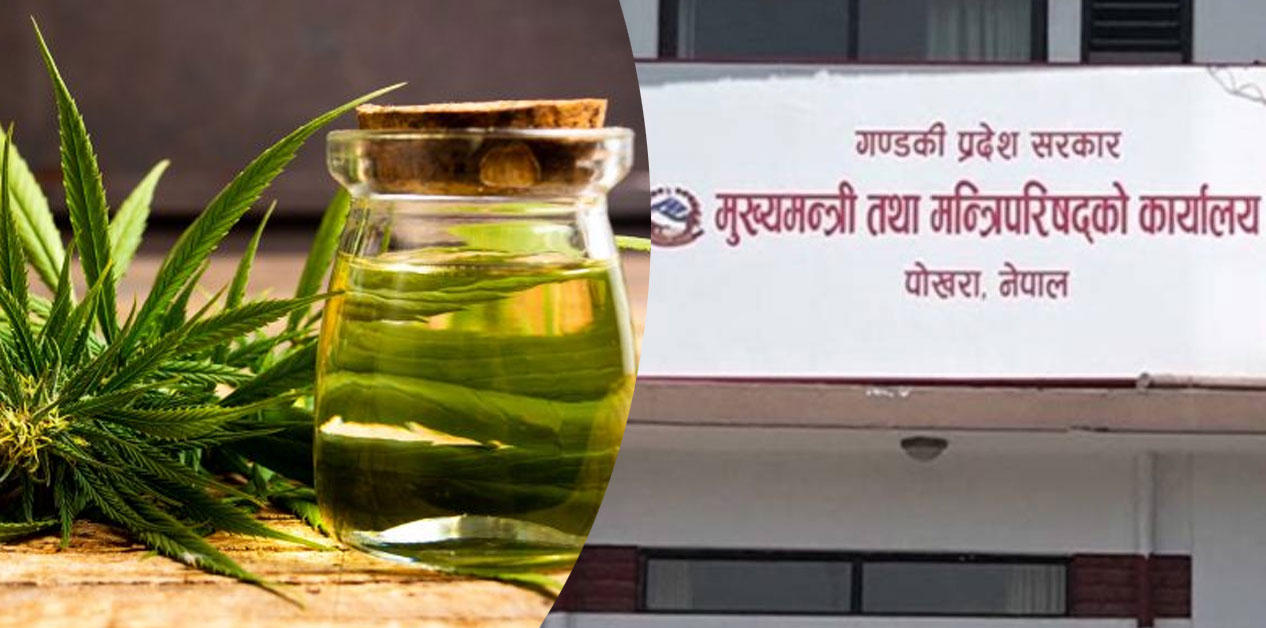
Nearly five decades after Nepal outlawed cannabis, two subnational governments have begun cautiously reopening the door to its regulated cultivation, with Gandaki Province pushing a formal legalization bill for medicinal and industrial use, and Ilam Municipality launching a tightly controlled pilot that allows farmers to grow hemp for fiber under strict monitoring.
In Gandaki, the push is unfolding at the policy level. Taking the debate of legalizing cannabis cultivation forward is Gandaki Chief Minister Surendra Raj Pandey, who has been raising the issue of legalizing cannabis cultivation ever since taking office. From public gatherings to the assembly floor, he has consistently raised “the potential of cannabis cultivation and the branding of local alcohol.”
In Ilam, by contrast, the approach is administrative and incremental. The municipality has moved ahead with a pilot under its own procedure, inviting farmers to apply for cannabis cultivation strictly for fiber production, while putting in place elaborate safeguards to prevent diversion into narcotic use.
Gandaki CM wants cannabis cultivation legalized
Since becoming Chief Minister of Gandaki, Pandey has been consistently advocating for cannabis cultivation, trade, and use. All of these are currently illegal. He went so far as to include a study on cannabis cultivation in his government’s list of 100-day achievements.
“A study of the potential of cannabis cultivation has been initiated, with consultations under way to make the necessary legal arrangements for the production of medicinal and industrial raw materials. Phased discussions are also ongoing with institutions engaged in research in this area,” the chief minister stated in point 33 of the 46-point list he presented.
The chief mMinister who has consistently raised both cannabis cultivation and local alcohol branding has already had the alcohol bill passed by the provincial assembly. The Gandaki Province Assembly passed the bill for regulating and managing the production of local alcohol in Gandaki Province on August 19, 2025.
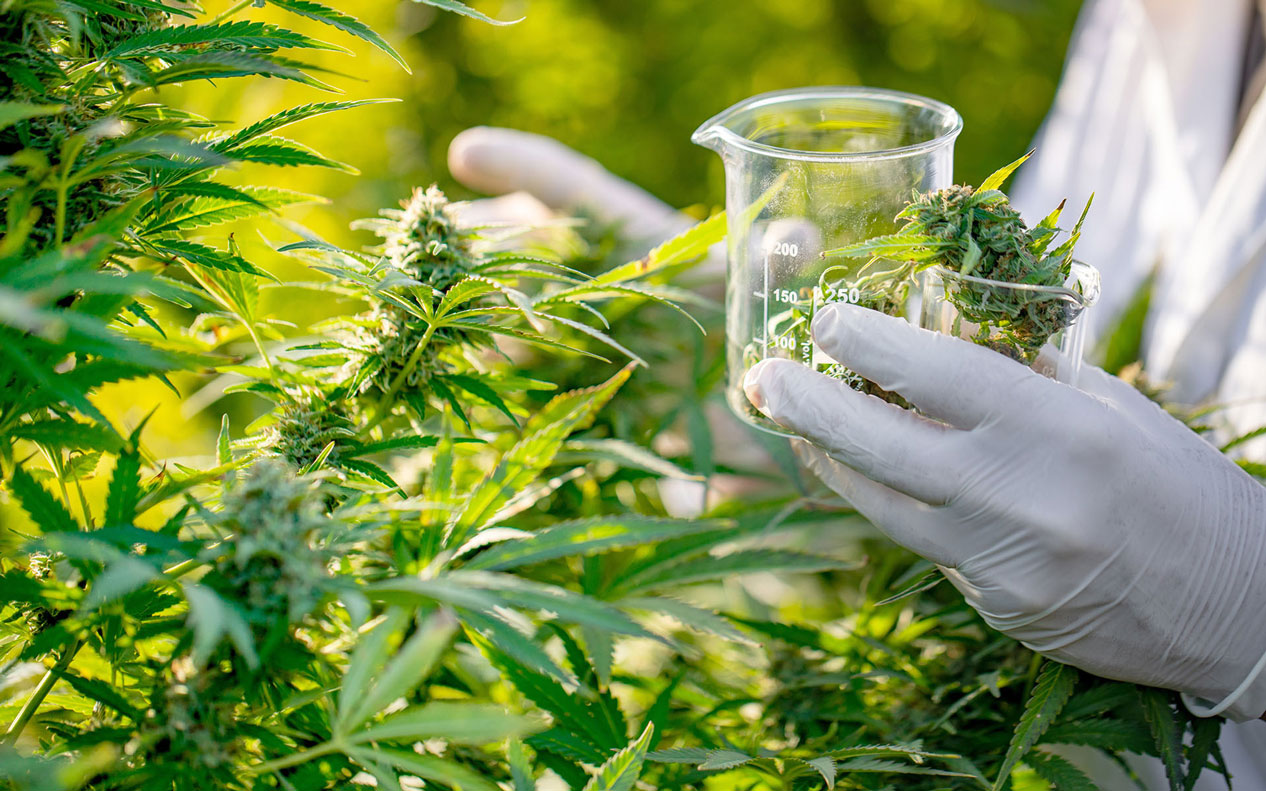
The provincial government, engaged in the effort to legalize cannabis cultivation, tabled a bill last November in the provincial assembly to make provisions for regulating cannabis cultivation for medicinal and industrial purposes. The bill has been referred to the Economic Development Committee for deliberation.
A technically weak bill
The Narcotic Drugs Control Act was enacted in 1976, prohibiting any individual from cultivating, producing, or purchasing cannabis. Section 4(g)(1) of the Act, however, provides that the Government of Nepal may make rules to govern the production, collection, and sale of hashish from wild cannabis plants that grow naturally in Nepal’s western hill region, for a specified period. The same section provides that activities carried out under a license shall not be considered an offence.
The bill brought by the Gandaki provincial government contains provisions to permit organized cannabis cultivation on available land in the province for medicinal and industrial purposes. But the Gandaki government, which is dreaming of using cannabis for medicinal and industrial purposes, appears to have fallen short on technical matters.
The two principal chemical compounds found in cannabis are tetrahydrocannabinol (THC) and cannabidiol (CBD). Of these, THC is the psychoactive compound that causes intoxication, while CBD does not. CBD is used as a medicinal compound. The US Food and Drug Administration has approved only one CBD-based drug, Epidiolex.
Even with a desire to use cannabis for medicinal purposes, there are legal complexities around using THC, which is considered psychoactive. Nepal is a signatory to the narcotics conventions; it has consented to the Single Convention on Narcotic Drugs 1961 (as amended in 1972), which places cannabis in the category of a narcotic drug and prohibits its cultivation and sale.
The convention, however, does not classify CBD as illegal, and Nepal’s Narcotic Drugs Control Act does not address it explicitly either. For this reason, experts hold that CBD may be used for its medicinal properties. It is also for this reason that experts, while pointing out the weaknesses of the Gandaki bill, say it must clearly specify THC and CBD.
At a meeting of the Economic Development Committee on March 16, 2026, chemistry and natural products research expert Dhakaram Bhandari said the bill must clearly distinguish the levels of THC and CBD. “The homework is not done. What is missing is specificity about THC and CBD levels. It also conflicts with the federal Narcotic Drugs Act,” he added. “If Gandaki brings in THC at below 0.3 percent, there may be disputes, but there would be a chance of winning the case later.”
The THC threshold Bhandari mentioned is highly significant. The estimated THC content in cannabis found in Nepal ranges from 10 to 16 percent, though no official study has been conducted.
In the United States, hemp – a variety of cannabis – has legal recognition under the 2018 Farm Bill, with the key condition that THC content must be below 0.3 percent and production must be solely for industrial or medicinal purposes – such as fabric, oil, seed, or CBD extraction.
If cannabis is to be used for industrial purposes, the THC level must be specified in the bill, Bhandari says, and he stresses that regulation must also be robust.
The proposed bill also defines cannabis-derived substances. Section 2 (e) states: “Cannabis-derived substances means, excluding resins and gums that can be used as narcotic drugs, the stems, bark, leaves, flowers, fruit, extract, or roots of the cannabis plant that can be used as industrial raw material or medicinal raw material.”
By this definition, cannabis usable as a narcotic drug is cannabis with a high THC content. The bill, however, does not provide legal clarity on this point. Psychiatrist Dr Nirmal Lamichhane says the regulation of THC is a critical issue. “CBD is useful for medicinal use and hemp. But THC levels must be monitored. The biggest challenge is how to regulate it,” he says.
The question of monitoring compound levels in cannabis was new territory at the March 16 meeting of the Economic Development Committee of Gandaki Province Assembly. The government seeking medicinal and industrial use of cannabis is itself unclear about which type of cannabis to cultivate. Although the cannabis plant used for fabric, the cannabis cultivated for CBD for medicinal use, and the plant used as a narcotic drug all belong to the same botanical family, they are produced differently depending on their chemical composition.
Cannabis used as a narcotic contains high levels of psychoactive compound and is typically grown for the plant’s flowers, which carry the highest concentration. Hemp, by contrast, is a variety of cannabis with extremely low psychoactive content, cultivated primarily for industrial purposes. Strong fiber extracted from hemp stalks is used to produce rope, fabric, bags, paper, and other industrial materials, while its seeds can yield oil and food products.
Although hemp and cannabis come from the same plant family, their chemical composition, methods of cultivation, and intended uses differ significantly. Any legislation on industrial or medicinal cannabis must therefore clearly define the distinction between the two.
In 2080 BS (mid-April 2023 to mid-April 2024)-, a research report titled ‘Possibilities and Challenges of Legalizing Cannabis Cultivation in Nepal’ was published. The study noted that fiber produced from the cannabis plant is strong and has traditionally been used to make carrying straps, rope, and tethers. According to the study, 23 books in the ayurvedic dispensary at Singha Durbar Vaidyakhana describe methods of purifying cannabis and detail its benefits and uses. These books state that compounds found in cannabis – known as Ratowari, Bijaya Ras, Bhav oil, Jatyadi Ras, and Agnikumari Ras – are useful in treating conditions including premature ejaculation, insomnia, runny nose, diarrhea, severe pain, and mental illness.
The study recommended that while cannabis has benefits, the regulatory dimension of any legalization must be addressed. It stated that uncontrolled legalization of cannabis is not immediately feasible, and that to follow the path of controlled legalization, as adopted by other countries, it is essential to build the regulatory tools needed for monitoring, prevention, and treatment with full awareness of the harmful aspects of cannabis products, and to establish specific systems, structures, and human resources to address the by-products of cannabis use such as addiction and social violence. Such structures, it noted, must have the authority, skills, and expertise to address both commercial and recreational dimensions.
Ilam steps into cannabis farming with caution and control
Taking its cue from Gandaki Province, Ilam Municipality has invited applications from farmers for cannabis cultivation.
The municipality, which prepared the ‘Hemp Cultivation Promotion and Management Procedure, 2026’ and published it in the Gazette on November 25, 2025, called on March 11, 2026, for farmers to submit proposals for cannabis cultivation.
According to Deputy Mayor Bishnu Kumari Limbu, at least 33 proposals have been received so far. The highest number, 26 applications, came from Ward 8. “Initially, the plan was to cultivate on a model basis in Ward Nos. 7 and 8, but applications also came from other wards. Farmers are excited,” said Limbu.
The procedure states that cannabis can be used for scientific research, medicine manufacturing, ayurvedic oil, yarn and cloth, organic fertilizer, and food items such as pickles. However, the municipality will currently allow cultivation only for yarn and cloth. Cannabis, also known locally as bhanga or bhango depending on the area, is used for medicinal and other purposes in various countries. Under current law, however, it is classified as a narcotic.
In the past, cannabis trade was open in Nepal, and foreigners used to visit, as it was openly sold in Kathmandu. In 1961, the United Nations placed cannabis on the list of narcotics and adopted the Single Convention to tighten its production and use worldwide.
Following this, Nepal imposed a ban on the cultivation, use, and trade of cannabis from the fiscal year 1973 to 1974. With the enactment of the Narcotic Drugs Control Act, 1976, cannabis production and trade were defined as crimes. Legal action began against those cultivating or consuming cannabis, a practice that continues today.
However, demands to allow cannabis cultivation for medicinal purposes have persisted within the country. In the dissolved parliament prior to the Gen Z protest, some members of parliament lobbied to legalize cannabis cultivation. Some leaders have also run campaigns arguing that legalization would provide relief to farmers in hilly regions.
Former MPs Sher Bahadur Tamang and Birodh Khatiwada, along with former Mayor of Kathmandu Metropolitan City Keshav Sthapit, have been actively campaigning for legalization. The government, in its budget statement for the fiscal year 2023 to 2024, also announced a feasibility study on cannabis cultivation for medicinal use.
Kathmandu University has established a network for study and discussion on the medicinal use of cannabis. Yogendra Man Shrestha, Chief of Ilam Community Agriculture Campus and a member of the network, said existing law does not completely ban cannabis cultivation. “It should not be cultivated or traded as a narcotic drug,” said Shrestha.
Section 4 of the Narcotic Drugs Control Act, 1976, prohibits the cultivation and production of cannabis. However, the same Act allows the government, or any organization on its behalf, to cultivate, produce, and import or export narcotic substances for medicinal or scientific purposes.
Ilam Municipality has introduced strict provisions in its procedure to prevent misuse. Section 8(b) requires farmers to inform the monitoring committee one week before the plants develop flowers, which can be used as narcotics. After notification through the ward, the local administration will destroy the flowers in the presence of all stakeholders, while other parts of the plant can only be sold to individuals or institutions designated by the municipality.
The procedure also provides for a seven-member Municipal Monitoring Committee led by the deputy mayor and a five-member Ward Monitoring Committee led by the ward chairperson where cultivation takes place.
Ganesh Kumar Khadka, Chief Administrative Officer of Ilam Municipality, said discussions were held at multiple levels on how to proceed in the absence of federal and provincial laws on cannabis cultivation. “We have started with the objective of producing yarn only, without contradicting prevailing laws. Permission will be granted only after verifying that applicants meet the required criteria,” said Khadka.
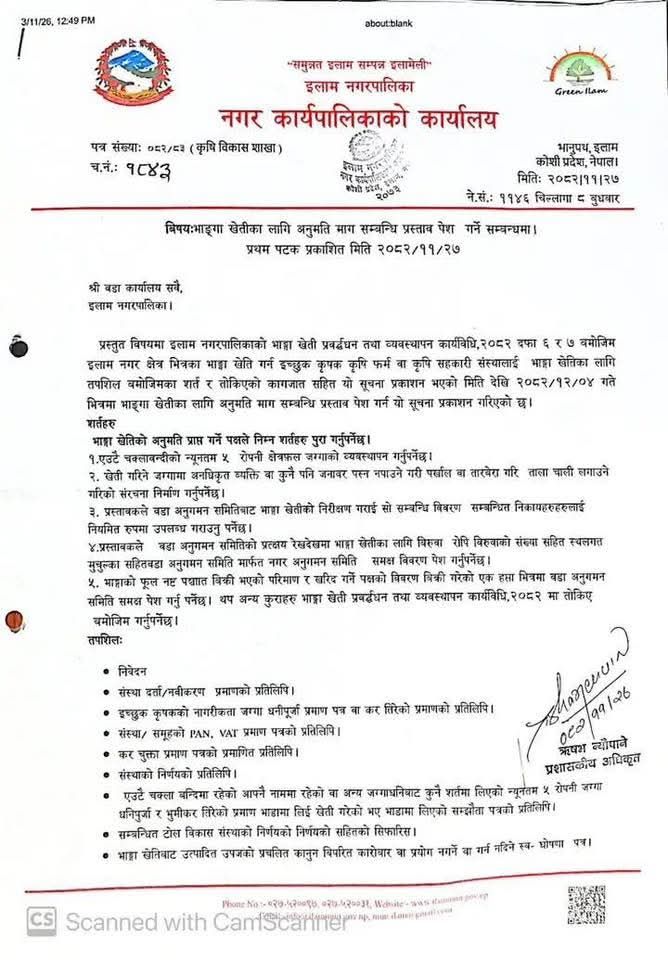
According to Limbu, who also coordinates the Municipal Monitoring Committee, farmers must submit their citizenship certificate, registration certificate of an agricultural firm or cooperative, permanent account number (PAN), and tax clearance certificate along with their proposal.
They must also provide land ownership documents and proof of land tax payment for at least 2,543.66 square meters of land held in a single plot, either in their own name or leased under certain conditions. Additional requirements include a decision and recommendation from the local Neighborhood Development Organization and a self-declaration stating that the produce will not be used or traded illegally.
Limbu said the municipality will provide training on cultivation methods and production only after proposals meet all criteria. “In the first year, we will train farmers on producing hemp fiber, from which thread and clothing will be made,” said Limbu.
Compulsory integration of beekeeping and insect farming
The municipality has introduced detailed ecological and agricultural requirements for cannabis cultivation, reflecting a broader attempt to integrate sustainability into the practice. One such provision mandates that at least one hive of Apis cerana, commonly known as the Eastern or Asian honeybee, must be maintained per 5,476 square feet of cultivated land.
To ensure the land does not remain fallow, farmers are also required to plant a variety of crops based on the recommendation of agricultural technicians. These include cardamom, ginger, turmeric, potato, basil, lemongrass, and Withania somnifera, locally known as ashwagandha.
The procedure further emphasizes ecological balance. It requires farmers to create biological habitats that support insects such as bumblebees, fireflies, and predatory species, making the cultivated land conducive not just for crops but for biodiversity as well.
Yogendra Man Shrestha, Chief of Ilam Community Agriculture Campus, said beekeeping is an essential component of cannabis cultivation. “Bees help enhance cannabis production, and high-quality honey can be obtained from cannabis flowers,” said Shrestha. “Ginger, turmeric, and even vegetables can also be cultivated alongside cannabis, further increasing its benefits,” he added.
Despite these integrated benefits, cannabis cultivation remains a demanding process. Farmers must fence their land to ensure it does not affect nearby communities and to restrict unauthorized entry. Monitoring committee officials must be invited for inspection at least once a month.
In addition, farmers are required to inform the Neighborhood Development Organization and the Ward Office about details such as the variety and number of plants being cultivated.
Deputy Mayor Bishnu Kumari Limbu said the municipality is approaching the initiative cautiously, with a phased plan for expansion.
“This is just our beginning. After fiber, we will develop procedures to allow cultivation for oil and seeds. We have been strict from the outset to prevent any activities that go against the law,” Limbu further added.