Kathmandu
Sunday, June 7, 2026





KATHMANDU: Now Nepal is at a crucial political juncture. Its future political course is still not clear. At this point, a new force is in power which carries the arduous task of redeeming the country from rampant corruption and mismanagement.
A force lacking a long political history, still to be tested, has been entrusted by the people to govern. People were fed up with the irresponsibility of ever changing coalition governments. In fact, instability led to irresponsibility. It was an urgent alternative chosen by people, driven by the suffocation created by a series of irresponsible governments.
It was the people’s answer in two ways, a super-majority to an alternative force. However, decisions made in difficult times are not always the best, and instability can somersault into tyranny, as democracy is a sharp edged sword. True lovers of the nation should always seek balance of power, as it is a universal political principle that power corrupts man and absolute power corrupts him absolutely. Here lies the importance of a strong opposition, even in a democracy and for democracy.
The present opposition in Nepal is not strong, not only in terms of numbers in parliament but also in moral strength to question the new party that has displaced them with an overwhelming majority. In such a situation, only strong moral will and deep democratic sense within the rulers themselves can restrain them from becoming despotic in a country of this level of public consciousness. It is a real test of moral strength on behalf of the RSP.
The demoralized erstwhile rulers have been completely discarded by the public. The RSP has instead emerged as a single major political force on March 5 election, as a reaction against the incumbent ruling side. The forces that have been rejected by the people must reform and reshape themselves to regain moral strength and reconnect with public sentiment. However, post election symptoms are not positive. There is a considerable number of people who sided with the new power outside RSP, namely Harka Sampang and Kulman Ghising, who could join hands with it if they are able to value the need of the moment over their past identities and prove themselves worthy of consideration.
On the other side of this reality, traditional forces were largely irrelevant on March 5 election, unable to read the rapidly changing public psychology.
Even after heavy losses, most of them show little sign of realization. They appear largely oblivious to public sentiment. There is limited optimism when observing the activities of the three major traditional political forces. CPN-UML and the Nepali Communist Party are focused on protecting their established leadership. They show no signs of reform or relevance, instead defending their positions against current public concerns. If this continues, they risk being out of the political race in the next election.
The Nepali Congress is clearly double minded. One faction attempted to move with the flow of time. That faction even led a rebellion and toppled the incumbent leadership before the election, fearing irrelevance. However, the outcome showed that although they recognized the need for change, their effort was not enough. They were not accepted as a real alternative.
Still unable to understand public sentiment, the old Congress leadership is now attacking the new leadership over its election failure. They are nowhere aligned with the current direction of time, just as UML and the Nepali Communist Party are behaving in a similar manner. They remain relevant only as references when discussing political forces, no longer as central subjects of national concern. They are mentioned mainly in connection with Gagan’s attempt to bring change within the party.
Just as the internal rebellion in the Nepali Congress was not enough before the election, internal fighting alone will not be sufficient for their future. They cannot remain confined to narrow internal struggles if they want to emerge as a strong political force. They must engage with public sentiment. It is not psychologically easy for them to suppress their traditional Congress mindset in the face of a public psychology that has developed deep dissatisfaction with what they once represented.
There is no doubt that the new leadership, Balen and Rabi, was trusted wholeheartedly by a section of people. However, there were also others who mainly wanted to overthrow the established power and saw them as the available alternative. It was more a rebellion than a fully conscious choice. That half minded acceptance will turn into trust and loyalty only if they perform reasonably well compared to past irresponsible governments.
In politics, internal struggle is often hidden while external struggle is more visible. This explains why figures like Rabi and Balen became more popular than Gagan, who remained confined within his party framework. If Gagan continues to limit himself within party boundaries instead of reaching out to broader society, he too may be swept away like a dry leaf in the present political storm. More importantly, this is no longer just a personal matter. He can become a key starting point for a possible alternative political force against the currently dominant new party and leadership.
We may also see other emerging alternatives from different corners, such as Harka Sampang. In the recent election, it was political strength and alignment that gave RSP an advantage over Harka and Kulman, especially when Balen joined hands with Rabi and further strengthened public sentiment.
More optimistically, if Gagan steps out of his narrow limits and joins hands with figures like Harka, Kulman and others, the possibility of an alternative force could become visible.
This is the demand of the time, as democracy survives only in balance of power. The value of a strong opposition cannot be overstated in a country with this level of public consciousness.
There is an urgent need for a new political force as an alternative to the present one, simply for democracy to function properly. It is increasingly clear that traditional parties like Nepali Congress, CPN UML, or the Nepali Communist Party may no longer remain dominant forces in the next election. Hope lies either in those who carry political legacy but were dissatisfied with their own leadership, like Gagan, or in new figures like Harka and Kulman who stand outside the mainstream. The chances will be stronger if they come together to form a single alternative party, rising above narrow party mentality in the interest of the country.
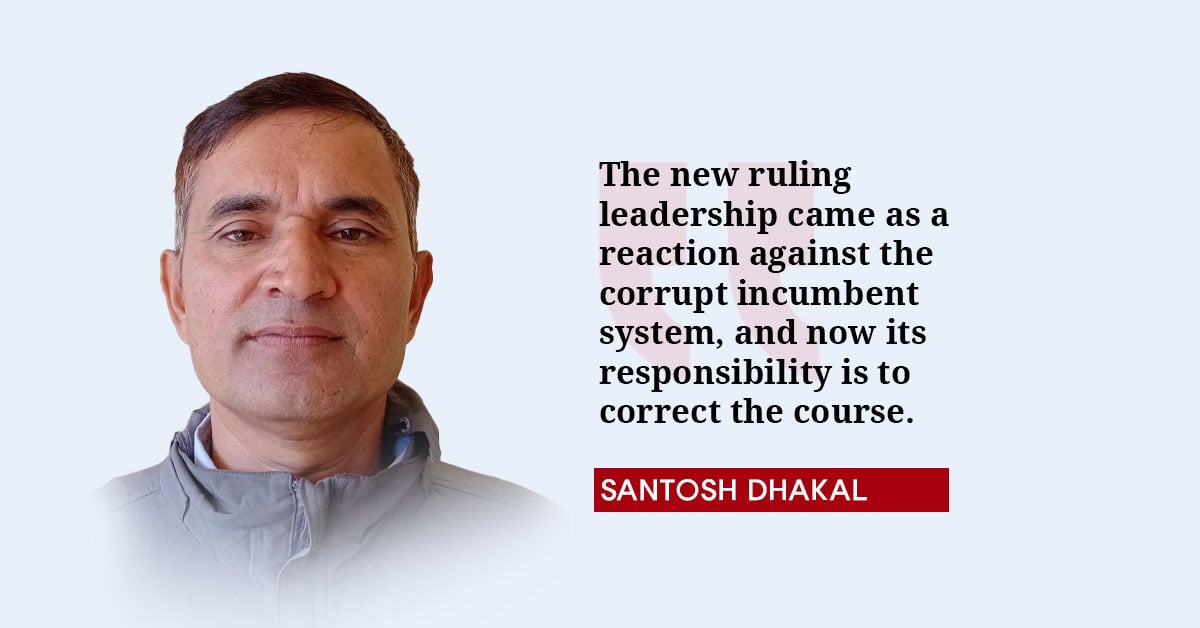
The new ruling leadership came as a reaction against the corrupt incumbent system, and now its responsibility is to correct the course. It is good for the country that they have established themselves on a corrective agenda. They have displaced other political forces in the process, creating a vacuum. And this vacuum itself is a new threat. A single dominant political force always poses a risk to democracy.
Now there is a new responsibility ahead. Other politicians must come together and present a viable alternative. We feel sympathy for traditional parties, as the vacuum is clearly expanding after the election. It is a worrying situation for democracy. There is hardly any political force left except the one in people’s minds. Others are steadily losing public acceptance. Traditional parties are increasingly seen as a burden on the nation. First, they failed as rulers. Now, they continue to fail by moving away from public expectations at a time when they are expected to reemerge as strong opposition forces.
This trajectory could push the country either toward a single party system or some form of direct rule or tyranny. A viable alternative is the need of the nation. The nation is calling for it. Who listens and who responds are the key questions of the moment. People are supporting the government because it is doing something new, and that is problematic. Some reject it without reason, which is worse.
Both unconditional support and unconditional rejection are the worst. This is where public consciousness is tested. This is where we must ask ourselves whether we are true nationals or blind party supporters, whether we are thinking for the nation or only for the satisfaction of our personal egos.