Kathmandu
Friday, June 26, 2026






KATHMANDU: Nepal News presents today’s snapshot of Nepal’s economic activities. Get quick updates on major market movements, policy shifts, and financial developments shaping the economy of Nepal. Here are the key economic highlights for today:
Governor and State Bank Officials Retain Posts Despite Ordinance
The recent government ordinance aimed at dismissing political appointees will not affect the Governor of Nepal Rastra Bank (NRB) or top officials at state-owned banks. The ordinance amends 110 laws, but the Nepal Rastra Bank Act is not among them, allowing Governor Biswo Nath Poudel to remain in office. Similarly, the chairpersons and CEOs of Nepal Bank Limited, Agricultural Development Bank, and Rastriya Banijya Bank are unaffected because they were appointed under specific regulations rather than the amended acts. Sources from the President’s Office confirmed that appointments governed by internal bylaws and regulations were not addressed by this executive order.
Commercial Goods Stranded as MRP Rules Halt Customs Clearance
For the past four days, the clearance of commercial goods has been completely halted at customs offices due to a government mandate requiring Maximum Retail Price (MRP) labels on all items. As a result, hundreds of cargo vehicles are stranded on the Indian side of the border. While industrial raw materials and perishables like potatoes and onions are being cleared, other consumer goods remain stuck. Business owners claim the delay is encouraging illegal smuggling through the open border at night to meet market demand. Customs agents warned that if the government does not address the labeling dispute soon, smaller traders may bypass formal channels entirely, leading to a loss of official revenue and increased smuggling activity.
Petroleum Imports via Kakarbhitta Reach Rs 16.813 Billion
Petroleum products worth Rs 16.813 billion were imported through the Kakarbhitta eastern border point by mid-April of the current fiscal year 2025/26. According to the Mechi Customs Office, these imports generated Rs 7.447 billion in revenue over nine months. The imports included 83,448 kiloliters of petrol valued at Rs 7.759 billion and 55,024 kiloliters of diesel worth Rs 5.871 billion. Additionally, the office recorded imports of LP gas worth Rs 1.90 billion, aviation turbine fuel (ATF) valued at Rs 570 million, and coal worth Rs 700 million.
Ordinance Dismisses 1,534 Officials Across State Bodies
Following the issuance of the Special Provision for Removal of Public Officials Ordinance, 2026, a total of 1,534 political appointees have been removed from their positions. The sweep impacted various regulatory bodies and public institutions, including high-level roles within the Ministry of Labor, Employment, and Social Security. Key departures include the executive directors of the Foreign Employment Board, the Social Security Fund (SSF), and the National Vocational Training Institute. The ordinance targeted members of advisory councils and boards appointed under the Foreign Employment Act, Labor Act, and Social Security Act, effectively vacating dozens of high-level administrative and specialist positions.
Over 1,300 Projects Selected for Startup Enterprise Loans
A total of 1,301 projects have been shortlisted for startup enterprise loans for the fiscal year 2025/26. According to the Industrial Enterprise Development Institute, over 65 percent of the selected projects are related to agriculture, animal husbandry, and herbs. Applicants from Mugu, Dolpa, and Madhesh are prominent on the list. The government has allocated Rs 1.26 billion for this year’s loans, which carry a 3 percent interest rate and range from Rs 500,000 to Rs 2 million. Final approval will depend on field inspections and interviews. Since the program began two years ago, the government has already recovered Rs 125 million in interest.
Government Moves to Recover Rs 7.5 Billion in Electricity Dues
The new government faces the challenge of resolving the decade-long dedicated and trunk line tariff dispute involving Rs 7.5 billion in outstanding arrears. The Ministry of Energy, Water Resources, and Irrigation has granted the Nepal Electricity Authority (NEA) autonomy to recover these dues from industries that utilized continuous power during peak load-shedding periods between early 2016 and mid-2018. While 58 industries were initially on the list, only 12 have fully cleared their payments. Currently, 46 industries, some protected by court stay orders and others unresponsive, still owe the premium charges.
Gandaki Province Economy Grows with Service Sector Dominance
A study by Nepal Rastra Bank indicates that Gandaki Province’s economy is strengthening, with a projected gross domestic product of Rs 548 billion. The province contributes 8.97 percent to the national economy and maintains an economic growth rate of 5.51 percent. The service sector is the largest contributor at 55.8 percent, while the industrial sector remains limited at 16.4 percent. Financial access is expanding with 1,392 bank branches, and digital banking has surged to over 31 million mobile users. For the fiscal year 2025/26, the provincial budget is set at Rs 31.979 billion, focusing heavily on capital expenditure at 59.70 percent.
Karnali Province Completes 302 km of Blacktopped Roads
Karnali Province has achieved a total of 302 kilometers of blacktopped roads, according to the Ministry of Physical Infrastructure and Urban Development. While 249.58 kilometers were completed by the end of the last fiscal year, an additional 53.26 kilometers were paved by mid-April of the current year. The province has also graveled 774.71 kilometers of road and opened 3,276.44 kilometers of tracks. Infrastructure growth includes 151 suspension bridges and 62 road bridges. However, progress has been hampered by international tensions affecting petroleum prices and material supply. Despite a goal to make the province free of risky ropeway travel this year, only 26 of the 63 planned suspension bridges have been finished so far.
Education Ministry to Discuss ‘Enrollment’ and ‘Fee’ Disputes Tomorrow
The Ministry of Education, Science, and Technology has scheduled a high-level meeting for Monday to address confusion surrounding student enrollment and fee structures. The discussion will include mayors of the Kathmandu Valley and representatives from local government associations. A primary focus is the discrepancy between federal and local enrollment schedules; while the center directed schools to start in April, local units in the valley began on April 24. The meeting will also tackle illegal fee hikes and the creation of a unified annual educational calendar. The participation of the Ministry of Home Affairs ensures that administrative strategies for upcoming academic sessions are also a priority.
Property Investigation Commission to Probe Officials in 2 Phases
The government-formed Property Investigation Commission is set to launch a two-phase inquiry into the assets of public officials and employees serving since 1991. Led by a former judge, the commission will first investigate asset disclosures from the fiscal years 2005/06 to 2025/26. The second phase will cover the period from 1991 to 2005. Priority will be given to individuals facing complaints, those with unexplained wealth, and staff in high-risk sectors like land administration and revenue. The commission will coordinate with international bodies like Interpol for foreign asset tracking. Findings will be submitted to the government, which is mandated to take action within 45 days.
Airlines Demand 50% Fee Waiver Amid Economic Crisis
The Airlines Operators Association of Nepal (AOAN) has requested the government to provide relief packages and subsidies to save the aviation sector from collapse. In a letter to the Ministry of Culture, Tourism, and Civil Aviation, the association cited the lingering effects of the pandemic, soaring fuel prices, and international tensions as causes for a severe financial crisis. Fuel costs, which previously accounted for 30 to 40 percent of operating expenses, have now reached 55 to 60 percent. The association is demanding at least a 50 percent discount on landing, parking, navigation, and handling fees. Furthermore, they suggested that service fees currently charged in US dollars should be converted to Nepali rupees to mitigate foreign exchange risks.
Geopolitical Tensions Cause 50% Drop in Lukla Flights
Flight operations at Tenzing-Hillary (Lukla) Airport have decreased by half due to ongoing geopolitical tensions in West Asia. According to the Civil Aviation Authority of Nepal, daily flights have dropped from an average of 400 to approximately 200. While this season typically sees around 1,500 daily passengers, numbers have dwindled significantly this year. While Indian tourists remain the most frequent visitors to the Everest region, the number of trekkers from Europe and the USA has seen a sharp decline. Currently, the airport is seeing more departing flights as tourists return to Kathmandu after completing their treks, while only three airlines continue to operate daily scheduled flights to the region.
Rs 20 billion in sal timber goes to waste as policy curbs choke output
Nepal is failing to tap its vast sal (Shorea robusta) tree timber potential as restrictive policies and procedural hurdles limit production and use. Only 8 million cubic feet is produced annually, about 16 percent of capacity, leaving 84 percent worth around Rs 20.16 billion unused. In Sunsari, the Jalakanya Community Forest earns just Rs 150,000 to Rs 200,000 a year, as rules allow harvesting only fallen trees. Experts say complex regulations, high costs, and limited access are discouraging production, forcing reliance on imported materials despite strong domestic potential.
Adverse Weather Causes 20% Drop in Wheat Production in Bara
Wheat production in the district has decreased by 20 percent this year due to unfavorable weather conditions. According to the Agriculture Knowledge Center, the total output fell by 17,980 metric tons compared to previous expectations. In the fiscal year 2025/26, farmers cultivated various wheat varieties across 29,000 hectares. While the target yield was 3.1 metric tons per hectare, the actual productivity dropped to 2.48 metric tons per hectare. Despite the lower volume, the 71,092 metric tons produced reached high quality standards, selling for Rs 4,000 per quintal in local markets like Kalaiya. This follows a more successful previous year where 96,620 metric tons were produced, valued at Rs 4.025 billion.
Everest Sugar Mill Pays Rs 1.764 Billion to Sugarcane Farmers
Everest Sugar Mill in Mahottari has completed the majority of payments for the 2025/26 crushing season. The mill purchased 2.85 million quintals of sugarcane from 11,818 farmers, producing over 261,000 quintals of sugar. A total of Rs 1.76 billion was deposited into farmers’ bank accounts. Following a government price hike, the mill paid Rs 620 per quintal at the gate and Rs 595 at collection centers. Despite the timely payments, total production fell 400,000 quintals short of the target due to a decline in cultivation. Farmers continue to demand a minimum support price of Rs 750 to cover rising production costs.
Strict Customs Rules Revitalize Domestic Markets in Biratnagar
The border market of Jogbani has turned quiet as domestic business centers in Biratnagar experience a significant surge in activity. This shift follows the federal government’s decision to strictly enforce customs duties on imported goods valued over Rs 100. Previously, consumers frequently crossed into India for daily essentials, clothing, and kitchenware, leaving local shops vacant. Now, areas like Mahendra Chowk, Shani Mandir, and the Biratnagar Bus Park are seeing high foot traffic and increased economic movement. Customs officials report that the number of individuals paying formal duties has risen to about 15 per day, while large-scale smuggling via bicycles and bags has been significantly curtailed, providing a boost to local entrepreneurs.
Local Unit Launches Electronic Farmer Listing Program
Shuklaphanta Municipality has initiated a farmer listing program to identify and classify agricultural workers for more transparent service delivery. Under the Right to Food and Food Sovereignty Act, the project uses six enumerators to collect personal and business details electronically. This database will be integrated with the national identity system to ensure that fertilizers, seeds, insurance, and subsidies reach the intended recipients without duplication. To register, farmers must provide their citizenship or national ID, land ownership documents, and lease agreements if applicable. Once verified by ward committees and the municipal executive, farmers will receive official identity cards, which will serve as the primary basis for accessing all future government agricultural benefits.
Traffic Violations: Rs 565,000 Collected in 24 Hours
During the last 24 hours, the Kathmandu Valley Traffic Police Office penalized 2,111 drivers for various rule violations, resulting in Rs 565,000 being deposited into the state treasury. Key infractions included 109 cases of driving under the influence, 184 for unauthorized ride-sharing, and 222 for speeding. Furthermore, 103 drivers were cited for disobeying traffic signals, 138 for lane discipline breaches, and 67 for honking in prohibited zones. Other penalties were issued for sidewalk parking, unauthorized passenger drop-offs, and general traffic non-compliance. These intensified checks aim to maintain road safety and ensure adherence to traffic laws within the capital city.
Fake Nepali-Brand Cigarettes Spread to Hill Districts via Smuggling Network
Police in Bajhang seized a large consignment of counterfeit Khukuri cigarettes from a mini-truck on Saturday and arrested two individuals from Shuklaphanta and Baitadi in connection with the smuggling. Authorities say the fake products, manufactured in India under popular Nepali brands, are now spreading from the Terai and Madhesh into high-altitude hill districts. The illegal trade is being carried out by organized networks operating along the open border, taking advantage of weak customs checks to distribute counterfeit goods across the country. Previously concentrated in southern border areas, the smuggling has expanded northward, raising concerns over enforcement gaps. Officials warn that the trade is damaging domestic cigarette manufacturers and causing significant revenue losses for the government, prompting calls for stronger border monitoring and stricter control measures.
Super Kabeli Khola-A to Issue IPO on May 12
Snow Rivers Company Limited, the developer of the Super Kabeli Khola-A hydropower project in Taplejung, is preparing to issue an Initial Public Offering (IPO) for the general public. The company will offer 718,125 shares at a face value of Rs 100 per share starting May 12. This issuance aims to raise Rs 71.8 million. Previously, shares were allotted to local residents of Sirijangha, Sidingwa, Hilihang, and Pathibhara Yangwarak rural municipalities, as well as Nepalese citizens employed abroad. The 13.5 MW project is already connected to the national grid.
Five-Star Royal Tulip Chitwon Hotel Proposes IPO
KTM Hospitality Limited, which operates the five-star luxury resort Royal Tulip Chitwon in Sauraha, has applied to the Securities Board of Nepal (SEBON) to issue an IPO. The company plans to issue 1.55 million shares at Rs 100 per share, with RBB Merchant Banking appointed as the sales manager. Care Rating Nepal assigned the company a ‘Double B Minus’ rating, indicating moderate financial risk. Built at a cost of approximately Rs 1.70 billion, the 65-room resort features international branding, a helipad, and proximity to the Kumroj Buffer Zone Community Forest.
Gold Price Drops by Rs 1,000 Per Tola on Sunday
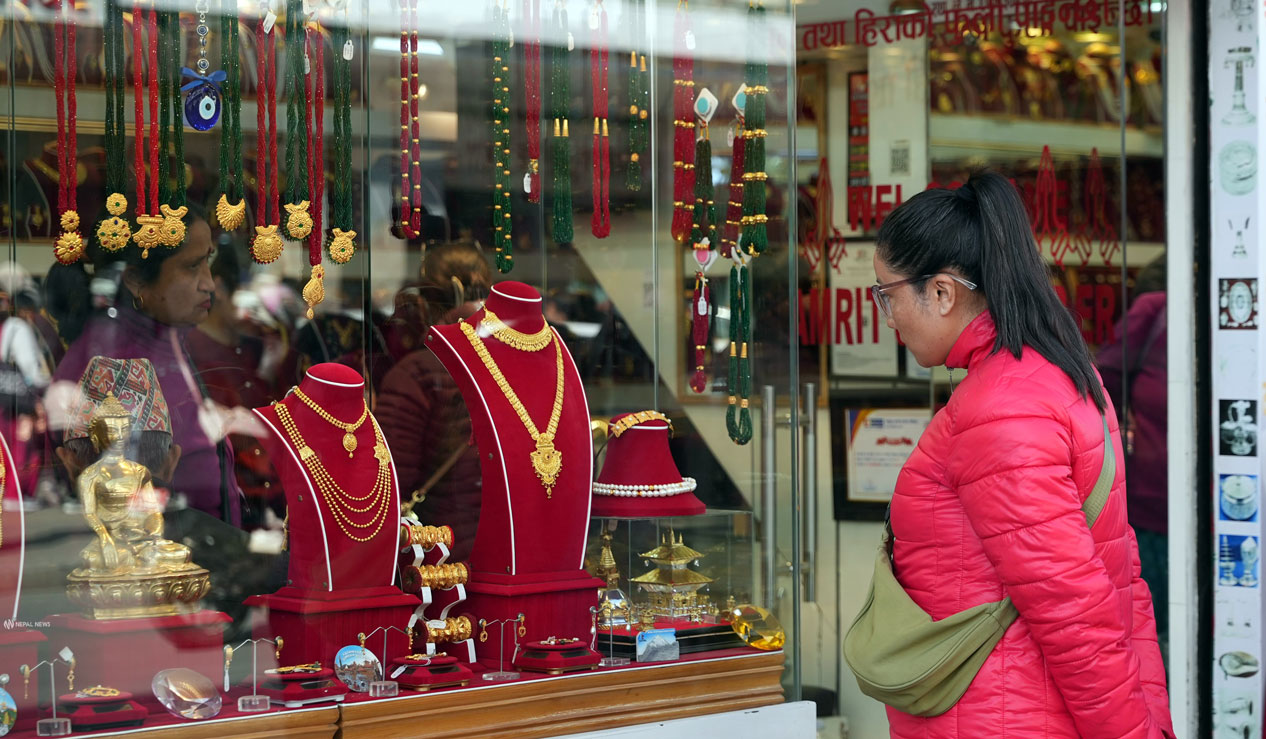
The price of gold has recorded a slight decline in the market on Sunday. According to details published by the Federation of Nepal Gold and Silver Dealers’ Association, the price of gold has decreased by Rs 1,000 per tola (11.66 grams) today. The federation stated that the price of gold has been fixed at Rs 295,100 per tola today. Earlier, on Friday, gold was traded at Rs 296,100 per tola. While the price of gold has gone down, silver has seen an increase. Silver, which was traded at Rs 4,945 per tola on Friday, has increased by Rs 65 today to reach Rs 5,010 per tola.