Kathmandu
Monday, June 29, 2026





Despite individual flashes of brilliance from veterans like Sompal Kami and Sandeep Lamichhane, Nepal’s inability to contain runs in the final overs remains a recurring nightmare in the ICC CWC League 2.

KATHMANDU: On April 29, during an ICC Cricket World Cup League 2 match against Oman, Nepali national cricket team pacer Sompal Kami took over the bowling responsibility in the death overs.
Given his experience of 69 ODI matches, it was natural for both head coach Stuart Law and captain Rohit Kumar Paudel to trust him. Sompal justified that trust to an extent. He attempted to keep Oman under pressure by taking the wickets of Vinayak Shukla, Jiten Ramanandi, and Shakeel Ahmed.
Looking at it from an individual perspective, a performance of three wickets in three overs seemed impressive. However, in cricket, results carry more weight than statistics. Ultimately, as Sompal conceded 59 runs in his nine overs, Oman faced little difficulty in crossing the 300-run mark.
Chasing a target of 306, Nepal was given a revised target of 258 in 36.5 overs due to rain. However, the batting of the Nepali team, which had already conceded a massive score, appeared weak. Nepal was bundled out for just 157 runs, losing seven wickets in the allotted overs. Consequently, Nepal faced a 102-run defeat according to the DLS method.
Sompal appeared frustrated after the match. “Once 300 runs are on the board, it doesn’t really matter who took how many wickets. What is the benefit of the four wickets I took if the win doesn’t come?” he said sharply.
Until the 40th over, the game seemed to be under Nepal’s control. Oman was limited to 233 runs with the loss of four wickets. At that time, Nepal showed signs of making a comeback. However, the picture of the game changed suddenly in the final 10 overs. Oman added 72 runs in 60 balls, taking the score to 305. This phase proved to be the most expensive for Nepal.
In the death overs, along with Sompal, Karan KC, Gulshan Kumar Jha, Sandeep Lamichhane, and Dipendra Singh Airee handled the bowling. Sandeep and Sompal bowled three overs each, while Karan bowled two, and Dipendra and Gulshan bowled one over each.

After taking a wicket against Oman.
However, Nepal failed miserably to control the runs during these overs. Sompal conceded 28 runs in the final three overs alone, although he did take three wickets. Before that, he had given 31 runs in six overs with one wicket. In the death overs, Karan conceded 19, Gulshan 13, and Dipendra seven runs, while Sandeep proved to be the most economical. He took one wicket while giving away only 6 runs in three overs.
The importance of death overs
There was a time when cricket was considered a game of patience, technical proficiency, and long partnerships. Batters stayed at the crease to build innings, runs were gathered systematically, and the game progressed gradually. However, with the arrival of T20 cricket, there has been a massive change in the pace, style, and mindset of the game. Today, cricket is not a test of patience but a competition of power, strategy, and instant decision-making.
The most thrilling form of this change is seen towards the end of the innings, i.e., in the death overs. In this phase, the direction of the game can change suddenly, just as it did in the match against Oman. A massive score can be built in just a few balls, or a team in a weak position can turn the game in its favor. Therefore, in modern cricket, the death over is considered the decisive turn of the match.
Generally, the final 10 overs in ODI cricket and the final four-five overs in T20 cricket are called death overs. However, there is no fixed limit to this. If a team has enough wickets left and a strong batting lineup, aggressive play begins even earlier. Former leg-spinner Rajkumar Pradhan states that this is why current captains and coaches make strategies focusing on the final overs right from the beginning.

Sompal Kami bowling against Oman.
“In today’s cricket, the final 5/10 overs determine the result of many matches. This is the time for the real test of a player’s mindset, strength, and decision-making ability. However, we haven’t been able to work enough on this aspect,” he says.
Modern cricket batters are not limited to traditional styles. They have given the game a new dimension. Shots like the helicopter, scoop, ramp, reverse sweep, and switch-hit have now become common. Especially in the death overs, these shots are becoming a challenge for bowlers. In today’s cricket, even a small mistake turns into a four or a six.
“Previously, batters would defend a good ball, but now they are sending it across the boundary. T20 cricket has developed this mindset. Now, this trend is starting to be seen in ODI cricket as well,” says Pradhan.
When discussing the best finishers in cricket history, the name of former Indian captain Mahendra Singh Dhoni always comes first. The ability to remain calm even in high-pressure situations was his biggest identity. He had developed the unique art of keeping the game under control until the end and showing aggression at the right time. His unbeaten 91-run innings against Sri Lanka in the 2011 ODI World Cup final is still remembered as a prime example of finishing.
Yuvraj Singh’s aggressive style is equally famous. The moment he hit six consecutive sixes against Stuart Broad in the 2007 T20 World Cup is considered one of the most unforgettable in cricket history. About four years later, he shared a crucial 47-run partnership in the final 10 overs with Dhoni against Sri Lanka to give India a six-wicket victory.
Such world-class examples show how the direction of the game can shift all of a sudden in the death overs. In Nepal’s context, however, the situation is different. Barring a few exceptions, neither a stable bowling mechanism capable of controlling runs in the death overs has been developed, nor has the batting capacity to finish the game aggressively been sufficiently established. This is why losing control in decisive overs remains Nepal’s main problem, according to former coach and spinner Pradhan.
At one time, the yorker used by Waqar Younis and Wasim Akram was considered a lethal weapon in cricket. However, modern batters have started sending that same ball across the boundary easily through scoop, ramp, and reverse shots. This change has forced bowlers to develop new strategies as well.
“As the aggressive style of batters increases, the job of bowlers has become extremely challenging. Especially, bowling in the death overs has become like putting one’s career at risk in today’s cricket. Therefore, back-of-the-hand slower balls, slower bouncers, wide yorkers, pace changes, and the use of various angles have become almost mandatory,” he says.
Amidst this challenging environment, some bowlers have established themselves as death over specialists. Former Sri Lankan player Lasith Malinga is considered one of the best death bowlers in limited-overs cricket. His unique sling action and consistently accurate yorkers put even the world’s best batters in difficulty. He used to bowl slower balls along with pace and succeeded in keeping the opposition under control by creating mental pressure.
Similarly, Jasprit Bumrah is one of the most successful death bowlers of the modern era. His unusual action, accurate yorkers, and ability to remain composed under pressure have proven decisive for India. Australia’s Mitchell Starc is famous for high speed and reverse swing. He makes the death overs lethal. Similarly, bowlers like Trent Boult, Dale Steyn, James Faulkner, Tim Southee, and Mohammed Shami have also given impressive performances in the death overs at various times. However, Pradhan notes that Nepali bowlers have not been able to maintain consistency.
Responsibility on the shoulders of limited players
After gaining One Day International (ODI) status in 2018, Nepal has played tournaments like League 2, the ACC Premier Cup, and the ODI World Cup Qualifiers. In these tournaments, the responsibility of Nepal’s death over bowling has mostly remained on the shoulders of limited players.
Players like Karan KC, Sompal Kami, Sandeep Lamichhane, Lalit Narayan Rajbanshi, and Dipendra Singh Airee have been handling the death over responsibility for a long time. Specifically, Abinash Bohara, considered a ‘death over specialist,’ played League 2 matches against Oman on February 5 and the USA on February 8, 2020. In the series held at the TU Cricket Ground in Kirtipur, he conceded 38 runs with two maidens in nine overs against Oman. However, despite giving 24 runs in the death overs, he remained wicketless.
At that time, Gyanendra Malla was leading the team. In that match, besides Abinash, Sandeep Lamichhane, Sushan Bhari, Dipendra Singh Airee, and Karan KC also bowled in the death overs. However, with Sandeep conceding 24, Karan 23, Dipendra two, and Sushan one run, they gave away 74 runs while taking three wickets in the final 10 overs. This became the main reason for Nepal’s 18-run defeat to Oman.
Three days later, in the match against the USA, spinner Kushal Malla made his debut. In the process of giving Nepal a 35-run victory, he also took over the death over bowling responsibility. This gave the team another option. However, Abinash, who conceded 13 runs in two overs in that same match, stopped being regularly included in the team thereafter. Spinner Sushan has already migrated to Japan, while former captain Paras Khadka retired and entered a management role in the Cricket Association of Nepal (CAN). Meanwhile, Kushal has recently stopped making it into the team.
Gulshan Kumar Jha made his place in the Nepali national team in 2021 at the age of 16. Since then, he has been continuously used as a potential option in the team’s death over strategy.
Looking at Nepal’s ODI journey over the past few years, the team has played 60 matches in the League 2 cycle alone, with an additional 35 matches besides those. However, despite playing so many matches, the results indicate that Nepal’s performance has not been stable. Among those matches, 41 losses, one tie, and two matches ending without a result show that the team is still in a transitional phase.
Specifically, death over bowling has remained one of Nepal’s weak points. Looking at the statistics of the ongoing League 2, Nepal has allowed the opposition to bat beyond 40 overs in only 14 matches. Even though Nepal keeps the opposition under pressure in the early or middle overs in most games, it has not been able to control runs in the final 10 overs against teams that play long innings. Consequently, they have had to face defeats in nine matches against the USA, Scotland, Oman, Canada, and the UAE.
During this period, the players who have bowled the most death overs are the pace duo of Sompal Kami and Karan KC, along with leg-spinner Sandeep Lamichhane. If the recent match against Oman is not counted, Sompal has taken five wickets while conceding 88 runs in a maximum of 17 overs in the death.
In contrast, Karan KC has bowled 15 overs—two fewer than Sompal—conceding 157 runs and taking six wickets. Although the wicket count appears impressive, his ‘economy’ is quite expensive. Karan is an aggressive bowler. Although he has reached the age of 34, he still possesses the ability to take wickets. This is why captain Rohit Kumar Paudel uses him in the death overs. However, due to this aggressive style, he also concedes many runs.
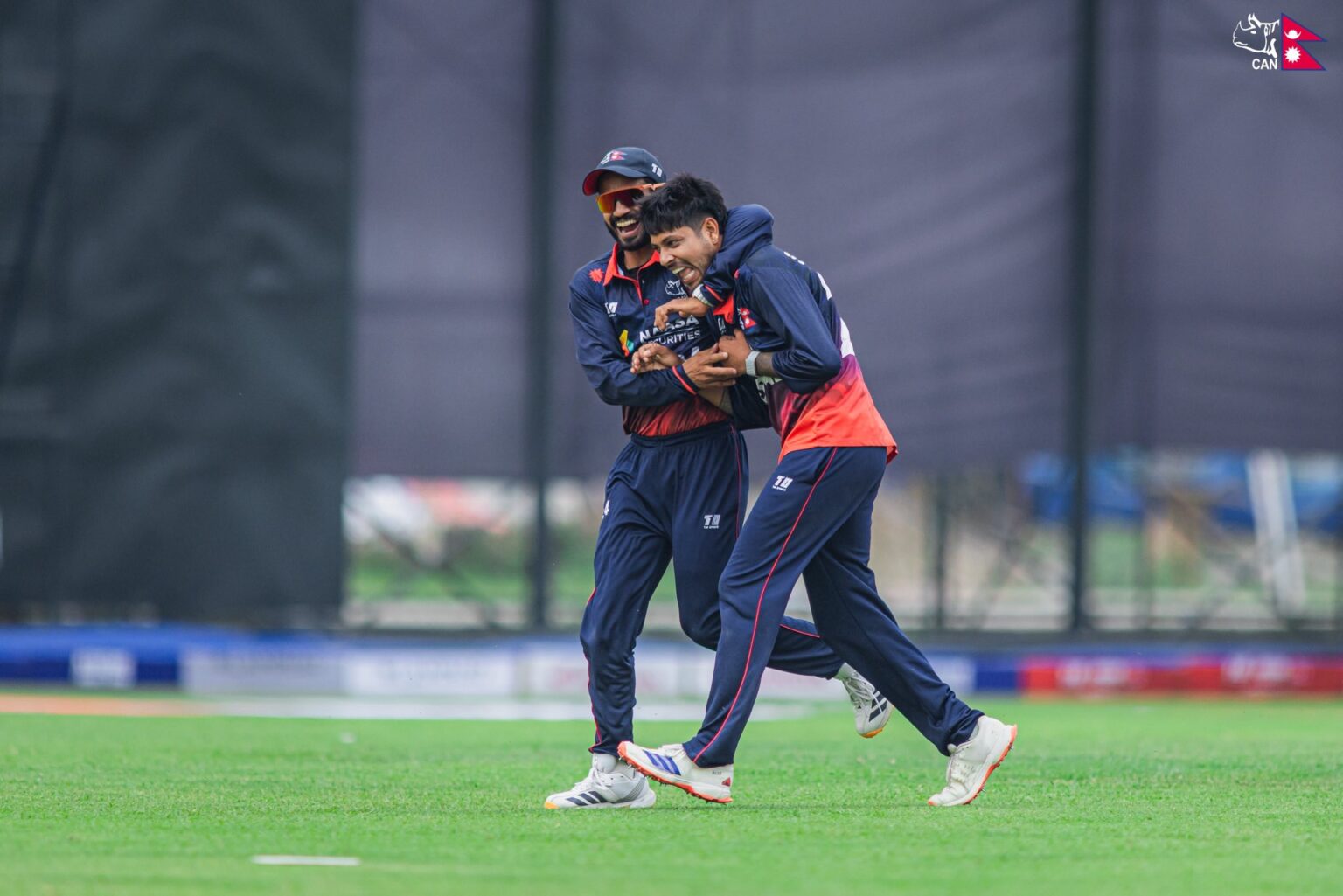
After taking a wicket against the UAE, Aasif Sheikh and Sandeep Lamichhane.
In the spin department, Sandeep has also bowled 17 death overs, taking four wickets while conceding 77 runs. Generally, using a spinner in death overs is considered risky, but Sandeep has given a relatively very effective performance. Since his googly, pace changes, and variations help control the flow of runs even in the final overs, there is no alternative but to use him, says former spinner Sanjam Regmi.
“Sandeep can bowl six googlies in six balls. Not only that, he keeps using new variations continuously. Therefore, the pressure on him is also higher,” he says. Young all-rounder Gulshan is still in the learning phase. However, his use in the death overs is seen as preparation for the future. His height and ability to extract extra bounce are considered positive aspects for the Nepali team. Nevertheless, due to a lack of experience, he still appears to be struggling to maintain line and length in high-pressure situations.
Therefore, Captain Rohit has been using himself along with Dipendra and Kushal Bhurtel according to the situation. However, the bowling of these three players in the death overs has not appeared effectively as expected. To be fair, former coach Monty Desai did not fail to try to find alternatives for Karan and Sompal, who are nearing retirement. He gave a debut to young pacer Rijan Dhakal, who plays domestic cricket for Bagmati Province, at home against Canada on February 8, 2024. Since then, he has also played against Scotland and the USA. In the death overs of those matches, he took one wicket while conceding 33 runs in four overs. However, he has not succeeded in making a permanent place in the team.
“Currently, the regular bowlers themselves are conceding many runs. Therefore, Rohit is being forced to use part-time bowlers. Such bowlers are generally used only when wickets are not coming. But when they are made to bowl in the death overs, many runs are being conceded. Therefore, the losses are also increasing,” he says.
Young Players Knocking on the Door of Possibility
After the Nepali cricket team’s performance in the long format did not meet expectations recently, the Cricket Association of Nepal (CAN) formed a Nepal ‘A’ team with the objective of preparing a ‘backup.’ This team, created under the plan to increase continuous competition in the main team, familiarize new players with the international environment, and keep options ready, has not had the opportunity to play enough matches.
The Nepal ‘A’ team had not played any competitive matches for a long time after playing a five-match series against Ireland ‘A’ in March-April 2024. This time, however, the team got the opportunity to play against Scotland and the USA, who came to Nepal to play League 2. Despite limited opportunities, some young players have started knocking strongly on the door of the national team through their performances. Most talked about among them is fast bowler Hemant Dhami.

Kushal Bhurtel coming on to bowl against Oman.
Hemant made his One Day International debut against Canada on February 12, 2024. In the process of giving Nepal a comfortable nine-wicket victory in that match, he took three wickets while conceding 49 runs in eight overs. The confidence, pace, and aggression he showed in his debut match were considered impressive. Specifically, his ability to extract swing with the new ball and his style of continuous attack seem to set him apart.
However, with the strong presence of pacers like Sompal, Karan, Gulshan, and Nandan in the national team, Hemant has not been able to secure a regular spot. Since the Nepali team currently has a mix of both experience and youth, opportunities for new players are not easy. Therefore, domestic cricket and ‘A’ team matches have become the main medium for them to prove themselves.
Hemant took a record 27 wickets while leading Sudurpashchim Province to the final for the first time in history in the Prime Minister Cup One Day Cricket Tournament. His consistent performance throughout the tournament established him as one of the most influential pacers in Nepali domestic cricket. Based on this performance, he also secured a place in the Nepali T20 team. However, he has not been able to get an opportunity in the 50-over team.
Not only in the pace attack, but new players are also creating pressure in the spin department. Spinners like Shahab Alam and Yuvraj Khatri have been consistently performing excellently in domestic cricket. Shahab’s experience and control, along with Yuvraj’s variety, have moved them forward as potential options. However, since there are established spinners like Sandeep and Lalit in the senior team, making a place in the team for new spinners is challenging.
Nevertheless, increasing competition within the national team is a positive sign for Nepali cricket. Team vice-captain Dipendra is also in favor of giving opportunities based on performance. He says an environment has now been created where players who do well in domestic cricket and the ‘A’ team can be brought to the senior team.
“Excellent players are coming from domestic competitions. Moreover, there is an A team as well. There are good players in that too. If someone in the senior team is not performing well, players can be brought from there too,” he says. Will new players now make a place in the team?