Kathmandu
Friday, June 5, 2026





Nepal’s trade deficit has crossed Rs 1.44 trillion in the first ten months of FY 2025/26, with imports surging nearly 15 percent and exports still heavily dependent on India, vegetable oil re-exports, and a narrow basket of commodities

KATHMANDU: The Department of Customs released preliminary foreign trade statistics covering the first ten months of fiscal year 2025/26, from mid-July 2025 to mid-May 2026, based on data collected through 24 major customs offices linked to the ASYCUDA World system.
The numbers tell a familiar story with some important shifts: imports continue to dominate, exports are growing, and India remains far and away Nepal’s most consequential trading partner.
The trade deficit remains enormous, customs revenue has climbed alongside import growth, and certain commodities and border crossings are doing more of the heavy lifting than ever.
What was the overall state of Nepal’s foreign trade in the first ten months of FY 2025/26?
Nepal’s total foreign trade volume in the first ten months of the fiscal year 2025/26 reached approximately Rs 1.941 trillion, compared to Rs 1.692 trillion in the same period of the previous fiscal year, an increase of roughly 14.75 percent.
Within that headline figure, the picture remains structurally skewed. Imports stood at Rs 1.692 trillion, while exports came to just Rs 248.96 billion, leaving a trade deficit of Rs 1.443 trillion.
Compared to the same period of FY 2024/25, imports grew by about 14.82 percent and exports rose by roughly 14.25 percent. Both sides of the ledger expanded at nearly the same rate, which means the ratio between imports and exports remained almost unchanged year on year.
For every one rupee Nepal earned through exports, it spent approximately Rs 6.80 on imports. Exports covered only about 12.82 percent of total foreign trade value, while imports accounted for the remaining 87.18 percent.
The size of the trade gap, Rs 1.44 trillion, is itself larger than Nepal’s entire export earnings by a factor of nearly six, which captures how far the country remains from any semblance of trade balance.
How much customs revenue did Nepal collect, and how does that relate to import volumes?
Nepal collected a total of Rs 414.08 billion in imports revenue during the first ten months of FY 2025/26. This figure covers all customs duties, value-added taxes, excise duties, and other levies collected at the border on imported goods, making it one of the most significant sources of government revenue in the country.
Looking at the duty rate breakdown, the 30 percent duty bracket generated the single largest share of customs duty collections at approximately 19.21 percent of total import duty. That bracket covered imports worth Rs 112.44 billion.
The 10 percent rate was the most significant in terms of import value, covering goods worth Rs 510.69 billion, which represented over 30 percent of total import value. The 15 percent rate covered Rs 211.34 billion worth of goods, while the 20 percent bracket covered Rs 116.66 billion.
The “Others” category, which captures items with rates outside the standard bands including specific duties on petroleum, alcohol, and tobacco, generated 20.64 percent of duty and covered goods worth Rs 217.63 billion.
The relationship between import value and duty collected reflects both the rate structure and the composition of what Nepal imports. Petroleum, which carries relatively low percentage duties but accounts for enormous import volumes, is one reason the effective average duty rate is moderate relative to total import value.
Who are Nepal’s biggest import partners and what does that reveal about the country’s trade dependency?
India dominates Nepal’s import landscape to a degree that makes any other trading relationship look minor by comparison. India supplied imports worth Rs 974.30 billion in the first ten months of FY 2025/26, which amounts to roughly 57.6 percent of Nepal’s total import bill. No other country comes close.

China is the second largest source at Rs 336.41 billion, or just under 20 percent of total imports. Together, India and China account for more than three quarters of everything Nepal buys from the rest of the world, which reflects both the geographic logic of landlocked procurement and the deep structural dependency that Nepali policymakers have long acknowledged as a vulnerability.
Beyond these two, the next tier of import partners is far smaller. The United Arab Emirates supplied Rs 49.74 billion, Argentina contributed Rs 95.28 billion, and Australia sent Rs 14.59 billion worth of goods. Several countries appear on the import list primarily for specific commodities: Argentina, for example, shows up almost entirely due to soybean imports.
Indonesia is present largely because of areca nut. Ukraine appears due to wheat. The concentration of Nepal’s import sourcing in its two immediate neighbours reflects cost and logistics realities, but it also means that disruptions on either border carry outsized consequences for everything from food prices to fuel availability.
Where does Nepal export to and how concentrated is that picture?
India is also Nepal’s dominant export destination, accounting for Rs 204.37 billion out of total exports of Rs 248.96 billion, or roughly 82 percent of all export earnings. This makes Nepal’s export portfolio even more India-dependent than its import sourcing, which has significant implications for economic resilience. If the Indian market became less accessible, Nepal would have almost no export base left standing.
The United States is the second largest export destination at Rs 16.59 billion, followed by Germany at Rs 4.05 billion and the United Kingdom at Rs 2.61 billion. Japan received Rs 1.84 billion in Nepali exports, while France took Rs 1.78 billion. Australia, despite being a significant source of imports to Nepal, received only Rs 1.75 billion in Nepali exports.
The concentration on India for exports reflects the reality of where Nepal’s export-ready goods, particularly re-exported refined vegetable oils, spices, herbs, jute and fabric goods, and processed agricultural products, find their nearest and most accessible market.
Some of the trade counted as exports to India also reflects value-chain dynamics: Nepal imports raw materials, adds some processing, and re-exports, which means the export figures slightly overstate Nepal’s domestic value addition. The narrow export base beyond India represents both an opportunity and a structural risk that trade diversification policies have repeatedly tried to address.
What are Nepal’s top import commodities and which chapters account for the most spending?
Petroleum and mineral fuels represent the single largest import category for Nepal by value, at Rs 299.51 billion. This includes petrol, diesel, aviation turbine fuel, LPG, and various petroleum derivatives.
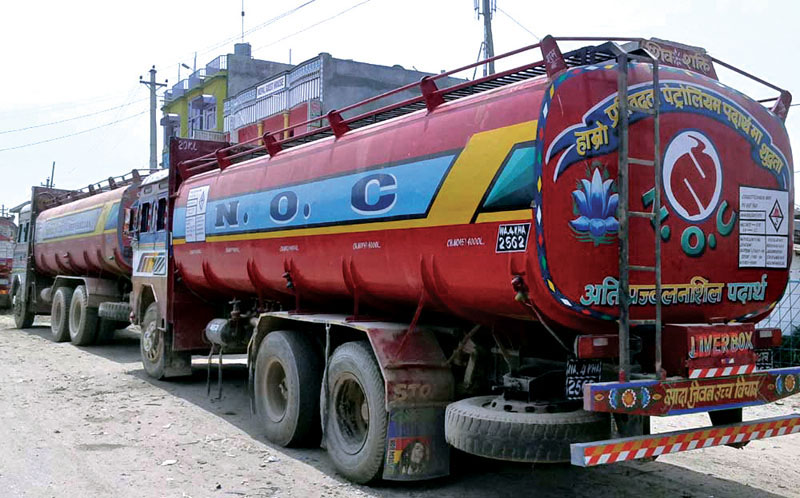
Diesel alone, at Rs 130.94 billion, is the largest single line item within this category, followed by LPG at Rs 46.13 billion and aviation fuel at Rs 20.81 billion. Petrol accounted for Rs 58.64 billion. The country’s dependence on imported petroleum is one of the most discussed structural features of its trade balance, given that Nepal produces virtually no fossil fuels domestically.
Cereals are the next significant category at Rs 51.26 billion. This includes paddy rice, wheat, maize, and barley, reflecting Nepal’s partial dependence on imported grain to supplement domestic production. Vegetable imports cost Rs 31.84 billion, fruits and nuts came to Rs 28.78 billion, and oilseeds and related products amounted to Rs 27.07 billion.
Machinery and mechanical appliances cost Rs 123.60 billion, while electrical machinery and equipment accounted for Rs 112.21 billion.
Iron and steel imports reached Rs 118.31 billion. Pharmaceutical products cost Rs 35.19 billion, and animal or vegetable fats and oils came to Rs 145.33 billion, largely due to edible oil imports.
What are Nepal’s most important export commodities?
The top export categories reveal a Nepal that exports primarily processed agricultural goods, natural resources, some light manufacturing, and re-exported refined products. Animal or vegetable fats and oils constitute the largest export chapter at Rs 117.55 billion, almost entirely driven by soybean oil, palm oil, and sunflower oil re-exported to India after being imported in crude form and refined.
Coffee, tea, spices, and condiments are the next most valuable export category at Rs 16.36 billion, led heavily by cardamom. Nepal is one of the world’s significant producers of large cardamom, and exports of this single commodity reached Rs 11.42 billion in the reporting period. Ginger, both fresh and processed, contributed Rs 1.04 billion in exports, while tea, particularly black tea exported in bulk, accounted for Rs 3.05 billion.
Vegetable materials, plaiting materials, and miscellaneous plant products exported Rs 3.45 billion, with broom grass and semi-processed catechu among the notable items. Carpets and floor coverings earned Rs 9.70 billion.
Apparel and clothing accessories contributed Rs 3.28 billion and added Rs 7.01 billion. Cement clinkers and Portland cement together generated Rs 2.43 billion in exports, mainly going to India. Yarn and textile fibres also represented meaningful export earnings, particularly synthetic yarn exported in significant quantities.
What is the scale and significance of edible oil re-exports to India?
One of the most structurally unusual features of Nepal’s export profile is the enormous scale of vegetable oil re-exports to India. Nepal imports crude soybean oil, crude palm oil, and crude sunflower oil, refines or processes them to some degree, and then exports the finished product to India.

In the first ten months of FY 2025/26, exports of soybean oil alone reached Rs 101.27 billion. Sunflower oil exports accounted for Rs 7.41 billion. Palm oil and its derivatives added several billion more. These numbers make vegetable oil the single largest export category by a wide margin.
However, this is a re-export trade that depends on India’s tariff structure making it commercially advantageous for Nepali refiners to serve as an intermediate step. The value added within Nepal in this chain is real but relatively modest compared to the gross export value recorded.
The continued growth of this trade category significantly inflates Nepal’s headline export figures, which is why analysts often separate it when assessing Nepal’s underlying export competitiveness.
When vegetable oil re-exports are set aside, Nepal’s export base looks considerably smaller and more concentrated in traditional goods like cardamom, jute products, carpets, herbs, and a narrow range of processed foods and garments.
How does Nepal’s trade with China look in detail?
China was Nepal’s second largest import source with Rs 336.41 billion in imports. The composition of Chinese imports covers a remarkably wide range: garlic accounted for Rs 2.17 billion, walnuts in shell for Rs 2.47 billion, and fresh apples for Rs 9.80 billion. Iron and steel products from China represented significant sums, as did plastics, electrical goods, machinery, textiles, synthetic yarn, and chemicals of all kinds.
1693039696.jpg)
Chinese imports into Nepal enter primarily through Tatopani, Rasuwagadhi, and Kodari crossing points, with Tatopani handling Rs 37.11 billion and Rasuwagadhi handling Rs 28.27 billion in the period. The diversity of goods from China illustrates how deeply integrated Chinese supply chains have become into Nepal’s retail, construction, manufacturing, and agricultural sectors.
Nepal’s exports to China, by contrast, were only Rs 1.39 billion in the same period, making the bilateral trade deficit with China Rs 335.02 billion, the second largest bilateral deficit after India. The exports to China included small quantities of herbs, plant materials, rudraksha seeds, some agricultural products, and metals. The asymmetry between what Nepal receives from China and what it sends back is even more extreme than the overall trade ratio suggests.
Which customs offices handled the most trade and why?
Birgunj customs office, which sits on the central Terai border with India and connects to the busiest land crossing between the two countries, processed the largest share of both imports and exports.
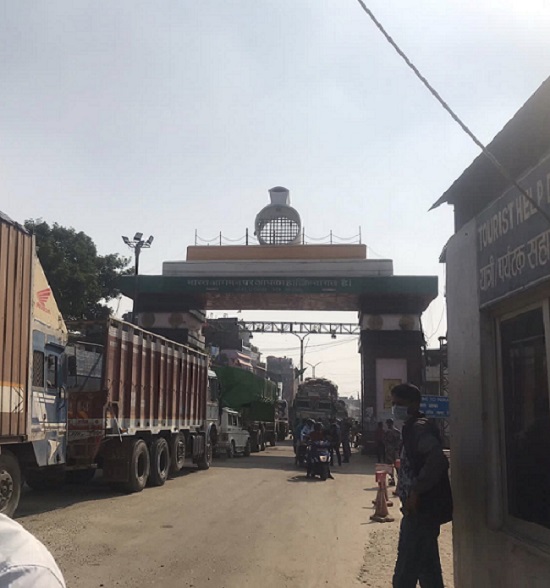
Imports through Birgunj reached Rs 794.87 billion, representing 46.96 percent of Nepal’s total imports. Exports through Birgunj were Rs 88.25 billion, or 35.45 percent of total exports. This single office handled nearly half of all goods entering Nepal from abroad.

Vehicles entering Nepal through the Birgunj border point. File photo
Biratnagar was second for imports at Rs 198.63 billion, accounting for 11.73 percent of total imports. Bhairahawa handled Rs 248.20 billion in imports, or 14.66 percent, and Nepalgunj processed Rs 70.23 billion.
For exports, Biratnagar ranked first at Rs 70.51 billion or 28.32 percent of exports, reflecting its importance for goods moving to eastern India, including jute products, herbs, and agricultural commodities. Tribhuvan International Airport handled Rs 172.03 billion in imports, largely in goods carried by air freight, and Rs 30.26 billion in exports.
Tatopani and Rasuwagadhi handle most of the China-facing trade, contributing Rs 37.11 billion and Rs 28.27 billion in imports respectively. The dominance of land border offices, particularly those facing India, in both import and export volumes confirms that Nepal’s trade flows are overwhelmingly conducted overland through its southern border.
How did imports grow across different commodity chapters and what drove that growth?
The growth in imports across the period reflects both underlying demand and price effects. Cereals, showed imports of Rs 51.26 billion against Rs 43.77 billion in the same period of the prior year, an increase driven partly by higher paddy and wheat volumes from India. Fats and oils, reached Rs 145.33 billion reflecting continuing large crude oil import volumes feeding the re-export trade with India.
Pharmaceutical imports rose to Rs 35.19 billion. Plastic articles reached Rs 58.08 billion. Electrical machinery came to Rs 112.21 billion, reflecting ongoing investment in infrastructure, grid expansion, and consumer electronics. Vehicles and vehicle parts accounted for Rs 96.79 billion, a category that tends to fluctuate with exchange rate movements, tariff changes, and consumer confidence.
Fertiliser imports were Rs 49.29 billion, a category entirely dependent on imports given Nepal’s lack of domestic production, and critical for agricultural output. Food preparations and processed food imports collectively amounted to tens of billions of rupees across multiple chapters, from Rs 6.62 billion in cereal-based bakery preparations to Rs 15.22 billion in miscellaneous edible preparations, reflecting the growing role of imported packaged and processed foods in Nepali consumption.
How significant were spice exports and which specific spices drove the numbers?
Nepal’s spice export sector is genuinely significant in global terms for a small economy. Total spice exports under the relevant chapters reached Rs 16.36 billion in the first ten months.
Large cardamom, Nepal’s most prized spice commodity, dominated entirely. Exports of large cardamom reached Rs 11.42 billion, with the overwhelming majority going to India. Nepal is one of very few countries that produces large cardamom at commercial scale, and its eastern hills growing regions enjoy a near-monopoly in certain grades.
Fresh ginger exports to India reached Rs 644.15 million, and dried and processed ginger, including the sutho or dried ginger paste form, added Rs 352.80 million primarily exported to Germany and other European markets.
Cinnamon exports, largely re-exported from Sri Lankan sourced stock processed in Nepal, reached Rs 179.68 million going mainly to India. Pepper exports were smaller, at Rs 693 million for all types combined.
Other spices exported include sichuan pepper, coriander seeds going to India, cumin seeds, and various spice mixes. The spice sector illustrates how Nepal can punch above its weight in specific value chains even within an overall export base that remains small.
The challenge is that large cardamom dominates so overwhelmingly that the sector’s performance tracks closely with a single commodity and its price cycle on Indian wholesale markets.
What do these trade figures tell us about the structural challenges Nepal still needs to address?
The ten-month trade statistics for FY 2025/26 confirm several structural features of Nepal’s economy that have remained largely unchanged for decades. The trade deficit at Rs 1.44 trillion is not a temporary imbalance but a reflection of the gap between what Nepal produces domestically and what its population needs and wants.
The country imports petroleum, cereals, fertilisers, machinery, vehicles, pharmaceuticals, chemicals, edible oils, and manufactured goods at scale, while exporting primarily agricultural commodities, a narrow range of manufactured goods, and re-processed imports.
The fact that India accounts for about 82 percent of exports means that any policy or market shift in India has an outsized effect on Nepal’s export revenues. Cardamom, jute goods, and vegetable oil dominate the export value list, leaving the country exposed to commodity price volatility.
The absence of significant industrial exports reflects limited domestic manufacturing capacity, infrastructure constraints, and a small internal market that makes scale difficult to achieve.
On the import side, the petroleum dependence is the most acute structural issue, consuming nearly Rs 300 billion annually and representing the single largest factor in the trade deficit. Reducing this through hydropower-based electric vehicles, efficient public transport, and reduced fuel consumption in industry and agriculture is frequently cited in policy documents but progress remains slow.
Customs revenue of Rs 414 billion is significant for government finances and any rapid improvement in the trade balance would require finding alternative revenue sources, which makes reform of the import-heavy growth model politically and fiscally complex.
The data from these ten months shows a trade picture that is growing in absolute volume but not changing structurally in any direction that would suggest the deficit narrowing meaningfully in the years ahead.