Kathmandu
Tuesday, July 21, 2026





Despite growing interest in cycling and its environmental benefits, the lack of dedicated bicycle lanes and poor road safety continue to deter riders in the Kathmandu Valley, cyclists and urban planners say.
KATHMANDU: Cycling activist Maheshwari Bista, 61, of Bungamati, Lalitpur, has been riding a bicycle since childhood and still prefers cycling for commuting around the city. However, she always has to jostle with large vehicles on the road. She says, “In some places, it has been painted as a bicycle lane, but that is not a dedicated bicycle lane, which is why it is not safe.” Her experience shows that although the bullying tendency of drivers of large four-wheeled vehicles to encroach on the lane is less than before, it has not completely improved. “When cycling in a group, there isn’t much risk, but when you are alone, they squeeze you out immediately,” she says.
Bista is a retired civil servant. She took charge as the Women Development Chief in various districts. During that time, she realized that women’s empowerment happens through ‘mobility’ alone, and because of this, she started teaching how to ride bicycles. Since the year 2020, she has taught seven thousand women to cycle.

Photo Source: Maheshwari Bista’s Facebook.
She states that initially, only eight women showed interest in learning to cycle. In recent times, however, interest in learning and riding bicycles has increased. “Since cycling keeps the body moving, agile, and fit, housewives have also liked it,” she says. “Cycling is good for health and the environment too; our campaign is also about buying a bicycle instead of buying a saree.” However, anxiety has not decreased due to unsafe lanes. “Even when sending sisters out on the road after teaching them, there is fear; if something happens, the blame comes back to oneself saying it happened because of that person,” she says. She also teaches traffic rules for safe cycling journeys on the road.
She states that to make the bicycle a day-to-day companion (day-to-day mobility) in cities like the Kathmandu Valley, there is a need for bicycle-friendly roads and humane behavior. To spread this awareness, on the occasion of World Bicycle Day today, cyclists including her organized a rally at Khulamanch. Initiated in 2018, World Bicycle Day is celebrated every year on June 3rd. The slogan for the day this time is—‘Cycling for a Greener Future’.
In Kathmandu, the black smoke (black carbon) emitted from old and diesel-petrol-run vehicles ranks number one among the causes of air pollution. Based on the annual average level of fine particles of 2.5 microns or smaller that cannot be seen by the eye, according to an analysis conducted by the World Bank, the share of the transport sector is 27 percent among the main causes of air pollution in Kathmandu. According to police statistics, the number of vehicles registered up to the fiscal year 2023/24 in just the three districts of Kathmandu, which has 2,084 km of roads, is 1,988,000.
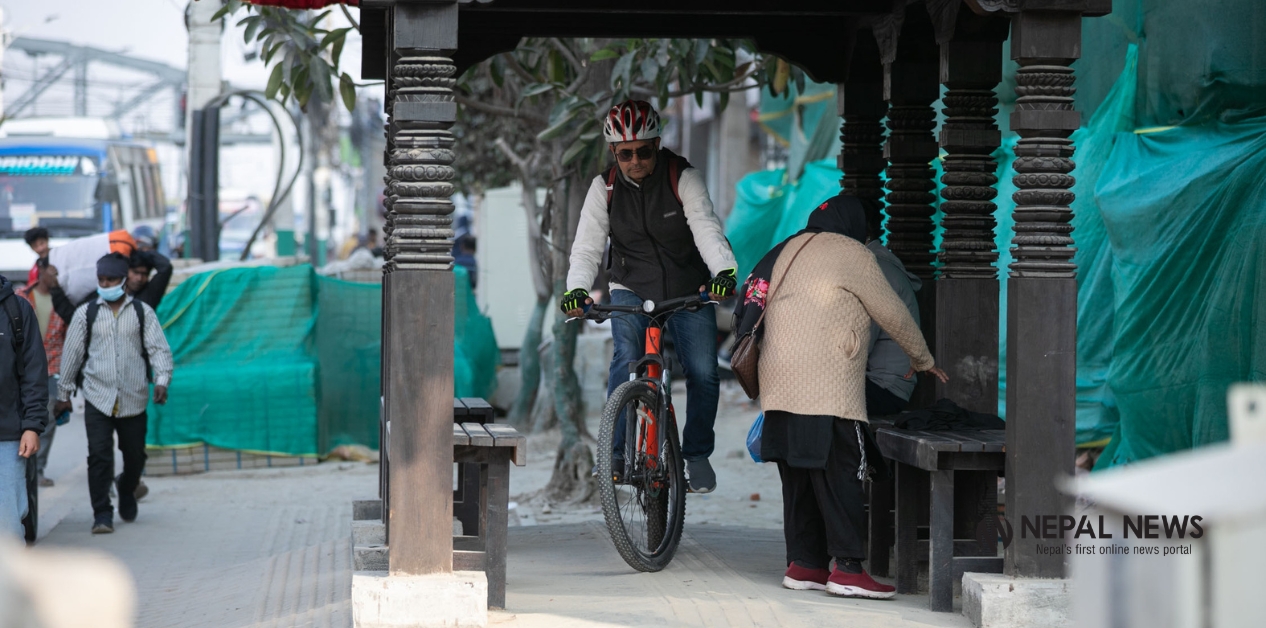
Although cycling is considered the best alternative to improve air quality by reducing carbon emissions from old and diesel-petrol vehicles, there is a lack of bicycle-friendly infrastructure. “We do not have dedicated lanes for bicycles; even though a bicycle lane (shared) is made in some places by painting green shapes of bicycles on the road or laying bricks, it is not convenient,” says urban development activist Saurav Dhakal. Although Dhakal initiated making Kathmandu a bicycle-friendly city around 2008, it has not achieved completeness till now. In 2008, a bicycle lane was built for the first time in front of the Tribhuvan International Airport. That is considered Nepal’s first and ‘dedicated’ bicycle lane.

Photo: Nepal Photo Library
After that, a bicycle lane was made by painting green color on the Maitighar to Tinkune road section. Since this alone would not ensure a safe cycling journey, debates started on road standards to make it convenient for pedestrians, cyclists, and public vehicles. The ‘Nepal Urban Road Standards, 2019’ issued by the Ministry of Urban Development divides urban roads into four classes—primary roads, secondary roads, access roads, and lanes. There is a provision that pavements, bicycle tracks, and plants/trees must be mandatory on all these four types of roads. According to the standards, the width of a primary road is 50 meters. There must be a pavement of at least two meters on both sides of the road. Apart from that, there must be a bicycle track of at least two meters on both sides. However, Dhakal states that this standard could not be implemented on the Maitighar to Tinkune section. “Investment was made many times in that bicycle lane, but a dedicated lane was not built,” he says. “The place designated to make the bicycle lane was vacant initially; later trees were planted, electricity boxes were added on top of that, and Falchas (traditional public resting place) were added.”
Lalitpur Metropolitan City has designated bicycle lanes on the Thapathali to Jawalakhel road section and other inner roads. The Mayor of Lalitpur, Chiri Babu Maharjan, while inaugurating the ‘Bicycle City Program’ on November 30, 2019 had said, “We are fed up because of smoke and dust, vehicles using fuel are spreading pollution, there is no worry of pollution when riding a bicycle, and it is beneficial for health as well.”
Compared to Kathmandu Metropolitan City, even though the bicycle lanes appear more organized in Lalitpur, Maheshwari Bista has the bitter experience that other vehicles have not stopped crowding them out.
Urban development activist Dhakal understands that since migration and urbanization are increasing at a rapid pace in Nepal, local levels must implement a sustainable urban transport system. “As soon as we say urban roads, the matter of pavements, bicycle lanes, and greenery management must come together; our policymakers and road designers must pay attention to this,” he says.
Dhakal concludes that since it is not possible to reach every place just by walking, the bicycle is the best option in the city. “But, neither is there a path for bicycles, nor respect for those who ride bicycles. No one’s attention has reached public transport management either,” he adds. “For this reason, harmony must be maintained among pedestrians, bicycles, and public transport on the road.”