Kathmandu
Tuesday, July 21, 2026





KATHMANDU: If there is one issue that affects Nepal, it is climate warming.
The consequences in terms of erratic rain patterns, extreme weather events, bursting of glacial lakes, and flooding are devastating and causing disproportionate harm to the people of the country.
Yet, so far, the new federal government has not heeded attention to the issue of climate change.
At the political level, there has not been any major speech about it by any senior representatives of the Balen Shah administration.
This is worrying and concerning at the same time especially because a climate vulnerable nation like Nepal should prioritize climate in its policymaking.
Focusing on it in terms of political capital, meaning having the federal government spending its energies on it, proposing new initiatives about it and allocating adequate resources, would bring clear benefits.
The country, as a result, would end up having a stronger credibility and also a higher degree of visibility in the international negotiations centered on the implementation of the Paris Agreement.
For example, as Nepal is pushing to elevate the Mountain Agenda within the Climate COP process, what is the government going to do in terms of grabbing the world’s attention to explain the gravity posed by climate warming on Himalayan Mountains’ eco system?
How, for instance, is Nepal going to partner and strengthen its collaboration with likeminded mountain nations like Peru, Chile, Kirgizstan, already at the front fore of climate action leadership in this area?
Can Nepal propose some novel ideas in this regard?
If smaller and even more climate fragile nations like Vanuatu or Tuvalu, two island nations in the Pacific, can take a bold stand in the international arena, why not Nepal?
That’s why it is essential for the federal government to come up with a strong approach for the upcoming 31st Conference of the Parties to be held in Antalya, Türkiye, from 9 to 20 November 2026 under a joint Turkish and Australian chairmanship.
The Federal executive that has already proved quite adept at harnessing technology to get inputs from the citizens could collect ideas on how the country can maximize its role in November.
Understandably, the negotiations are not only extremely complex and multifaceted, covering a variety of policy areas from mitigation to adaptation to loss and damage to climate finance, agriculture, gender, each defined by its own mechanisms and processes.
They are also painfully frustrating and awfully slow at producing meaningful changes and there is a clear rationale to discuss ways that the climate COP process can be “modernized” and “simplified”.
Yet the negotiations spearheaded within the United Nations Framework Convention on Climate Change are the only legitimate path to claim for the implementation of the Paris Agreement.
But Nepal needs to be bold, audacious and come up with new ideas.
Citizens, especially the youths, should be enabled and supported to play a meaningful rather than tokenistic role in reimagining more effective climate governance, internationally but also nationally.
For example, besides finding fresh ways of pitching the Mountain Agenda, Nepal could come up with some policy recommendations on reforming the governance of the implementation of the Paris Agreement.
While it is unthinkable to reimagine a new treaty, what is instead doable to imagine is a conversation from the Himalayan range on how to reduce the literally endless list of procedures and mechanisms supposedly aimed at implementing the Paris Agreement.
That’s why soliciting ideas for this reform could be a start, together with even more practical request to the citizens to propose solutions to enhance the effectiveness of climate policies in the country.
Here an important question should be asked: does Nepal possess the right institutions to internally tackle climate warming?
For example, what is the Climate Change Council doing?
How is it performing?
Established in 2009, this coordinating mechanism, led by the Prime Minister, is practically inactive and defunct.
In 2024, the Climate Change Bill-2080 BS proposed the establishment of a National Climate Authority but there has not been any progress in enacting this legislation.
In the course of the next article, part of this series centered on climate governance, I will focus on some examples of national climate authorities around the world to prove that climate centered governance is indispensable these days.
In the last piece of this series, I will write about bottom up approaches to involve citizens in formulating climate policies, namely, the role of climate assemblies.
It is important to establish a national conversation on how the climate challenge requires a tailored made governance that can truly be inclusive and bottom up, what, in jargon, it is called “whole of the society” approach.
Young people should have a central role in this effort of defining what such a new governance system means and what the implications would be.
Involving them would make sense not only in terms of opening up the policy making arena to a new crop of citizens but also to legitimize the state’s work in a complex area like climate change.
I wrap up this first piece of the series with the following propositions.
First, open up a digital Call for Ideas on how Nepal should prepare itself for the COP 31.
Students and individual citizens, NGOs, youths’ clubs, representatives of private sectors should be able to propose ideas and suggestions in an easy and seamless fashion.
Creating an online platform is something that is very doable and it won’t even require additional budget.
Second, engage the citizenry “live”, inclusively and across the nation.
Following up on the above-mentioned Call, the federal government should partner with the Provinces in holding discussions with the public, including forums with civil society members. Ideally, climate assemblies could be also planned and held locally.
Third, Nepal would come up with its own “playbook” of policy ideas for the COP 31.
The results of this process should help and support the government in preparing itself for the COP 31.
In practice, this means coming up with a strong public engagement, including ensuring a strong delegation represented at the highest levels with clear policy propositions and a plan to convene several stakeholders meetings on the sidelines of the official negotiations. Public relations and public diplomacy do matter in the context of climate warming.
We should not forget the biodiversity dimension of climate change.
Fourth, do not forget biodiversity.
Unfortunately, the equally complex issue of biodiversity is governed by a different convention from the Climate Convention and the Paris Agreement, its latest incarnation, creating a rigid and artificial separation between two issues that are interlinked and connected.
We should remind ourselves that this year there will also be the COP of the Convention on Biological Diversity (CBD), formally the COP 17 to be held in Yerevan, Armenia at the end of October, just a few days before the climate COP.
Some governments like Brazil and Colombia have been trying to bridge this gap and the gulf between the Paris Agreement that effectively modernized the Climate Convention and the Biodiversity Convention, both adopted in 1992, is being slowly being narrowed and at least there is a political consensus on finding ways to bring these legal tools and their enforcing mechanisms closer to each other.
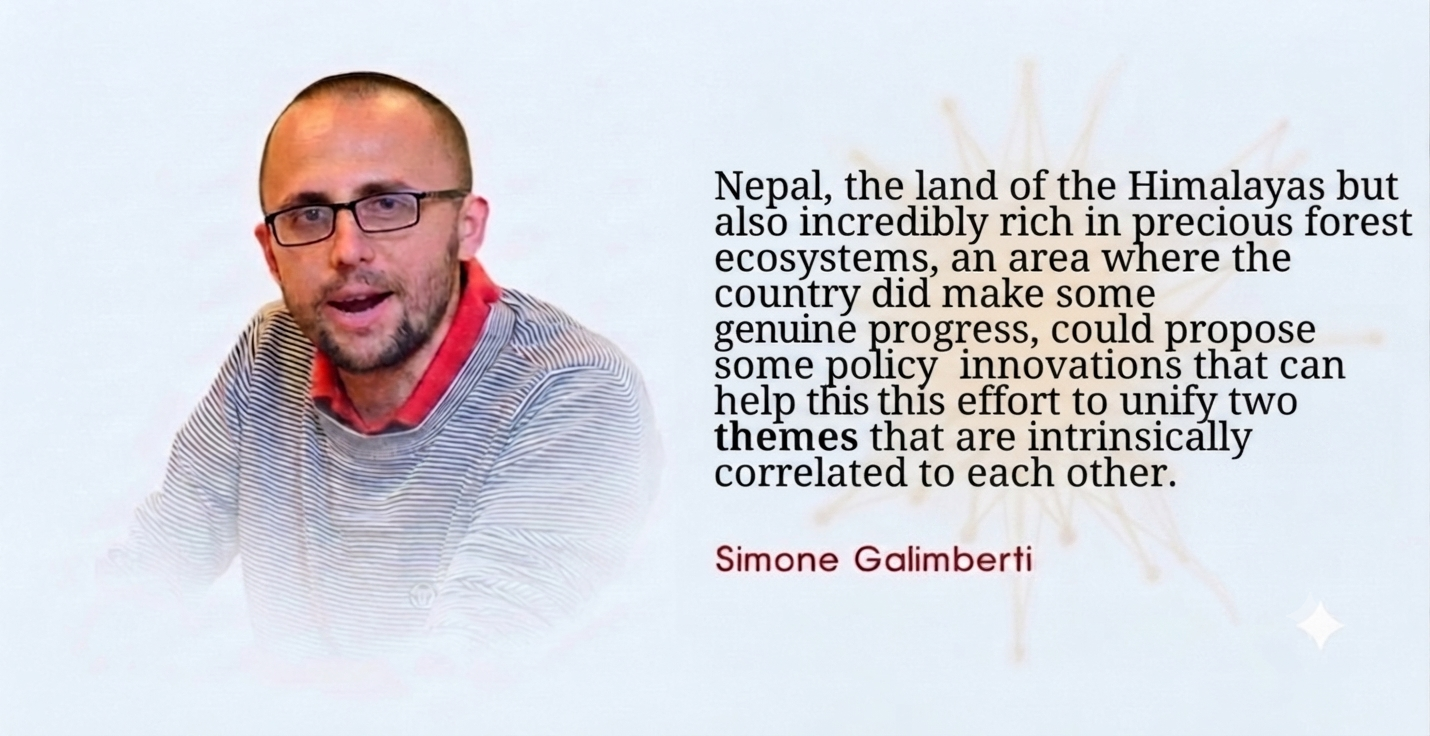
Nepal, the land of the Himalayas but also incredibly rich in precious forest ecosystems, an area where the country did make some genuine progress, could propose some policy innovations that can help this effort to unify two themes that are intrinsically correlated to each other.
Fifth, the federal government should set a timeframe to reboot and enhance its climate toolkit.
For example, the federal executive should re-open the file of the Climate Change Bill and in this way, it can put in place a series of mechanisms that can serve the purpose to defend citizens against climate warming and biodiversity destruction.
The federal government has shown a strong inclination to dismantle a number of statutory bodies and mechanisms, but it must be smart at realizing that Nepal needs agile but effective institutions to deal with climate and biodiversity that are capable of including and engaging its people.
Sixth, invest in youths, inclusively.
The nation has many passionate climate and biodiversity activists.
Even if many youths from marginalized communities are still underrepresented in these fields, it is paramount that the Federal government and also the provincial governments invest small but symbolically important resources in building the knowledge and expertise of young people in the area of climate negotiations.
This undertaking should include making a deliberate attempt at bringing on board youths from historically marginalized groups, offering them opportunities to build their knowhow that, so far, they have been deprived of.
Seventh and last: create a National Fellowship on Climate and Biodiversity Policymaking.
This idea would represent the “ice on the cake” related to the efforts of the government to build a new cohort of climate and biodiversity young leaders.
To understand how this idea could work out, imagine the following scenes.
In both Antalya and Yerevan, a dozen of highly motivated and knowledgeable young climate and biodiversity Fellows from Nepal are busy revising and preparing official statements and position drafts, providing advice to their government’ s “colleagues” while also presenting and sharing their experiences and insights in multiple side events that happen at the margin of the official negotiations.
Wouldn’t these scenes be powerful?
Wouldn’t they also convey the message that Nepal is fully ready and equipped to tackle the climate and biodiversity challenges?
Even more importantly, wouldn’t these youths show that the country is investing in the new generations, unafraid of finding ambitious and novel ways to claim for its inalienable rights to protect its people from anthropogenic destructions caused by others?
(This is the first piece of a series of three articles focused on climate governance. The second piece will focus on examples of national climate authorities, while the third one will highlight the role of climate citizens’ assemblies.
The second and third pieces of this series will be published in the following weeks.)