Kathmandu
Tuesday, July 21, 2026





From legal accountability to economic policy and foreign relations, the government's performance raises questions about whether it is living up to its central election promise.
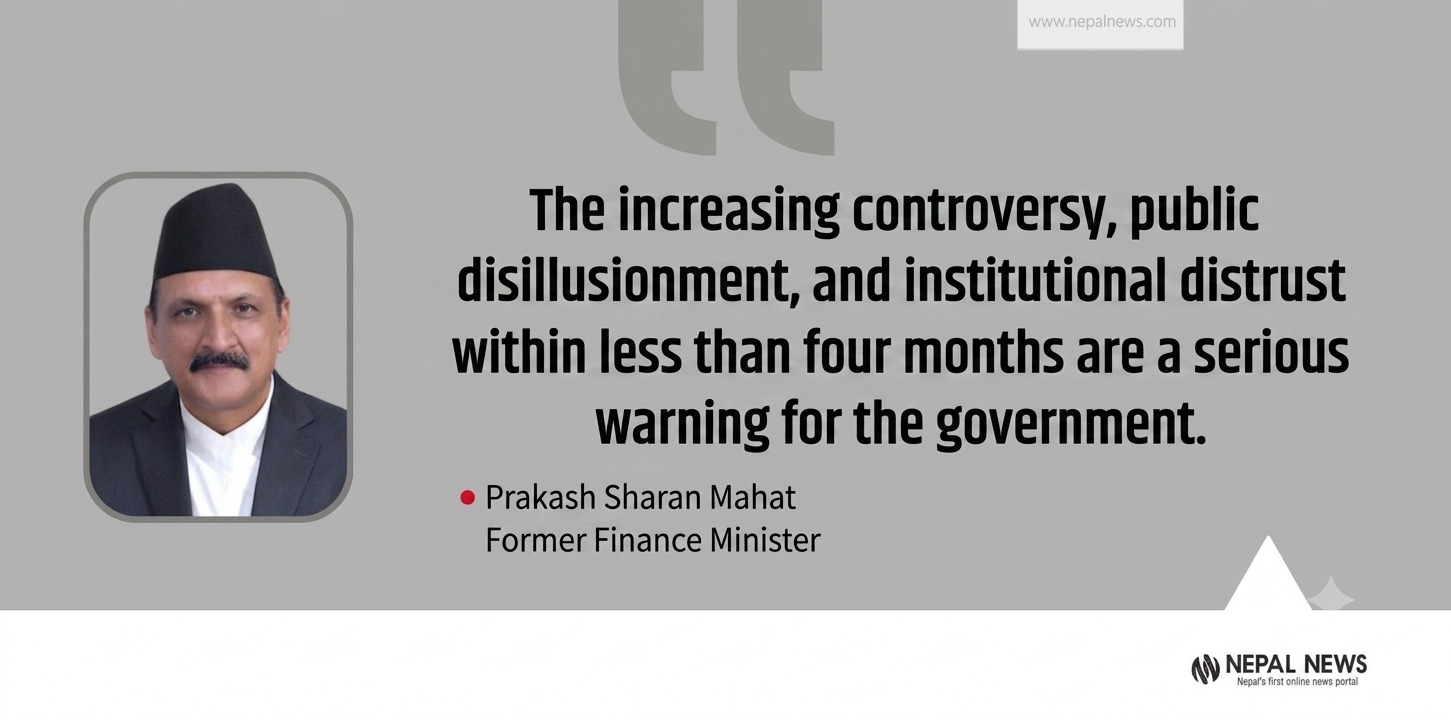
KATHMANDU: The current government is failing to work in a mature manner. The Rastriya Swatantra Party won the election by making good governance its primary slogan, and the present government was formed on the strength of that public mandate. However, the very foundation of good governance is the rule of law and strict compliance with the law.
Those currently in power seem to hold a mindset that only they know what is best for the country and its people, and that whatever they deem right is correct. Operating under such a mindset carries a risk of bypassing legal procedures.
Just because the government claims to have good intentions does not guarantee that the outcome will also be positive. If the process is not lawful, even well-intentioned actions can produce adverse results. Therefore, the government must implement its policies and programs while abiding by the law. However, the government currently does not appear to be walking that path.
To establish good governance, legal procedures, evidence, and institutional dignity must be prioritized. Actions should not be initiated on the grounds of political bias or retribution. Where there are sufficient grounds and evidence, action should be taken according to the law. But if an intent to harass anyone without grounds or evidence becomes apparent, it naturally raises questions about the government.
Certain individuals in government exhibit a mindset focused on “settling scores” with older political parties. Under that influence, suspicions have arisen that proceedings are being pushed forward even in matters lacking sufficient legal basis and evidence. Such a style is neither conducive to good governance nor compatible with the democratic system.
Middle and lower-middle classes neglected
The government’s budget and economic operating style have created hardship for the lower-middle and middle classes. The government has paid insufficient attention to their daily needs, income status, and rising expenses.
The government appears to hold the belief that once the sentiments of the upper economic class are addressed, investment will automatically increase and generate employment. However, an economy does not function solely in that manner. Long-term results can be achieved only when the interests of all classes and groups are addressed in a balanced way. Global economic experience has consistently demonstrated this reality.
Even the budget presented by the government failed to remain free from controversy. Questions were raised from the outset regarding the public’s expectations of the budget. Issues surrounding the lack of transparency in budget formulation and related decisions have entered public debate. The weakening credibility of the budget is not a good signal for the economy.
The government’s attention should be directed toward programs through which the public feels direct relief, job creation, price control, and public service delivery improvements. However, concrete plans to translate such matters of public concern into practice are lacking.
Regarding the issue of landless settlers, the government has failed to show sensitivity. Rather than identifying genuine landless settlers and managing their settlement or arranging alternative housing, merely evicting them cannot be a solution. Leaving them stranded after offering assurances of alternative management is an even more irresponsible move.
Caution required on foreign debt
Another serious issue at present is foreign debt. The current government has accelerated the pace of taking on foreign debt. Parties currently in power previously opposed foreign borrowing, arguing that debt was becoming excessive. However, upon assuming power, they appear inclined to bring in debt at an even greater pace than before.
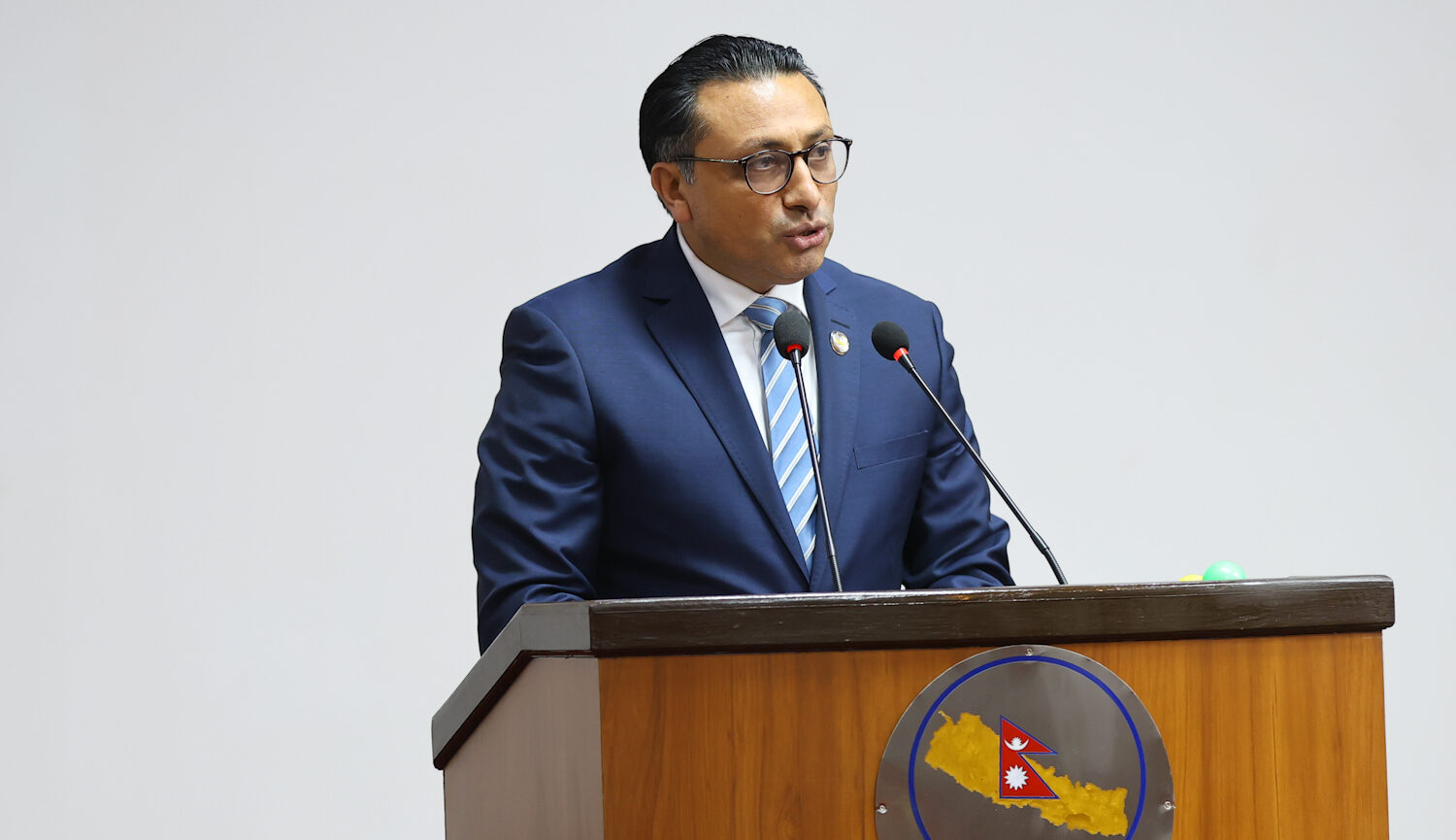
Finance Minister Swarnim Wagle
During my tenure as Finance Minister, decisions were made to decline certain loans and review several loan proposals. Taking loans is not inherently wrong. However, an evaluation is mandatory regarding whether that debt is necessary, under what terms it is being taken, how much return it will yield, and what the repayment capacity looks like.
At present, there seems to be a rush to bring in foreign loans without adequate review of necessity and conditions. Such a trend risks increasing the debt burden in the future and triggering serious economic problems. Foreign loans should be taken solely for productive sectors, with clear returns, and based on national necessity.
Distrust in state organs
The government has failed to build confidence with the administrative mechanism and other state structures. Instead of taking the bureaucracy into confidence and delegating work with clear responsibilities and trust, the government’s relationship with it remains weak.
The government is getting work done through subordinate structures, but its failure to build trust has led to persistent problems in decision implementation. Effective governance is impossible when the administrative apparatus is kept under fear, pressure, or distrust.
The government also appears to be heading in the wrong direction regarding the appointment of advisors and aides. Appointments must be based on merit, capability, and institutional need. When appointments are made on the basis of personal proximity or political convenience, both the operational capacity and credibility of the government are compromised.
Constitutional bodies are not subordinate to the government. Those organs must be allowed to function independently according to the Constitution and the law. If the executive attempts to curb them, their independent status is undermined. From the perspective of good governance, that represents a serious deviation.
Certain activities and details made public regarding the government and the Prime Minister’s Office also appear inconsistent with the dignity of the office. If such matters are treated lightly, even greater institutional problems could arise in the future.
Lack of balance in diplomacy
The balance that the government should maintain in foreign relations is also missing. For a country like Nepal, diplomatic proactiveness, credibility, and balanced relations are crucial. However, the government’s performance in this area remains weak.
In international relations, even a small oversight can have long-term repercussions. Therefore, the government must prioritize the national interest over immediate political gains. Clarity and balance are necessary in relations with neighboring nations, development partners, and other international powers.
The government has also not presented itself with adequate preparation regarding the heightened tensions in the Middle East and the potential inflation, fuel supply disruptions, and commercial impacts stemming from them. Plans for alternative supplies, price controls, and market management should be formulated before problems arise. However, the government lacks concrete, actionable plans.
Growing disillusionment
Less than four months since the formation of the government, widespread criticism, controversial decisions, public disillusionment, and numerous questions arising do not constitute an encouraging sign.
Raising the slogan of good governance and maintaining good governance in practice are two different things. A tendency to ignore the strict letter of the law, undermine the dignity of state institutions, and advance proceedings without evidence does not establish good governance. Instead, it further weakens the state of governance.
The government must correct its working style immediately. It must place the rule of law at the center and take the administrative mechanism into confidence. It must balance the interests of all classes in its budget and economic policies. When taking foreign loans, a rigorous review of necessity and return must be conducted. The independence of constitutional bodies must be respected, and a mature, balanced policy must be adopted in foreign relations.
The government still has time to make improvements. However, for that to happen, it must abandon the mindset that only what it deems right is correct, and instead prioritize the law, institutional procedures, and public accountability. The first condition of good governance is the rule of law. Any claim to good governance that ignores this principle will lack credibility.
(Based on a conversation between former Finance Minister and Nepali Congress leader Prakash Sharan Mahat and Shambhu Regmi.)