Kathmandu
Monday, June 8, 2026





From the launch of Mero Mobile in 2005 to the ongoing Smart Telecom investigation, a chronology of the ownership disputes, tax battles, regulatory controversies and criminal probes that have shaped Nepal’s largest private telecom operator

KATHMANDU: When Spice Nepal launched mobile services under Mero Mobile brand in 2005, it cracked open a market that Nepal Telecom had monopolized for decades.
What followed over two decades was not merely a corporate success story but a sustained entanglement of political patronage, opaque ownership transfers, tax evasion, and ultimately a criminal conspiracy in which a defunct telecom company’s state-owned assets were quietly funneled to Nepal’s dominant private operator through a rigged bank auction.
TIMELINE
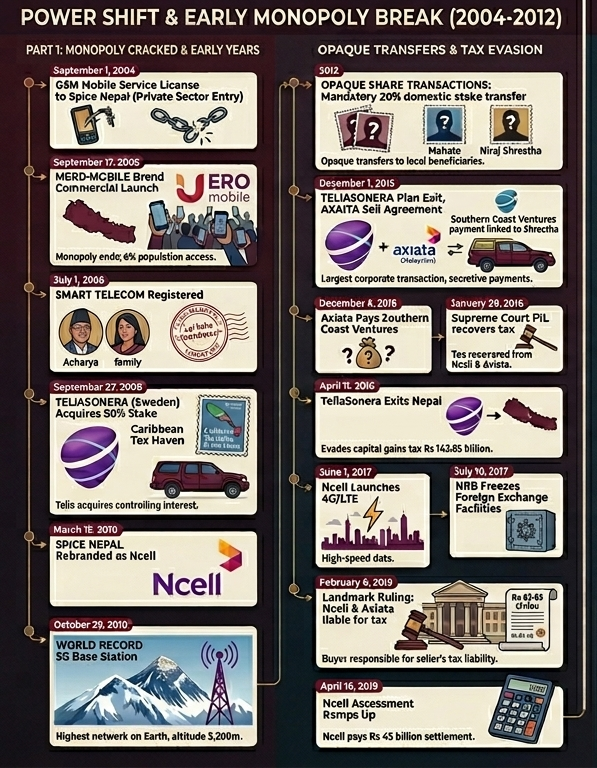
September 1, 2004: Spice Nepal Private Limited is registered and issued a GSM cellular mobile service license by the Nepal Telecommunications Authority. This marks the entry of the first private sector telecom operator in Nepal, breaking the state’s absolute monopoly over mobile communications.
September 17, 2005: Spice Nepal commercially launches mobile services under the brand name ‘Mero Mobile’ in Kathmandu, becoming Nepal’s first privately operated GSM service. At the time, only six percent of Nepal’s population has access to mobile phones.
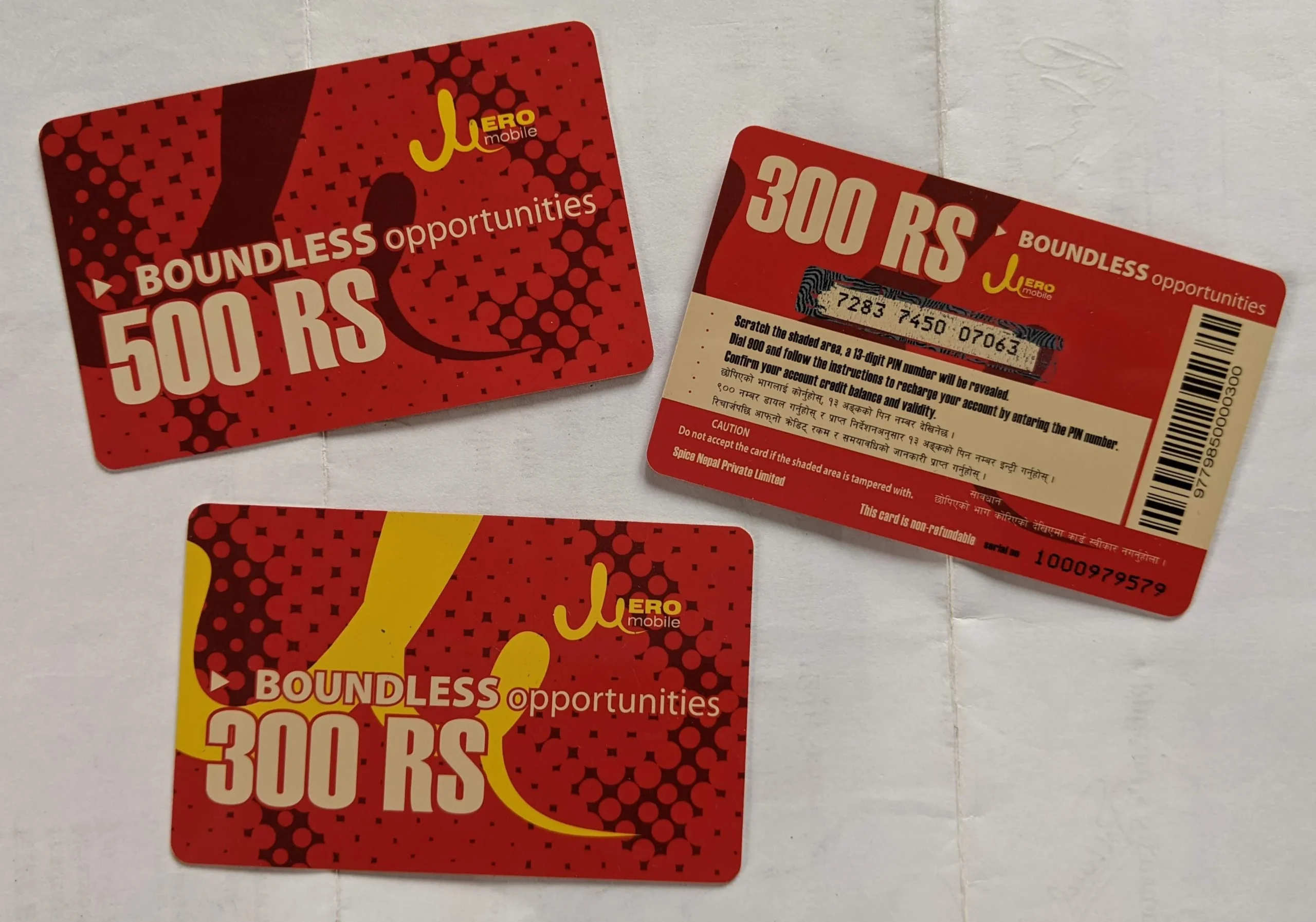
Recharge card of Mero Mobile. Photo courtesy: Reddit
July 1, 2008: Smart Telecom Private Limited is formally registered in Nepal. The company is co-founded by Sachin Lal Acharya, who serves as founding chairman, and Satish Lal Acharya, who holds shares through Singapore-registered Lal Sahu Distributors Private Limited. This company will later control 70 percent of Smart Telecom.
September 26, 2008: Satish Lal Acharya chairs Applifone in Cambodia, a company that becomes controlled by Telia between 2008 and 2010 before being merged into another Cambodian company called Latelz. These early corporate links between the Acharya family and Telia’s global network will later become central to investigative findings.
September 27, 2008: Swedish telecommunications giant TeliaSonera acquires a controlling 80 percent interest in Spice Nepal, outright buying into Nepal’s private telecom market. Reynolds Holdings, a subsidiary registered in Saint Kitts and Nevis, a Caribbean tax haven, is the holding vehicle for this 80 percent stake.
March 12, 2010: Spice Nepal is formally rebranded as Ncell following TeliaSonera’s takeover. The brand name change reflects the company’s ambition to position itself as Nepal’s leading private mobile operator.
October 29, 2010: Ncell installs a 3G base station near the Everest Base Camp at an altitude of 5,200 meters, setting a world record and becoming the highest-altitude 3G network on earth. The company by this point has extended coverage to all regions of Nepal.
2012: According to subsequent investigative reporting, local Nepali investors begin acquiring the mandatory 20 percent domestic stake in Ncell through a series of opaque share transactions. Upendra Mahato, Niraj Govinda Shrestha, and entities connected to Bhawana Singh Shrestha, wife of Satish Lal Acharya, are among the primary beneficiaries during this period.
April 15, 2013: Smart Telecom officially launches mobile services under the SmartCell brand after receiving a unified telecommunications license from the NTA. Sachin Lal Acharya chairs the company and Satish Lal Acharya holds shares through his Singapore company. Smart Telecom is Nepal’s third mobile operator.
December 1, 2015: TeliaSonera announces its planned exit from Nepal. The Swedish company signs an agreement to sell its 60.4 percent stake in Reynolds Holdings, which owns 80 percent of Ncell, to Malaysian telecommunications conglomerate Axiata Group Berhad at an enterprise value of USD 1.03 billion, the largest corporate transaction in Nepali history. Around the same time, records show Axiata pays USD 90 million to a secretive offshore company called Southern Coast Ventures, a payment that investigators later link to Bhawana Singh Shrestha’s vehicle, Sunivera Capital Ventures, through her husband Satish’s corporate connections.
December 8, 2015: Days before the Axiata-Sunivera partnership formalizes, Axiata pays the USD 90 million to Southern Coast Ventures. The connection between this payment and the subsequent Sunivera-Axiata share arrangement will later be the subject of an investigative journalism report by CIJ-Nepal and Finance Uncovered.
December 15, 2015: Bhawana Singh Shrestha’s Sunivera Capital Ventures signs a share agreement with Axiata to co-hold the 20 percent domestic stake in Ncell. This arrangement effectively places the Acharya family as Nepal’s representative local partner in the country’s largest private telecom company.
January 26, 2016: Nepal’s parliamentary committee formally asks for responses from the Inland Revenue Department, the Department of Industry, the Ministry of Information and Communication, and the NTA regarding the capital gains tax implications of the TeliaSonera-Axiata deal.
January 28, 2016: A public interest litigation is filed in the Supreme Court by former government secretary Dwarika Nath Dhungel and six others, demanding that capital gains tax be recovered from Ncell and Axiata on the TeliaSonera share sale.
Building of axiata
April 11, 2016: TeliaSonera completes the sale of Reynolds Holdings to Axiata, officially transferring 80 percent ownership of Ncell. TeliaSonera exits Nepal without paying any capital gains tax on the transaction, which Nepal’s Large Taxpayers’ Office later calculates generated capital gains of approximately Rs 143.65 billion.
April 13, 2016: Axiata formally takes charge of Ncell from TeliaSonera. Nepal’s Large Taxpayers’ Office subsequently writes to Axiata and Ncell demanding payment of the capital gains tax that TeliaSonera had evaded. Axiata disputes liability.
January 28, 2017: The Supreme Court PIL formally registers the petition demanding capital gains tax from Ncell and Axiata.
June 1, 2017: Ncell formally launches 4G/LTE services across the Kathmandu Valley, including Nagarkot, Banepa, and Dhulikhel. This marks the commercial beginning of high-speed mobile data in Nepal’s capital.
July 10, 2017: Based on letters from the Large Taxpayers’ Office, the Nepal Rastra Bank issues directives to all banks and financial institutions prohibiting them from providing foreign exchange facilities to Ncell, Axiata, and Reynolds Holdings.
Around 2017: Nepal Investment Mega Bank and Prime Commercial Bank begin extending loans to Smart Telecom, ultimately providing a total consortium credit of Rs 5.20 billion covering overdraft facilities, letters of credit, and long and short-term loans.
December 24, 2017: A Supreme Court bench of Justices Om Prakash Mishra and Kedar Prasad Chalise issues an order allowing the repatriation of Ncell profits, stating that obstruction of dividend repatriation would harm the company and its shareholders. This order effectively lifts the NRB restriction imposed earlier in the year.
February 6, 2019: The Supreme Court’s extended full bench, headed by Chief Justice Cholendra Shumsher Rana and including Justices Meera Khadka, Bishwambhar Shrestha, Ananda Mohan Bhattarai, and Tanka Moktan, issues a landmark ruling ordering Ncell and Axiata to pay the capital gains tax liability that TeliaSonera had left behind. The court reasons that since TeliaSonera had already exited Nepal, the buyer is responsible for settling the seller’s unpaid tax obligations.
April 9, 2019: The full text of the Supreme Court’s February 6 mandate is publicly released, ordering the government to recover the tax from Ncell and Axiata within three months. This triggers the Large Taxpayers’ Office to begin formal demand proceedings.
April 16, 2019: The Large Taxpayers’ Office formally determines the combined capital gains tax liability of Ncell and Axiata at Rs 62.63 billion, including accumulated interest. Since Ncell had already paid Rs 23.57 billion, the office orders payment of the remaining Rs 39.06 billion within one week.
April 22, 2019: Ncell moves the Supreme Court claiming the tax assessment was made without due process and that its outstanding liability stands at only Rs 14.36 billion, triggering a further legal dispute over the exact amount owed.
May 2019: Axiata takes Nepal to the International Centre for Settlement of Investment Disputes (ICSID), claiming Nepal violated the bilateral investment promotion and protection agreement signed between Nepal and the United Kingdom in 1993. Axiata argues the investment dispute must be settled under British jurisdiction because Reynolds Holdings was a British Virgin Islands entity.
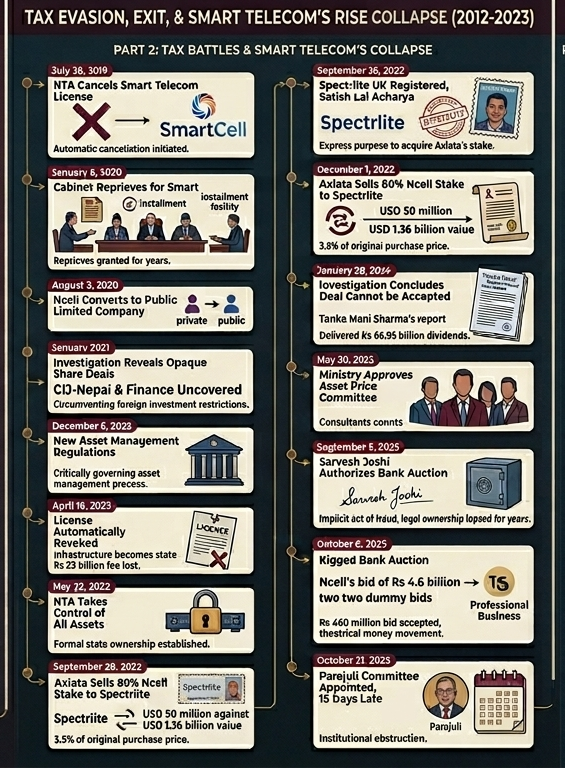
July 28, 2019: The Nepal Telecommunications Authority moves to cancel Smart Telecom’s operating license. At this point the company owes approximately Rs 2.32 billion in outstanding dues to the government. The NTA formally initiates cancellation proceedings.
August 30, 2019: Some sources indicate the NTA formally issues the license cancellation order against Smart Telecom, though the company immediately obtains a court stay blocking implementation. A legal battle over the cancellation begins.
January 6, 2020: A cabinet meeting under then-Prime Minister KP Sharma Oli overturns the NTA’s cancellation decision and grants Smart Telecom an installment facility for its outstanding dues. The government specifies the amounts: Rs 598.80 million for the first installment, Rs 832.30 million for the second, Rs 774 million for the third, Rs 715.6 million for the fourth, and Rs 657.2 million for the fifth. This is the first of four cabinet-level reprieves that Smart Telecom will receive.
April 2020: Ncell reportedly pays a further portion of the capital gains tax settlement, closing out a portion of the dispute. The combined total eventually paid reaches approximately Rs 45 billion, ending that phase of the tax controversy.
August 3, 2020: Ncell is converted from a private limited company to a public limited company, with its name changing to Ncell Axiata Limited. This structural change is made in anticipation of future regulatory requirements.
September 14, 2020: The Oli-led government grants Smart Telecom a second extension, providing an additional six months to deposit its outstanding dues. This is despite the company’s failure to pay a single installment under the January 2020 arrangement.
January 2021: The Centre for Investigative Journalism-Nepal and British outlet Finance Uncovered publish a landmark investigation revealing opaque share deals in Ncell’s 20 percent domestic ownership. The investigation identifies Upendra Mahato, Niraj Govinda Shrestha, and Bhawana Singh Shrestha as primary beneficiaries. Most critically, the investigation finds that Axiata paid 90 million US dollars to Southern Coast Ventures, an entity connected to the Acharya family, shortly before Sunivera formally purchased the 20 percent Ncell domestic stake, raising accusations that foreign money funded the mandatory local shareholding to circumvent Nepal’s foreign investment restrictions.
March 14, 2021: The cabinet under then-PM Oli grants Smart Telecom a third deadline extension, now pushing the repayment facility into the year 2021. Smart Telecom has still not paid any meaningful amount toward its total liabilities.
July 12, 2021: The cabinet grants Smart Telecom a fourth and final deadline extension, giving the company until mid-January 2022 to clear its dues. This is the last government lifeline Smart Telecom receives before its automatic cancellation.
December 5, 2022: The Telecommunications Service Provider Asset Management Regulations, 2022 are published in the Nepal Gazette by the then Sher Bahadur Deuba government. This regulation, the first of its kind in Nepal, is enacted specifically to govern the asset management process of companies like Smart Telecom whose licenses are not valid. Critics and investigators later allege the regulation was deliberately designed to facilitate the eventual transfer of Smart Telecom’s assets to a buyer, and that key provisions beneficial to service providers were inserted that were absent from the NTA’s original draft.
March 31, 2023: Reports emerge that the Ministry of Communication and Information Technology has prepared a draft bill to amend the Telecommunications Act in ways that would prevent the government from taking ownership of Ncell after its 25-year license expires in 2029. Analysts and MPs allege the bill is being shaped by vested interests connected to both Ncell and Smart Telecom’s owners.
April 15, 2023: Smart Telecom’s 10-year license, issued on April 15, 2013, reaches its expiry date. The company has failed to submit a valid renewal application or pay any portion of the Rs 23 billion renewal fee. The previous court stay order has lapsed.
April 16, 2023: Smart Telecom’s operating license is automatically revoked. Under the Telecommunications Act, 1997, and the Asset Management Regulations, 2022, all of Smart Telecom’s physical infrastructure, towers, network equipment, and systems legally become the property of the Government of Nepal at the moment of cancellation.
May 5, 2023: The NTA issues its first call for Expressions of Interest for a five-member asset valuation committee to assess Smart Telecom’s assets, as required under the 2022 regulations. The application process is the first step toward a government-managed orderly auction.
May 22, 2023: The NTA issues a formal public notice declaring that it has taken control of all assets, infrastructure, networks, and equipment of Smart Telecom. This notice functions as the definitive legal marker establishing state ownership over Smart Telecom’s physical assets.
May 19, 2023: The NTA republishes its Expression of Interest notice after citing insufficient applications in the first round.
June 23, 2023: The NTA issues a third call for qualified consultants for the asset valuation committee, again citing inadequate responses. The repeated failures to constitute the committee will later be seen as a sign of deliberate obstruction.
September 2023: The NTA issues a fourth and final call for Expressions of Interest for the asset valuation committee. Names of five qualified consultants and alternates are eventually selected and recommended to the Ministry of Communication and Information Technology. The Ministry takes no action on this recommendation for months.
September 26, 2023: Spectrlite UK Limited is registered in the United Kingdom. The company is incorporated in the name of Satish Lal Acharya, a Singapore citizen of Nepali origin and husband of Bhawana Singh Shrestha, who holds the 20 percent domestic stake in Ncell through Sunivera Capital Ventures. Spectrlite has essentially no business history and was formed with the express purpose of acquiring Axiata’s 80 percent stake in Ncell.
November 29, 2023: Axiata Group Berhad publicly announces its decision to exit Nepal, citing a challenging investment climate. Axiata says it will divest all its holdings in Ncell and invests the narrative that Nepal’s regulatory environment has become untenable for foreign investors.
December 1, 2023: Axiata officially announces that it has signed an unconditional sale and purchase agreement with Spectrlite UK Limited for the sale of Reynolds Holdings Limited, which holds approximately 80 percent of Ncell’s equity. The declared purchase price is USD 50 million, a figure that represents roughly 3.5 percent of the USD 1.36 billion Axiata had paid for the same stake in 2016. The NTA is not consulted or informed in advance, despite telecommunications regulations requiring prior NTA approval for any share transfer exceeding 5 percent of paid-up capital.
December 2, 2023: Axiata confirms completion of the sale transaction. The NTA immediately demands an explanation from Ncell, calling the process a violation of the prior-approval requirement under the Telecommunications Regulation, 1997.
December 5, 2023: Kathmandu Post reports the NTA has formally written to Ncell and Axiata demanding details of the sale agreement. The then NTA chairperson Purushottam Khanal publicly states the authority had not been informed of the deal and that prior regulatory approval was mandatory.
December 7, 2023: The Pushpa Kamal Dahal cabinet forms a five-member high-level investigation committee under former Auditor General Tanka Mani Sharma to examine the Ncell share sale. Members include Secretary Phanindra Gautam, Joint Secretaries Baburam Bhandari and Ritesh Kumar Shakya, and Nepal Chartered Accountants Association president Sujan Kumar Kafle. The committee is given 30 days to submit a report.
December 7, 2023: Nepal’s parliamentary State Affairs and Good Governance Committee directs the government not to approve the Ncell sale until the investigation committee’s findings are complete. The committee writes to the Office of the Prime Minister, Finance Ministry, Ministry of Communication and Information Technology, and the Ministry of Industry, Commerce and Supply.
December 18, 2023: The NTA formally instructs Ncell to submit complete details of the sale and purchase agreement, marking the third time the authority has formally demanded documentation.
December 19, 2023: The parliamentary State Affairs Committee formally directs against approving the Ncell deal, reinforcing the earlier instruction.
January 29, 2024: The Tanka Mani Sharma investigation committee submits its report to Prime Minister Pushpa Kamal Dahal. The committee concludes the sale between Axiata and Spectrlite UK cannot be accepted as it stands. Key findings include that the deal was not conducted at arm’s length, that the seller Axiata is set to continue receiving dividends from Ncell until 2029 despite selling its stake, that between its founding and fiscal year 2022-23 Ncell had sent abroad Rs 66.95 billion in dividends against confirmed foreign investment of only Rs 8.2 million, meaning dividend repatriation had exceeded verified foreign investment by 825 times, and that the group behind Smart Telecom’s collapse and the group that acquired 80 percent of Ncell are one and the same family.
February 18, 2024: A cabinet meeting officially decides not to honor the Axiata-Spectrlite share purchase agreement. The cabinet also decides that Ncell Axiata’s tax audit for fiscal years 2019-20 and onwards must be completed by the Internal Revenue Department and that outstanding tax liabilities must be determined and collected.
March 2024: Spectrlite UK submits a formal request for approval of the ownership transfer to the NTA. Despite this submission, the NTA takes no decision on the application, leaving the transaction in regulatory limbo. Legally, the company continues to be registered as Ncell Axiata Limited.
April 29, 2024: The government publicly announces its decision to take ownership of Ncell’s assets after the company’s 25-year license expires in 2029. Under Section 33 of the Telecommunications Act, 1997, the government has the right to seize the land, buildings, devices, equipment, and infrastructure of any telecommunications company with more than 50 percent foreign investment after its license period ends.
May 27, 2024: Ncell pays Rs 4 billion toward its Rs 20 billion license renewal fee, three months before the license expiry deadline of August 31, 2024. The company formally requests an installment plan for the remaining Rs 16 billion.
August 30, 2024: The Ncell license, which had been running since September 1, 2004, is renewed by a cabinet decision for the final five-year period through August 2029. The renewal includes Rs 20 billion in fees to be paid in installments with 10 percent interest. Critically, the cabinet imposes a condition freezing Ncell’s ownership structure for the renewal period, prohibiting any share sales or transfers, effectively blocking formal recognition of the Spectrlite purchase. Legal analysts later argue this condition conflicts with the 2022 Asset Management Regulations which had allowed share transfers up to three years before license expiry.
May 30, 2025: The Ministry of Communication and Information Technology approves the formation of a five-member asset price determination committee for Smart Telecom’s assets, headed by NTA official Rajesh Parajuli. This committee is supposed to provide the formal government valuation that would precede any auction of Smart Telecom’s assets. The NTA is required to notify Parajuli and direct the committee to begin work.
September 5, 2025: Sarvesh Joshi, then-Chairman and Managing Director of Smart Telecom, writes a formal letter to Nepal Investment Mega Bank explicitly authorizing and requesting the bank to proceed with auctioning Smart Telecom’s assets to recover its outstanding loans. Investigators later identify this letter as a pivotal act of fraud: Joshi signs it at a time when Smart Telecom has had no legal ownership of those assets for over two years.
September 19, 2025: Nepal Investment Mega Bank publishes a 35-day public auction notice for Smart Telecom’s assets. The bank acts as the lead creditor of a consortium that extended Rs 5.20 billion in loans to Smart Telecom, and it proceeds without informing or seeking permission from the NTA.
September 29, 2025: According to banking records cited in the investigation, Ncell deposits the final payment for Smart Telecom’s assets within the bank’s stipulated 14-day period, and Smart Telecom’s loan account at NIMB is officially closed.
October 5, 2025: A person named Khumnath Adhikari opens a new bank account one day before the auction. On this date, Narendra Ulak transfers Rs 42.5 million into the account. CIB investigators later argue this money movement was designed to manufacture the appearance of a competitive bidder.
October 6, 2025: The auction is held. Three companies submit bids. Transtech Company, operated by Palina Shrestha, bids Rs 450 million. Professional Business Network bids Rs 420 million. Ncell Axiata Private Limited bids Rs 4.6 billion, which is accepted. Between 11:08 AM and 2:05 PM on this date, Rs 2.5 million of the money transferred into Adhikari’s account is returned, a three-hour transaction cycle investigators later describe as theatrical money movement designed to simulate genuine competitive participation.
October 6, 2025: The bank formally notifies both Ncell and Smart Telecom that Ncell’s bid of Rs 460 million has been accepted. Government asset valuation committees, working independently, later estimate the physical market value of the auctioned assets at approximately Rs 40 million, meaning Ncell paid roughly eleven times the government’s own estimate.
October 21, 2025: The NTA finally delivers the formal letter of appointment to Rajesh Parajuli, notifying the asset valuation committee of its mandate. This letter arrives 15 days after Ncell had already purchased the assets. Investigators treat this four-month gap between the May 30 ministerial approval and the October 21 delivery as deliberate institutional obstruction, not bureaucratic delay.
December 30, 2025: Ncell applies to the NTA for permission to integrate Smart Telecom’s purchased equipment and infrastructure into its own network, seeking the operational benefits it paid Rs 460 million to obtain.
January 7, 2026: Ncell CEO Michael Foley submits a formal letter to the Sushila Karki-led government requesting resolution of the company’s future after its license expires in 2029. The letter raises the possibility of an IPO and commitments to 5G investment if continuity is guaranteed. Ncell argues it has paid over Rs 320 billion in total taxes since its founding.
March 9, 2026: The NTA formally denies Ncell’s December 30 application to use Smart Telecom’s auctioned equipment, citing the legally contested nature of the asset transfer. This means Ncell has paid Rs 460 million for infrastructure it cannot legally deploy.
May 4, 2026: The CIB arrests Sarvesh Joshi, former Chairman and Managing Director of Smart Telecom, from his residence at Khursanitar, Kathmandu, acting on an arrest warrant issued by the Kathmandu District Court. He is charged with fraud and criminal breach of trust for authorizing the auction of assets he had no legal right to transfer. This is the first major arrest in the case.
May 12, 2026: The CIB locates and arrests Jyoti Prakash Pandey, CEO of Nepal Investment Mega Bank, from Kamalamai Municipality Ward 6 in Sindhuli district. Pandey had reportedly switched off his phone and cut contact with investigators. The Sindhuli District Police Office assists in the operation. He is brought to Kathmandu on charges of fraud, criminal breach of trust, and organized crime as chairman of the bank’s loan recovery committee, the body that authorized and executed the auction.
May 13, 2026: Pandey is formally presented before investigators in Kathmandu. This arrest triggers an immediate and public reaction from the Nepal Bankers Association and the broader financial sector, which describes it as a dangerous precedent threatening the legal framework for bank loan recovery.
May 14, 2026: The CIB conducts a formal raid on Ncell’s corporate headquarters at Nakkhu, Lalitpur, and seizes key documents related to the Smart Telecom transaction, including internal correspondence, ownership transfer records, and financial documents. The bureau simultaneously requests additional documents from Ncell’s corporate office.
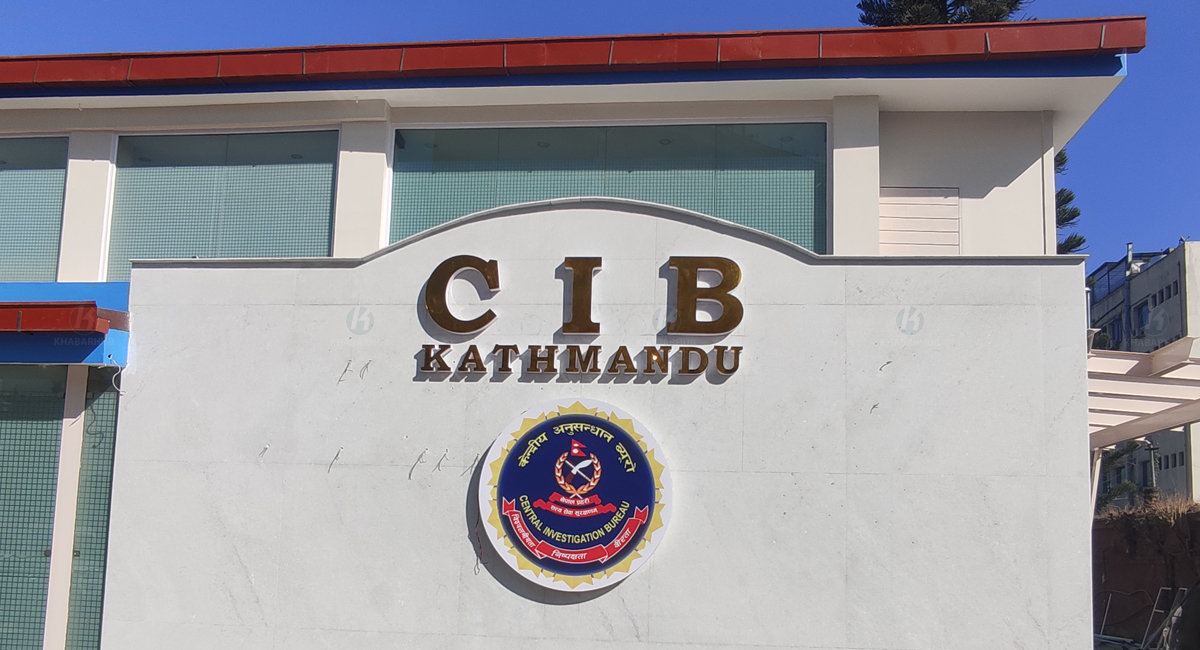
May 14, 2026: The CIB also arrests Palina Shrestha, operator of Transtech Company, one of the alleged dummy bidders that submitted an artificially low Rs 450 million bid at the October 6, 2025 auction. Narendra Ulak, linked to the financial transactions surrounding the auction process, is also arrested separately.
May 15, 2026: A division bench of the Supreme Court consisting of Justices Saranga Subedi and Shanti Singh Thapa orders the release of Jyoti Prakash Pandey from custody, ruling there is no need to detain him for the investigation to continue. The court releases him on personal recognizance and bars him from foreign travel without court permission. The Supreme Court’s reasoning, that the bank’s loan recovery constituted a banking process, is seized upon by bankers as vindication.
May 15, 2026: On the same date as Pandey’s release, Ncell CEO Michael Foley signs and dispatches a formal letter to NIMB demanding either immediate transfer of the auctioned Smart Telecom assets to Ncell’s possession or a full refund of the Rs 460 million it paid in October 2025. CIB investigators and legal analysts point to this letter as an implicit acknowledgment by Ncell that the auction process may not have been legally sound.
May 2026: Joshi, Palina Shrestha, and Narendra Ulak are released after courts deny police requests for extended remand. The CIB spokesperson Shiva Kumar Shrestha publicly states that release from custody does not mean release from investigation and that the probe is continuing.
June 2026: The CIB investigation remains active across multiple tracks. The criminal track continues against all four released individuals. The Acharya family, specifically Satish Lal Acharya, Sachin Lal Acharya, and Bhawana Singh Shrestha, remain under the CIB scanner but have not been formally arrested. Sources indicate Satish and Bhawana have been unreachable since the investigation focused on Ncell.
CIB Chief Manoj KC has publicly stated that Ncell’s board-level authorization for the asset purchase is a central focus of ongoing evidence gathering. The NTA has simultaneously confirmed it will not permit Ncell to use the disputed equipment until legal questions are resolved.
The constitutional validity of the 2022 Asset Management Regulations, the unresolved Spectrlite-Axiata ownership transfer, the pending capital gains tax questions from that share sale, and the broader question of Ncell’s future beyond 2029 all remain open, making this simultaneously the largest regulatory, corporate, and criminal case in Nepal’s telecom history.