Kathmandu
Monday, July 27, 2026





Which is More Valuable for Tribhuvan University: Collecting Rs 2 Billion from Non-Returning Scholars, or Retaining Hundreds of Scientists?
KATHMANDU: Typically, universities dominate headlines for their academic breakthroughs. However, universities in Nepal are more frequently recognized for leadership disputes, property conflicts, student strikes, and faculty politics. Tribhuvan University (TU), the backbone of Nepal’s higher education system, is currently at the center of a national media storm. Around 400 professors and staff members who left on official study leave have failed to return from abroad, prompting the university administration to take strict measures to recover the invested funds along with accrued interest.
From a legal standpoint, this move is entirely justified. The state made significant investments in these academics based on employment agreements, and those who breached these contracts must be held accountable. Yet, a critical question is being left out of the national discourse: Why didn’t they return? And an even larger question looms before us: Is recovering Rs 2 billion really the best asset Nepal can gain from them?
Why Didn’t They Return?
In December 2024, during the administration led by KP Sharma Oli, the TU Executive Council formed an investigation committee to look into the misuse of study leaves. According to the committee’s report, there are 191 faculty members who failed to report back for duty after their leave expired, and another 207 who took leave but never completed their intended degrees. These untraceable academics owe TU anywhere from a minimum of Rs 1 million to a maximum of Rs 5 million per person under university regulations. Since the probe began, a few professors have made contact and reimbursed their salaries and allowances.
Ever since the investigation committee was formed, the entire conversation has revolved purely around money. There has been virtually no coverage of any politician—veteran or newcomer—TU leader, civil society member, or stakeholder asking or trying to comprehend why these professors chose to stay abroad. Those who are attempting to explain their side are on the defensive, and their voices have failed to break into the main news cycle or reach policy-making circles.
Though overlooked by the media, research indicates three clear, primary reasons why these professors choose not to return from abroad:
face severe hurdles regarding the recognition and equivalence of their foreign degrees. Although reforms implemented last year provided some relief, the problem remains unresolved. Nepalese academic institutions routinely fail to properly recognize high-level degrees and certificates earned through years of hard work abroad. This leaves returning scholars with deep uncertainties regarding their professional futures.
Bureaucratic bottlenecks plague the system. Professors frequently face situations where study leaves take years to get approved, programs run slightly longer than expected, or essential leave extensions are denied. This traps them in a moral and administrative catch, where returning means sacrificing everything they have built, while staying makes them look like offenders. They are trapped by the system, not by greed. The door to leave was wide open, but the door to return was made incredibly difficult.
This group consists of individuals who made a deliberate, long-term choice to stay abroad due to world-class research environments, access to advanced laboratories, opportunities to collaborate with peer scientists, academic freedom, merit-based promotions, and highly competitive salary packages.
The Overlooked Equation
Thousands of Nepalese scientists and academics currently abroad who genuinely wish to return home are closely watching this aggressive fund-recovery campaign. They observe:
“Even those who hold permanent tenure at TU and have former colleagues looking out for them are facing legal prosecution instead of a welcoming environment. If we go back under these circumstances, we would have to start from scratch. The country lacks both the resources, the environment, and the professional respect required for serious research.”
These scholars are constantly asking their families and peers, “Is it really a wise decision for me to return to Nepal?”
The current system gives a clear answer: “The time is not yet right; the country is still not ready to host scientists.” The advice they receive from family and friends echoes this sentiment. Among those who did choose to return, many express deep regret, and some have already packed their bags to head back abroad.
What Global Experience Teaches Us?
The issue of academics failing to return from study leave is by no means unique to Nepal. Developing countries across Asia, Africa, and Eastern Europe have long grappled with the phenomenon of state-funded scholars settling abroad. Most of these nations initially resorted to legal prosecution and financial penalties, just as TU is doing now. However, the countries that eventually realized this was the wrong tool for the job reformed their approaches and turned the situation into an engine for national development. Those that failed to see this are still struggling with the same problem.
After losing a vast pool of scientists and high-potential talent, China imposed massive financial deposits and steep fines on departing academics in the 1990s. Recognizing that this did not yield the desired results, Beijing pivoted away from ‘punishment’ and toward attraction. They offered state-of-the-art laboratories and highly attractive salaries through initiatives like the ‘Thousand Talents Plan’, alongside research autonomy. The results are clear: thousands of scientists returned. Today, China leads the world in manufacturing, Artificial Intelligence (AI), and semiconductors. It now designs programs to attract not just its own diaspora, but top global scientists as well—including several Nepalese scientists currently working there under these very schemes.
Starting in the 1960s, India enforced a policy similar to Nepal’s current approach, demanding the repayment of principal amounts with heavy interest. Despite this, 73% of researchers who went abroad never returned. Aggressive fund recovery failed to stem the ‘brain drain’ for decades. It was only after the economic liberalization and massive infrastructure developments of the 1990s that Indian scientists began returning in droves. Today, India uses a dual strategy: while it terminates the service and freezes the pensions of non-returning staff, it simultaneously treats their knowledge as a national asset. Rather than merely squeezing them for cash, India focuses on connecting them with domestic university students for knowledge transfer. Through high-prestige initiatives like the VAIBHAV and Ramanujan Fellowships, returning researchers are offered monthly salaries of up to INR 400,000.
The ‘KIST Model’ (Korea Institute of Science and Technology) is globally regarded as one of the most successful historical strategies for reversing brain drain. South Korea gave returning scientists unprecedented autonomy, essentially telling them: “Set your own salary, run your own lab, and standard bureaucratic civil service rules will not apply to you.” It is widely acknowledged that these very scientists went on to lay the foundations for South Korea’s global tech giants, such as Samsung and LG.
On the other hand, African nations like Ghana, Zimbabwe, and South Africa have relied heavily on fund recovery and penalties for decades—a policy that remains active. Instead of containing the brain drain, it has only accelerated it. Between 2005 and 2015, the number of trained African doctors moving to the United States spiked by 70%, with no measurable increase in those returning.
These varied global case studies present a single, powerful lesson: Nations that relied solely on punishment never solved the issue of brain drain. Nations that combined accountability with an environment that welcomed talent transformed their universities and economies through those very scientists. Nepal must realize that brain drain is curbed by building an empowering work environment, not by wielding penalties.
The Math Nepal Refuses to Do
The government claims it will recover Rs 2 billion from the professors and staff who violated their study leaves. Let us compare this figure against the alternative value they could generate. A single world-class researcher returning to Nepal has the potential to secure Rs 50 million to 100 million in international research grants. This means a returning professor can bring in resources that far exceed their actual salary.
They bring back global networks, a proven track record of publications, and institutional collaborations with elite entities like Harvard, MIT, Oxford, and the IITs. They possess the capacity to deliver world-class education to 30 or 40 local students every single year.
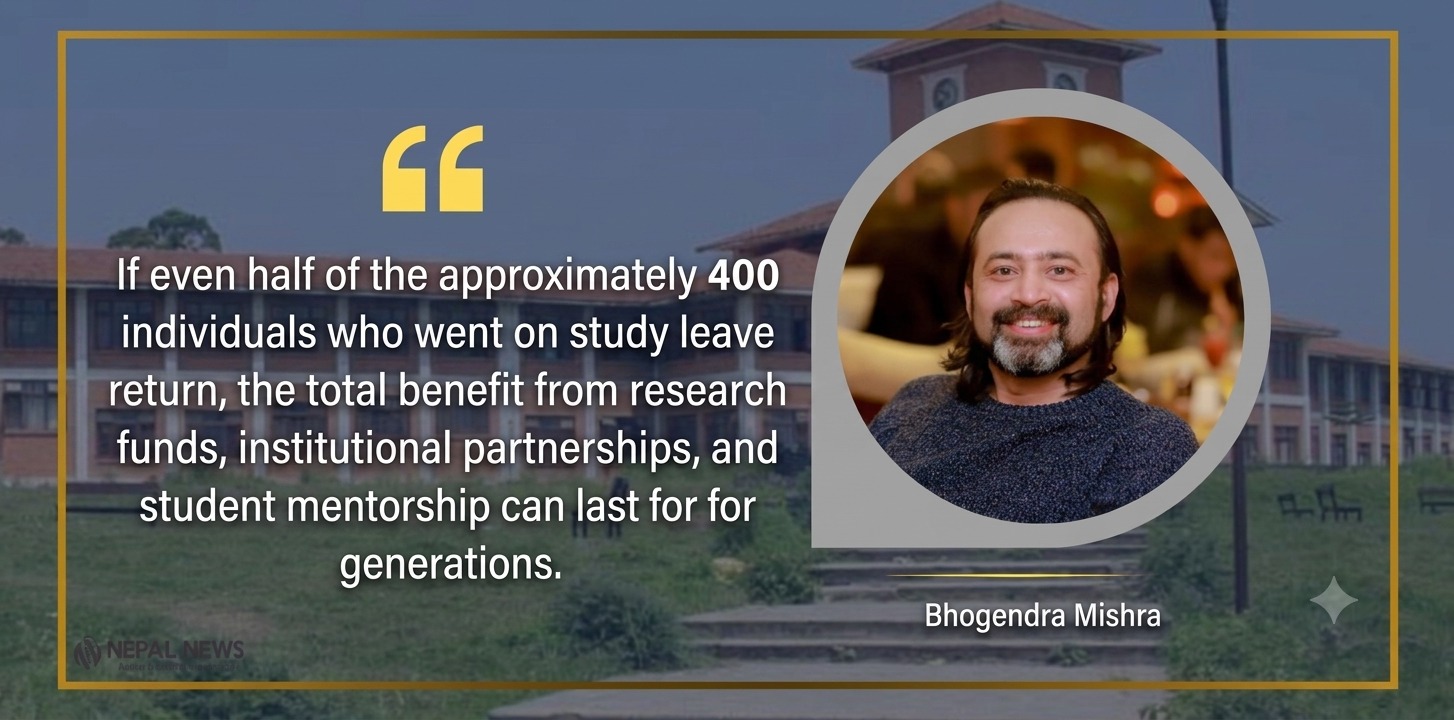
If even half of the 400 absent academics return, the cumulative benefit from research funding, institutional partnerships, and student mentorship would yield generational returns. This would significantly reduce the necessity for future generations of Nepalese youth to go abroad just to access a quality education. The monetary value of this transformation is hundreds of times greater than the cash TU is currently chasing. If 200 scientists return, they could inject over Rs 20 billion worth of research value into Nepal. Yet, we are short-sightedly focusing on a Rs 2 billion recovery target.
For a society deeply impacted by brain drain, the underlying message sent by the state matters far more than short-term financial recovery. If the state takes steps to welcome scientists, streamlines degree verification without unnecessary hassle, and signals to the diaspora that their past administrative lapses can be managed to secure a productive future, the value of that message will far outweigh any financial settlements.
To achieve this, the new government should implement the following five-point roadmap as a bare minimum:
Balance Amnesty with Accountability: Provide a definitive window of opportunity for scholars to return, offering an amnesty or restructuring of their fines. Strict legal action should be reserved exclusively for those who flatly refuse any form of engagement or repatriation.
Abolish the Complicated Equivalence Bureaucracy: Stop subjecting degrees from recognized foreign institutions to tedious equivalence processes. Instead, focus strictly on verifying whether a degree is genuine or fraudulent. Simplify this bottleneck, which currently deters willing scholars from returning.
Eliminate Administrative Barriers: Ensure that returning scientists do not get bogged down for months in paperwork, litigation, or petty political infighting within university administrations.
Guarantee Research Autonomy: Allow returning scientists the complete independence to utilize international research grants and set up state-of-the-art laboratories. Eliminate administrative roadblocks to foster a healthy, thriving culture of inquiry.
De-politicize Tribhuvan University: A merit-based system can never survive as long as political appointments and partisan promotions control higher education. The leadership and faculty appointments of the university must be completely insulated from political party influence.
Nepal does not need to match American or European salary scales to win back its talent. South Korea did not do that. India’s VAIBHAV fellowship was not designed to financially compete with Silicon Valley. What those countries offered was profound professional respect, institutional autonomy, and a genuine validation that “the country truly needs you.” This message of respect carries immense power.
The fund recovery campaign initiated by TU is not inherently wrong; the rule of law must be upheld. Those who deliberately misappropriated state funds must compensate for the financial loss. However, this financial recovery represents only half of the policy loop—and it is by far the less critical half.
The ultimate question remains: What kind of institution does TU aspire to be? An agency that chases its former academics across international borders, or an institution that successfully reverses the nation’s brain drain? TU must build a clear path back home for its 400 talented educators, and by extension, for thousands of Nepalese scientists worldwide. Those in the halls of power must remember: buildings can always be constructed with loans from the ADB or the World Bank, but a nation is built by its minds. It is time for Nepal to choose its true priorities.
— Milan, Italy