Kathmandu
Monday, June 22, 2026





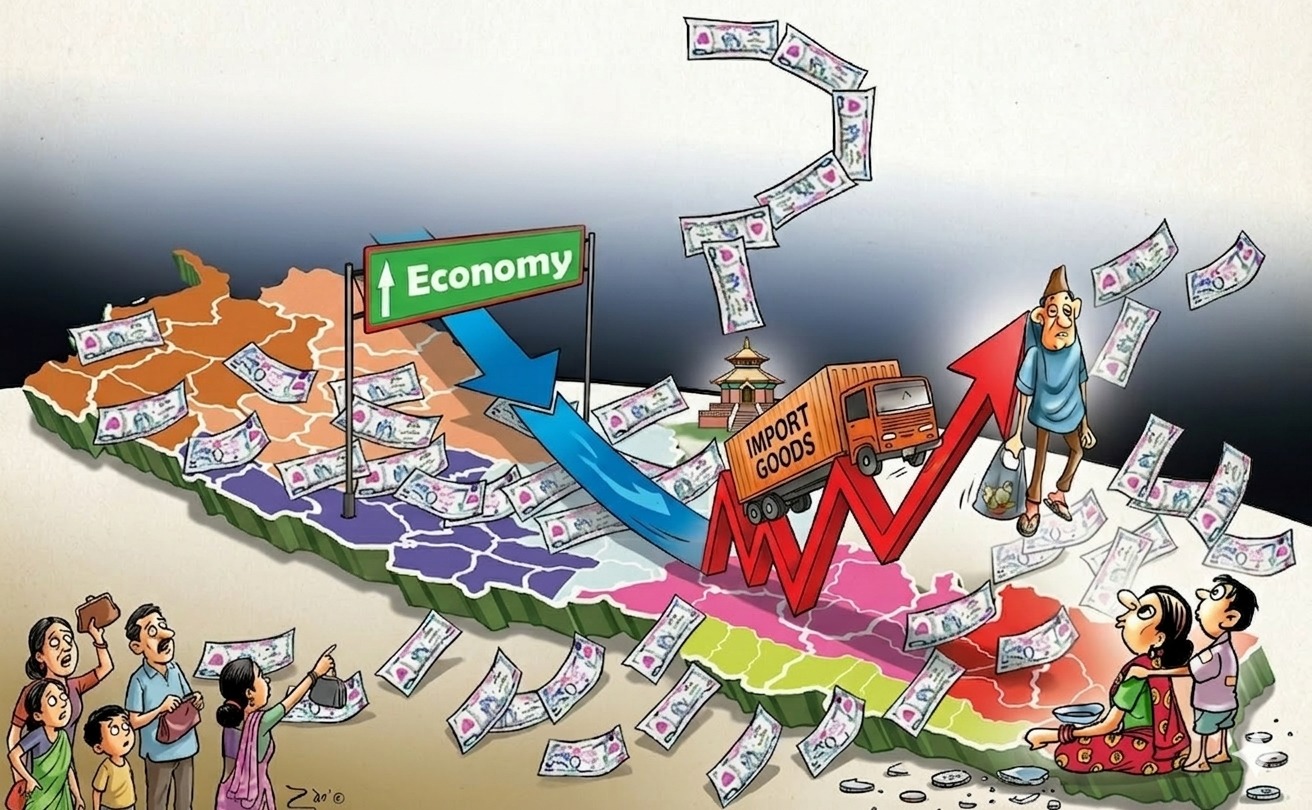
KATHMANDU: The Department of Customs has released foreign trade statistics covering the first eleven months of the current fiscal year, from mid-July 2025 to mid-June 2026. The data, compiled from the ASYCUDA World system across 24 major customs offices, shows imports rising faster than exports, pushing the trade deficit higher than the same period last year.
The figures remain preliminary and subject to revision once the full annual trade statistics are finalized, but they offer the clearest picture yet of Nepal’s external trade performance for the year.
What do the latest customs figures show about Nepal’s overall trade picture this fiscal year?
The Department of Customs data for the first eleven months of fiscal year 2025/26 shows that Nepal’s total foreign trade reached about Rs 2.172 trillion , marking an increase of 14.78 percent compared to the same eleven month period last fiscal year, when total trade stood at Rs 1892.37 billion.
This growth was driven by a sharp rise in imports rather than exports, which means the structure of Nepal’s trade has tilted even further toward dependence on goods coming in from abroad.
Total trade combines both the value of imports and exports, and its expansion in this case is not necessarily a sign of a healthier trade balance since the gap between what the country buys and what it sells has also widened during the same period.
The growth rate of total trade is slightly lower than the growth rate of imports alone, which signals that imports were the dominant force behind the overall increase, while exports contributed a smaller share to the combined total.
How much did Nepal import during these eleven months and how does that compare with last year?
Nepal’s imports for the first eleven months of fiscal year 2025/26 stood at Rs 1894 billion. This figure represents an increase of 15.16 percent over the same period of the previous fiscal year, when imports were recorded at Rs 1644.80 billion.
The rise in imports outpaced the rise in exports, continuing a long standing pattern in Nepal’s trade where the value of goods entering the country grows faster than the value of goods leaving it.
Imports cover a wide range of categories including petroleum products, machinery, vehicles, iron and steel, electrical equipment, edible oils, cereals and fertilizers, many of which are essential for both household consumption and industrial activity.
Because imports make up such a large share of total trade, even a moderate percentage increase translates into a very large absolute rise in rupee terms, which is part of the reason the trade deficit has also grown substantially during the same period.
What was the total export figure and how much did it grow?
Exports during the first eleven months of fiscal year 2025/26 reached Rs 277.97 billion, up by 12.28 percent from Rs 247.57 billion recorded during the same period last fiscal year.
While this growth rate is respectable on its own, it remains lower than the 15.16 percent growth seen in imports, which is the main reason the trade deficit has widened rather than narrowed. Export growth was led by a few specific product categories, most notably edible oils and fats, which alone accounted for the largest single share of total export earnings.
Other contributors included tea, coffee and spices, man made fibres, carpets and various food and agricultural preparations.
The fact that exports grew at a slower pace than imports reflects a structural pattern that has persisted in Nepal’s trade for years, where the country’s productive base for tradable goods remains narrower than its demand for imported goods and raw materials.
How large is Nepal’s trade deficit now and how has it changed from last year?
The trade deficit, which is the difference between the value of imports and the value of exports, stood at Rs 1616.13 billion for the first eleven months of fiscal year 2025/26. That amounts to an increase of 15.67 percent compared to the deficit of Rs 1397.23 billion recorded during the same period of the previous fiscal year.
This is the steepest growth rate among all four major indicators tracked in the trade direction table, higher even than the growth in imports themselves. The widening of the deficit confirms that the gap between what Nepal earns from exports and what it spends on imports continues to expand year after year.
A growing trade deficit generally places more pressure on the country’s foreign exchange reserves and its current account, since the shortfall has to be financed through other sources of foreign currency inflow such as remittances, tourism earnings, foreign aid or borrowing.
What is the imports to exports ratio and what does it tell us about the trade structure?
The imports to exports ratio for the first eleven months of fiscal year 2025/26 stands at 6.81, meaning that for every rupee worth of goods Nepal exported, it imported close to seven rupees worth of goods. This is a slight worsening from the ratio of 6.64 recorded during the same period last fiscal year, an increase of about 2.56 percent.
This ratio is one of the simplest ways to capture the imbalance in Nepal’s merchandise trade, and a rising ratio indicates that the imbalance is deepening rather than improving. The persistence of such a high ratio over many years points to deep structural issues in Nepal’s economy, including limited industrial capacity, heavy reliance on imported fuel, machinery and consumer goods, and a comparatively underdeveloped export base.
Policymakers have repeatedly cited this ratio when discussing the need to diversify and expand domestic production for both import substitution and export promotion, though actual progress on the ground has been slow to reflect in the customs data.
What share of total trade do exports and imports each represent, and is this share changing?
Exports accounted for 12.80 percent of Nepal’s total foreign trade during the first eleven months of fiscal year 2025/26, down slightly from 13.08 percent during the same period last fiscal year, a decline of about 2.18 percent in relative terms.
Correspondingly, imports made up 87.20 percent of total trade, up marginally from 86.92 percent a year earlier, an increase of around 0.33 percent. Although these shifts appear small in percentage point terms, they are meaningful because they show a consistent direction of change, with exports gradually losing ground as a proportion of the country’s overall trade activity.
This trend matters because a shrinking export share relative to total trade is generally interpreted as a sign that the trade imbalance is structural rather than a one off seasonal fluctuation.
It suggests that growth in the value of goods Nepal sends abroad continues to fall behind growth in the value of goods it brings in, a pattern that has held steady across recent years.
Which commodity categories topped Nepal’s import list during this period?
Mineral fuels and mineral oils, classified under chapter 27, were by far the largest import category, with imports worth Rs 343.43 billion during the first eleven months of fiscal year 2025/26.
This category includes petroleum products such as petrol, diesel, kerosene and aviation fuel, and its dominance reflects Nepal’s near total dependence on imported fuel for transportation, industry and household energy needs.
The second largest category was animal and vegetable fats and oils along with their cleavage products, valued at Rs 162.33 billion, largely driven by edible oil imports. Machinery and mechanical appliances under chapter 84 followed at Rs 140.09 billion, while iron and steel imports reached Rs 131.52 billion.
Electrical machinery and equipment came in at Rs 125.71 billion, and vehicles, including cars, motorcycles and other transport equipment, accounted for Rs 112.23 billion. Other significant import categories included plastics at Rs 65.33 billion, precious stones and pearls at Rs 62.78 billion, cereals at Rs 55.93 billion and fertilizers at Rs 49.83 billion.
Which products led Nepal’s export earnings during this period?
Animal and vegetable fats and oils, the same broad category that ranked second among imports, was also the single largest export category by far, generating Rs 131.11 billion in export value during the first eleven months of fiscal year 2025/26. This reflects Nepal’s significant trade in refined edible oils, much of which is processed domestically using imported crude palm and soybean oil before being re-exported, particularly to India.
Coffee, tea, mate and spices ranked second among exports at Rs 17.29 billion, followed by man made staple fibres at Rs 12.86 billion and carpets and other textile floor coverings at Rs 10.68 billion.
Other notable export categories included food industry residues and prepared animal feed at Rs 9.15 billion, wood and articles of wood at Rs 8.89 billion, apparel and clothing accessories not knitted or crocheted at Rs 7.74 billion and preparations of vegetables and fruit at Rs 7.14 billion.
These figures show that Nepal’s export basket remains concentrated in a relatively small number of processed agricultural and textile based products.
Which countries does Nepal import the most from?
India remained Nepal’s largest source of imports by a wide margin, supplying goods worth Rs 1092.02 billion during the first eleven months of fiscal year 2025/26, which is more than half of Nepal’s total import value for the period.
China was the second largest source at Rs 382.25 billion, followed by Argentina at Rs 105.08 billion, a figure driven largely by edible oil and agricultural commodity imports.
The United Arab Emirates supplied imports worth Rs 50.99 billion, while the United States accounted for Rs 29.10 billion.
Other significant import sources included Indonesia at Rs 20.87 billion, Australia at Rs 17.29 billion, Thailand at Rs 16.83 billion and Brazil at Rs 15.79 billion.
The dominance of India and China together, which combine to supply well over three quarters of Nepal’s total imports, underscores how dependent Nepal’s supply chains remain on its two giant neighbours for everything from fuel and machinery to consumer goods and industrial inputs.
Which countries are the biggest buyers of Nepali exports?
India was overwhelmingly the largest destination for Nepali exports, absorbing goods worth Rs 228.13 billion during the first eleven months of fiscal year 2025/26, which works out to more than 80 percent of Nepal’s total export earnings for the period.
The United States was the second largest export destination at Rs 18.58 billion, a relationship driven significantly by exports of woolen carpets, readymade garments and other handicraft products.
Germany followed at Rs 4.40 billion, the United Kingdom at Rs 2.94 billion, Japan at Rs 2.04 billion and France at Rs 1.94 billion.
Australia took in exports worth Rs 1.91 billion, the United Arab Emirates Rs 1.63 billion and China Rs 1.59 billion.
This heavy concentration of export earnings in a single market, India, leaves Nepal’s export sector highly exposed to any changes in Indian demand, trade policy or border conditions, a vulnerability that has been highlighted repeatedly by trade analysts and policymakers over the years.
How does the China-India trade comparison look from both the import and export side?
The contrast between Nepal’s trade relationship with India and China is stark when imports and exports are compared side by side.
On the import side, India supplied Rs 1092.02 billion worth of goods while China supplied Rs 382.25 billion, meaning India remains Nepal’s dominant trading partner for goods coming into the country, though China’s share is substantial and reflects years of growing trade through both the Tatopani and Rasuwa border points as well as containerized shipments routed through Chinese ports.

Rasuwa border
On the export side, the imbalance becomes far more extreme, with India purchasing Rs 228.13 billion worth of Nepali goods compared to just Rs 1.59 billion from China. This means Nepal sells more than 143 times as much to India as it does to China, even though China is its second largest source of imports.
This asymmetry highlights a long standing concern among Nepali trade officials and economists, namely that Nepal has been unable to translate its growing import relationship with China into a meaningful corresponding export relationship.
Which customs points handled the largest share of Nepal’s trade?
Birgunj customs office handled the largest share of both imports and exports among Nepal’s 24 major customs points during the eleven month period. It processed imports worth Rs 890.57 billion, accounting for 47.02 percent of all imports, and exports worth Rs 99.69 billion, accounting for 35.86 percent of all exports, reflecting its position as the primary land port connecting Nepal with India through Raxaul.
Bhairahawa customs office ranked second for imports at Rs 275.58 billion, or 14.55 percent of the total, while Biratnagar ranked second for exports at Rs 78.75 billion, or 28.33 percent of the total.
Tribhuvan International Airport customs handled Rs 185.41 billion in imports, equal to 9.79 percent, and Rs 33.72 billion in exports, equal to 12.13 percent, reflecting the growing role of air cargo in Nepal’s trade, particularly for higher value and time sensitive goods.
Mechi customs office, serving the eastern border, processed Rs 53.33 billion in imports and Rs 23.55 billion in exports.
How much customs revenue has the government collected from import duties during this period?
The Department of Customs data shows total import duty collection of Rs 170.40 billion during the first eleven months of fiscal year 2025/26, calculated against a total import value of Rs 1894.10 billion.
This means the effective average duty rate across all imports works out to roughly 9 percent of the total import value, though actual rates vary widely depending on the specific tariff slab applied to different goods.
The largest single contributor to this revenue came from imports taxed at the 10 percent duty rate, which generated Rs 28.66 billion in revenue from imports worth Rs 564.53 billion, the single biggest value category among all duty slabs and accounting for close to 30 percent of total import value.

Department of Customs
Imports taxed at the 30 percent rate contributed Rs 33.23 billion in duty despite a comparatively smaller import value of Rs 125.84 billion, showing how higher tariff slabs applied to specific goods can generate disproportionately large revenue relative to their share of import volume.
How significant are duty free or zero rated imports within the total figure?
Imports entering at the zero percent duty rate amounted to Rs 152.68 billion during the eleven month period, representing about 8.06 percent of Nepal’s total import value for the year.
These zero rated imports typically include essential goods, certain raw materials, items covered under bilateral or regional trade preferences, and goods that the government has chosen to exempt from customs duty for policy reasons such as keeping the price of essential commodities affordable or supporting specific industries that depend on imported inputs.
The existence of a meaningful zero duty category alongside the various other duty slabs, including 5 percent, 10 percent, 15 percent, 20 percent, 30 percent, 40 percent and 80 percent, illustrates how Nepal’s tariff structure is designed with multiple tiers intended to balance revenue collection against considerations such as consumer affordability, industrial protection and adherence to international trade commitments.
The 80 percent duty slab, the highest among the listed categories, applied to imports worth Rs 8.74 billion and generated Rs 5.54 billion in revenue, the smallest import value among the listed slabs but among the highest effective rates.
What do these eleven month figures suggest about Nepal’s trade trajectory for the rest of the fiscal year?
With less than one month remaining before the close of fiscal year 2025/26, the data through mid-June 2026 indicates that Nepal is on track to record another year of double digit growth in both imports and exports, with the trade deficit also expanding at a similarly fast pace.
If the trends observed over these eleven months continue into the final month, mid-June to mid-July, the full year figures are likely to confirm a trade deficit well above Rs 1700 billion and total trade approaching or exceeding Rs 2300 billion.
The consistent dominance of mineral fuel imports, the continued concentration of export earnings in edible oils destined mostly for India, and the persistent reliance on India and China for the bulk of imported goods all point to structural patterns that are unlikely to shift dramatically within a single fiscal year.
The Department of Customs has noted that these figures remain preliminary, based on data from customs offices using the ASYCUDA World system, and are subject to revision once the complete annual statistics are finalized and published.