Kathmandu
Friday, June 26, 2026





Proposed legal amendments introduce a mechanism to issue a formal notice of appearance first in cases outside of heinous or serious crimes, allowing authorities to proceed with an arrest only if the individual fails to attend
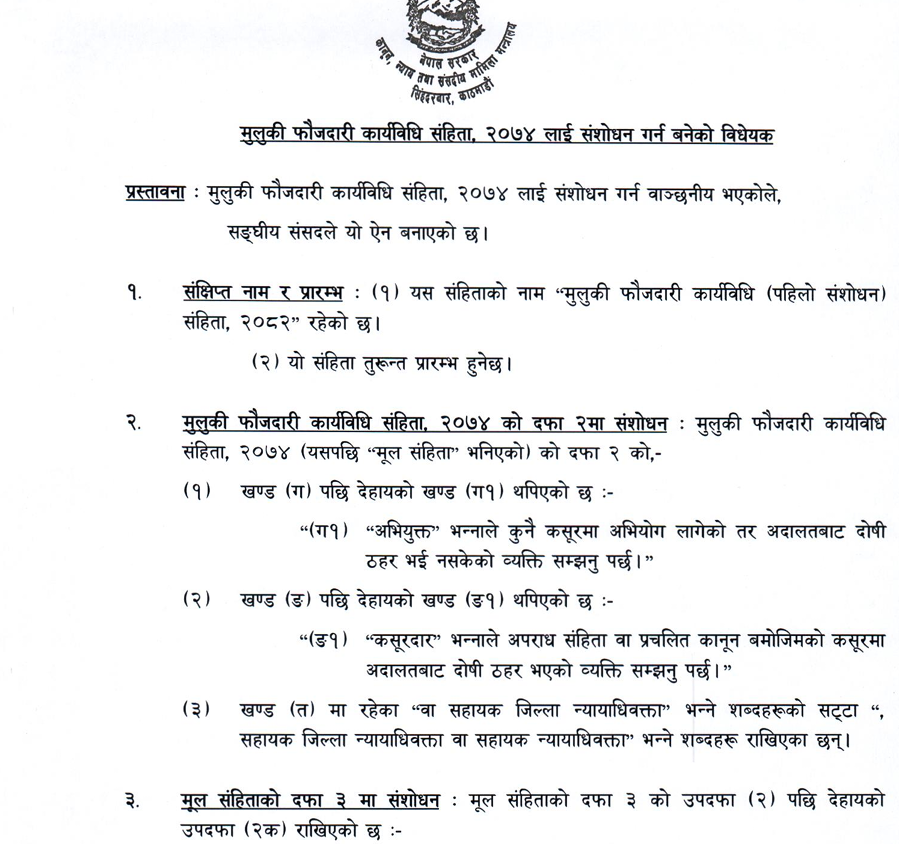
KATHMANDU: In a major shift to reform the judicial system, the government is preparing to amend the law to halt the practice of immediate arrest before investigation. The proposed “Bill Formulated to Amend the Civil Criminal Procedure Code, 2017,” introduces a legal provision requiring authorities to first issue a formal summons in cases outside of heinous or serious crimes, making arrest a recourse only if the accused fails to appear.
Specifically, an amendment to Section 9 of the Civil Criminal Procedure Code which governs suspect arrests mandates that individuals be notified beforehand. The draft bill states: “Except in cases where a person has committed a heinous or serious offense, or has attempted, abetted, or engaged in a criminal conspiracy for such offenses, or has been an accomplice in such an offense, or in circumstances where an urgent arrest warrant must be issued, a notice of appearance must be given prior to arresting such person in other offenses.” However, the proposed clause clarifies that if an individual fails to appear despite receiving the notice, authorities retain full power to proceed with an arrest.
In the existing provision of the Code, however, Section 9 (1) states that “If any person connected with an offense is found or is in the act of committing an offense, the police or investigating officer may arrest him.”
The government has been immediately arresting and taking individuals into custody on charges of various crimes, conspiracies, and acting as accomplices, and conducting investigations only thereafter. The government has faced fierce criticism on the grounds that arresting people merely on suspicion infringes upon an individual’s privacy and reputation.
Similarly, the matter of keeping individuals in custody for investigation has also been amended. Currently, the Code has a provision allowing an order to keep someone in custody for a maximum of 25 days at multiple times. Amending that provision, it has been made so that a person can be kept in custody for a maximum of 15 days in offenses carrying a prison sentence of up to three years, and for 25 days in offenses carrying a sentence higher than that.
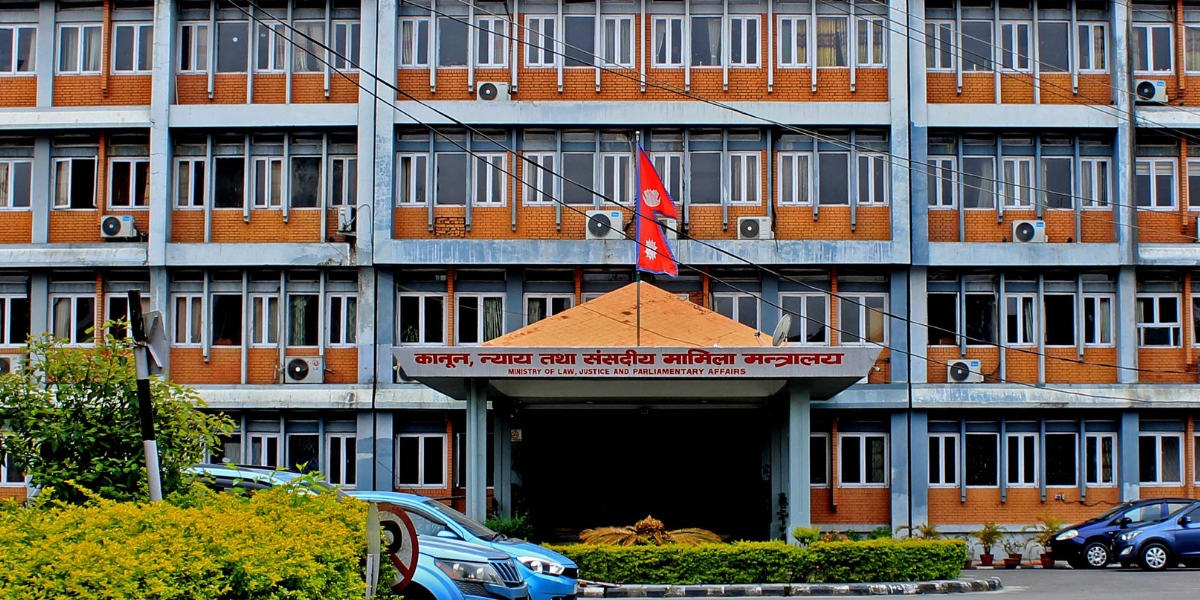
The Ministry of Law, Justice and Parliamentary Affairs has informed that amendments and additions are being made to 60 sections of the Civil Criminal Procedure Code. The Ministry has sought opinions and suggestions from the general citizens along with others on the legal provisions intended to be amended. The Ministry has asked to send rational opinions within 15 days starting from June 22.
In the amendment of the bill, provisions for alternatives to detention have been made after the detention-release debate in court. Until now, after the detention-release debate for trial, individuals were either sent to prison, released on bail, or released on a recognizance. In the draft of the amendment, a provision has been added that if a serious offense is not seen in the detention order, the court, instead of keeping the person in custody, may release them by fitting an electronic monitoring device or may prescribe a location limit.
It is provided that if an order is made to release someone using an electronic monitoring device, the cost of the device must be borne by the accused themselves, and if they refuse to bear the cost, they must be sent to prison for trial.
In the amendment of the bill, there are provisions including compromise in eight cases including fraud, release of property withheld during the course of investigation, and loosening the concept of jail based on conduct.
Attorney General can cause compromise in 8 cases
In Section 117 of the Code, the matters of cases where a compromise can be reached have been added. A provision has been made allowing the Attorney General to order a compromise in eight cases. This includes fraud, cases related to foreign employment, usury, criminal breach of trust or criminal cheating, banking offenses arising from check dishonor or non-payment of loan, cases related to misrepresentation in contract or agreement work, cases involving damage to public property, and other government-cases of personal transactions that do not affect public peace.
Furthermore, the draft of the amended bill introduces a provision empowering the Attorney General to authorize a settlement even in government-prosecuted cases that are sub-judice in court or in the stage of judgment execution, provided it is deemed reasonable. Expanding upon Subsection 2 of Section 117, the newly inserted provision states: “Except in cases where loss or damage has been caused to the government, even if the cases run by the government are sub-judice at any level or are in the stage of execution of judgment, the Attorney General may order a compromise upon an application submitted by both the defendant and the victim to the concerned government attorney requesting to cause a compromise.”
New provision in withholding property
A new provision has also been proposed regarding the release of property of any person withheld during the course of an investigation. Adding to Subsection 1 of Section 33 of the Civil Procedure Code, there is a provision to release the property of any person withheld by an investigating officer in connection with the investigation of any criminal offense. A provision has been placed that if the investigation report is submitted and the charge sheet is filed, the property can be released if it is not necessary to keep it withheld. The withheld property must be released based on an application by the government attorney or the concerned person.
In Subsection 2 of Section 33 itself, it has been added that “If a decision is made not to prosecute the person whose property was withheld during the course of investigation, or if prosecuted, the concerned government attorney shall direct to release the withholding.” If there is a claim that property in excess of the claimed principal amount to be recovered from the accused has been withheld, the court shall release the property. A provision has been made that if the accused is acquitted in the property withheld by the order of the court, or if there is no remaining amount of fine, penalty, or compensation to be paid by him, the concerned court shall release the property.
Discount in imprisonment and fine
A provision has also been made in the amended bill that if a person convicted by a court voluntarily presents themselves at the court within 60 days of receiving the notice of the judgment for the execution of imprisonment or fine, such person shall receive a 20 percent discount on the determined imprisonment or fine.
If a person in jail has good conduct, an alternative to serving the prison sentence has been given. Provisions have been made so that a prisoner with good conduct can be assigned to community service, the prison sentence can be suspended, the prison sentence can be served by staying in prison only on the weekends or during night-time, kept in an open prison, placed on parole, socialized, or assigned to physical labor in lieu of imprisonment.