Kathmandu
Tuesday, July 28, 2026





Set in the quiet hills of Sikkim, Tribeny Rai’s brilliant cinematic debut explores the unspoken bonds, silent sacrifices and fierce friction between three generations of women.

KATHMANDU: There is a strong belief in fiction and cinema that stories born from the creator’s own experiences and lived realities are more vibrant and credible than purely fictional ones. Tribeny Rai’s Shape of Momo is one such cinema, where the director has made her own experiences and memories the core foundation of the story.
As director and co-writer Rai has stated in her interviews, Shape of Momo is not exactly her autobiography, but it is very close to her life. It also blends the experiences of the women around her. Furthermore, the film was shot in her own village.
The cinema depicts the daily lives of four women across three generations of a single family living in a rural setting of a Himalayan village in Sikkim. The central character, Bishnu (Gaumaya Gurung), has returned to Sikkim after leaving her job in Delhi. Her mother’s role is portrayed by Pashupati Rai, who is well-accustomed to balancing household chores with community responsibilities. Bishnu’s grandmother is an elderly woman living in the hope that her son will take her to Dubai, while a pregnant Junu (Shyama Shree Sherpa)—who is Bishnu’s sister—has come to stay at her maternal home, seeking temporary freedom from the control of her husband and mother-in-law.
These characters in a male-free household are interdependent and devoted to one another. Family intimacy shines through scenes where the whole family sunbathes together, sisters sing the “Cuckoo Cuckoo” song while making momos, or when they openly make jokes about passing gas and tease each other while eating momos. There are also numerous scenes showcasing the love between the sisters and between the mother and daughter.

However, the central female characters of Shape of Momo share not only love but also plenty of contradictions, which makes them realistic. Each character’s life is defined by the circumstances they face. They appear struggling to strike a balance between their own expectations and compromises.
Turning a blind eye to minor issues and maintaining balanced relations with everyone from the village headman to laborers is the strength of Bishnu’s mother. In contrast, Bishnu is an independent woman whose thought process and style have been shaped outside the village; she immediately confronts things she dislikes. She possesses a firm desire to bring changes to the customs and behaviors within the household, and she even attempts to intervene.
In this pursuit, she gets into a spat with Padam, the boy who helps with household chores. A years-old relationship with the family members who look after her orange orchard falls apart. When Bishnu calls the police to arrest people who were enjoying themselves inside a tent near her house, her action irritates everyone from the neighborhood to the Panchayat. Instead of offering a solution, Bishnu’s progressive ideas disrupt the social balance that her mother had preserved between the neighborhood and the community for years. Her mother also grows resentful after her daughter ends up adding one problem after another instead of solving them.
Shape of Momo begins with a scene where Bishnu reads aloud the words she wrote for a mobile phone advertisement at a neighborhood gathering. While her face lights up with joy when her writing is praised, it turns gloomy the moment she is compared to a male and the issue of marriage is brought up.
Throughout the movie, from beginning to end, there are many instances emphasizing that women should give birth to a son. The relevance of naming the film Shape of Momo (sounded out contextually as “Like a Son” in local wordplay/thematic relevance) is found right there.
This scene establishes Bishnu and her mother as members of the community right at the start. In the scenes that follow, the conflict between family and individual, society and individual, and self-identity and tradition emerges even more subtly.
There is a character in the film who plays a decisive role in the transformation of Bishnu’s character: the teenage son of the family that takes care of Bishnu’s orange orchard.Angered by Bishnu’s pressure on his parents to demand money without understanding his family’s plight, the teenager resists. His resistance is depicted through scenes like holding a hot tea kettle, boycotting the acceptance of apples and pomegranates, and stepping on glass. Following every such incident, a long silence envelops Bishnu in the subsequent scenes. This incident also reflects her class prejudice.
Within this conflict in Shape of Momo , the interdependence between the characters is also accommodated. The interconnectedness tied to family, community, and one’s birthplace is highlighted with great importance.
In Shape of Momo , directed by a woman and featuring a female-dominated cast, there is also a question of how women carve out their space in the presence or absence of men. This is subtly portrayed through the relationship between Bishnu and Gyan (Rahul Mukhiya). Bishnu, who dreams of opening a homestay on her own land, feels she has found reliable support in the village after meeting Gyan, an architect. However, she gradually senses that others expect more from her when she is with Gyan. She cannot handle this pressure.
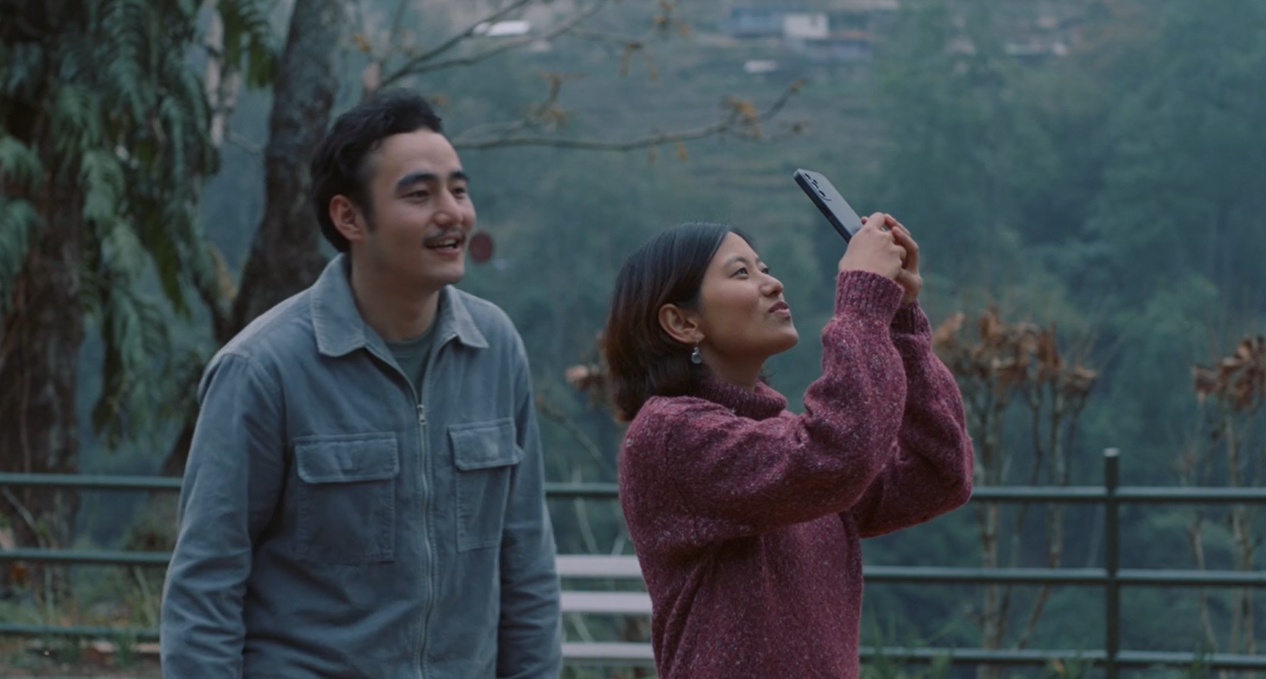
On one hand, her mother’s dissatisfaction, and on the other, the dilemma regarding her relationship with Gyan, push Bishnu into a difficult corner.
The mother says, “To live in the village, you must endure and tolerate. This is not your Delhi.”
Bishnu replies, “I will not endure, I will not tolerate.”
The mother snaps, “Then leave the house and go.”
Will Bishnu leave the house? What will happen to her dream of running a homestay in the village? Will Bishnu and Gyan’s relationship lead to nothing?
The answer could be anything. After all, contradictions, resistance, and compromises are what shape life. That shape might not be like a perfectly molded momo made by Junu, but rather like the “shapeless and formless” momo made by Bishnu. Whether in society or at home, being “unfit” is, after all, just like being a shapeless momo.
This idea also appears in the words of the letter Bishnu writes to her mother: Isn’t it strange? The very things that exhaust and entangle Bishnu are the ones that have given shape to her life.
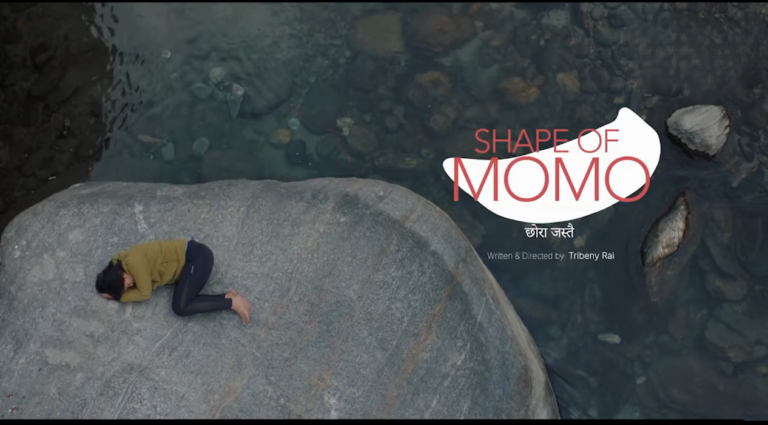
Portraying the minute details, behaviors, and emotions of characters rather than grand events and conflicts, the film is given a title akin to a son. Although Bishnu is an independent character—even her cat is named ‘Aazadi’ (Freedom)—she does not want to be like a son; she wants to be free like a bird. Yet, society compares her by calling her “just like a son.”
Throughout the movie, from beginning to end, there are many instances emphasizing that women should give birth to a son. The relevance of naming the film Shape of Momo is found right there. The film’s very first scene establishes that the community stands above Bishnu and her mother. In the end, in the letter addressed to her mother, Bishnu says—I knew it; you had to give birth to a son, but I was born instead.
Regardless, the decision to return to Sikkim from Delhi gives Bishnu a chance to know her mother. It teaches her to look at her relationship with her home and loved ones in a new way. And, most importantly, she discovers herself.
With home at the center—which in itself acts as a fifth character— Shape of Momo presents the dimensions of relationships strictly from a female perspective. This cinema provides a new lens to look at and think about the relationship between women and the home.
Even the cinematographer has operated the camera in a way that makes one feel the contrast between the indoor and outdoor scenes. Whether it is Bishnu observing the glittering houses while talking to her mother through binoculars at night, or the final scene where Bishnu lies amidst clothes dried on the green grass, the visuals are captivating.
The lighting, which changes alongside the dark and bright moments of the characters, and the sound design, which evokes the mood of both characters and nature, also grab the audience’s attention.
The natural acting of actors including Gaumaya Gurung, Pashupati Rai, and Shyama Shree Sherpa makes the story even more lifelike. The local Sikkim dialect adds an extra sweetness.
(Shape of Momo is a film that had its world premiere at the Busan International Film Festival and the San Sebastian International Film Festival. Having been screened at numerous festivals and winning awards, this film is being screened today as the opening film at the 23rd edition of the five-day Kathmandu International Mountain Film Festival (KIMFF).)