Kathmandu
Tuesday, July 28, 2026





After navigating legal hurdles to reach the theaters, the Swastima Khadka-starrer Lalibazar attempts to portray the struggles of the Badi community, but falters in its execution and sensitivity.
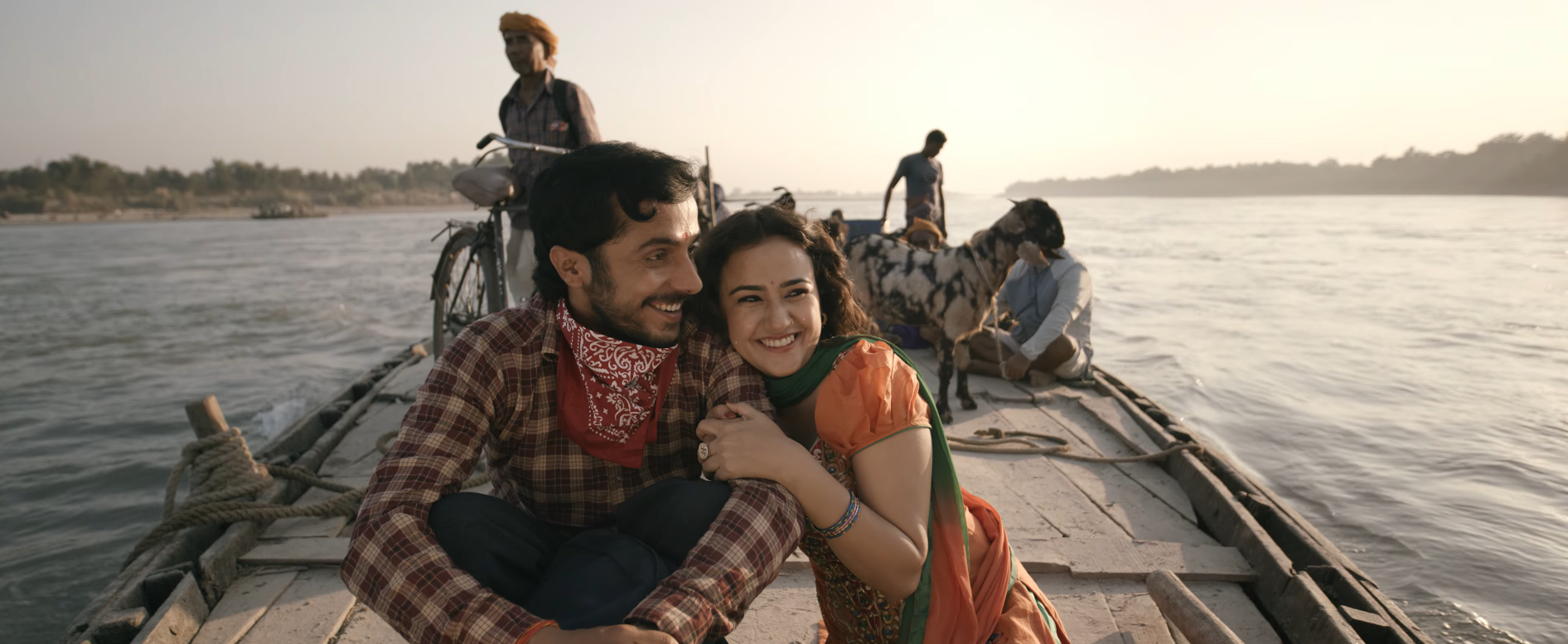
KATHMANDU: Lalibazar , which arrived in theaters after facing legal obstacles on the eve of its release, is currently a subject of intense discussion. Even after its public release, voices calling for a halt to its screening have not subsided.
Before understanding this controversy surrounding Lalibazar , let’s understand the film’s plot.
At the center of the story is the Badi community of Western Nepal. The women of the Badi community—who traditionally made musical instruments and provided entertainment through dance and music—were forced into sex work during a specific period in history due to exploitation by the ruling class.
Directed by Yam Thapa, the film’s setting—Lalibazar—is shown as a community trapped by feudal power, where the innocence of young Badi girls is treated as a commodity by the local elite, represented by the character Raja Saheb
The film’s protagonist, Madhubala (Swastima Khadka), considers sex work a continuation of the tradition kept alive by her mothers and grandmothers. An encounter with a postman, Narayan (Bishal Devkota)—who arrives ringing his bicycle bell and reads love letters for her—gives her a glimpse of a different world. It awakens a desire in her to step out of the dark world of Lalibazar and live in a world of light.

Although the postman Narayan loves Madhubala, society hates her as a woman engaged in sex work. The day after Madhubala leaves home expecting a beautiful life with Narayan, she faces unexpected rejection. She is forced to return to Lalibazar, helpless.
Social prejudice prevents Narayan and Madhubala from becoming one. However, their daughter, Maharani—born as a token of their love—does not let their love die. After various events, Madhubala decides to educate her daughter so that the hardships and the hellish life she endured do not negatively impact her. Simultaneously, she resolves to free her daughter from the cycle of sex work. In essence, Lalibazar is the story of a mother’s struggle to make her daughter educated and independent while breaking the vicious cycle of the flesh trade.
However, the primary obstacle remains Raja Saheb (Rabindra Singh Baniya), who has long intended to subject Maharani to the same cycle of exploitation her mother fought to escape, having made a deal for her years prior. The story moves toward its destination with the curiosity of whether Madhubala can save her daughter from the shadow of the cruel Raja Saheb. The responsibility of reaching the story’s conclusion lies with the audience.
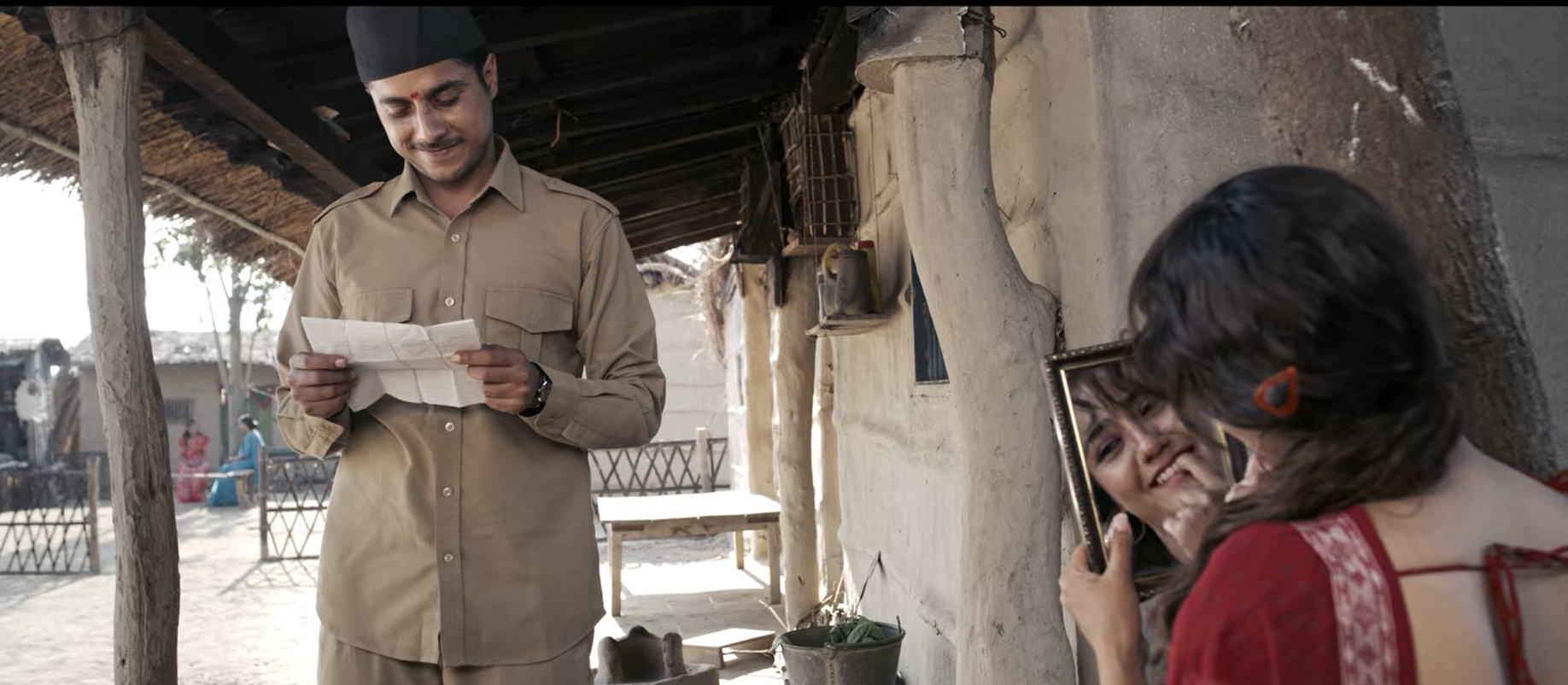
Set in the surroundings of Bardiya, the film touches upon the period from 1988 to mid-1993. The posters of Bollywood heroes and heroines seen on the room walls are used as an important tool to reflect the environment of that time, which is beautiful. Thoughtful color grading not only shows two different worlds—the colorless and the colorful—but also depicts two different eras. While the songs had already become popular, the film’s background score fails to be special.
The impact of lead actress Swastima’s acting spans from the beginning to the end of the film. The performances of characters ranging from the young and adolescent Maharani to ‘ Haija ‘ and ‘ Kothari ‘ are attractive. The appearance of Rabindra Singh Baniya as Raja Saheb is indeed terrifying, but by the end of the film, his character becomes “monotonous” for the audience.
For Swastima, who has been presenting excellent acting skills, Lalibazar could be considered another step after Bulbul and Chiso Manchhe . However, her characterization in Lalibazar is weak. At a glance, Madhubala, who seems to rebel against the feudal system and patriarchal society, is shown as both whiny and rebellious at once, which is contradictory.
Madhubala’s agency is so weak that she is dependent on men for the important decisions she makes. For example, at the center of the story is the mother-daughter bond and the mother’s struggle to make her daughter educated and independent. Yet, before deciding to give birth to that daughter, Madhubala tries to abort the pregnancy. The credit for the decision to send the daughter to school also goes to Narayan.
Making a film about the ill tradition and oppression of Badi women being used as objects of pleasure against their will is certainly commendable. However, a film made on such a sensitive subject must be evaluated on how sensitively it portrayed the story.
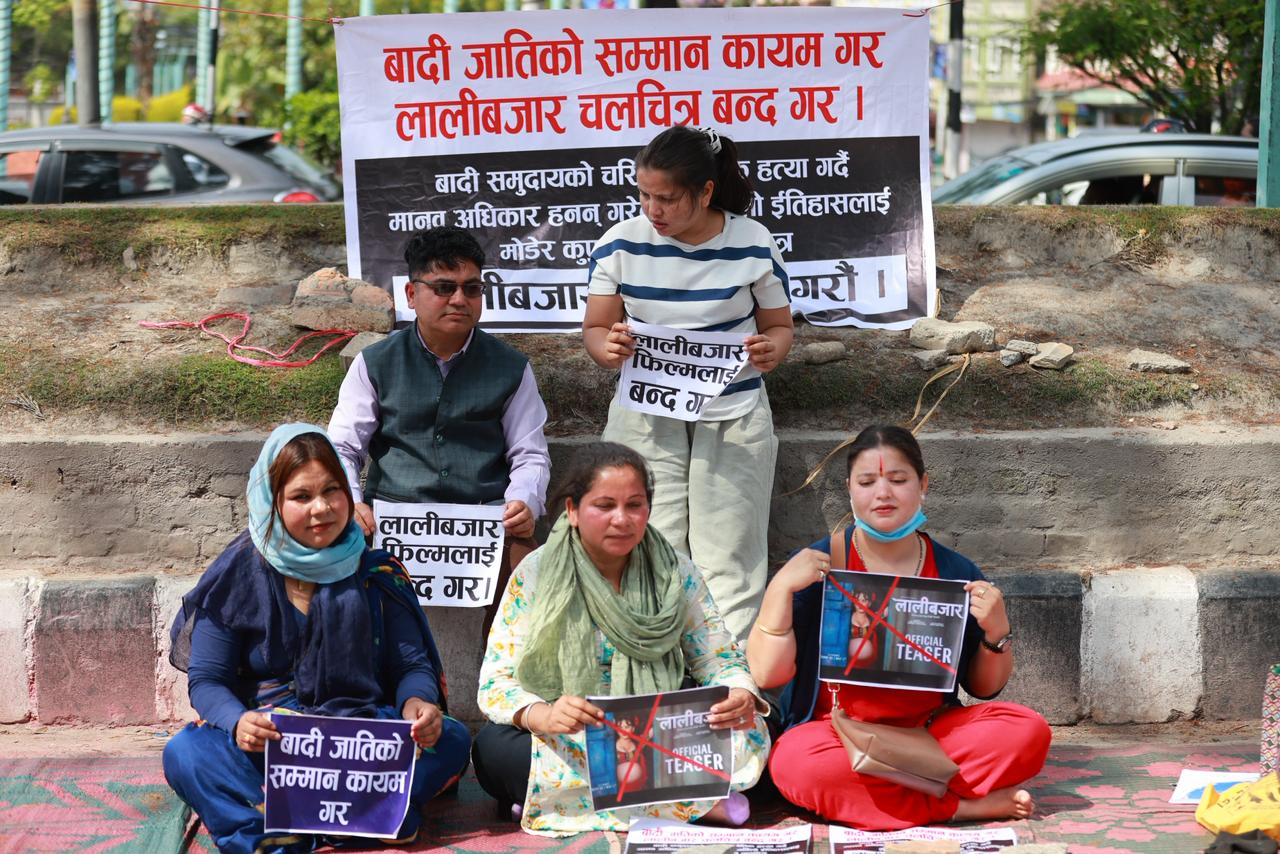
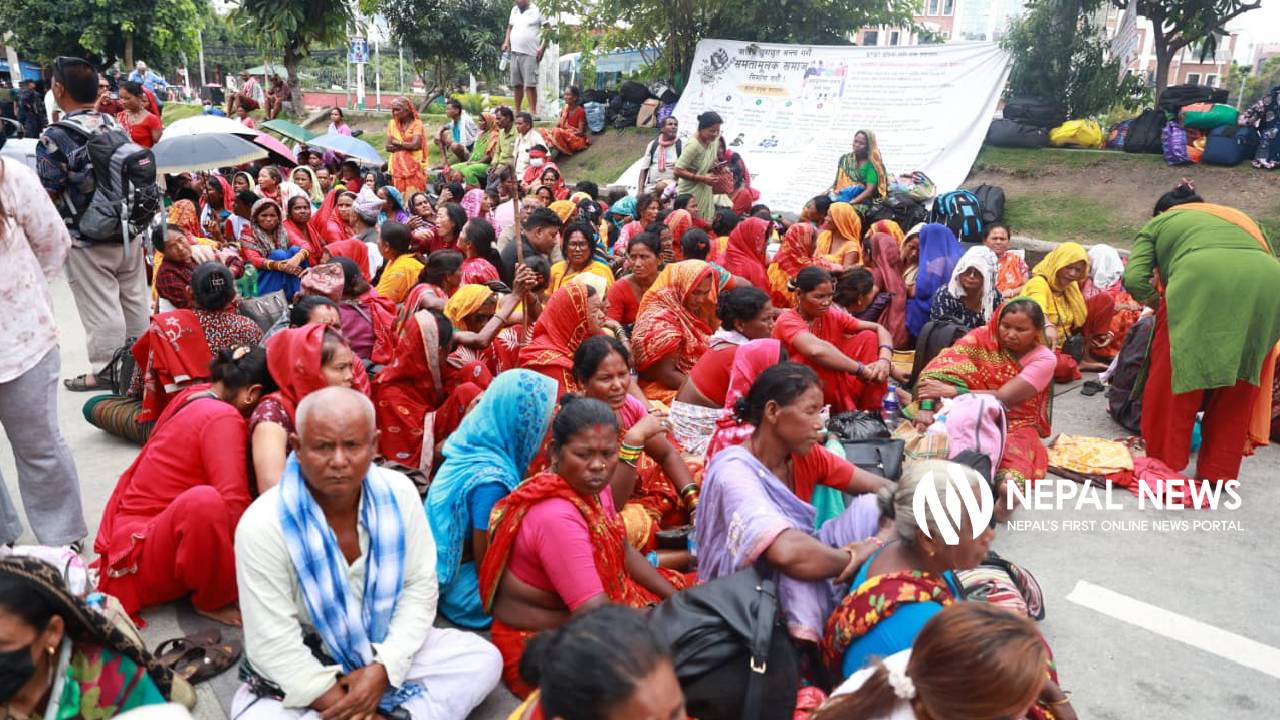
Members of the Badi community protesting, demanding a ban on the screening of Lalibazar . Photo: Nepal Photo Library
In the past, the Badi community has rebelled repeatedly against the exploitation and humiliation by the state. In 2007, a continuous 48-day movement took place to change the perspective that views the Badi community only through the lens of the sex trade. There should have been some level of synergy between this rebellion of Badi women/community and the rebellion Madhubala carries out in the film. Ironically, that is not found.
It must be said that the pre-interval portion of Lalibazar is very weak. This weakness begins from the scene where Madhubala elopes with Narayan. Whether it’s the scene of being humiliated and kicked out of a relative’s house after eloping with Narayan, or the scenes where Narayan returns to Lalibazar to meet Madhubala, they are all “loud.” Somehow, the rhythm of the film regains balance after the interval. Specifically, it is sustained by the intimate relationship between Madhubala and her daughter. Nevertheless, the series of crying and exaggerated “melodrama” continues until the final fight of the film. Such exaggeration in the story of a sensitive community grates in many places. A few flashback scenes of Narayan and some intimate moments between the mother and daughter bind the audience. Unlike the flashbacks, the initial meeting scenes between Madhubala and Narayan fail to connect.
The attempt to mold Lalibazar into a commercial mold rather than an artistic one is the film’s weakness. An even bigger weakness is the film’s failure to enter into the root causes of the historical, economic, caste-based, and sexual exploitation against the Badi community.
How was the Badi community trapped in the quagmire of the sex trade in the past? By failing to establish this problem while trying to tell the story of their desire for liberation, Lalibazar fails to establish the historical social context.
Perhaps for such reasons, representatives of the Badi community reached the court against the film. They are expressing dissatisfaction on social media and have even sat for sit-ins on the streets.
The protests weren’t only against the film. Artists and creators also took to the streets in favor of the film.
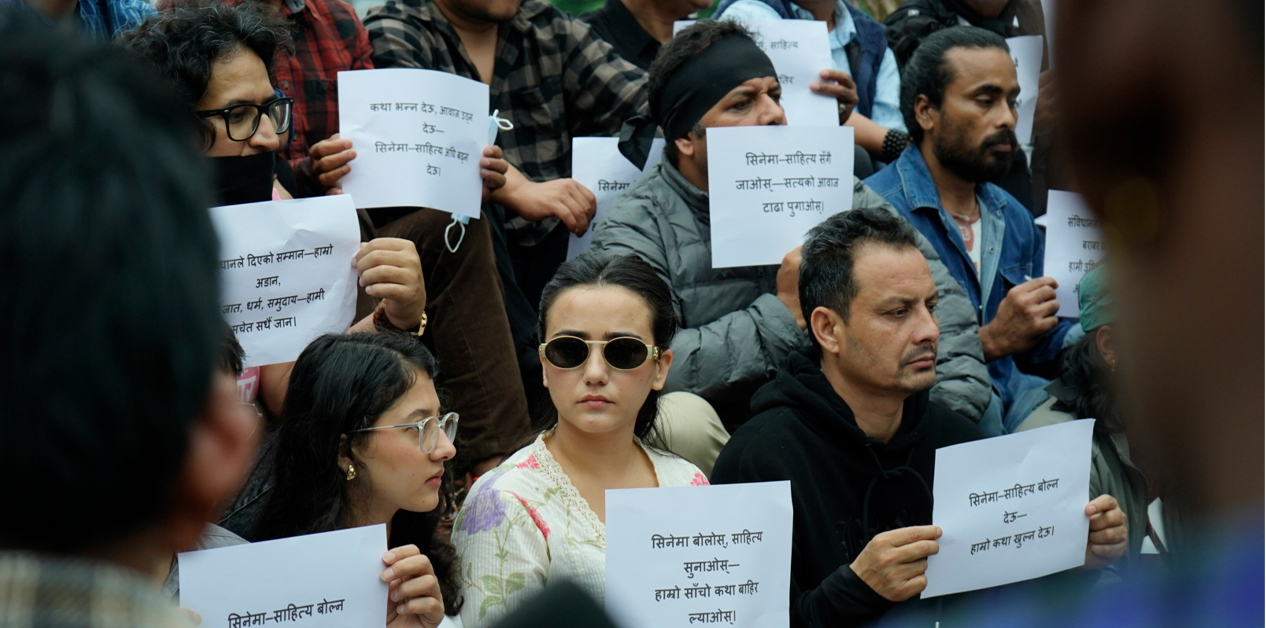
Artists protesting the court-ordered stay on the screening of Lalibazar . Photo: Bikram Rai
The opinions of creators and activists have clashed before regarding cinema or literature created about the Badi community. After the release of the film Pandit Bajeko Lauri directed by Deepak Oli, Saraswati Pratikhya’s novel Nathiya , and Bibek Ojha’s novel Ailani —all of which told stories of the Badi community—Badi activists reached the court in 2018.
Whether in politics or art, the question of representation is a poignant issue in today’s time. Equally strong is the aspect of creative and freedom of expression. Therefore, the current division of opinion for and against Lalibazar is natural.
The current debate, controversy, and difference of opinion have brought one question to the surface: How to link freedom of expression with the liberation of marginalized communities?
What kind of answer Lalibazar gives to this question may vary according to the audience’s understanding.