Kathmandu
Thursday, July 23, 2026





After 55 years as one of the world's poorest nations on paper, Nepal is still not ready to take its name off the list. Here is everything you need to know about the country's complicated journey to shed its Least Developed Country tag — and why it just asked for more time, again.
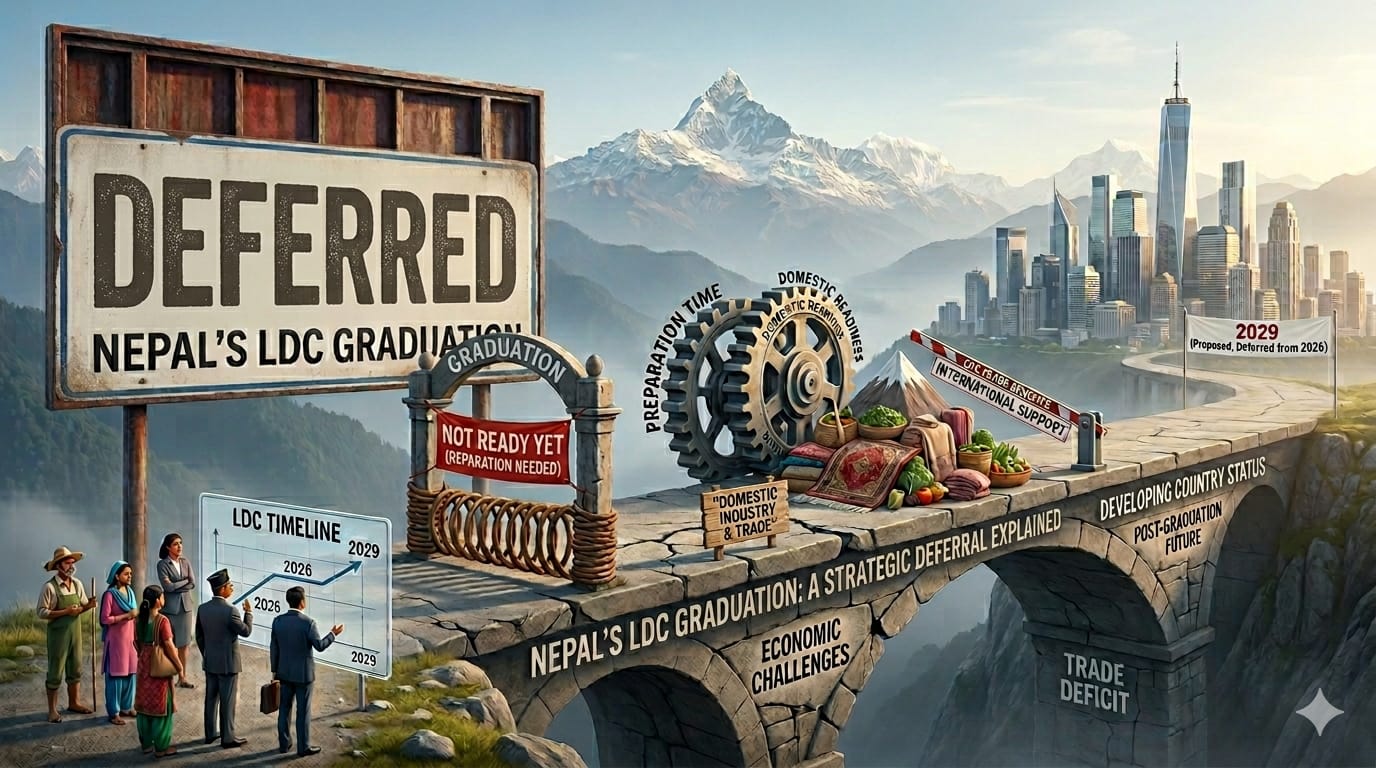
KATHMANDU: Nepal has been on the United Nations’ Least Developed Country list since 1971, the year the category was created. For over five decades, this status entitled the country to duty-free trade access, concessional loans, and various international support measures.
Nepal first became eligible to graduate in 2015 but deferred due to the earthquake. It deferred again in 2018, then accepted a five-year preparatory period in 2021, setting November 24, 2026 as the graduation date — a deadline it now plans to push back once more.
This explainer will delve into the historical background of Nepal’s inclusion in the LDC category, the criteria and timeline for graduation, reasons behind the deferred transition, the opportunities and risks that lie ahead, and the broader national and international significance of this development.
What exactly is the LDC category, and why does it matter so much?
The Least Developed Country category was created by the United Nations General Assembly in 1971 to identify nations facing the most severe structural obstacles to development — countries that were poor not just because of bad luck or bad policy in a particular year, but because of deep, systemic disadvantages.
The classification matters enormously because it comes with a package of international support measures that most people never hear about but that quietly shape a country’s economy every single day. Member countries on the LDC list receive duty-free and quota-free access to markets in wealthier nations, concessional loans at very low interest rates, exemptions from certain intellectual property rules (so they can, for instance, manufacture or import medicines without paying full patent fees), and technical assistance programs from the United Nations and its agencies.
For a landlocked country like Nepal — sandwiched between two massive economies and distant from the sea — these privileges are not a symbolic gesture. They are a genuine lifeline that affects what its industries can export, what it pays to borrow, and how much international goodwill it can count on.
How and when did Nepal first get put on the LDC list?
Nepal was placed on the original LDC list in 1971, the very year the category was established. At that time, the country was classified based on three characteristics that the UN had identified as markers of extreme underdevelopment: very low per capita income (Nepal’s was around US$70 per year), weak human assets in education and health, and high economic and environmental vulnerability. All three applied, and Nepal fit squarely into the new category.
It joined a group that was mostly African nations, making it one of the only South Asian countries on the list at the time. For the next five decades, Nepal remained there — surviving earthquakes, political upheaval, a decade-long civil war, the transition from monarchy to federal republic, and a global pandemic — while gradually improving its indicators without quite breaking free of the classification.
Fifty-five years is a long time to carry any label, and the LDC tag, for all the benefits it carries, has also become a kind of brand that Nepal’s own diplomats now say sends a discouraging signal about the country’s potential.
What are the criteria for graduating out of the LDC list, and how does Nepal measure up?
The UN’s Committee for Development Policy evaluates LDCs every three years using three specific indicators. The first is Gross National Income per capita — a country needs to sustain a GNI of at least US$1,306 per person to meet this threshold.
The second is the Human Assets Index, which measures education and health outcomes including school enrollment, literacy, child mortality, and maternal health — a score of 66 or above is required.
The third is the Economic and Environmental Vulnerability Index, which assesses how exposed a country is to economic and environmental shocks — a score below 32 is needed. To qualify for graduation, a country must meet at least two of these three criteria in two consecutive triennial reviews.
Nepal presents one of the most unusual cases in the history of this system. It has consistently passed the Human Assets Index and the Vulnerability Index tests — meaning it has genuinely improved its education and health outcomes and reduced its exposure to shocks. But it has repeatedly missed the income threshold.
In fact, Nepal is on track to become the only country in history to graduate from LDC status without ever having met the income criterion. In the 2024 triennial review, it missed the income target by just six dollars per person.
When did Nepal first become eligible for graduation, and what happened?
Nepal first cleared the thresholds on the HAI and EVI in the UN’s 2015 triennial review — the same year the catastrophic April 25 earthquake killed nearly 9,000 people, displaced millions, and wiped out infrastructure that the country had spent decades building.
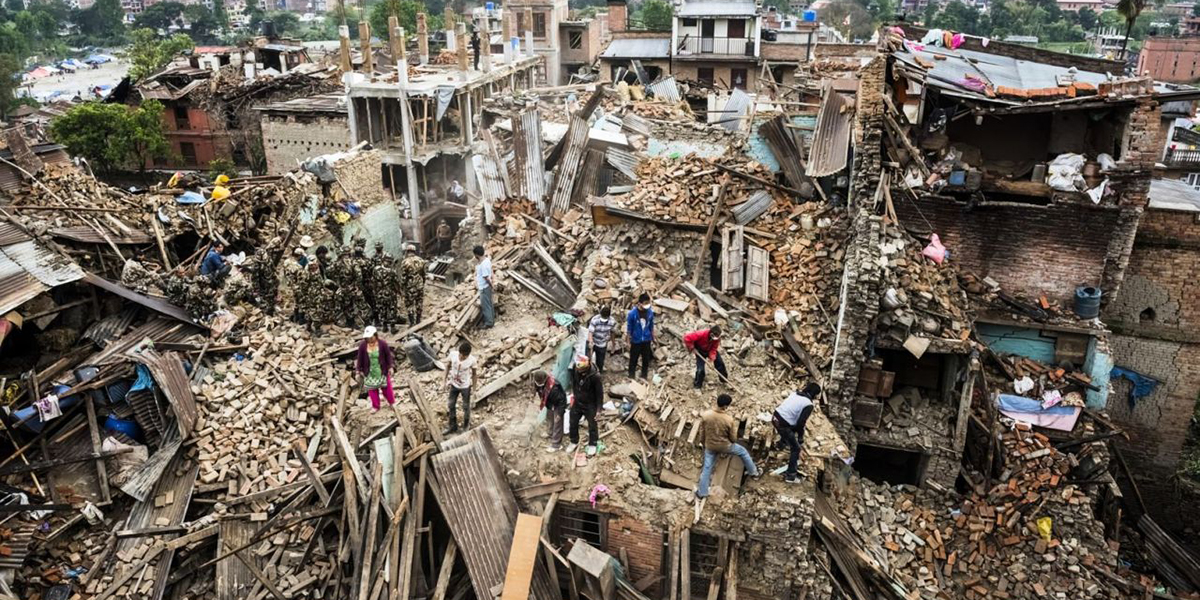
The devastating earthquake of April 25, 2015
The government, quite reasonably, asked the UN’s Committee for Development Policy not to push the graduation forward, arguing that the country needed time to rebuild and that graduating in such fragile conditions would strip it of international support precisely when it needed that support most.
The CDP accepted Nepal’s request and deferred any graduation recommendation. Three years later, in the 2018 review, Nepal again met the criteria. By this point reconstruction was underway but far from complete, and Nepal’s GNI per capita remained very low: at only around US$745, which was roughly 40 percent of what the income criterion required.
The government asked for another postponement, and that was granted too. Critics later pointed out that Nepal used those years to mark time rather than to genuinely prepare.
What happened in 2021, and why was the graduation pushed all the way to 2026?
In its February 2021 triennial review, the Committee for Development Policy once again found that Nepal met the graduation thresholds — this time with GNI at US$1,027, HAI at 75, and EVI at 24.7. Officially, the CDP formally recommended Nepal for graduation. However, the world was still deep in the COVID-19 pandemic.
Nepal’s economy had contracted by 2.4 percent in fiscal year 2019-20, tourism had collapsed, remittances were disrupted, and small enterprises across the country were struggling to survive. Nepal again requested additional time, but this time asked for five years rather than the standard three.
The UN agreed, meaning the official graduation date was set for November 24, 2026. Bangladesh and Laos were given the same five-year extension for the same reasons. The UN General Assembly formally endorsed this timeline in November 2021 through a unanimous resolution. That gave Nepal nearly a decade from when it first met the criteria to actually exit the LDC category — a preparatory window unlike almost anything in the history of the system.
What preparation did Nepal actually do during those five years?
In theory, the 2021-2026 period was supposed to be used to build the foundations for life after LDC status. The National Planning Commission developed a Smooth Transition Strategy in early 2024, which laid out four core objectives: preparing for a high-quality, sustainable exit from LDC status; minimizing the impact of losing LDC-specific support measures; identifying ways to use the opportunities that graduation would create; and setting goals for development beyond 2026.
The government also updated its Nepal Trade Integration Strategy in 2023, expanding the priority export product list from 12 items to 32 — adding things like electricity, cement, IT services, and various agricultural products. It engaged with the WTO, the EU, and bilateral partners to negotiate transition arrangements. On paper, there was activity. In practice, the execution was weak.
The Smooth Transition Strategy was not effectively implemented. Plans to negotiate Free Trade Agreements with China, Japan, Australia, and the United States produced no concrete framework or negotiations. Multiple governments came and went during this period without sustaining momentum on graduation preparation, and the September 2025 Gen Z protests came along before the work was anywhere near complete.
What were the September 2025 Gen Z protests, and how did they affect the graduation picture?
The Gen Z protests of September 2025 were a wave of mass demonstrations, primarily led by young people frustrated by corruption, unemployment, poor governance, and a government crackdown on social media that became the immediate trigger. The protests turned violent. Businesses were burned and vandalized across Nepal’s major cities. Infrastructure was damaged. The political order was upended, and the coalition government that had been managing the country was replaced.

Youth gathered in New Baneshwar during the Gen Z movement. Photo: Bikram Rai / Nepal News.
The economic toll was staggering. The Federation of Nepalese Chambers of Commerce and Industry estimated direct losses to the private sector at around Rs 88 billion, while broader estimates accounting for public infrastructure damage, lost opportunities, and job losses ran as high as Rs 3 trillion — roughly equivalent to one and a half times Nepal’s annual national budget, or nearly half of the country’s entire GDP.
More than 15,000 jobs were directly affected in the immediate aftermath. The protests came at the worst possible moment for a country fourteen months from a graduation that required investor confidence, a functioning private sector, and a stable business environment.
What trade benefits would Nepal lose upon graduation, and who would be most affected?
Graduating from LDC status means losing a carefully constructed architecture of preferential treatment that has quietly underpinned Nepal’s export economy for decades. The most significant losses fall in the area of trade access.
Under the European Union’s Everything But Arms initiative, LDCs like Nepal can export virtually all goods to the EU with zero tariffs and no quotas. This benefit has supported Nepal’s garment manufacturers, carpet exporters, and producers of handicrafts. It will phase out gradually after graduation.
In Canada, Australia, and China, there are separate duty-free and quota-free schemes specifically for LDCs that Nepal will lose eligibility for. Under the South Asian Free Trade Area, Nepal benefits from LDC-specific provisions. In the WTO system, Nepal has flexibilities on subsidies, export incentives, and pharmaceutical patent rules that other developing countries do not have.
The sectors most at risk are garments, textiles, carpets, and handicrafts — labor-intensive industries that employ women and people from economically marginalized communities in disproportionate numbers.
An International Labour Organization report released in March 2026 estimated that if graduation proceeds without effective preparation, up to 132,000 jobs could be lost within five years and economic losses could reach nearly US$1 billion.
Why is Nepal’s case particularly unusual globally?
Nepal is set to become the first country in the history of the LDC classification system to graduate without ever meeting the income criterion. Every other country that has graduated — Botswana, Cabo Verde, Maldives, Samoa, Equatorial Guinea, Vanuatu, and Bhutan — cleared the income bar as part of its graduation.
Nepal’s GNI per capita in 2024 was US$1,300, just six dollars below the threshold of US$1,306. By the time of the 2025 UN monitoring report, it had risen to US$1,404, finally crossing the line — but that was after the graduation recommendation had already been made and after a decade of not meeting the standard.
This matters because income is a blunt but important measure of whether people in a country can actually absorb the loss of international support. The fact that Nepal’s measured income has grown doesn’t mean the underlying economy is robust.
Economists point out that the growth has been driven substantially by remittances from overseas workers and by the re-export of products like refined soybean oil and palm oil rather than by genuine productive transformation of the domestic economy.
What about Nepal’s standing with international financial organizations and lenders?
Nepal’s position with international financial institutions is already shifting, independent of the LDC graduation. The World Bank and other multilateral lenders typically adjust the terms of their lending as a country’s income rises, moving it from the most concessional categories toward somewhat less generous terms.
Japan’s JICA — one of Nepal’s major bilateral lenders — provides its most concessional loans specifically to countries with both LDC and low-income status; graduation from LDC means these terms will phase out. South Korea’s loan terms are similarly set to become less favorable. Germany announced it would terminate its bilateral official development assistance to Nepal in 2025.
The combination of losing trade preferences and facing higher borrowing costs creates a compounding squeeze, particularly for a country that still relies heavily on external resources to fund its development budget. Nepal has never received a sovereign credit rating, which means it cannot easily tap international capital markets as a fallback.
Adding to these pressures, in February 2025 — months before the September protests — Nepal was placed on the Financial Action Task Force’s grey list for deficiencies in its anti-money-laundering and counter-terrorism financing framework, further dampening investor sentiment.
What role does India play in Nepal’s trade picture, and how does graduation affect that?
India absorbs roughly two-thirds of Nepal’s total exports, making it by far the country’s dominant trading relationship. The good news, from the graduation perspective, is that Nepal’s preferential market access in India is built into a bilateral trade treaty and is not tied to LDC status. That means the roughly 60 to 66 percent of Nepal’s exports going to India will not face new tariff walls when Nepal graduates.
Representative file image depicting trade at Nepal-India border
The bad news is that this creates a heavy dependence on a single market, and the other markets where Nepal does export — the EU, the UK, Japan, Canada, Australia, and Turkey — are precisely the ones where LDC-specific tariff preferences apply and will eventually be withdrawn.
Nepal’s exports to the EU and UK together account for only about four percent of total exports, but for the garment and handicraft sectors specifically, these are critical markets.
The India-EU Free Trade Agreement concluded in January 2026 adds another layer of complexity, as it will give Indian garment manufacturers preferential access to the EU — the same market where Nepal’s garments currently enjoy duty-free entry — creating new competitive pressure at precisely the moment Nepal is losing its own preference advantage.
What has the UN Committee for Development Policy said about the possibility of further delay?
The CDP’s position, as stated explicitly at its 26th Plenary Session in March 2024, was that it would not recommend any further extension of Nepal’s preparatory period beyond 2026. The CDP noted that Nepal had been making steady progress on its indicators, that the country had had an extended five-year preparation period rather than the standard three years, and that additional delay would not be appropriate.
This was before the September 2025 protests and before the scale of economic disruption became clear. The UN’s own 2025 monitoring report confirmed that Nepal had, by then, met all three graduation criteria — which would seem to strengthen the case for proceeding.
However, the UN system also has provisions for reconsideration in cases of extraordinary external shocks, and there is precedent for reviewing situations that materially change after a graduation recommendation is made.
How does Nepal’s situation compare to what Bangladesh did?
Bangladesh, one of the other two countries scheduled to graduate from LDC status in November 2026 along with Nepal and Laos, moved ahead of Nepal in seeking a formal delay. On September 25, 2025, the Bangladeshi government wrote to the United Nations requesting an independent assessment of its readiness for graduation, citing political and economic disruption following its own period of unrest.
Bangladesh’s case was somewhat different from Nepal’s — Bangladesh’s economy is considerably larger and more export-oriented, and it had estimated that immediate graduation could cost it approximately US$8 billion in annual export revenue.
The UN Office of the High Representative for Least Developed Countries agreed to conduct a comprehensive assessment. Bangladesh has formally sought deferral until 2029. Nepal’s economists and business leaders watched this process closely, and many argued that Nepal should follow a similar path.
The key difference was that Nepal’s exports — while vulnerable — were not on the same scale, and some analysts argued the argument for deferral was proportionally weaker, even as the economic disruption from the protests had been severe.
What were the arguments on the other side — those who said Nepal should proceed with graduation as scheduled?
The case for proceeding with the November 2026 graduation was not trivial. Some experts have argued consistently that the benefits of graduation outweigh the costs and that Nepal’s preparation, while imperfect, was not so deficient as to justify another delay.
They have pointed out that over two decades Nepal had achieved genuine improvements — school enrollment had risen, child mortality had declined, health infrastructure had expanded. Graduation sends a positive signal to international investors and rating agencies that a country has developed beyond its most fragile state.
Remaining on the LDC list indefinitely carries its own reputational cost — Nepal’s own Foreign Ministry officials began saying privately that being labeled a Least Developed Country for decade after decade sends a discouraging message about the country’s prospects.
Senior officials also noted that even without a formal deferral, LDC trade preferences continue for a transition period after graduation, giving the country additional breathing room to adjust.
What is the FATF grey listing, and why does it complicate graduation?
In February 2025, Nepal was placed on the Financial Action Task Force’s grey list, which identifies countries with significant weaknesses in their systems for combating money laundering and terrorism financing.
Being greylisted is not a catastrophic designation — it is not the same as being blacklisted — but it creates real-world consequences. Banks and financial institutions in other countries become more cautious about transactions involving greylisted countries. Correspondent banking relationships become more complicated.
Businesses and investors looking at Nepal see an additional layer of risk and compliance burden. For a country trying to improve its investment climate in preparation for losing LDC trade preferences, the grey listing came at the worst possible time.
It compounded the existing concerns about political instability and weak institutional capacity, and it made it significantly harder to argue that Nepal’s business environment was ready for the additional scrutiny that comes with graduating to developing country status.
What did Nepal decide on May 12, 2026?
After months of debate between economists, business groups, and government officials, Nepal’s National Planning Commission (NPC) made its decision on May 12, 2026 — just over six months before the scheduled November graduation date.
The NPC decided to formally seek a three-year deferral from the United Nations, aiming to push the graduation date to 2029. The private sector, led by the Federation of Nepalese Chambers of Commerce and Industry, had been pushing for this for several months.
Then Chief Secretary Ek Narayan Aryal had publicly stated in November 2025 that the government was rethinking the graduation timeline given the scale of damage from recent disasters and the September protests.
The decision means Nepal will need to submit a formal request to the UN Committee for Development Policy outlining the justification for the delay and the steps it plans to take during the additional time.
The move follows a path similar to Bangladesh, which made a comparable request earlier. It is Nepal’s third time asking for a postponement of a graduation that it has technically been eligible for since 2015.
What happens next, and what would a genuine graduation require?
Assuming the UN accepts Nepal’s request — which is not guaranteed, given that the CDP had previously indicated it would not extend the preparatory period — Nepal would have until 2029 to put its house in order.
The question that every economist and trade expert in Kathmandu has been asking is whether the country will actually use that time differently than it used the previous postponements. The pattern has been consistent: meet the criteria, ask for more time, and then not make meaningful progress during the extension.
Genuine preparation would require completing negotiations with the EU for Generalized System of Preferences Plus access — a scheme that requires ratifying 27 international conventions on human rights, labor standards, and environmental governance.
It would require substantive FTA negotiations with at least some key markets. It would mean implementing the existing Smooth Transition Strategy rather than letting it sit on a shelf. It would require rebuilding investor confidence through institutional reform and governance improvements.
It would mean addressing the FATF grey listing. And it would require political stability sustained long enough for businesses to plan and invest. None of these things is impossible. All of them are difficult.
Nepal’s graduation, when it finally happens, will only be meaningful if the country has genuinely changed — not just on paper, but in the lives of people across its villages and cities. The label matters far less than what lies beneath it.