Kathmandu
Friday, July 10, 2026





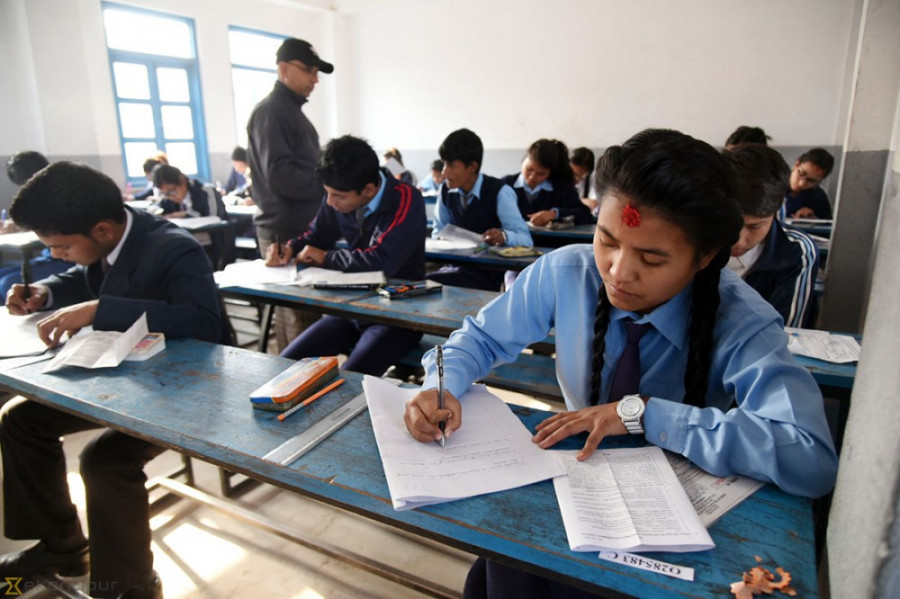
KATHMANDU: The Secondary Education Examination (SEE) for the 2026 academic session is scheduled to run from April 2, 2026, to April 12, 2026. This year’s examination calendar reflects a 12-day delay to accommodate the House of Representatives elections held on March 5. Approximately 517,000 students are registered to sit for the exams across the country, making it one of the largest coordinated academic events in Nepal.
In a significant policy shift, Education Minister Sasmit Pokharel has announced a complete ban on Bridge Courses and private entrance preparation classes, effective April 14, 2026. The Ministry has clarified that Grade 11 admissions will now be based strictly on school records and SEE results, with the objective of reducing the financial burden on families and the psychological stress on students during the transitional period between secondary and higher secondary education. This decision marks a structural change in how post-SEE academic competition is managed in Nepal.
What is the historical background and origin of the SEE in Nepal?
The tradition of national-level examinations in Nepal dates back to 1934, when the School Leaving Certificate (SLC) was first introduced as the country’s primary standardized examination system. In its early years, the structure and administration of the examination were heavily influenced by the British-Indian education model, reflecting Nepal’s limited institutional capacity at the time.
Notably, the exams were initially conducted under the supervision of Patna University in India, which played a central role in evaluating Nepali students.
It was not until 1946 that Nepal began independently conducting these examinations, marking a major step toward educational sovereignty.
For more than eight decades, the SLC remained the defining academic benchmark for students completing secondary education. However, as global education systems evolved toward grading-based evaluation rather than rigid pass/fail outcomes, Nepal initiated reforms to modernize its system. This culminated in the Education Act (Eighth Amendment) in 2016, which officially replaced the SLC with the Secondary Education Examination (SEE), aligning Nepal’s academic structure with contemporary international practices.
When did the SEE officially replace the SLC and why was the change made?
The SEE officially replaced the SLC in 2017, although the transition process began earlier with the introduction of the Letter Grading System in 2015. The first cohort of students appeared for the SEE in March 2017 under the new framework. While the renaming of the exam was the most visible aspect of the reform, the underlying objective was far more structural.
For decades, the SLC had been widely known as the “Iron Gate”, symbolizing a high-pressure examination that could determine a student’s entire academic and professional future. A single failure meant losing a year, reinforcing a rigid and stressful system.
By rebranding the exam as SEE and shifting the “School Leaving Certificate” status to Grade 12, policymakers aimed to reduce the psychological burden on students at the Grade 10 level. The reform sought to reposition Grade 10 as a transitional academic stage rather than a terminal point, encouraging a more flexible and continuous learning pathway within Nepal’s education system.
Who is responsible for conducting the SEE?
The SEE is administered by the National Examination Board (NEB) through the Office of the Controller of Examinations (Class 10) located in Sanothimi, Bhaktapur. Prior to the reforms introduced by the 2016 Education Act, the SLC examinations were conducted by the Office of the Controller of Examinations (OCE) under the Ministry of Education.
The establishment of the NEB was intended to centralize and standardize examination systems across both Grade 10 and Grade 12, ensuring consistency in evaluation and certification. While the NEB retains authority over certification and national standards, Nepal’s 2015 Constitution and subsequent Local Government Operation Acts have introduced a degree of decentralization in the education sector.
Provincial and local governments now play an increasing role in logistical arrangements, monitoring, and management of examination centers. Despite this decentralization, the SEE certificate remains a nationally recognized credential, maintaining uniform academic equivalence across the country.
How has the examination format evolved over the decades?
The format of Nepal’s secondary-level examination has undergone significant transformation over the decades. In its early years, the system was entirely subjective and percentage-based, with students required to achieve an aggregate score of 32% to pass.
The evaluation emphasized rote memorization and theoretical knowledge, with limited focus on practical application. Over time, reforms have introduced application-based questions, encouraging analytical thinking and problem-solving skills. One of the most notable changes has been the inclusion of practical assessments.
Currently, most compulsory subjects follow a 75:25 evaluation ratio, where 75 marks are allocated to the written theoretical exam and 25 marks are derived from internal practical assessments conducted by schools. This represents a major shift from earlier practices, where subjects such as Social Studies and English had no practical components.
Additionally, the format and structure of question papers have been standardized across Nepal’s seven provinces to ensure uniformity in difficulty level and curriculum coverage, thereby promoting fairness and comparability in student performance nationwide.
How does the current GPA ranking system work?
Nepal currently follows a 4.0 scale Letter Grading System for evaluating SEE performance. Unlike the previous pass/fail model, this system assigns grades based on the percentage of marks obtained in each subject, thereby providing a more nuanced assessment of student achievement.
The grading scale ranges from A+ (GPA 4.0) for scores between 90% and 100%, down to D (GPA 1.6) for scores between 35% and 39.9%. A critical feature of the current system is the Non-Graded (NG) provision.
To qualify for Grade 11, students must secure at least 35% in the theoretical (written) component of each subject. Failure to meet this minimum threshold results in an NG designation, regardless of performance in practical assessments.
Students receiving an NG are not eligible to progress to higher studies until they clear the subject through a supplementary examination. This rule reinforces the importance of core academic competency while maintaining flexibility through opportunities for grade improvement.
Why is the SEE different from high school board exams in other countries?
The SEE stands out as a transitional mid-secondary national examination, a feature that distinguishes Nepal’s education system from many others globally. In most Western education systems, there is no centralized national board examination at the Grade 10 level; students are typically assessed internally by their schools until they complete Grade 12.
In Nepal, however, the SEE continues to hold significant academic, institutional, and cultural importance. Historically, the SEE (and previously the SLC) functioned as a primary filter for entry into the labor market, with many jobs requiring this qualification as a minimum standard. Even today, various government services and security forces use SEE certification as an eligibility criterion.
Furthermore, the scale of the examination is notable, involving nationwide coordination, strict security protocols, and even the mobilization of the national army for transporting question papers. This level of organization and significance is uncommon for a Grade 10 examination, making the SEE a uniquely high-stakes academic event.
What are the major obstacles students face while appearing for the SEE?
Students across Nepal encounter a wide range of challenges while preparing for and appearing in the SEE, many of which are shaped by geographic and socio-economic disparities.
In remote Himalayan and hilly regions, students often have to travel several hours on foot to reach designated examination centers, and in some cases, they stay in temporary accommodations for the duration of the exam period. This logistical burden adds to the stress of the examination itself.
Additionally, the digital divide remains a significant barrier. Students in urban areas generally have access to private coaching institutes, online learning platforms, and better educational infrastructure, whereas those in rural regions often face shortages of qualified teachers, particularly in subjects like Science and Mathematics.
This disparity is reflected in performance trends, with community (government) schools consistently recording lower pass rates compared to private (institutional) schools. These systemic inequalities highlight the uneven distribution of educational resources and opportunities across the country.
What subjects are included in the SEE curriculum?
The SEE curriculum is structured to provide a comprehensive educational foundation, consisting of six compulsory subjects and two optional subjects.
The compulsory subjects include English, Nepali, Mathematics, Science and Technology, and Social Studies, ensuring that all students acquire core competencies across key academic areas. In addition to these, students are required to select two optional subjects based on their interests and future academic goals.
Popular choices include Optional Mathematics, Computer Science, Accountancy, and Economics, among others.
For students enrolled in the Technical Stream, the curriculum differs significantly, focusing on specialized vocational subjects such as Civil Engineering, Agriculture, or Electrical Engineering. This stream is designed to equip students with practical skills that enable them to either enter the workforce directly after Grade 10 or pursue further technical education.
The dual-track system reflects Nepal’s effort to balance academic and vocational pathways within its education framework.
How is the “Iron Gate” perception changing in the modern context?
The metaphor of the “Iron Gate”, historically associated with the SLC, has evolved in the context of the SEE, though it has not entirely disappeared. In the past, failing a single subject meant failing the entire examination, effectively blocking a student’s academic progress.
The introduction of the grading system has reduced this rigidity and softened the stigma associated with failure. However, the pressure has not been eliminated; it has instead shifted in form. Competition for Science stream enrollment in Grade 11 remains intense, with colleges imposing strict GPA requirements and subject-specific criteria.
As a result, students who pass the SEE may still find themselves unable to pursue their desired academic paths if their grades are not sufficiently high.
In this sense, the “gate” continues to function as a filtering mechanism, determining access to future educational and career opportunities, albeit in a less absolute but still significant manner.
What role does the Technical Stream play in the SEE system?
The Technical and Vocational stream plays a crucial role in diversifying Nepal’s education system by offering an alternative to the traditional academic pathway. Introduced to address issues of unemployment and skills shortages, this stream focuses on practical, skill-based education tailored to specific industries.
Students in the technical stream study specialized subjects related to fields such as engineering, agriculture, and electrical work, with a curriculum that emphasizes hands-on training and field experience.
The evaluation system for these students places greater weight on practical and field-based assessments, reflecting the applied nature of their studies.
This approach enables students to acquire job-ready skills by the time they complete Grade 10, allowing them to enter the workforce as junior technicians or pursue further technical training.
The government has actively promoted this stream as part of a broader strategy to decentralize economic opportunities and strengthen local labor markets, particularly in rural areas.
How are SEE question papers prepared and secured?
The preparation and distribution of SEE question papers involve one of the most secure processes within the Nepali administrative system. Subject experts and experienced educators are selected to draft multiple sets of question papers under strict confidentiality, often working in isolation to prevent leaks.
Once finalized, the papers are printed under high-security conditions, with the involvement of security agencies, including the Nepal Army, in the transportation process. The printed papers are then dispatched to district headquarters, where they are stored in police lockers until the day of the examination.
On each exam day, the papers are transported to designated centers under police escort and are opened only shortly before the examination begins, in the presence of the Center Superintendent and other officials.
These stringent measures are designed to maintain the integrity of the examination and prevent incidents of question paper leakage, which have historically led to cancellations and public unrest.
What are the rules regarding supplementary and grade increment exams?
The National Examination Board provides students with an opportunity to improve their performance through Grade Increment (supplementary) examinations. Students who receive a Non-Graded (NG) result in up to two subjects are eligible to sit for these exams, which are typically conducted within one to two months after the publication of SEE results.
This system allows students to rectify their performance without losing an entire academic year, enabling them to join the ongoing Grade 11 academic session. However, the policy is stricter for students who fail in more than two subjects.
In such cases, they are required to retake the full set of examinations in the following year’s regular cycle, effectively extending their academic timeline by one year. This approach balances flexibility with academic standards, ensuring that students meet minimum competency requirements while still having pathways for recovery.
How did the pandemic permanently alter the SEE structure?
The global COVID-19 pandemic caused an unprecedented disruption to Nepal’s education system, leading to the cancellation of physical SEE examinations in 2020 and 2021. During this period, the government adopted a system of internal assessments, allowing schools to evaluate and grade their students based on continuous performance.
This marked a significant departure from the long-standing tradition of centralized national examinations. While the approach ensured academic continuity, it also raised concerns about grade inflation and inconsistencies in evaluation standards across schools.
In the aftermath of the pandemic, the NEB reinstated physical examinations but also incorporated lessons learned from this period. There is now an ongoing policy discussion about integrating formative and continuous assessment methods into the system, reducing reliance on a single high-stakes examination.
Although the SEE remains the primary national benchmark, the pandemic has accelerated debates around long-term structural reform in Nepal’s education system.
What was the Bridge Course culture before the recent government ban?
Before the government’s recent ban, the Bridge Course system had become a prominent feature of Nepal’s post-SEE academic landscape, particularly in urban centers. These courses were designed to prepare students for Grade 11 entrance examinations, which are conducted by competitive higher secondary schools and colleges with limited seats.
Bridge courses typically covered advanced topics bridging the gap between Grade 10 and Grade 11 curricula, with a strong focus on subjects like Science and Mathematics. They also helped students adapt to multiple-choice question formats and improve skills such as English proficiency and computer literacy.
For many students, enrolling in a bridge course was seen as essential for gaining admission to prestigious institutions. However, the system also imposed significant financial costs on families and contributed to academic pressure during what was traditionally a break period.
The government’s decision to ban these courses reflects an attempt to create a more equitable and less stressful transition process.
What is the socio-economic impact of SEE results on Nepalese families?
The SEE is not merely an academic examination in Nepal; it is a significant social and economic event that affects entire families and communities. The publication of results often triggers widespread public attention, with relatives, neighbors, and social networks closely following students’ performance.
High achievement brings prestige and recognition, while lower grades can lead to social stigma and emotional stress. Economically, SEE results play a critical role in determining access to scholarships and quality education opportunities.
Both government programs and private institutions offer financial support to high-performing students, particularly those from community schools and disadvantaged backgrounds.
For many low-income families, a strong SEE performance represents a crucial pathway to upward mobility, enabling access to better educational institutions and future employment prospects. As such, the SEE continues to occupy a central place in Nepal’s social fabric, shaping aspirations, opportunities, and life trajectories.
Notable Past Achievers: Where Are They Now?
Baburam Bhattarai (1969) served as the Prime Minister of Nepal and is widely recognized as an architect and political leader who played a significant role in shaping the country’s modern political landscape.
Kishore Thapa (1974) went on to become a senior government secretary and is known for his expertise in urban planning and policy development in Nepal.
Luna Bhatta (1981) made history as the first female board topper and later established herself as a senior physician based in the United States.
Prakash Thapaliya (1992) has built a distinguished career as a leading scientist and researcher specializing in optics and photonics.
Bishwo Bandhu Bagale (1996) is recognized as a senior medical professional and surgeon with contributions to healthcare services.
Bishal Gyawali (2002) has gained international recognition as a global oncologist and currently serves as an associate professor at Queen’s University.
Samir Shrestha (2004) has established himself as a software engineer and tech entrepreneur in Silicon Valley, representing Nepal’s growing presence in the global technology sector.