Kathmandu
Tuesday, July 21, 2026





A principle may die, but values must not die. An ideology may be false, but conscience must remain true.
In modern political history, principles have been presented as symbols of human liberation, equality, and justice. The emotional impulse created by political slogans during anyone’s adolescence is not an individual experience, but a shared psychology of universal political socialization. Althusser has called ideology the imaginary relationship of individuals to their real conditions of existence. That is, ideology denotes the imaginary relationship of an individual with the real condition of their existence. According to this concept, people view their socio-economic reality through the lens of ideology (such as religion, justice, patriotism), due to which they feel an imaginary yet powerful relationship with that reality. Such a perspective is not always correct. Because of this imaginative relationship, ideologies appear revolutionary during youth. Along with youth, a bitter truth mixed with maturity and political consciousness is unveiled: ideologies survive, but principles die.
Explanation
The death of principles is not biological, but moral and practical. A principle that is not applied in practice remains confined only to speeches and manifestos. No matter what the principle is, it begins to be used in a contrary manner in practice. At such times, principles do not remain alive but end up becoming a dead ideology. Hannah Arendt considered the most dangerous aspect of ideology in modern politics to be its mechanical application, where automated loyalty takes the place of human conscience. This is exactly what is seen in the Nepali context: the principle that communism is the power of the people became confined in practice to the privilege of a specific class. Secularism, instead of tolerance, turned into a comprador structure. The republic became a project of the redistribution of power rather than civic dignity.
Looking at it from an international perspective, this is not a problem exclusive to Nepal. The collapse of the Soviet Union, the market-oriented transformation of Chinese communism, and the dominance of the elite class (corporate capture) in Western liberal democracy have shown that once principles are connected with power, they lose their moral conscience. Gramsci has said—if ideologies separate from public consciousness and become merely instruments to maintain dominance, they transform into hegemonic ideology (hegemonic ideology). This exact hegemony appears dominant in the Nepali political structure. That is, here, principle is the language of power, not the guidance of life.
The most serious consequence of this process is seen in youth. Youth believe in ideology, not in political parties. After youth experience a practical betrayal in ideology, disappointment, silence, and political alienation are born. This silence, in Paulo Freire’s words, is the culture of silence (culture of silence). In places with such a culture, the oppressed stop speaking because language no longer brings liberation, but deception. In this way, the funeral procession of principles is not only an ideological crisis, but also a crisis of democratic consciousness.
Post-Principle politics: Values, conscience, and comparison
The death of principles raises an important question—can politics exist without principles? The answer is not simple. History, however, shows that values exist at a deeper level than principles. Ideologies are changeable according to time, place, and context, but values (self-respect, integrity, compassion, justice) are comparatively timeless. John Rawls, placing justice above any specific ideology, brought forward the recognition that fairness is justice. This shows that value-based politics is not only possible but necessary.
There are examples of value-centered leadership in both Eastern and Western traditions. Buddha did not propose any political principle, but brought about social transformation through the values of compassion and the middle path. Gandhi prioritized self-control and truth over state power. Mandela made reconciliation, not revenge, a political value. All these examples show that ideology lives first in life, and only after that does it spread in society.
Comparatively speaking, it has been seen that when politics begins to run only on the monopoly of principle, ideological hypocrisy (ideological hypocrisy) is born. Liberalism becomes a puppet under the influence of foreign powers. Nationalism becomes a factor for ethnic and cultural division. Religion becomes a source of enmity instead of social unity. Charles Taylor has warned that when there is a lack of values in modern identity politics, identity itself becomes violent. The ethnic, religious, and regional polarization seen in Nepal is the result of this value-void principle.
In this context, calling it ‘the funeral procession of principle’ is not pessimism, but a warning. It is a cautiously made call stating that now politics must belong not only to ideology, but to conscience as well. Conscience means critical consciousness, which does not accept any principle as the ultimate truth. Jürgen Habermas has considered democracy as a continuous process of dialogue and criticism. He is not ready to accept the rule of fixed principles. In such a democracy, the role of an intellectual is broader than an electoral constituency. Politics remains as the moral guardian of society.
A principle may die, but values must not die. An ideology may be false, but conscience must remain true. If Nepal cannot assimilate this transition from principle toward values, the funeral procession of political principles will continue. If values can be placed back at the center, a new moral politics can take birth from that very silence. If this happens, however, the funeral procession of principle can also be stopped.
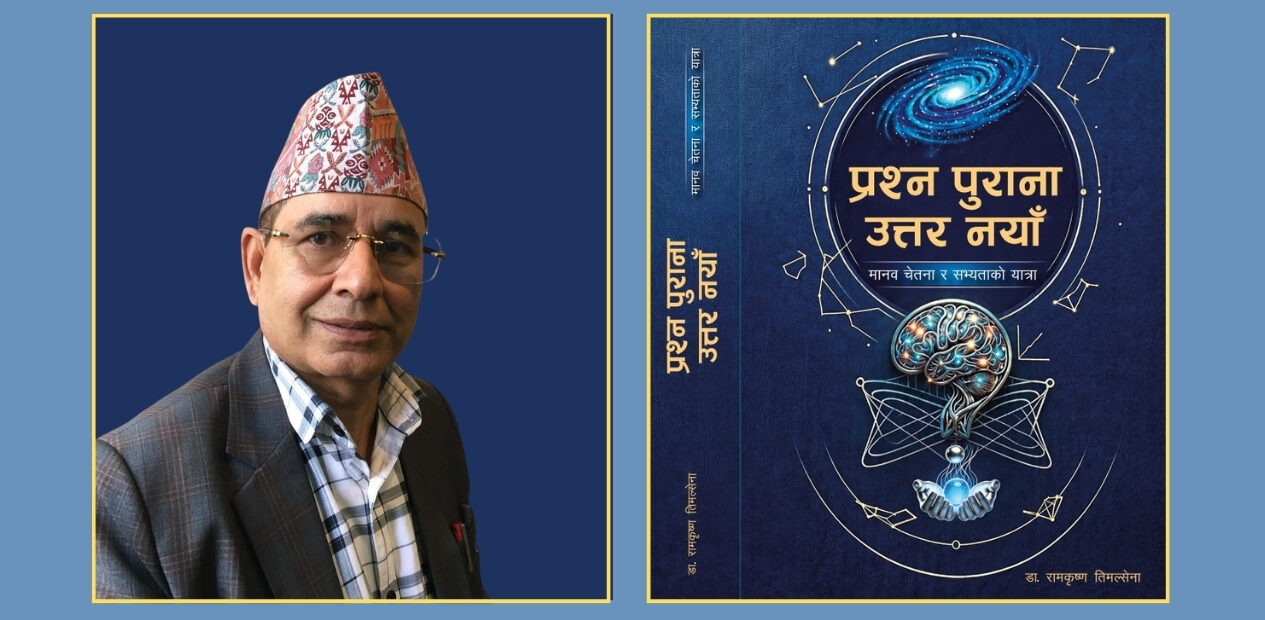
(An excerpt from the book ‘Prashna Purana Uttar Naya’ (Old Questions, New Answers) written by the former Registrar of the Supreme Court, Ram Krishna Timalsena. The book is being launched on May 31 (Sunday).)