Kathmandu
Tuesday, July 21, 2026





Unplanned road expansion across the Annapurna region is shortening iconic trekking routes and forcing visitors to trade Himalayan vistas for dust, traffic and muddy motor roads.
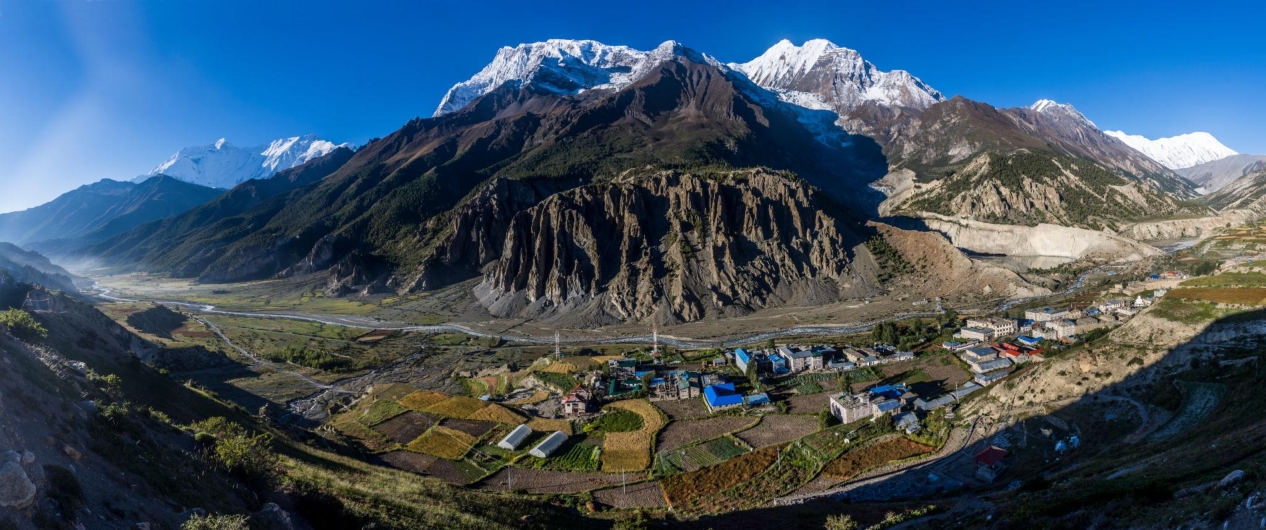
POKHARA: Until a few years ago, reaching Ghorepani in Myagdi required a five-day walk. Today, after catching a jeep from Pokhara, one can arrive there in just a few hours.
The Ghorepani–Poon Hill trekking trail, located in the Annapurna Conservation Area, is a top choice for tourists visiting to witness blooming rhododendrons in March–April and clear mountain vistas during the autumn season. Jeeps now ply roads where only trekkers once walked. Trekkers are now forced to walk on the very same motor roads—wading through mud during the monsoon and braving choking dust in the winter.
The road network has affected more than just the Ghorepani–Poon Hill trek; most traditional trails across the Annapurna Conservation Area have been integrated into roads. While roads have eased travel for locals—making it easier to transport patients to hospitals and deliver daily necessities—they have shortened the distance of world-famous treks and diluted the overall experience and charm.
Once starting from Lamjung, completing the Annapurna Circuit Trek used to take up to three weeks. Today, jeeps reach Chame, Manang village, and Khangsar, shortening the journey to around 10 days.
Even tourists who wish to walk are forced to use the motorable roads for large portions of the route.
Lost in the dust
Pema Tshering Gurung of Manang Ngisyang Rural Municipality-6 says tourists frequently complain about having to walk on roads. “Tourists complain about the dust. But what can be done?” he asks. “Previously, the Annapurna Circuit was ranked among the top 10 trekking trails in the world. Now, the condition has deteriorated. When dust completely covers you even while sitting inside a vehicle, one can only imagine the plight of those walking on the road.”
He expresses disappointment that despite repeated requests to construct separate footpaths alongside the roads, their pleas have gone unheard. He notes that building a separate trail just a hundred or two hundred meters away from the motor road would provide immense relief to tourists.
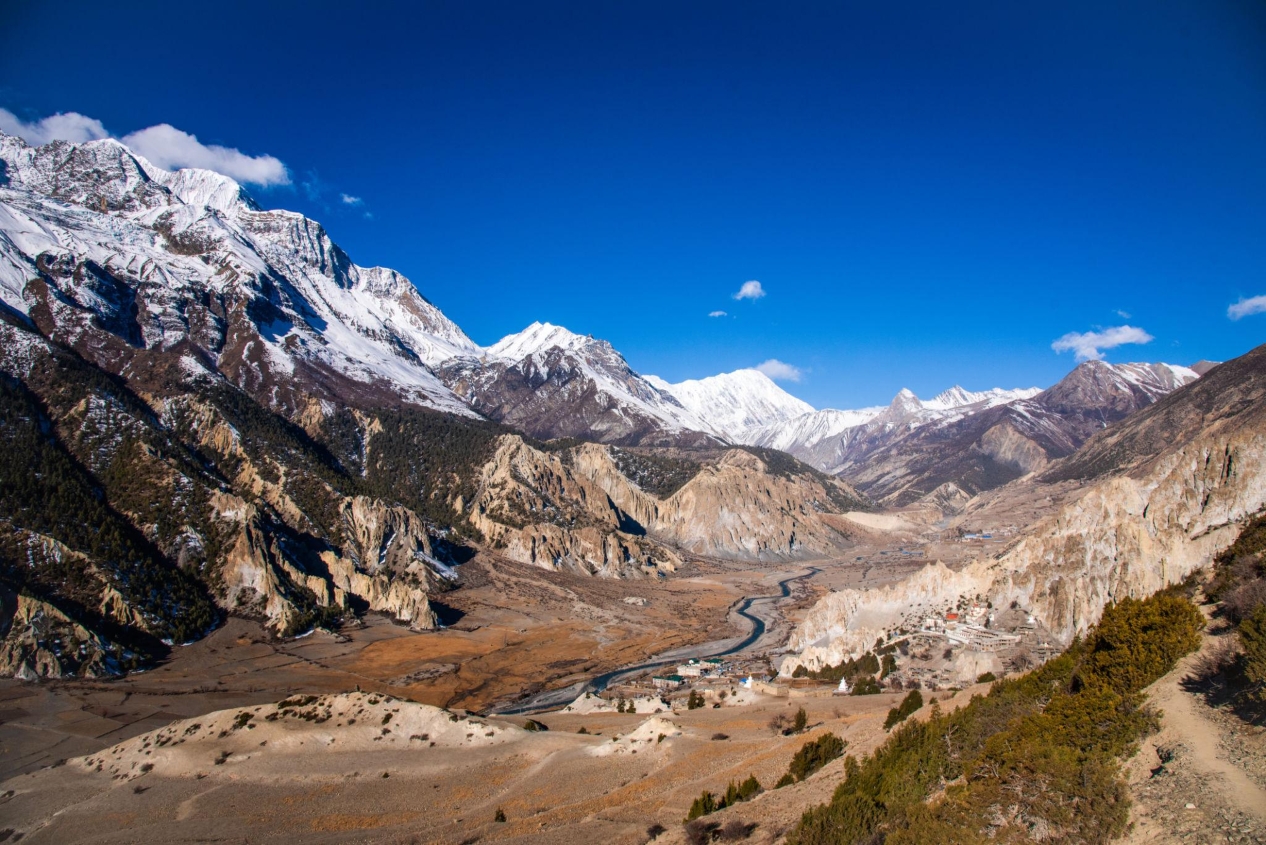
Annapurna Region. Photo Source: Wikimedia Commons
The Annapurna Conservation Area Project (ACAP) has constructed alternative trails along some sections of the Annapurna Circuit. Heading up from Chame toward Pisang and Manang village, some segments allow walkers to bypass the road. However, in most areas, tourists are still forced to walk on roads busy with vehicular traffic.
Pema stresses that relying solely on ACAP to construct alternative trails is not enough; local communities and local governments must also take the initiative.
“ACAP has built some tracks around Humde and Pisang villages,” he says. “It is also the responsibility of the locals to develop trekking trails in their own villages. If every village builds paths in its area, the work will get done. For cliffside or challenging terrains, plans can be requested from the government.”
The convenience brought by roads
For local residents, roads are not just about tourism; they are a fundamental infrastructure linked to healthcare, education, markets, and daily life.
Karma Gurung of Manang Ngisyang Rural Municipality-6 notes that local life has become significantly easier since the roads arrived. “In the past, if someone fell ill, we had to carry them all the way to Lamjung or call a helicopter,” he says. “Not everyone had the money to hire a helicopter. Now, we can take patients immediately by vehicle. That is the best aspect of having roads.”
While extending roads to settlements and markets is necessary, stakeholders note that expanding roads without adequate study and long-term planning has put trekking routes at risk.
Karma mentions that domestic tourist arrivals in Manang have increased following road connectivity, somewhat energizing the local tourism business. However, he has observed a negative impact on tourism due to a decline in foreign trekkers. “Transportation has provided convenience, but other aspects of tourism are worsening,” he remarks. “The arrival of roads has impacted traditional trekking.”
He expresses frustration that despite requests to ACAP for alternative trails, progress has not met expectations. “ACAP collects entry fees from tourists, but it hasn’t built sufficient alternative trails,” he says. “If they cannot do the work, let the local government collect the fees. The local government can build the trails.”
Roads following trekking trails
Stakeholders point out that while connecting settlements and markets to roads is essential, road expansion without proper study and long-term planning has thrown trekking routes into crisis.
Their grievance is not with the construction of roads itself, but with turning the historic footpaths used by tourists directly into motorable roads.
Rabin Kadariya, head of ACAP, acknowledges the issue, admitting that problems arose because roads were built directly along traditional trekking routes.
“Where there used to be a walking path, a motor road has taken over. That is why this problem occurred,” he says. “In some parts of Manang and Mustang, alternative trails have been constructed to bypass the roads. Nevertheless, in many places, tourists still have to walk on the roads and face dusty conditions.”
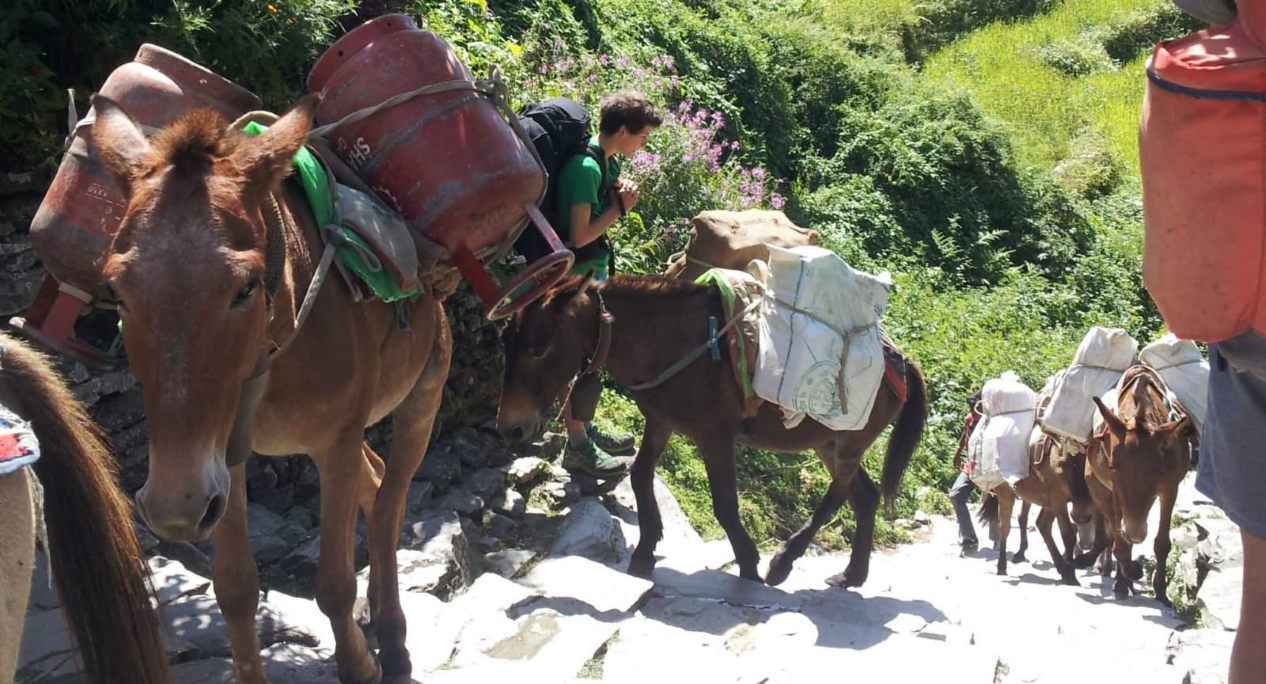
Transportation of goods via mules on the Annapurna Trekking Trail. Photo: Prabhakar Gautam
Kadariya explains that ACAP is preparing to separate old trails from roads where feasible and to develop new, road-free trails as tourist destinations.
However, due to geographical constraints, bypassing roads to build alternative routes is not easy everywhere. Rivers run through some sections, while steep cliffs line others. In several places, old trails have also been damaged by hydroelectric projects and natural disasters.
Some tourists starting their trek from Jagat in Lamjung still use the old path to reach Tal. However, trails above Tal have been severely impacted by floods, roads, and hydropower projects.
“We are conducting studies to see if the trail can be diverted into the forest away from the road in certain areas,” Kadariya says. “However, due to rivers and steep cliffs, creating alternative routes is difficult in many places. Local levels, committees, and ACAP are working together where feasible.”
Lost experience as treks shorten
According to trekking guide Pratikshya Khanal, tourists do not come to Annapurna merely to walk on dirt roads. They arrive expecting the natural environment and authentic trekking experience of the classic Annapurna Circuit. “Tourists come with expectations of the Annapurna Circuit as it used to be,” she says. “However, we are currently unable to offer the core experience that Annapurna once provided. Since people have to walk on motor roads in many places, they end up asking for alternative circuits.”
Efforts are underway to promote new, roadless trails in the Annapurna region as alternatives. Pratikhya suggests that trails in the Dhaulagiri and Manaslu regions could also be promoted as viable substitutes.
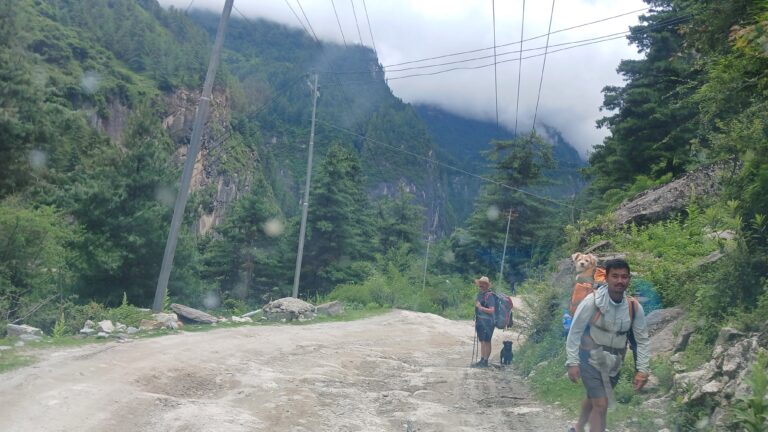
Trekkers walking on a newly built road in the Annapurna region. Photo: Reena Thapa
However, she emphasizes that no other trail can truly replace the unique identity of Annapurna. The Annapurna Circuit offers an unmatched combination of diverse topography, cultures, climates, vegetation, and Himalayan vistas in a single journey. “The biodiversity and natural beauty that Annapurna offers cannot be matched by other trails,” she says. “Therefore, to save the Annapurna Circuit, alternative trails must be built, even if slightly above or below the road.”
Alternative trails do not necessarily need to be long. She notes that even paths that simply distance trekkers from vehicular noise, dust, and traffic could preserve the classic Annapurna experience to some extent.
In search of new destinations
Krishna Acharya, President of the Trekking Agencies’ Association of Nepal (TAAN), stresses that because traditional trails are shrinking due to road expansion, new destinations must be identified and promoted. “Trekking routes are shortening because of roads,” he says. “If we do not explore and promote new destinations, tourists coming to Nepal might divert to other countries or regions.”
He mentions that TAAN has recently been working on promoting and upgrading trekking routes in the Dhaulagiri region. He emphasizes that mistakes made in the Annapurna region must not be repeated when developing new trails.
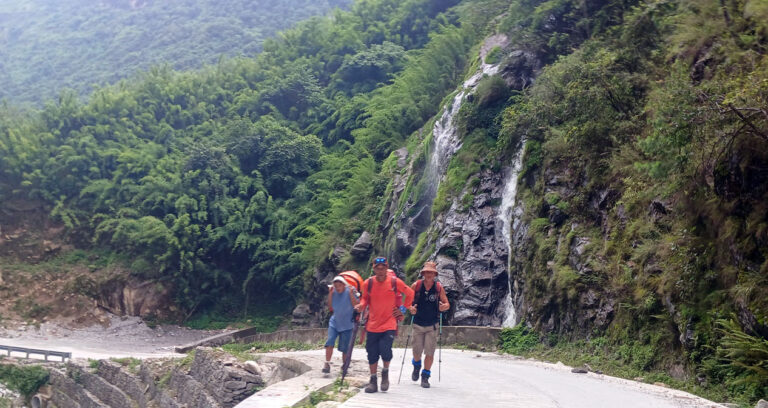
Trekkers on the Annapurna Trekking Trail. Photo: Reena Thapa
However, Acharya’s experience shows that simply building an alternative trail on the opposite side of a road isn’t always an easy fix for trekkers. “Attempts were made in Manang and Mustang to open alternative trails across the river from the road,” he says. “However, when a motor road is right across the way, it becomes mentally difficult for tourists to walk a longer path. Merely creating alternative tracks is not enough; they must also offer a meaningful trekking experience.”
Roads have undeniably provided healthcare, market access, and transportation conveniences to the residents of the Annapurna region. Therefore, stakeholders emphasize that it is not a matter of choosing between roads or trekking trails. Instead, a balanced plan is needed—one that extends roads to settlements while safeguarding distinct, off-road paths for trekkers, free from dust, mud, and traffic.
Acharya concludes, “Whatever has been ruined is ruined. Now, we must protect the trails that remain intact.”