Kathmandu
Tuesday, July 14, 2026





Sidelining the top leaders of the old parties, Sushila Karki and Balen Shah, who were not even active within party politics, have become the center of power and influence in Nepal

KATHMANDU: In 2082 BS (2025/26), unimaginable change appeared in Nepali politics. In this year, the very power center of politics shifted. The primary reason was the Gen Z movement of September 8 and 9, 2025. The Gen Z movement did not only dissolve the government and parliament; it also made former Chief Justice Sushila Karki the executive head. Karki’s arrival in power politics was not just unexpected but sudden.
The Nepali Congress, CPN (UML), and the then-Maoist party, which had taken turns holding power for three decades, have been caught in extraordinary crisis after the Gen Z movement. The CPN (Maoist Center) even changed its party name after the Gen Z movement, transforming into the Nepali Communist Party (NCP). Since the Gen Z movement was focused precisely against the old establishment, old parties and their leaders were in the movement’s crosshairs. The digital revolt that began on social media against “nepo babies” and “nepo kids” had already turned into a terrifying storm by the time it reached New Baneshwar at noon on September 8, 2025.

Youth gathered in New Baneshwar during the Gen Z movement. Photo: Bikram Rai / Nepal News
After the March 5 election, itself caused by the Gen-Z movement, three former Prime Ministers have been displaced from power and parliamentary politics. The Nepali Congress’s then-president Sher Bahadur Deuba was displaced as president even before the general election through a special party convention and did not even participate in the parliamentary election. Former Prime Minister and UML Chairperson KP Sharma Oli was defeated in Jhapa-5, and another former Prime Minister Madhav Kumar Nepal in Rautahat-1. Former Prime Minister and NCP Chairperson Pushpa Kamal Dahal was elected from Rukum East, but his political power has weakened. Many had assessed that Dahal would have been defeated had he not gone to Rukum East. After RSP won 182 seats in the House of Representatives election, old parties’ standing in parliament has become defensive.
The results of the House of Representatives election have completely overturned the landscape of power and parliamentary politics. In 2082 BS, old parties and many of their leaders have been pushed to the margins of parliamentary politics. The new House of Representatives has become the home of new parties and youth. So much so that 2082 BS is remarkable not only in terms of political trend change but also in terms of change of characters. Most former Prime Ministers have left the political field; their place was taken before the election by Sushila Karki and after the election by former Kathmandu Mayor Balendra Shah (Balen). Political science professor Lok Raj Baral says, “Citizens had sought change, and that change came through the election itself. Old political forces went out, and new ones rose.”
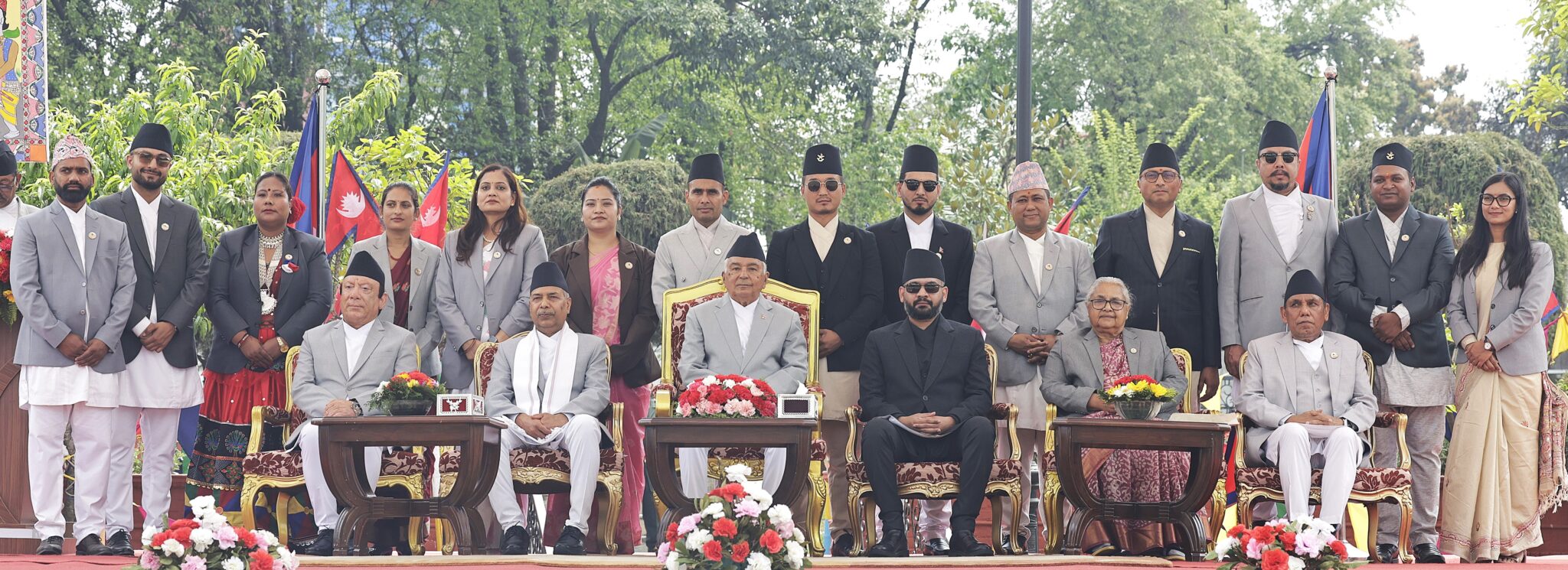
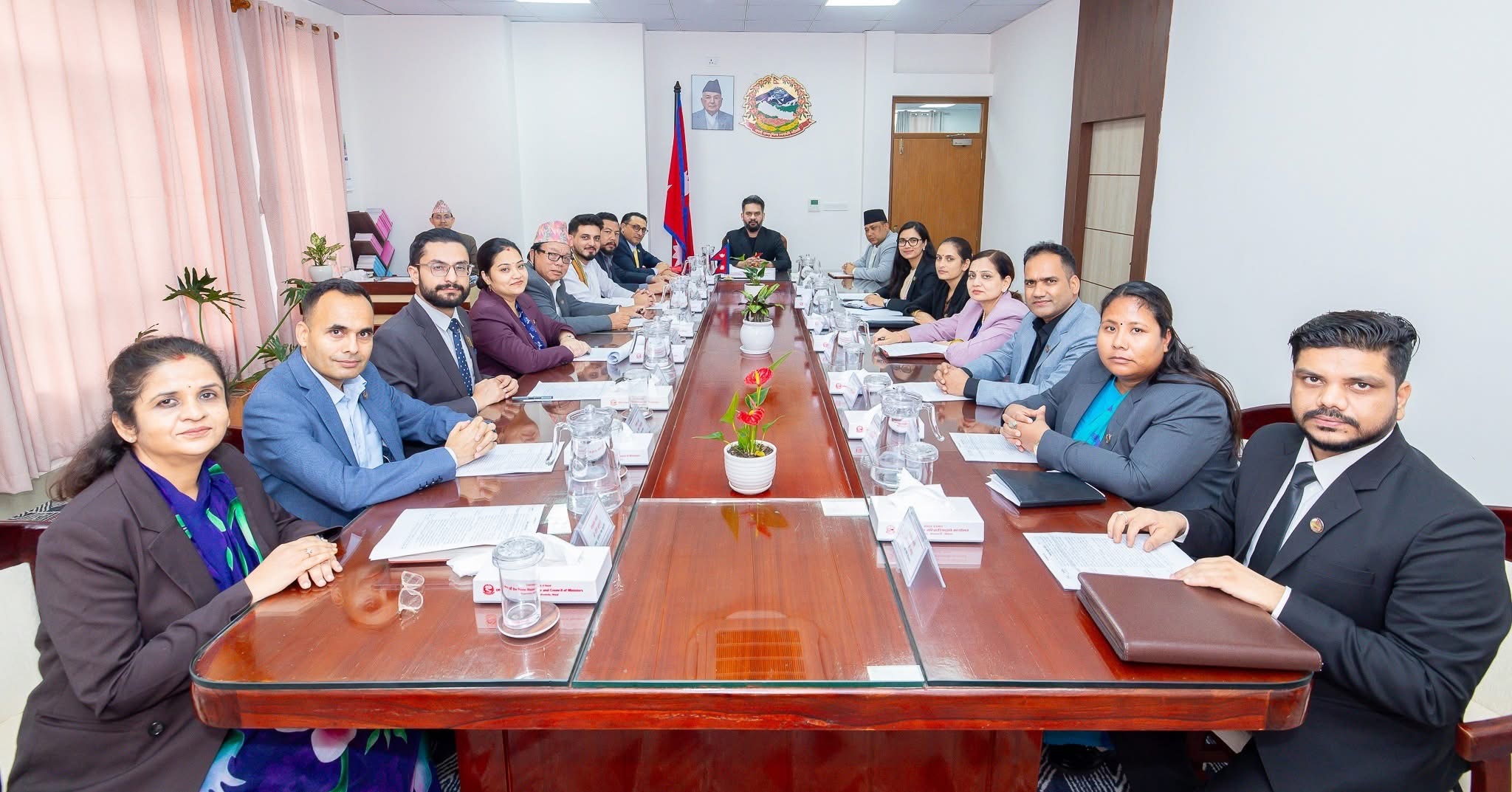
On March 27, after newly appointed Prime Minister Balen Shah took the oath of office and secrecy, he posed for a group photograph with the newly appointed ministers. Photo: Bikram Rai/Nepal News
Sushila Karki, who had already made history as the country’s first female Chief Justice, was given the opportunity in 2082 BS to make history again – as the first female executive, conducting a peaceful election within the time allotted. Although she was the Prime Minister of an interim government, she succeeded in holding a peaceful election. The major political parties of the country participated in the election held by the Karki government, and it was not violent.
Interestingly, the election held under Karki’s leadership shrank the standing and power of old parties and leaders. New young people whom many had not anticipated rose to prominence in politics. In this sense, she has become the architect of displacing traditional power through the ballot. Professor Baral says, “Populists are dominant everywhere right now; in Nepal too, populism has come to the fore rather than traditional political principles.”
Many have praised the role Karki played in taking charge during the country’s crisis and peacefully restoring it to its constitutional rhythm. She had in fact also done historic work as a justice and as Chief Justice of the Supreme Court. Having served as acting Chief Justice from 13 April to 10 July 2016, she served as Chief Justice from 11 July 2016 7 June 2017. Several notable cases were decided during her tenure. Karki had found former Information and Communications Minister Jayprakash Gupta guilty of corruption and sentenced him to one and a half years in prison along with a fine.
Oli’s defeat has also been seen as the displacement of the old generation and Balen’s win as the rise of a new one.
During Karki’s tenure, the appointment of then-CIAA chief commissioner Lokman Singh Karki was annulled. Likewise, three former Inspectors General of Police were sentenced to prison in the Sudan scandal. A ruling was made to return to government ownership the Chhauni property that had been given as dowry to former King Gyanendra Shah’s daughter Prerana Rajyalaxmi Singh. Similarly, the decision to ban surrogacy – renting out women’s wombs – was also Karki’s.
While Karki was still delivering verdicts in one major scandal after another as Chief Justice, the then-ruling parties Nepali Congress and CPN (Maoist Center) attempted to impeach her on 30 April 2017. At that time an impeachment motion was registered in parliament with the signatures of 249 Nepali Congress and Maoist MPs. On the proposal of Nepali Congress leader Min Bishwokarma and with the seconding of Maoist’s Tek Bahadur Basnet, she was even handed a suspension letter as soon as the impeachment was registered.
But at that time, due to obstruction by the opposition including UML, discussion on the impeachment against Karki could not take place in parliament. On 5 May 2017, a bench of then-Supreme Court justice Cholendra Samsher Rana rendered the impeachment ineffective, and she returned to the Supreme Court.
After retiring as Chief Justice due to age limits, Karki had been active in writing books and studying, until the Gen Z movement brought her to the center of power. Her husband Durga Subedi had been a Nepali Congress leader in his time. Karki herself had also been close to BP Koirala. Having understood politics from close quarters, she kept her distance from politics after entering the judicial service.
RSP, which lacks a strong organization, secured 30 of the 32 Madhesh seats because of Balen’s influence alone. That is why in 2082 BS, Balen has become the country’s powerful Prime Minister and the main center of power.
Frequently visible in public activities, she had gone to inspect the riot-hit area of Baneshwar after the September 8 Gen Z movement. Karki made a statement that those who had fired on young children and youth from the state’s side must be brought to account, and from that moment, she caught everyone’s attention. Even the Gen Z generation who did not know her came to know her after that statement.
Because of the movement, then-Prime Minister KP Sharma Oli resigned on September 9 and the Nepali Congress-UML coalition government fell. After that, the youth active in the Gen Z movement held extensive Discord discussions on who should become the new Prime Minister. It was in that process that voices calling for Karki to be made Prime Minister arose on social media.
Initially, Balen’s name was in circulation for Prime Minister. Balen, who was the mayor of Kathmandu Metropolitan City, did not want to become interim Prime Minister at that time. When youth participating in the Gen Z movement discussed who should become Prime Minister on Discord, most had named Balen. Karki became Prime Minister on Balen’s own proposal. Current affairs analyst Rajendra Sharma says the statement Karki gave after the Gen Z movement was itself the turning point that made her Nepal’s first female Prime Minister. Sharma says, “She had understood politics from before, but had not been active in politics recently. After the Gen Z movement, she came to the center of power.”
The displacement of former prime ministers
The primary target of the Gen Z movement was then-Nepali Congress president Sher Bahadur Deuba, who had been continuously active in Nepali politics for five decades and served five times as the country’s Prime Minister. Deuba and his wife, then-Foreign Minister Arzu Rana Deuba, were beaten by protesters at their own residence in Budhanilkantha. The Deuba couple’s home was set on fire. Security personnel rescued the Deuba couple in an injured state from the site. He was shortly thereafter also displaced from his own party. The Nepali Congress’s special convention elected Gagan Thapa as the new president.
Deuba is not the only former Prime Minister to be displaced from parliamentary politics. UML chairperson and former Prime Minister KP Sharma Oli, considered a shrewd political player, was also defeated in his own constituency by nearly 50,000 votes, by Balen, a new player in politics. Balen, who had only recently entered party politics, displaced Oli who had been a six-time MP and four-time Prime Minister. This contest between Oli and Balen was not just a clash between candidates of two parties; it was also a conflict between the old and new generations of politics.
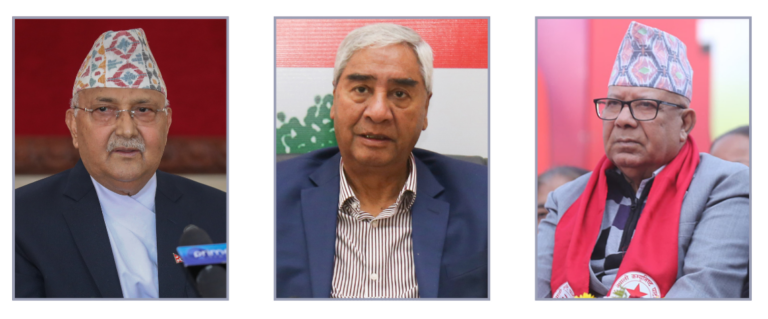
Former Prime Ministers (from left): KP Oli, Sher Bahadur Deuba and Madhav Kumar Nepal
Oli’s defeat has also been seen as the displacement of the old generation and Balen’s win as the rise of a new one. RSP had already presented Balen before the election as the future Prime Minister, which increased voters’ inclination toward Balen nationwide. He entered the electoral campaign across the country as if he were the candidate for direct executive. With a heavy mandate in the March 5 election, Balen became Nepal’s 43rd Prime Minister – at the age of just 36. Having risen in politics as a representative of the new generation, Balen has in just four years of entering politics become the main power center of Nepali politics. Today, the country’s politics revolves around him.
It was the Gen Z movement that made Balen the power center of Nepali politics so quickly. Political scientist Dev Raj Dahal says, “Balen, who had become the city’s mayor without being affiliated with party politics, became the country’s powerful Prime Minister within just three years of that. There had been talk that he would enter parliamentary politics in 2027, but the Gen Z movement made him the power center in 2026 itself.”
The experience Balen gained as the mayor of Kathmandu Metropolitan City alone is not sufficient to fulfill the responsibilities of a Prime Minister. How capable he will be as the country’s executive head in addressing growing public aspirations remains to be seen.
Balen, who rose to the center of power and influence by sidelining veteran leaders who had spent their entire lives in politics and even endured imprisonment for it, does not come from a political background. Having studied engineering, he had become known among the younger generation over the past decade through rap battles. While continuing his rap career, he ran as an independent candidate in the 2022 local elections for Mayor of Kathmandu Metropolitan City. Defeating experienced candidates from established parties, he became Kathmandu’s mayor on his very first attempt.
Although he won as an independent candidate and became mayor of Kathmandu Metropolitan City, Balen’s popularity spread nationwide. His work in areas such as education, health, and heritage within the metropolis increased public trust in him. He also promoted his work through social media. Indeed, during his tenure as mayor, Balen remained at the center of both controversy and attention, at times threatening to burn down Singha Durbar via social media, and at other times making strong statements against then-Prime Minister KP Sharma Oli. Frustrated by the misgovernance of old political parties and bureaucracy, citizens supported Balen’s rebellious stance on social media.
As Balen’s supporters increased, Oli’s support declined. Balen also supported the Gen Z movement initiated by the new generation against political distortions. Meanwhile, the Rastriya Swatantra Party (RSP), represented in parliament, also expressed support for the Gen Z movement. During the protests, police gunfire on September 8, 2025, resulted in the deaths of 19 people, which further angered the public against the Oli government. In resistance to government repression, widespread arson broke out on the next day at Singha Durbar, parliament, and courts. Over the two days of protests, 76 people lost their lives, and property damage amounted to Rs 84.45 billion.
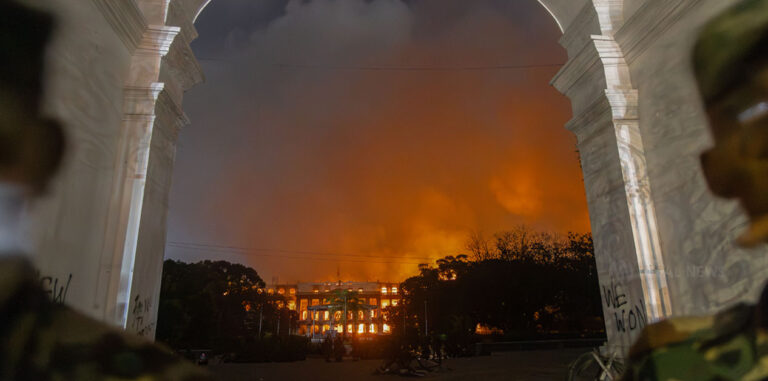
Singha Durbar burning on September 9, 2025, the second day of the Gen Z movement. Photo: Bikram Rai/Nepal News
After the Gen Z movement, Balen played a decisive role in forming a government under the leadership of former Chief Justice Sushila Karki. Through social media, he had called on Gen Z protesters to negotiate with the army, and following his call, Sudan Gurung of Hamro Nepal and various Gen Z groups held talks with the army at the military headquarters.
Before the elections, Balen resigned from his position as mayor and joined the Rastriya Swatantra Party. According to political scientist Krishna Pokharel, it was Balen’s entry into the RSP that created a nationwide wave in the party’s favor during the elections. His influence was most visible in Madhesh Province. Despite lacking a strong organizational structure, the RSP secured 30 out of 32 seats in Madhesh largely due to Balen’s impact. As a result, in the year 2082 BS, Balen has become the country’s powerful Prime Minister and the central figure of political power.
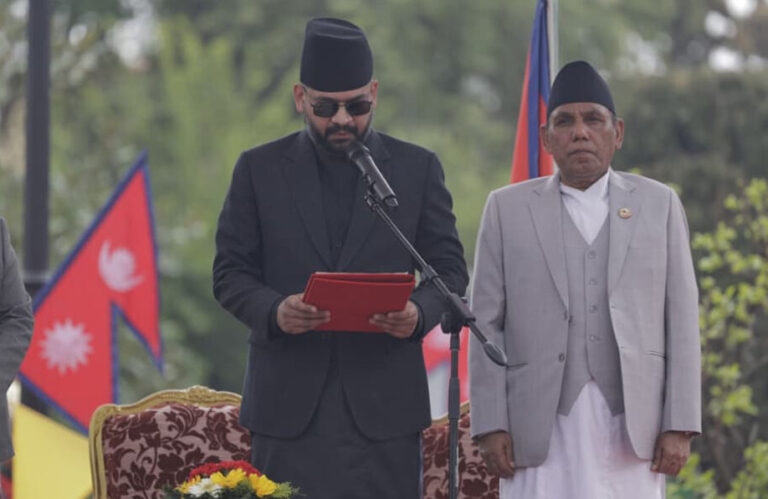
Prime Minister Balendra Shah. Photo: Bikram Rai/Nepal News
The experience Balen gained as the mayor of Kathmandu Metropolitan City alone is not sufficient to fulfill the responsibilities of a Prime Minister. How capable he will be as the country’s executive head in addressing growing public aspirations remains to be seen. The challenge before Balen as Prime Minister is to change the country while keeping both domestic and external forces in balance. Those close to him say his habit of studying subjects he doesn’t know and seeking advice from experts will make it easier to face the challenges ahead. Nevertheless, Balen’s test will come on the benchmark of implementing the promises RSP made to citizens during the election.
Political scientist Amrit Kumar Shrestha says it will be difficult for Balen, who has become the new power center by demolishing the old ones, to balance and manage both domestic and external forces. Noting that Balen’s initial steps as Prime Minister have appeared positive, political scientist Shrestha adds, “If Prime Minister Balen rises above personal interest to work for the country’s interest and moves forward in cooperation with all sides, he will succeed.”