Kathmandu
Sunday, July 5, 2026





An energetic start has improved administrative discipline, but growing executive centralisation, weak implementation and mounting pressure on democratic institutions have raised difficult questions about the direction of governance.

KATHMANDU: Governments are rarely judged solely by what they accomplish in their first hundred days. More revealing is the governing philosophy they establish-the institutional habits they cultivate, the constitutional boundaries they respect, and the administrative culture they create. Balendra Shah’s government entered office with an extraordinary parliamentary mandate, promising not merely a change of leadership but a fundamental reconstruction of how the Nepali state functions. It pledged to dismantle entrenched patronage networks, restore discipline to an inefficient bureaucracy and deliver one hundred concrete reforms within one hundred days.
Three months later, the picture is far more complicated than either supporters or critics initially anticipated.
The government has undoubtedly altered the mechanics of day-to-day administration. Civil servants now report to their offices on time. Attendance has become routine rather than optional. Long-standing habits of informal networking inside Singha Durbar have been curtailed. The Prime Minister himself has rejected the traditional culture of governing from Baluwatar, spending his working days inside the Prime Minister’s Office and treating the official residence largely as a private space rather than the country’s political command centre.
These are not insignificant changes. For decades, Nepal’s executive authority had gradually migrated away from formal state institutions and into the Prime Minister’s residence, where political bargaining, bureaucratic lobbying and informal power networks frequently overshadowed institutional decision-making. Shah has attempted to reverse that trend by physically returning executive authority to government headquarters Singha Durbar.
Yet restoring the location of government has not necessarily strengthened the institutions of government. Instead, the administration increasingly exhibits a different form of centralization-one built less around political patronage than around an unusually concentrated decision-making structure operating inside the Prime Minister’s Secretariat.
An ambitious agenda, modest implementation
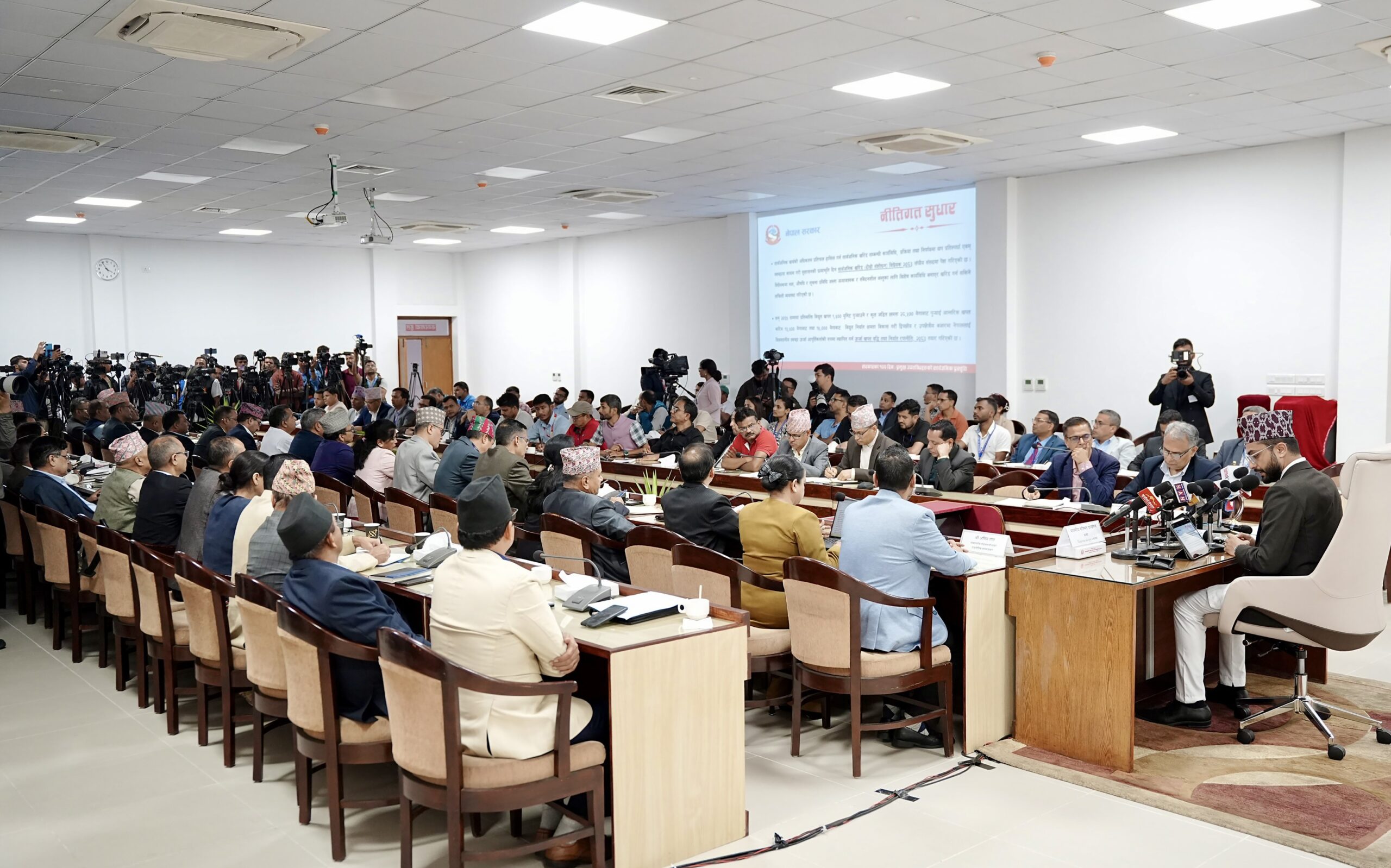
The government’s own reform programme illustrates the gap between ambition and execution. Upon assuming office, the Cabinet unveiled a one-hundred-point governance reform agenda that promised rapid administrative restructuring across ministries. Among its flagship commitments was the completion of a comprehensive Business Process Re-engineering programme within thirty days, intended to simplify public service delivery through new procedures, standards and monitoring systems.
That promise remains largely unfulfilled. Independent assessment of the government’s own commitments presents a sobering picture:
Only 16 of the 100 commitments have been fully implemented, 22 initiatives have begun but remain incomplete and 62 commitments have shown little meaningful progress.
In other words, nearly two-thirds of the government’s flagship reform agenda remains stalled after the expiry of its own deadline.
Such implementation gaps are hardly unique in Nepal, where governments routinely over-promise and under-deliver. What distinguishes this administration is the contrast between its image of relentless executive activism and the relatively limited institutional delivery beneath that image. The government’s political energy has consistently outpaced its administrative capacity.
A growing parallel bureaucracy
One of the least noticed-but potentially most consequential-institutional changes during the government’s first hundred days has been the quiet expansion of political appointments inside ministerial offices.
While the administration has simultaneously pursued civil-service downsizing and organisational rationalisation, it has also created a substantially larger layer of political advisers across ministries-raising questions about whether the state is truly becoming leaner or simply more political.
The change follows the Cabinet’s approval of the Directive on the Management of Ministers’ Advisers and Secretariats, 2083, which allows ministers to appoint between three and five external advisers with the equivalent status of a Government Secretary. Unlike previous governments, where such appointments generally required separate Cabinet approval, ministers can now recruit them directly under the standing directive.
Under the new framework, the Ministries of Energy, Infrastructure Development, Agriculture, and Forests and Environment may each appoint up to five secretary-equivalent advisers, including one paid adviser entitled to the salary, allowances and official facilities of a serving government secretary. The remaining ministries may each appoint up to three advisers, including one paid secretary-equivalent adviser. In total, the directive creates space for 57 secretary-ranked advisers across the government’s 17 ministries.
The expansion extends well beyond advisers. Each minister is also authorised to appoint a chief private secretary at joint-secretary level, private secretaries, coordination and implementation officers, communications staff, administrative assistants, drivers and office support personnel.
Altogether, ministers’ personal secretariats could eventually employ around 210 politically appointed personnel, despite the government’s broader commitment to reducing the size of the state.
The timing is striking. At the same time, ministries are conducting Organisation and Management (O&M) surveys aimed at reducing permanent staffing levels. The government plans to reduce the number of permanent secretaries from 71 to around 61, while surplus secretaries created after reducing ministries to 17 have already been placed in an additional pool under the Office of the Prime Minister and Council of Ministers. If these plans proceed, Nepal will have 57 politically appointed secretary-equivalent advisers alongside only about 61 permanent secretaries, bringing the two groups close to numerical parity.
Supporters argue that ministers need specialist advisers capable of accelerating reform and bringing expertise unavailable within a traditionally slow-moving bureaucracy. Critics, however, warn that creating dozens of secretary-ranked political appointees risks blurring the line between political advice and executive authority. As the number and status of political advisers expand, questions inevitably arise over their relationship with permanent secretaries, the chain of administrative command and accountability within ministries.
For a government elected on a promise of making the state smaller, faster and more efficient, the simultaneous contraction of the permanent bureaucracy and expansion of the political secretariat represents one of the more intriguing-and potentially controversial-institutional reforms of its first hundred days. Whether it strengthens policymaking or creates a parallel administrative structure will become clearer as the new system begins operating in practice.
The rise of the secretariat state
Every modern executive office relies upon political advisers. Their role is to coordinate policy, manage communication and facilitate the Prime Minister’s work.
The concern emerging during Shah’s first hundred days is not the existence of advisers but the apparent expansion of their practical authority.
Multiple accounts from within government suggest that access to the Prime Minister has become increasingly mediated through a handful of secretariat members. Senior civil servants reportedly struggle to secure direct meetings with the Prime Minister, while politically appointed advisers frequently become the primary channel through which ministries communicate with the executive.
Such arrangements blur an important constitutional distinction. Political secretariats exist to assist elected leaders-not to substitute for formal administrative decision-making.
Nepal’s civil service operates through clearly established legal hierarchies. Political advisers possess influence but not statutory executive authority. When informal actors begin issuing operational instructions to ministries or participating directly in administrative decisions, accountability becomes increasingly difficult to identify.
Institutional governance depends not simply upon making decisions but upon ensuring that decisions emerge through legally recognised processes. This distinction appears increasingly blurred.
Judicial independence under pressure
No institution has generated greater constitutional unease during the government’s first hundred days than the judiciary. Successive governments have long been criticised for treating judicial appointments as extensions of political bargaining, with key constitutional positions frequently distributed through informal power-sharing arrangements rather than transparent assessment of judicial competence. The Shah government entered office promising to break with that culture, arguing that Nepal’s courts should be led by merit rather than political patronage.
Yet its early actions have raised fresh questions-not about whether the old system has been dismantled, but whether it is being replaced by another model of executive influence.
The most controversial decision came when the Constitutional Council recommended and parliament confirmed Supreme Court Justice Dr. Manoj Kumar Sharma as the Chief Justice despite his being fourth in the Court’s order of seniority. The recommendation broke with a judicial convention that had remained largely intact for decades, making it the first known instance in which a Chief Justice has been nominated by bypassing several more senior judges.
Constitutionally, the government possesses discretion in judicial appointments. Yet constitutional systems function not only through written provisions but also through conventions that safeguard institutional independence. Seniority has never been an absolute constitutional requirement in Nepal, but it has evolved into an important convention designed to minimise executive discretion and protect the judiciary from political influence. Departing from that convention therefore demanded a clear, transparent and objectively measurable justification.
The government has argued that judicial appointments should be based on merit and performance rather than seniority alone. But all the government claimed proved wrong in facts.
In principle, few would dispute that proposition. Across many democracies, merit-based judicial appointments are viewed as preferable to automatic promotion by seniority. The difficulty lies elsewhere.
No publicly articulated framework exists defining what constitutes merit. The government has neither introduced measurable evaluation criteria nor undertaken broader judicial reform establishing competitive appointment procedures. Without transparent standards, replacing seniority with executive discretion risks making appointments appear more political rather than more meritocratic.
The controversy was compounded by divisions inside the Constitutional Council itself. The Chair of the National Assembly and the Leader of the Opposition formally recorded notes of dissent, arguing that the recommendation departed from established institutional practice without adequate justification. What might otherwise have been presented as judicial reform instead became an illustration of constitutional disagreement at the highest level of the state.
Concerns have been reinforced by parallel efforts to alter the institutional architecture of judicial governance. The government’s attempt to amend decision-making procedures within the Judicial Council through ordinance has fuelled wider debate over the growing reach of the executive into institutions constitutionally designed to remain independent. Taken together, the appointment of a Chief Justice outside established convention and attempts to reshape the Judicial Council have created the perception that the executive seeks greater influence over the judiciary at precisely the moment it claims to be strengthening institutional governance.
None of these decisions necessarily breaches the constitutional text. Yet constitutional democracies depend as much upon unwritten conventions as upon formal legal provisions. Institutions remain independent not simply because constitutions declare them so, but because political leaders exercise restraint in areas where the law grants discretion. Once long-standing conventions are abandoned without transparent principles or broad political consensus, judicial independence becomes increasingly dependent upon the preferences of the government of the day rather than the stability of constitutional norms.
For an administration elected on a promise of institutional renewal, the challenge is therefore larger than appointing a single Chief Justice. It is whether judicial reform will ultimately produce a more independent judiciary-or a judiciary whose leadership is increasingly shaped by executive preference under the language of meritocracy.
A Narrowing space for independent journalism
A government’s attitude towards the press often reveals as much about its democratic instincts as its legislative agenda. During its first 100 days, Balendra Shah’s government has projected an increasingly uneasy relationship with independent journalism, prompting concerns that constitutional guarantees of press freedom are being tested not through sweeping censorship but through a steady accumulation of political, administrative and legal pressures.
No single decision has fundamentally altered Nepal’s media landscape. Instead, the concern lies in the direction of travel. Official rhetoric has become more confrontational, institutional boundaries appear increasingly blurred, economic leverage has entered the regulatory toolbox, and judicial interventions have added new uncertainty for news organisations. Taken together, these developments have created a perception that the cost of scrutinising those in power is rising.
The clearest signal came from the Home Ministry. Rather than leaving complaints against the media to the statutory mechanisms established under Nepal’s legal framework, Home Minister Sudan Gurung indicated that the ministry itself would take a more direct role in responding to alleged media misconduct. The distinction is significant. In constitutional democracies, regulatory authority derives from institutions rather than individual officeholders.
When executive authority appears to expand beyond established legal processes, concerns naturally shift from media ethics to institutional restraint.
Pressure has also become increasingly informal. Journalists report that the principal threat is no longer physical intimidation but a more pervasive climate of digital hostility. Supporters of the governing establishment have intensified online attacks against reporters, editors and commentators, creating an environment in which reputational harassment has become a routine response to critical reporting. Such campaigns rarely require formal state involvement to produce their intended effect. Their greatest consequence is psychological: encouraging editors and reporters to avoid subjects that invite organised retaliation.
Economic policy has reinforced these anxieties. The government’s decision to channel official advertisements and public notices exclusively through state-owned media has transformed public spending into a potential instrument of influence over the information market. For many private news organisations, government advertising remains an important revenue source. Redirecting those funds inevitably reshapes competitive conditions and raises questions about whether financial policy is being used to reward proximity to the state rather than promote a pluralistic media environment.
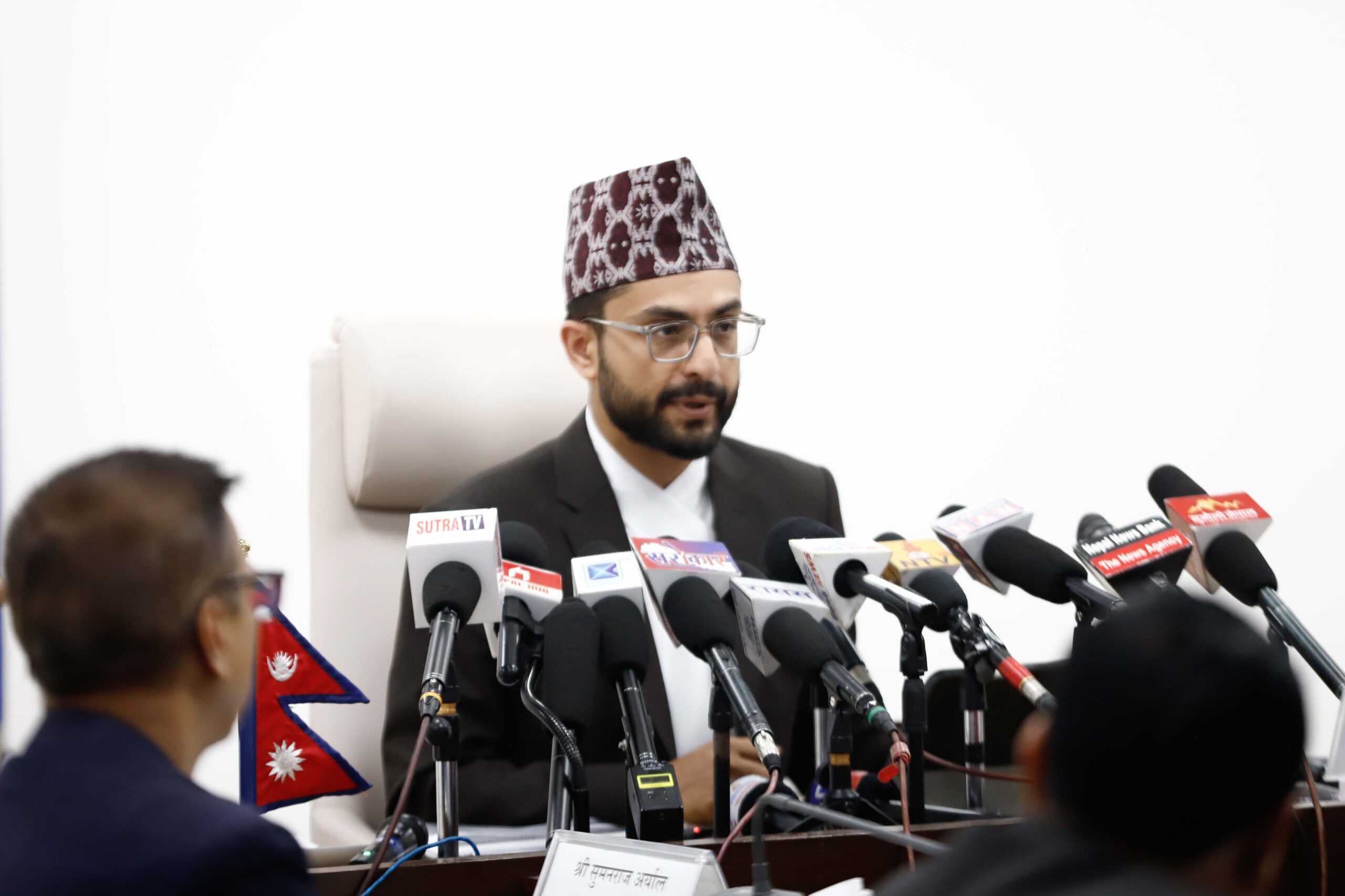
The deterioration extends beyond policy. In 100 days into office, the government has maintained limited engagement with independent media, avoiding the sustained press scrutiny that has traditionally accompanied democratic accountability. Direct communication with citizens may be politically efficient, particularly in the age of social media, but it cannot substitute for questioning by an independent press. Democracies require both.
Judicial developments have added another layer of uncertainty. A prison sentence imposed on a newspaper editor in a defamation case, followed by a court order requiring the removal of dozens of published news reports, has intensified debate over the legal boundaries of investigative journalism. While each ruling rests on its own legal merits, their cumulative effect has been to increase perceptions of legal risk within newsrooms already operating in an increasingly hostile political climate.
Institutionally, this represents an important correction. Yet the redistribution of physical authority has not necessarily produced broader institutional participation.
The result is less visible censorship than growing caution. Editors become more selective, journalists more restrained and potential sources more reluctant to speak. Such shifts rarely occur through a single dramatic confrontation. They emerge gradually, as political pressure, financial incentives, legal uncertainty and social intimidation begin reinforcing one another.
The first 100 days therefore raise a broader constitutional question. The strength of press freedom is measured not when governments welcome favourable coverage, but when they tolerate sustained scrutiny. On that measure, the administration’s early record has become one of the more contested aspects of its opening months in office.
Replacing one power centre with another
Perhaps the most significant structural change of the first hundred days has been the relocation of executive authority.
Previous prime ministers frequently governed from prime minister residence Baluwatar. Ministers, bureaucrats, political leaders, diplomats and business figures gravitated towards the official residence rather than the constitutional offices of government. Formal institutions often became little more than venues for rubber-stamping decisions already negotiated elsewhere.
Shah has deliberately broken with that tradition.
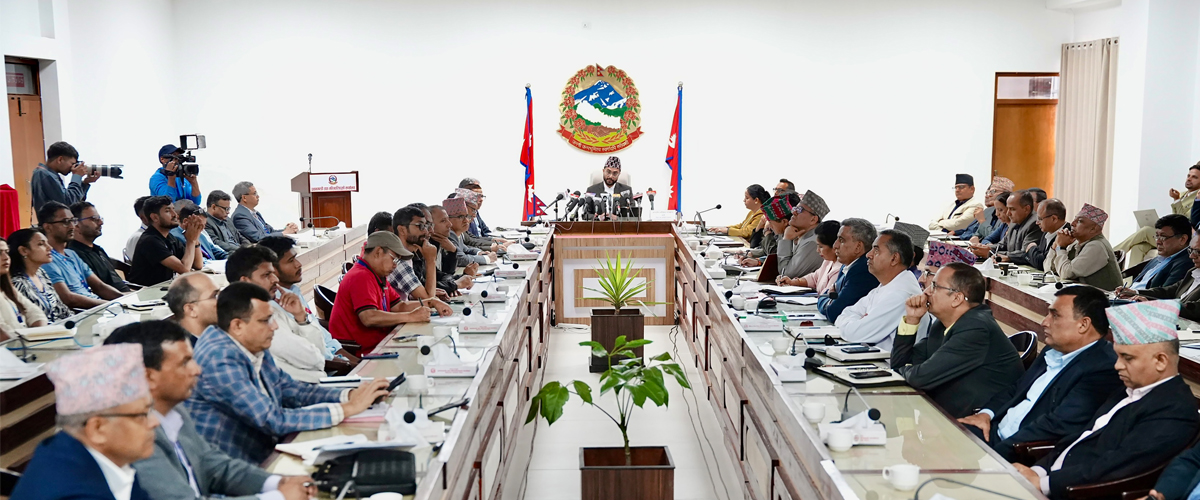
Cabinet business, administrative meetings and parliamentary consultations have largely shifted back to Singha Durbar. The Prime Minister maintains regular office hours comparable to those of an ordinary civil servant. Ribbon-cutting ceremonies and ceremonial appearances have been avoided. Public attention has shifted from political spectacle towards administrative routine.
Institutionally, this represents an important correction. Yet the redistribution of physical authority has not necessarily produced broader institutional participation.
Instead of dispersing decision-making across formal administrative channels, executive authority appears increasingly concentrated within a remarkably small circle of political advisers and secretariat officials. The result is not decentralisation but recentralisation through different actors.
Efficiency without institutional restraint
The government’s supporters often argue that Nepal’s bureaucracy required disruption rather than procedural caution.
There is merit in that argument. Attendance discipline has improved. Internal monitoring has become stricter. Government offices appear noticeably more active than under previous administrations. Idle movement inside Singha Durbar has diminished, while National Vigilance Centre personnel actively monitor employee attendance. Administrative complacency has undoubtedly been challenged.
However, efficiency alone cannot define democratic governance.
Modern constitutional systems deliberately constrain executive power because procedural safeguards exist not to protect inefficiency but to prevent arbitrariness.
Several controversies during the government’s first hundred days illustrate this tension.
The Cabinet authorised an MBBS admission outside the procedures established by existing medical education legislation. A civil servant was detained after sending an SMS directly to the Prime Minister seeking appointment support, raising questions about proportionality and due process.
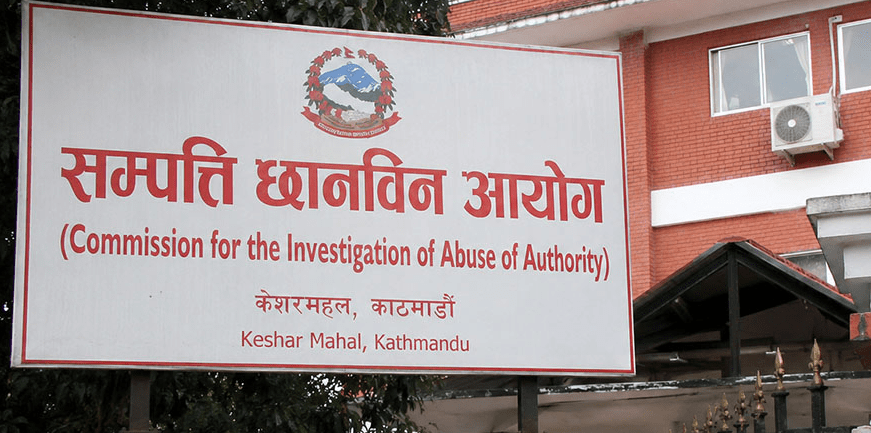
Senior officials of a constitutional commission were summoned to the Prime Minister’s Office during an ongoing investigation, creating unprecedented concerns regarding executive interference with constitutionally independent institutions.
Individually, each episode may be defended on administrative or political grounds.
Collectively, however, they suggest a governing instinct increasingly comfortable bypassing established procedures whenever those procedures appear inconvenient.
That represents a more significant constitutional concern than any individual controversy.
Democracies ultimately depend less upon the intentions of leaders than upon their willingness to operate within institutional limits.
Parliamentary accountability remains the missing pillar
If Singha Durbar has become more active administratively, Parliament has become noticeably less central politically.
The Prime Minister has maintained only limited engagement with regular parliamentary scrutiny, including inconsistent participation in scheduled question-answer sessions. Attendance has often appeared reluctant rather than routine.
This matters because parliamentary accountability is not ceremonial.
Executive governments derive democratic legitimacy not only from elections but through continuous scrutiny by elected representatives.
The government’s occasionally confrontational posture towards Parliament has therefore created an uncomfortable imbalance.
The controversy surrounding the Prime Minister’s remarks on the Nepal–India border dispute demonstrated the risks of limited parliamentary engagement. Rather than returning promptly to clarify his position before the House, the issue remained politically unresolved, allowing institutional tension to deepen unnecessarily.
Strong electoral mandates strengthen governments.
They do not diminish Parliament’s constitutional authority.
Political confidence bordering on executive certainty
The government’s governing style reflects extraordinary political confidence. That confidence is understandable.
The administration enjoys one of the strongest parliamentary mandates in recent Nepali history. It emerged from widespread public frustration with traditional political parties and promised a decisive break from incremental governance.
The central question facing the Shah government is therefore no longer whether it can govern energetically. Its first hundred days have answered that.
Such mandates naturally encourage ambitious executive action. The danger arises when electoral legitimacy begins substituting for institutional legitimacy.
Repeated public rhetoric suggesting that rapid action justifies procedural shortcuts risks creating an executive culture that views constitutional checks primarily as obstacles rather than safeguards. That perception has become increasingly visible during the government’s first hundred days.
Not failure, but an unfinished transition
Declaring the government either a success or failure after only one hundred days would be premature. Its achievements are genuine.
Administrative discipline has improved. Government offices function more regularly. Executive authority has returned from informal political residences to formal constitutional institutions. Several governance initiatives—from public service delivery to passport processing and bureaucratic monitoring-have demonstrated measurable progress. Yet equally genuine are the institutional concerns.
Implementation has fallen significantly behind the government’s own commitments. Decision-making has become highly centralised within a narrow advisory circle. Parliament has received inconsistent engagement. Constitutional conventions have occasionally been treated as optional rather than foundational. Administrative efficiency has, at times, appeared to come at the expense of procedural restraint.
The central question facing the Shah government is therefore no longer whether it can govern energetically. Its first hundred days have answered that.
The far more consequential question is whether it can transform executive energy into durable institutional governance-one that strengthens rather than bypasses constitutional processes.
Nepal has witnessed many governments capable of exercising power. Its democratic future depends upon governments equally willing to restrain themselves through the institutions they were elected to strengthen.