Kathmandu
Monday, June 22, 2026





Official letters regarding the enforcement of public interest verdicts and court orders keep bouncing endlessly from one agency to another.
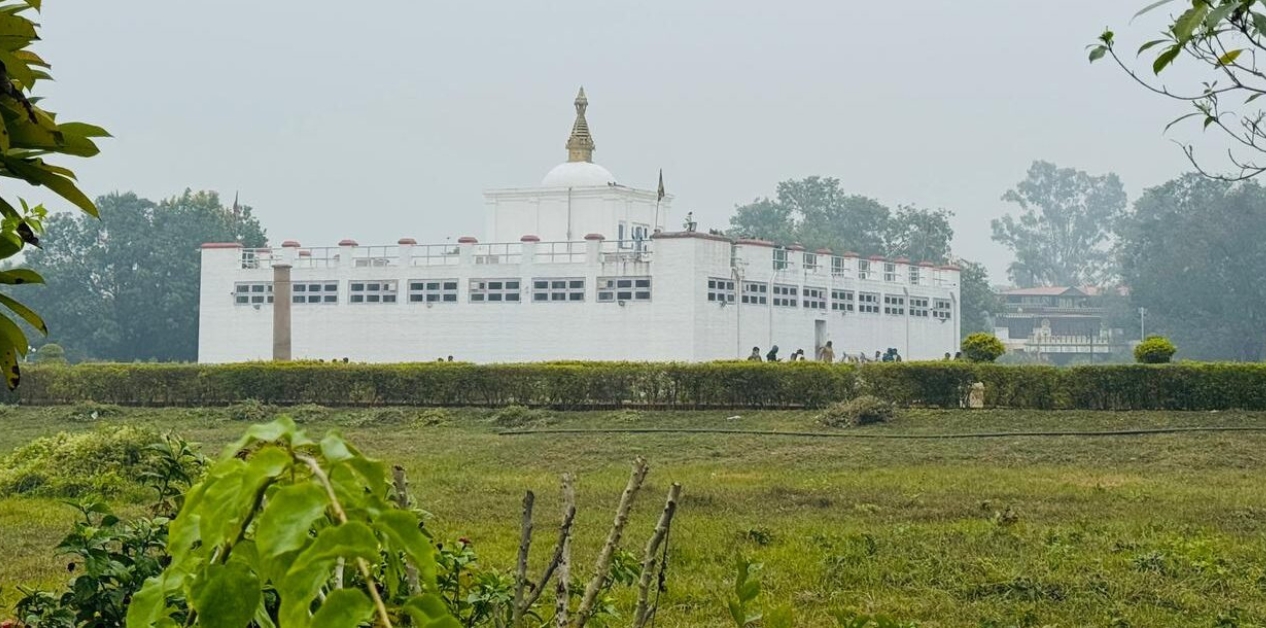
KATHMANDU: On August 27, 2025, the Supreme Court issued a mandamus for the long-term preservation of Lumbini, the birthplace of Gautam Buddha. The court ordered that no permissions be granted for new industries emitting dust, smoke, or carbon-based pollution up to the Indian border in the south and within a 15-kilometer radius in the other three directions. It also mandated that existing industries within this zone be shut down or relocated within two years. A joint bench of Justices Kumar Regmi and Sunil Kumar Pokharel passed this verdict on a writ petition filed by representatives of the Forum for Protection of Public Interest (Pro Public) and others, naming the Office of the Prime Minister and Council of Ministers (OPMCM), various ministries, departments, and private sector industries as respondents.
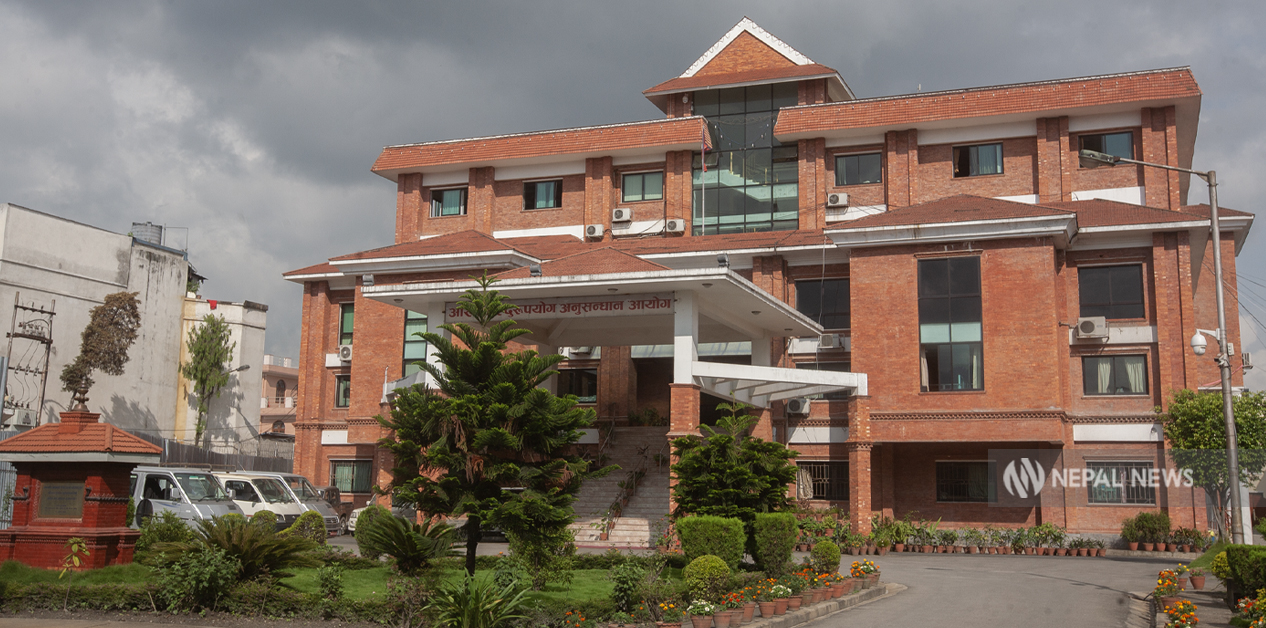
To implement this verdict, the Judgment Execution Directorate (JED) under the Supreme Court dispatched a letter to the OPMCM. However, claiming that executing the verdict is difficult and impractical, the government is seeking a path toward a judicial review. Puskar Sapkota, Legal Secretary at the Prime Minister’s Office, stated that the verdict is of an un-executable nature.
The Directorate has begun prodding stakeholders regarding the status of judgment execution. Speaking at an interaction program organized by the Directorate with stakeholders on June 19, 2026, Secretary Sapkota remarked, “When we measure 15 kilometers south as directed by the Supreme Court, 5 kilometers actually fall within India. If we implement the verdict fully, the airport will also have to be shut down. How do we execute this?”
Although Sapkota claimed that the Supreme Court’s verdict specified a 15-kilometer distance south of the Lumbini perimeter wall, the actual text of the verdict does not state so. Instead of 15 kilometers to the south, the verdict explicitly states “up to the Indian border.”
Secretary Sapkota stated that since implementing this verdict is practically impossible, groundwork is underway to send it back to the Supreme Court for a review. According to Sapkota, 38 verdicts related to the Prime Minister’s Office remain to be executed. Letters have been sent to the respective agencies for this purpose. He maintained that there is no ambiguity that Supreme Court verdicts must be implemented. However, government apathy persists in executing judgments beyond just the Lumbini preservation case. The line ministries continue to make various excuses to avoid enforcement.
The Prime Minister’s Office and ministries often accuse writ petitioners of naming them as respondents even in matters completely unrelated to them. During the interaction, Mahendra Prasad Saki, Under-Secretary at the Ministry of Land Management, Cooperatives, Federal Affairs, and General Administration, stated that directives must be issued directly to the government Secretaries for judgment execution. He added that lower-tier employees cannot do anything beyond forwarding letters for implementation. During the program, he remarked, “What can we, as law officers, do alone? We do as much as possible.” He expressed helplessness, noting the difficulties in judgment execution.
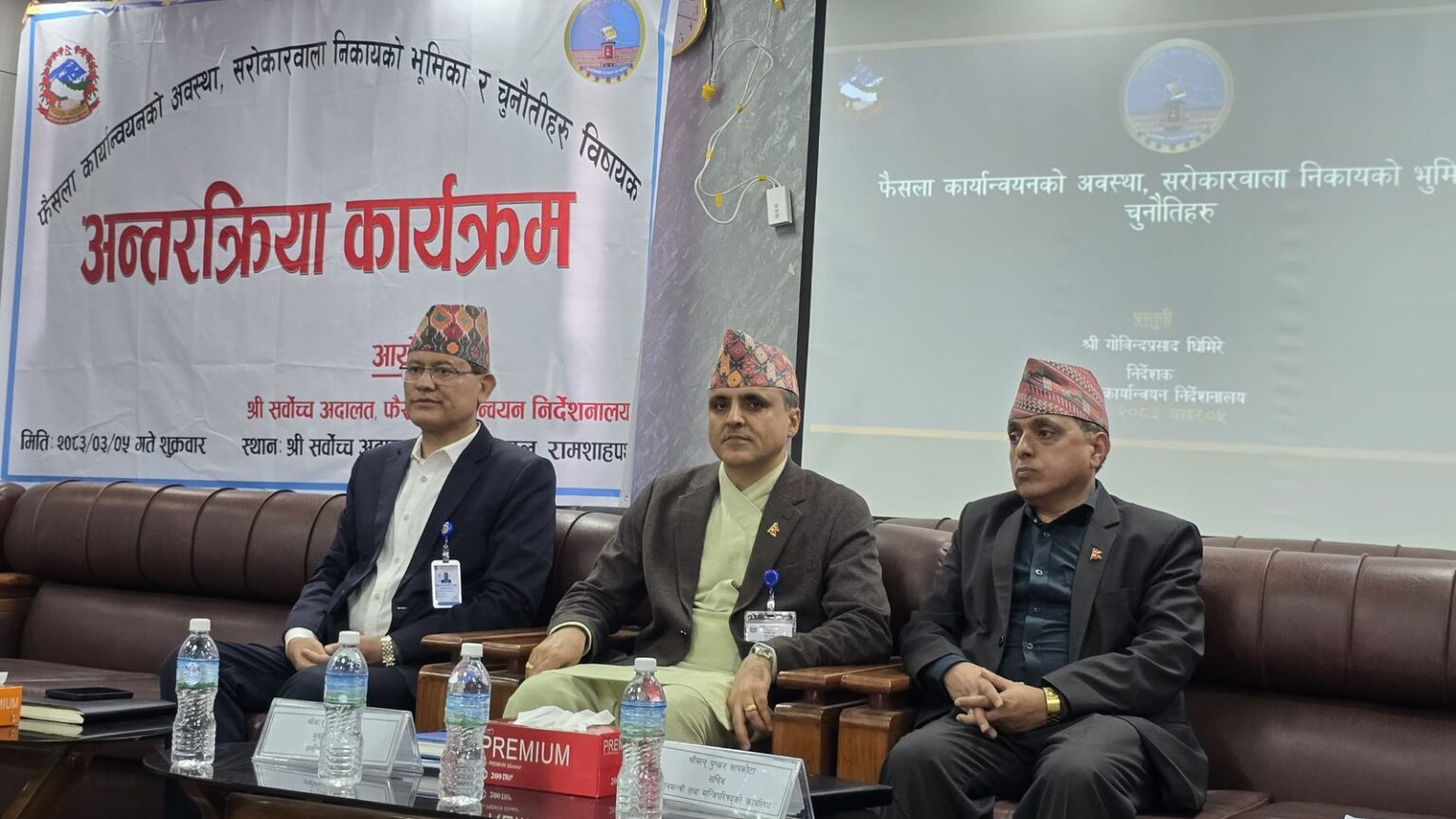
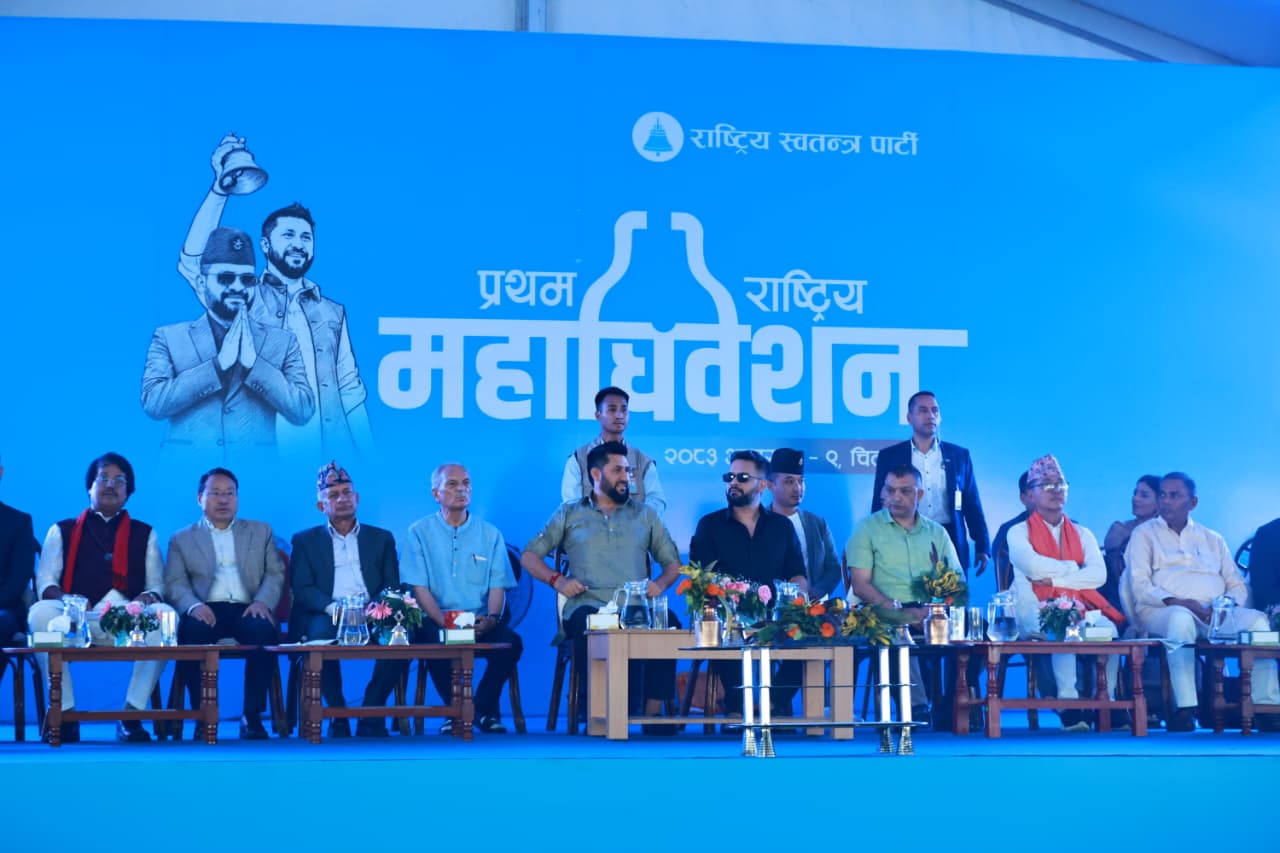
An interaction program on the “Status of Judgment Execution, the Role of Stakeholders, and Challenges.” Photo: Nepal News
On the other hand, the Judgment Execution Directorate is exhausted from constantly sending enforcement letters. Govinda Prasad Ghimire, Director and Spokesperson of the Directorate, said, “In some cases, despite sending up to 11 reminders, we have not received a single letter in reply.”
Ghimire noted that it is not easy to execute mandamus, directive orders, and verdicts issued by the Supreme Court on matters of public interest. Since 2010, vital files have spent years bouncing around—from the Prime Minister’s Office to ministries, departments, and sub-branches—leaving actual enforcement completely stranded.
The government recently decided to implement the report of the commission formed three decades ago under the leadership of Ram Bahadur Rawal to investigate the encroachment of government and public land. There had been prolonged pushing for the execution of this report. On May 26, 2009, the Supreme Court had issued an order for the implementation of the ‘Rawal Commission Report 1995’. A joint bench of the then-Justices Tap Bahadur Magar and Mohan Prasad Sitoula had issued directive orders to implement the commission’s report and investigate the encroachment of government land across the country. The Rawal Commission had studied public lands only within Kathmandu, but suggested forming an expert committee to investigate the encroachment of government and public lands nationwide.
Reminders for execution
According to data from the Directorate, correspondence has been sent for the execution of 244 verdicts and orders related to public interest. Among these, 38 verdicts concerning the Office of the Prime Minister and Council of Ministers remain unexecuted. Similarly, 28 verdicts related to the Ministry of Finance, 35 related to the Ministry of Home Affairs, 31 related to the Ministry of Law, Justice, and Parliamentary Affairs, 23 related to Land Management, Cooperatives, and Federal Affairs, 11 related to the Ministry of Education and Sports, 14 related to the Ministry of Agriculture, Forestry, and Environment, and the remaining verdicts related to all other ministries, including the Ministry of Infrastructure Development, are awaiting execution.
Bimal Paudel, Chief Registrar of the Supreme Court, stated that the judiciary ensures the guarantee of rights granted by the Constitution and the law. He mentioned that the non-execution of judgments adversely impacts the standards of the rule of law both nationally and internationally. According to him, due to unexecuted judgments, a cumulative prison sentence of 121,000 years remains to be served, and around Rs 34 billion in fines remains uncollected.
Gajendra Bahadur Singh, Director General of the Judgment Execution Directorate, emphasized that since enforcement is a complex issue, inter-ministerial cooperation is essential. Referring to the issue of ministries failing to respond to correspondence, he stated that the rate of unexecuted judgments has risen because employees are failing to shoulder their responsibilities. He warned that as citizens’ expectations grow, it will be difficult for civil servants to sustain their positions if they do not remain accountable to service seekers.
Directorate Spokesperson Ghimire stated that because the contents of a verdict serve as a binding command for the executing agency, challenging a verdict amounts to defying an order. He warned that failure to execute judgments could invoke Article 126 and Article 128(4) of the Constitution, as well as Section 17 of the Administration of Justice Act, 2016. Article 126 of the Constitution states, “All shall abide by the orders or decisions given by courts in the course of trial of lawsuits.” Similarly, Article 128(4) states, “All shall abide by the interpretation of the Constitution and law or the legal principles expounded by the Supreme Court in the course of trial of lawsuits.”
The law provides that the Supreme Court can initiate contempt proceedings and penalize anyone who obstructs the administration of justice or disobeys its orders or verdicts. However, the Directorate has not yet initiated contempt proceedings against any officials who fail to execute judgments.