Kathmandu
Monday, June 15, 2026





KATHMANDU: While the dispute over updating active membership intensifies, the establishment faction of the Nepali Congress has simultaneously deployed two political “cards” to stop the disgruntled faction. On one hand, a seven-point proposal, reportedly prepared by Vice President Vishwa Prakash Sharma, has been made public. On the other hand, the deadline for updating membership has been extended, offering more opportunities to the dissatisfied faction.
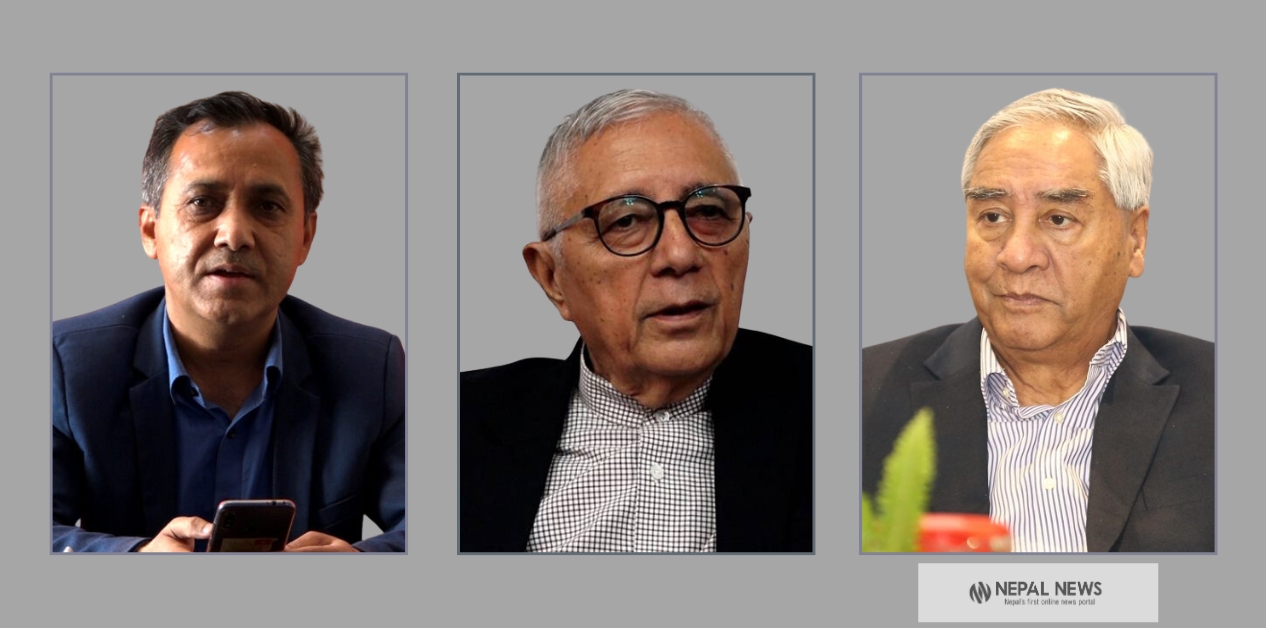
The establishment faction claims that the seven-point proposal, made public on Sunday morning, had already been sent to both former President Sher Bahadur Deuba and leader Shekhar Koirala on May 30. However, Koirala has publicly stated that he received no such proposal. Leaders from the Deuba faction also state that the proposal only reached as far as former Vice President Purna Bahadur Khadka. Leader Bimalendra Nidhi says, “The seven points only reached him. He has already stated that it holds no meaning as it fails to address the core issues.”
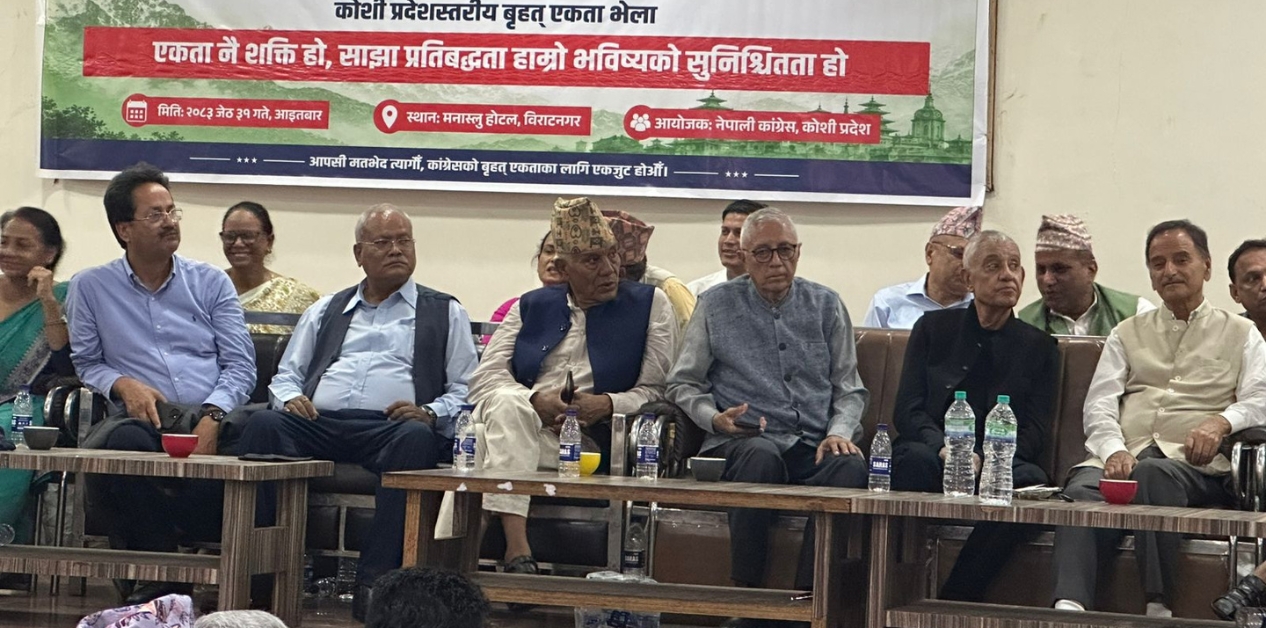
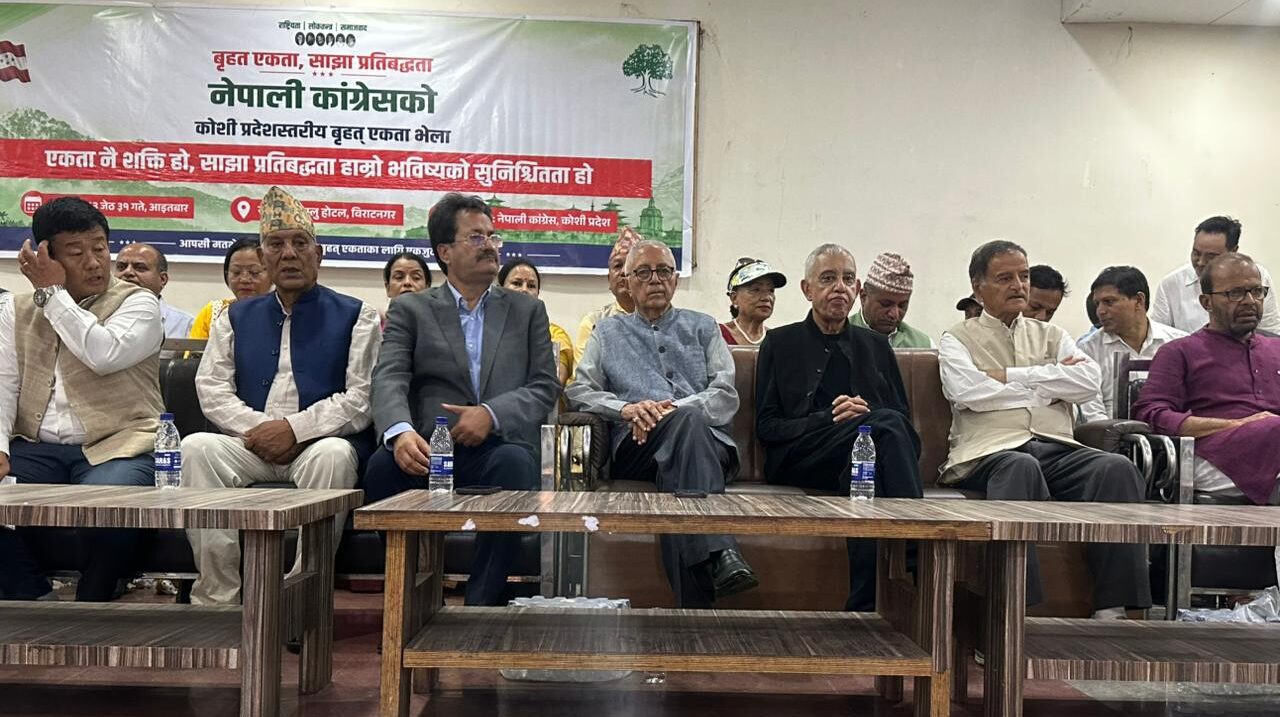
According to Nepali Congress spokesperson Devraj Chalise, the seven-point proposal had to be made public because “no response was received from the rival faction for 16 days.” Even though the establishment faction threw two “cards” simultaneously at the peak of the membership update dispute, the rival faction has not backed down. Joining hands in Biratnagar of Koshi Province, both the Deuba and Koirala groups proclaimed unity through a mass gathering on Sunday.
Seeing no relevance in the seven-point proposal, the Deuba faction held a gathering in Madhesh Province on June 14. Both the Deuba and Koirala factions merged into a single front in Biratnagar under the slogan of “party unity.” Separated for a long time, BP Koirala’s son, Shashank Koirala, and Shekhar Koirala were seen sharing the same stage. Shashank, who had previously joined the Deuba faction and refused to cooperate when Shekhar ran for party president, has now grown closer to his brother Shekhar Koirala. Before the gathering, Shashank had visited Shekhar’s residence. The desire of Congress members to see these two family leaders, who carry the political legacy of BP Koirala, standing on the same front has been fulfilled.
Shashank became emotional during the gathering where Shekhar was the chief guest. Mentioning that tears came to his eyes when he visited the Koirala residence, he questioned whether Gagan Thapa could run the party alone. He said, “The Nepali Congress is fractured. Now, we must move forward by uniting the party. The goal must be to make the party one.” Alongside Shashank, influential leaders from the Deuba faction, including Krishna Prasad Sitaula, Bijay Kumar Gachhadar, Min Bishwakarma, NP Saud, and Mohan Bahadur Basnet, were present at the gathering.
It is understood that the establishment faction made the seven points public targeting this very gathering and the potential future activities of the rival faction. General Secretary Gururaj Ghimire says, “The update is open to all party members. It can be updated from home via mobile. The extension covers those who were left out, and we hope it creates an environment for those who have not yet participated in the update process.”
Conditions of the seven-point proposal
The first point of the proposal published by the establishment faction states that, by embracing the special general convention held in accordance with Article 17(2) of the party statue, the updates made by the Election Commission, and the final decision of the Supreme Court, everyone must forget all disputes and move forward unitedly. Furthermore, it proposes that if there are disagreements regarding the process and outcome of the special general convention, they can be raised either orally or in writing as a political agenda during the closed session of the 15th General Convention. To reassure the rival faction, the point states, ‘We commit to ensuring no discriminatory behavior against any member based on whether they participated in the special general convention or not.’
The second point states that during the preparations for the 15th General Convention, the work of updating active membership will be completed within the scheduled timeframe, and the ambiguities within the constitution regarding this matter will be clarified before moving forward. The rival faction disagrees with the update process. Their disagreement has been completely ignored in the proposal. Instead, they have attempted to attract the rival faction by inserting constitutional provisions into the same point. Following the special general convention, Congress had amended its constitution. Provisions for the distribution, renewal, and updating of active membership were introduced in the constitution. Since the introduction of the update process, the rival faction has consistently rejected it. “By updating, we aimed to digitize the party’s membership, but they found it uncomfortable,” says General Secretary Ghimire. “It is not a provision that requires a constitutional amendment. We have stated that if there is any confusion, it can be discussed.”
The third point proposes providing a respectful role as ‘Senior Leaders’ within the Central Committee to veteran leaders who have contributed to the party for a long time. President Gagan Thapa had already made this proposal to Koirala during their meeting on May 5. Koirala has already rejected the proposal. The Koirala and Deuba groups have proposed merging the committees elected from the 14th General Convention and the special general convention. They maintain the stance that the internal management of leaders must be arranged within the committee formed in this manner. The proposal attempts to lure the rival group’s leaders by throwing the ‘Senior Leader’ card.
The fourth point proposes respectfully including individuals—whether they were previously in the Central Committee or not—who are willing to fulfill responsibilities into the Central Committee, as well as ensuring proper representation in the Performance Committee. This point also expresses the view that the tradition of automatically becoming a delegate to the General Convention should end, and an arrangement should be made where all members of the Central Committee must be elected as delegates starting from the ward level.
The fifth point proposes respectful participation and cooperation within the Election Committee, Discipline Committee, and Active Membership Management Committee, which will run the 15th General Convention.
The sixth point proposes forming a 15th General Convention Management Committee as an organ of the Central Committee.
The seventh point mentions that arrangements should be made to assign responsibilities to leaders willing to work in sister and wing organizations as presidents, office-bearers, or according to their qualifications and desires. The rival group has not expressed disagreement on these matters.
However, the rival faction believes that the seven-point proposal fails to address the core political questions they have been raising. The rival faction has concerns about the lack of concrete commitments regarding the dissatisfaction observed in the membership update, the power structure formed after the special general convention, or maintaining organizational balance before the 15th General Convention. Therefore, rather than a blueprint for dispute resolution, it is viewed as a political attempt to bring the disgruntled faction to the dialogue table. Leaders state that the announcement of additional concessions for the membership update is not a mere coincidence, but a parallel political effort to halt the establishment-rival alliance. Nonetheless, the Deuba-Koirala faction did not stop their joint gathering in Koshi Province.
Attempts to placate the rival faction
Nepali Congress has announced that it will hold its regular 15th General Convention by this coming October. Active membership is the sole foundation of the General Convention. Because control over active membership forms the basis of the internal balance of power, a tug-of-war persists between the establishment and rival groups. At the peak of the membership update dispute, Congress has once again extended the timeframe for updating, renewing, and distributing new active memberships. Although remote areas, internet connectivity issues, and technical delays were cited as reasons, this decision appears to provide relief to the rival faction, which lagged behind in the membership updates.
A meeting held on Sunday by the Central Membership Management Committee, coordinated by General Secretary Pradip Paudel, extended the membership update deadline for Bara and Khotang until June 21. Arrangements have also been made for missed wards in other districts to apply to the central office with the necessary details to request up to an additional seven days. The deadline for Nepali Public Relations Committees abroad has been set until June 24, and until July 4 for certain members of a special nature.
The most significant aspect of the decision is offering another opportunity to “left-out” members to update via application even after the deadline has expired. The committee has reserved the right to grant further time if it deems necessary. The membership distribution and update program, which Congress launched on May 16, initially aimed to finish by June 5. The deadline was then extended to June 11. However, after expected progress was not met within the stipulated time, a new arrangement was introduced.
According to party statistics, out of 782,209 active members so far, details of only 687,931 members have been entered into the digital system. While the updates for 538,622 members have been completed, 149,309 members are still in the process.
The decision to extend the time is viewed within Congress with more political significance than as a routine administrative decision. The rival faction does not appear ready to back down immediately. Indicating this, leader Dhanraj Gurung, who is close to Koirala, says, “Forget about these seven-point matters!”
As there is no sign of the rival faction stopping despite both ‘cards’—the seven-point proposal and the membership update extension—the power struggle within Congress is likely to escalate further. Following the provincial gathering in Koshi, the Deuba-Koirala faction has set a common platform for their ‘Unity Campaign.’ They now appear to have a strategy to move forward aggressively against the leadership as a single group. Both factions have put forward Shekhar as their leader.