Kathmandu
Saturday, July 18, 2026





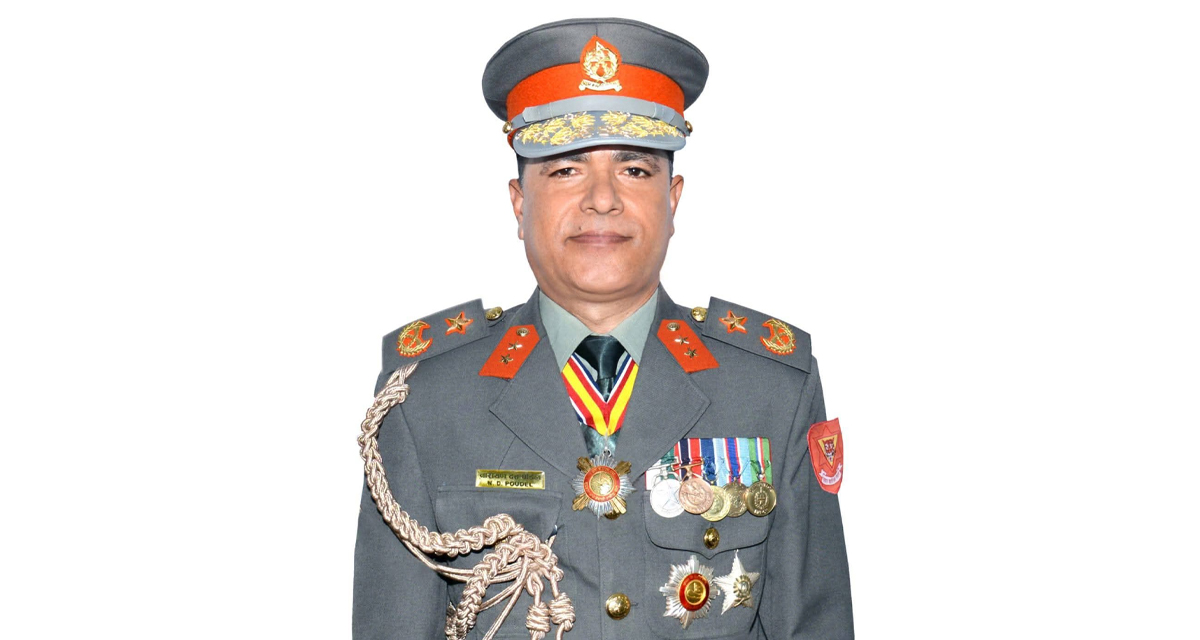
KATHMANDU: Narayan Dutta Poudel has risen from humble beginnings to become the 13th Inspector General (IGP) of the Armed Police Force (APF), one of the country’s key paramilitary institutions.
On April 27, 2026, the Cabinet approved his promotion from Additional Inspector General (AIG) to the top leadership position. He is scheduled to assume command on May 1, 2026, succeeding outgoing IGP Raju Aryal, who completed a four-year tenure and retired on the same date.
Born in what was then Jarbuta Village Development Committee (now part of Surkhet district in Karnali Province), Poudel completed his School Leaving Certificate (SLC) from Surkhet before entering public service through the civil service examination. He initially secured a position as a Kharidar (a junior administrative role) and served for about five years at Birendranagar Municipality.
During this period, he continued his studies and earned a bachelor’s degree while working in local government administration. He has openly shared that joining the police was never part of his original plan—he had been considering higher civil service roles—but encouragement from friends led him to attempt the Nepal Police Inspector examination in Kathmandu, which he cleared on his first try.
Poudel formally joined the Nepal Police as an Inspector in 1998. After completing basic training, he was deployed to the challenging Rolpa district during the height of the Maoist insurgency. There, he commanded a striking team, facing direct confrontations in a highly volatile environment.
His leadership, operational effectiveness, fearlessness under pressure, and ability to boost the morale of officers under his command earned him a one-grade promotion as recognition from Nepal Police headquarters.
He recalls those intense days vividly, noting instances where colleagues were injured by gunfire while he remained unharmed by chance.
His postings in the Nepal Police included roles such as officer-in-charge at area police offices in Birtamod (Jhapa), instructor at the National Police Training Academy in Maharajgunj, and duties at the District Police Office in Dang.
In the early 2000s, as the government formed the Armed Police Force (APF) on October 24, 2001, to strengthen internal security and counter the insurgency, Poudel was among those transferred from Nepal Police.
He moved to the APF on April 17, 2001, initially as a Deputy Superintendent of Police (DSP), with his permanent promotion to that rank following shortly after. This transition allowed him to gain deeper expertise in paramilitary operations, base security, and specialized duties.
Over nearly three decades of service—spanning about 28 years by the time of his IGP appointment—Poudel accumulated a wide range of experiences across field operations, staff roles, training, and policy-level responsibilities.
Key milestones in the APF include serving as commander of security bases (such as in Tulsipur, Dang), working in the secretariat of the National Security Council at Singha Durbar, and participating in the United Nations Mission in Nepal (UNMIN) as an arms monitoring member during the peace process following the Maoist ceasefire. This role provided him practical insights into conflict management and the delicate transition from war to peace.
He rose steadily through the ranks: promoted to Superintendent of Police (SP) in 2006, where he commanded border security offices (e.g., in Bardiya), led specialized task forces like Nilbarahi Battalion and Banglamukhi, and held positions in regional headquarters such as the Barah Bahini in Pakali and the Pashupati Bahini in the Kathmandu Valley.
In 2013, he advanced to Senior Superintendent of Police (SSP), taking on administrative responsibilities, including in the Administration Department, quality control directorates, financial administration, and as commandant of a UN peacekeeping training school in Kakani.
He also served as assistant brigade commander in various brigades. Poudel was promoted to Deputy Inspector General (DIG) in 2018, during which he commanded provincial-level brigades in Lumbini and Gandaki provinces and handled key departments focused on operations, border security, and human resources.
His elevation to AIG came on May 20, 2022, when he was one of the senior-most DIGs recommended for the position. As AIG, he led major departments at APF headquarters in Halchowk, Kathmandu—including Human Resource Development, Border Security, and Operations—gaining command experience over all three primary AIG-level portfolios in the force.
He also stood in temporarily for the IGP during absences and participated in high-level internal functions.
His appointment as IGP followed the conventional principle of seniority within the APF. While other contenders, such as AIG Banshi Raj Dahal (promoted about five months after Poudel) and AIG Ganesh Thada Magar (more junior by roughly two years in both promotion and recruitment batch), were in the race, Poudel held the top position in the queue.
Under existing service rules limiting tenure to 30 years of total service, his term as IGP is expected to last approximately two years, until around March 2028, when he reaches retirement age.
Throughout his career, Poudel has demonstrated commitment to both domestic security and international peacekeeping. He has participated in UN missions, including a six-month stint with the Formed Police Unit (FPU) in Liberia and a longer 25-month deployment in Kosovo, earning United Nations medals for his service.
He has also completed several advanced international trainings, such as Counter Terrorism Strategy Management in Sri Lanka, Advanced Security Operations in the United States, and programs on big data policing in China, along with participation in conferences and study tours in countries like the USA, China, and Denmark.
Domestically, his training portfolio includes courses on police research, special armed tactics, counter-terrorism components, and leadership in combat scenarios.
Poudel has received numerous national honors and decorations for his contributions, including the Suprabal Janasewa Shree, Prabal Janasewa Shree (fourth class), Gorkha Dakshin Bahu (fourth class), provincial service medals, and other recognitions. These accolades reflect his operational record, leadership during critical periods of Nepal’s history—from insurgency-era challenges to post-conflict stabilization—and his focus on professional standards.
As the new chief of an organization with over 37,000 personnel, Poudel assumes responsibility for the APF’s multifaceted mandate under the Ministry of Home Affairs. This includes border security, internal law and order support, protection of vital installations and revenue, disaster response, and rapid deployment in crises—often encapsulated in the “BIRD” framework (Border, Internal security, Revenue, Disaster).
His background blends frontline combat experience from the conflict era, administrative acumen from municipal and headquarters roles, peacekeeping exposure, and senior-level departmental leadership.
Poudel’s journey—from a junior clerk in a local municipality who never initially envisioned a police career, to commanding Nepal’s Armed Police Force—highlights a story of perseverance, adaptability, and steady professional growth.
At a time when the APF continues to evolve amid modern security demands, including urban challenges, border management, and disaster preparedness in Nepal’s varied geography, his leadership is anticipated to prioritize discipline, operational efficiency, inter-agency coordination with the Nepal Police and Nepal Army, and maintaining the force’s commitment to public service and national stability.
Personal details about his family or private life remain largely out of the public spotlight, consistent with the profile of many senior security officials in Nepal who emphasize service records over personal narratives.
His appointment underscores the value placed on seniority, institutional experience, and a track record built over nearly three decades in uniform.