Kathmandu
Tuesday, July 14, 2026





Government negligence hampers the conservation of the river, which faces an existential crisis due to rampant pollution and encroachment

JANAKPUR: The existence of the Dudhmati River, which holds historical and religious importance connected with the Mithila civilization and culture, has fallen into a crisis as garbage is mixed into it.
This river, which flows through Dhanusha and Mahottari districts, is believed to belong to the Ramayan era. However, with the throwing of garbage and mixing of sewage water, this river of religious and cultural faith has turned into a polluted drain.
According to the inhabitants of Mithila, the history of this river belongs to the Treta era. According to a popular legend, the Kamadhenu cow had come to feed milk to Mother Sita. There is a religious belief that this river was formed after Mother Kamadhenu flowed a stream of milk from her udder. The subject of the historical and religious importance of the river is mentioned in the ‘Mithila Mahatmya.’
The stream of the Dudhmati River, which has its origin site at Sakhuwa, Ward 5, Kshireshwornath Municipality of Dhanusha, flows up to Matihani of Mahottari, passing through Janakpurdham. This river is one of the oldest rivers of Mithilanchal itself. Hindu devotees take this river as an important site to conduct bathing, considering it holy, and to perform deity rituals and ancestral rituals.
Since Dudhmati has religious importance, Indian tourists have been coming here for bathing while inquiring about the river. However, after looking at the condition of the river, they have been returning disappointed. Amitbhai Patel, aged 60 years, who came from Ahmedabad, India, said that he came to bathe having heard about this river, but the water is not even fit for bathing.
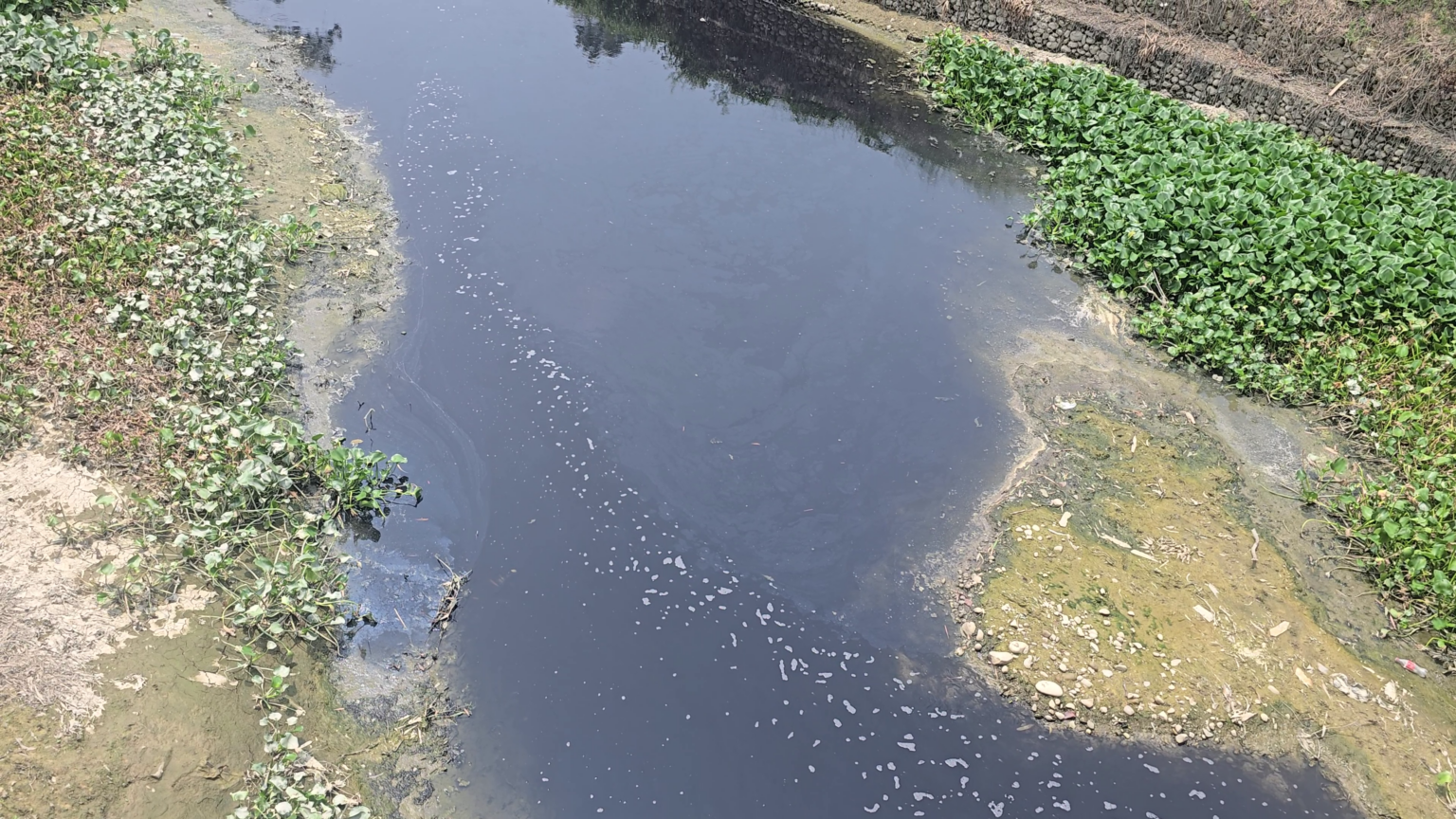
Polluted Dudhmati River
According to Sogarath Das of Basbitti, Janakpurdham Sub-Metropolitan City-22, pure water used to flow in Dudhmati in the past, the movement of sages and saints used to take place here, and worship rituals used to go on. However, gradually due to human activities, the river became polluted. He says, “Until a few decades ago, the water of the Dudhmati River used to flow like milk, but after drains and garbage were thrown right into the river, this river is awaiting conservation.”
According to Bindeshwar Sah of Basbitti itself, irrigation was also being done in this region in the past from the water of Dudhmati. However, due to the unmanaged urbanization and encroachment of the Janakpur area, the mouth of the river has been getting blocked and the river has shrunk, according to his statement. He states that in most places, the banks of the river have been filled up and converted into registered private land. Due to this, the existence of the river is in a state of ending altogether. He says, “Today, the stream of the river remains in only a few places; people have grabbed the remaining places. The river narrowed down this way is in a further crisis as it falls into the grip of pollution.”
Up to the origin site north of Baniniya, Ward 3, Laxminiya Rural Municipality of Dhanusha, the flow area of the river has been encroached upon. The flow area of the river has been filled with soil and made into fields, and houses have also been built in the flow area. Inhabitants state that the natural flow of the river stopped when land grabbers and local individuals registered the river’s thousands of square meters of land under their own names as registered private property and encroached upon it. Encroaching on the river area, commercial fish ponds have been dug.
According to Basudev Mandal, aged 78 years, the river reached a state where its existence is ending after several pieces of land along the riverbanks were made private in the urban survey of the fiscal year 1963/64 in collusion with the employees of the Land Revenue Office. “We grew up playing right beside this river. After the fiscal year 1963/64, the river began falling into encroachment and went on becoming polluted,” he says.
With the mixing of garbage like plastic, glass, chemicals, and sewage from the town area, the water of the Dudhmati River has become black and foul-smelling. According to Bimlesh Mishra, the Ward Chairman of Janakpurdham Sub-Metropolitan City-22, the cleaning of this river has been being done every Saturday through the activeness of youth. However, since the origin area itself is blocked, the river remains polluted, according to his statement.
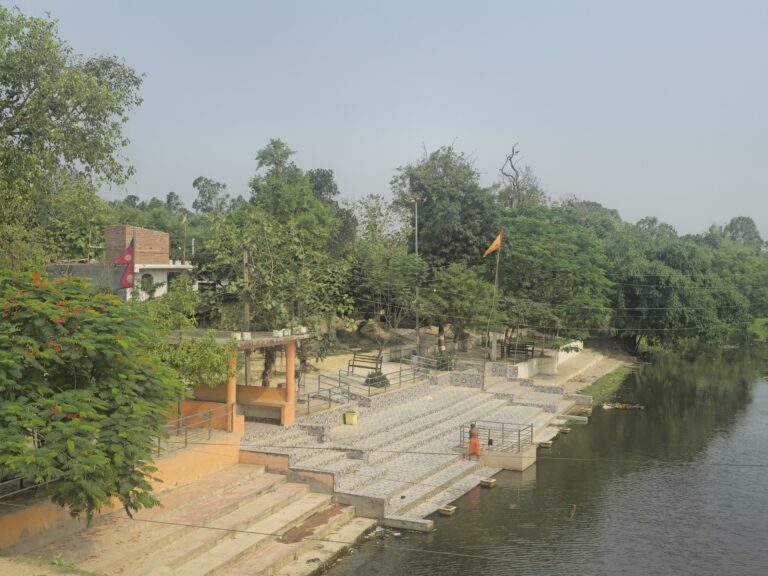
Dudhmati River looking somewhat clean in Basbitti due to the cleaning campaign of local youth
Although the Ministry of Irrigation and Water Supply of the Madhesh Province Government showed initiative some time ago to make Dudhmati free from encroachment, the campaign cooled down after the minister changed. Local activist Sudip Mandal says, “Only through the coordination of all three levels of government can this river be returned to its old form.”
Slow river conservation plan
With the objective of conserving and beautifying the Dudhmati River and vacating the natural flow area, demarcation was started in the last week of December 2025. For the determination of boundaries by identifying the natural flow area of the river, demarcation, mapping, and excavation were started up to 29 kilometers from the origin site at Arjanwa village, Ward 5, Kshireshwornath Municipality, up to the Indian border.
The Madhesh Province Government had taken a policy under the Dudhmati River Development Project to remove the encroachment of the land of the river area and to beautify the river by excavating the filled-up river. The work was brought forward by forming a high-level committee under the coordination of the then Minister for Energy, Irrigation, and Water Supply of the Madhesh government, Shesh Narayan Yadav. The Ministry of Energy of the provincial government had allocated Rs 25 million in the initial phase in the current fiscal year 2025/2026.
Under the multi-year project of around Rs 5 billion, plans were put forward to arrange, besides the flow area of Dudhmati, at least 11-meter by 11-meter asphalt roads on both sides; beautification of a pond along with a temple and a park at the origin site; a park along with a temple of Dudhmati and Mother Sita near every village falling in the flow area of the river; and dams at a distance of every two kilometers. However, the work has not moved forward till now. Along with the change in government, the plan has become stranded.
The then energy minister Yadav had put forward two plans: one of Rs 110 million, where the river would be returned to its old condition by excavating, and another of Rs 340 million for beautification and dam construction. Out of those, work has started on the plan of Rs 110 million. However, the speed of the work is very slow. “The Dudhmati River is important from the religious and tourism point of view; therefore, the province government must bring work forward, keeping its conservation a priority,” former minister Yadav says.