Kathmandu
Saturday, June 13, 2026





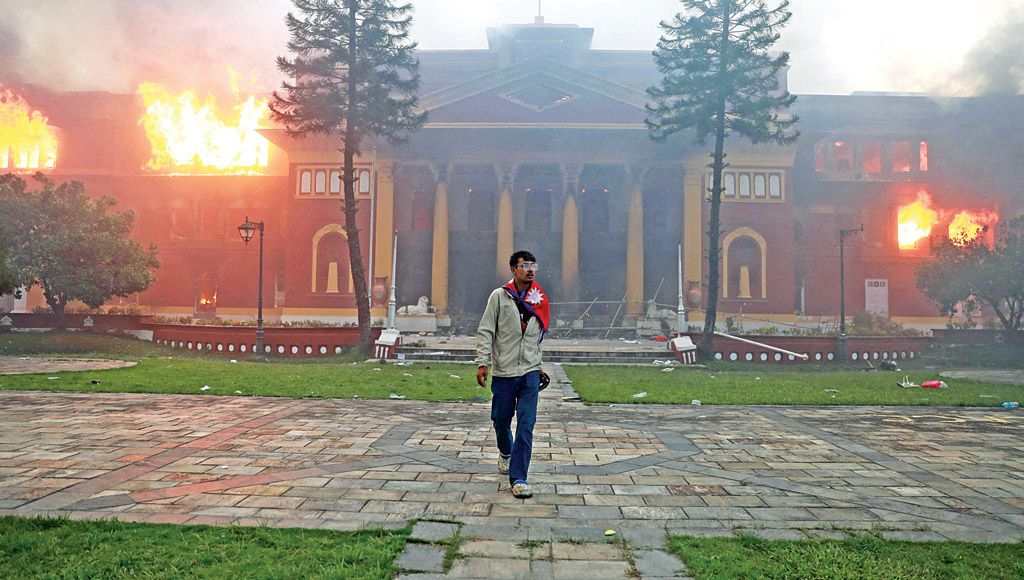
KATHMANDU: It has been revealed that during the Gen Z movement on September 9, the Nepali Army evacuated President Ram Chandra Paudel to a secure location shortly after he accepted the resignation of then-Prime Minister KP Sharma Oli.
Dr. Deepak Karki, the then-Secretary of the Office of the President, provided this testimony to the Inquiry Commission on the Gen Z Movement. According to his statement, the resignation of KP Oli was approved at 2:50 PM.
The statement notes that the Nepalese Army moved the President to safety at 3:00 PM, after which Shital Niwas (the Presidential Residence) was set on fire.
“The letter for the resignation of then-Prime Minister KP Sharma Oli arrived at approximately 2:45 PM. After the resignation was approved at 2:50 PM, we moved from the President’s residence to a secure location provided by the Nepalese Army at around 3:00 PM,” Karki’s statement reads. “Following our departure, we received reports of arson and vandalism targeting the President’s Office building, its physical assets, and government records.”
Karki further testified that the failure to manage state affairs and governance in a timely manner led to the massive scale of destruction.
“Regarding the protests and subsequent damage on September 8 and 9, 2025 (Bhadra 23 and 24, 2082), the losses might have been minimized had the issues emerging in state governance and management been addressed promptly,” he stated.
He added that reports were streaming in about Singha Durbar, the Supreme Court, the Parliament Building, and various Nepal Police units being targeted. “The Nepali Army had briefed the President on the security situation,” he said.
When questioned about his views on the Gen Z generation’s outcry against rising corruption and financial irregularities following the implementation of the new Constitution and federalism, Karki clarified that the Constitution itself was not the problem.
He argued that while the Constitution of Nepal provides a robust framework for independence, sovereignty, human rights, and democratic values, the crisis occurred because those in executive roles failed to fulfill their responsibilities. He noted that the authorities and institutions failed to address public grievances in time or rectify sectoral weaknesses, leading to the eventual unrest—emphasizing that the “Constitution did not cause the country’s problems.”