Kathmandu
Saturday, June 13, 2026





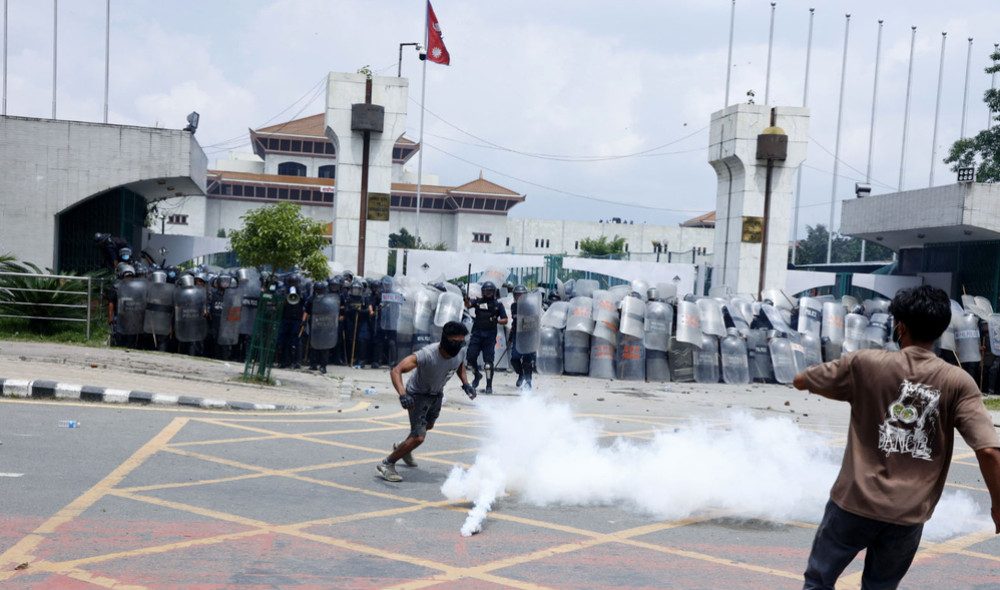
KATHMANDU: An 907-page report by a high-level inquiry commission led by former high court judge Gauri Bahadur Karki into the September 8–9, 2025 Gen-Z protests detailing a dramatic breakdown of security at Nepal’s federal Parliament and exposing deep coordination failures among security agencies.
The report provides a comprehensive account of deployments by the Nepal Police, Nepali Army, and protesters across multiple flashpoints, including the storming of the Parliament premises at Baneshwar.
According to testimony by Central Special Task Force (STF) Commander, Police Inspector Samunnat Adhikari, the protests initially began peacefully at Maitighar Mandala on September 8 but quickly escalated into violent unrest.
Protesters breached Parliament security, climbed railings, and launched coordinated attacks using stones, rods, slingshots, and even petrol bombs. Security forces responded with tear gas and aerial firing to disperse the crowd.
Adhikari stated that despite efforts to contain the situation, protesters entered the Parliament complex, committing arson and vandalism. By the second day, the situation had deteriorated further, with critical security posts already destroyed, limiting STF deployment capacity.
The report documents extensive damage, including the destruction of 40,000 liters of diesel, barracks, mess and canteen facilities, CCTV control rooms, walk-through security gates, vehicles, and personal belongings of security personnel.
In his statement, Adhikari claimed that STF personnel did not fire directly at protesters, instead relying on crowd-control measures.
“We used tear gas and aerial firing under operational command. No STF team member fired directly at protesters. I am not aware of any deaths caused by STF bullets,” he stated, adding that casualties, if any, may have resulted from other police or Armed Police Force (APF) units.
He also reported that 12 police personnel were injured during the clashes, while he himself sustained an eye injury after being struck by a stone.
On September 9, Adhikari described a far more complex and dangerous situation, with simultaneous attacks across Kathmandu Valley preventing reinforcements. Protesters, some allegedly carrying looted weapons, re-entered the Parliament area and set fire to fuel reserves and infrastructure.
Despite extreme risks, STF personnel managed to secure some critical installations before retreating to safer positions. Before withdrawal, limited force-including tear gas, rubber cartridges, and a small number of live rounds-was used to prevent further explosions near fuel storage.
The report highlights serious coordination gaps among Nepal Police, Armed Police Force, and the Nepali Army, which Adhikari said undermined operational effectiveness and morale.
He noted that while the Nepali Army was deployed after curfew orders on the first day, its response on the second day was inadequate, with troops failing to intervene even as protesters moved in and out of the Parliament premises. The APF was also described as having played a minimal role during critical moments.
Adhikari recommended major reforms, including specialized training, improved technical equipment, real-time threat analysis systems, and the establishment of satellite STF bases in each province.
The report paints a stark picture of institutional failure during one of Nepal’s most volatile protest episodes in recent history, raising serious questions about preparedness, inter-agency coordination, and command responsibility at the highest levels.