Kathmandu
Thursday, July 9, 2026





From a road project that cannot pay its contractor to a poverty rate that rose instead of falling, Nepal's record of planned development is a story of ambition repeatedly outpacing political will, budget, and capacity to deliver
KATHMANDU: “Interventionist work will be done in good governance, economic transformation, long-term planning, and transformative projects. With the next budget, we want to change the course of the economic ship; it will be genuinely transformative.”
Immediately after assuming office on March 27, newly appointed Finance Minister Swarnim Wagle told Ministry of Finance staff that he would work relentlessly on good governance and development. With the formation of an RSP government that received a mandate for good governance, stability, and economic development, the test of addressing public aspirations has already begun. From its first cabinet meeting, the government has drawn up 100 governance reform agenda items to be completed within 100 days, and has begun working through results-oriented service delivery. How it performs on planned development remains to be seen.
Past practice, however, offers little reason for enthusiasm about planned development.
Nepal has been pursuing good governance and planned development for 69 years. The National Planning Commission (NPC) was established as an institutional structure in 1956, launching the era of periodic planning. Under the NPC, chaired by the Prime Minister, 10 five-year plans and five three-year plans were implemented over the 68 years from 1956 to 2024, yet targeted progress was not achieved. The implementation of the policies, strategies, and programs set out in those plans did not proceed as expected.
Former finance minister and governor Yuba Raj Khatiwada, who also served as vice-chairman of the NPC, says that unstable governments, lack of budget certainty, and weak capacity to mobilize available resources have prevented expected results from being achieved. “Every plan is made carrying new aspirations, but a new government is formed before the plan made under the previous one can even be implemented,” he says. “Even if the new government technically appears to work within the plan, it has its own fresh agenda and priorities which means the plan is never properly implemented and significant progress never materializes.”
New plan, same old targets
Because the government has been unable to advance work in line with periodic plans, it is compelled each time to draft and implement a new plan carrying over the unmet targets of the old one. The Sixteenth Plan, currently being implemented, is a case in point. The plan, which came into effect from fiscal year 2023/24, has set 20 key indicators with targets to be met by its final year of 2028/29, including raising the Human Development Index to 0.650, reducing the proportion of the population below the poverty line to 12 percent, bringing average life expectancy to 73 years, and ensuring 100 percent of the population has access to electricity.
But several of these indicators were already expected to be achieved under the preceding Fifteenth Plan. The government had set a target in the Fifteenth Plan (FY 2018/19–2080/81 BS) to reduce the proportion of the population below the poverty line to 9.5 percent and to bring electricity access to all citizens. Alongside its periodic plans, the government has also put forward a 25-year long-term vision from 2019 to 2043 under the slogan ‘Prosperous Nepal, Happy Nepalis’. Implementation of the Long-Term Vision 2100 began with the Fifteenth Plan and will continue through to the Nineteenth Plan.
The government’s own review report acknowledges that the Fifteenth Plan, hit by the Covid-19 pandemic from its very first year of implementation, failed to achieve its targets. Rather than falling, the poverty rate rose by approximately four percent, meaning some 1.2 million additional people fell below the poverty line. The target of delivering electricity to all local units and 100 percent of the population was met for only 96.7 percent of the population.
Progress was also absent in the basic dimensions of human life – education, health, employment, and agriculture. The Auditor General’s 62nd Annual Report for the fiscal year 2023/24 notes that the Fifteenth Plan’s target of reaching a net enrolment rate of 99 percent at the basic level (classes 1 to 8) in its final year was met only at 95.1 percent. The target of achieving a 65 percent net enrolment rate at the secondary level (classes 9 to 12) was also missed; the Economic Survey 2024/25 shows the rate reached only 57.9 percent. The target of raising the proportion of secondary students studying technical subjects to 30 percent shrank to just 2.7 percent. And the target of bringing internet connectivity to 95 percent of schools was achieved at only 43.1 percent.
In the health sector, the Economic Survey 2024/25 records that the Fifteenth Plan’s target of raising average life expectancy to 72 years was met at only 71.3 years by the plan’s final year, FY 2023/24. Targets were also missed for reducing maternal mortality to 99 per 100,000 live births, neonatal mortality to 14 per 1,000 live births, and under-five child mortality to 24 per 1,000 live births; by the plan’s final year, the figures stood at 151, 21, and 33 respectively. The target of bringing 60 percent of the population into health insurance coverage was achieved for only 28.43 percent.
The government’s review report acknowledges that the target of creating 2.5 million additional jobs and significantly reducing the unemployment rate during the plan period was not met as expected, though it does not specify how far unemployment fell short. The Economic Survey 2024/25 states that in the previous fiscal year 2023/24, as many as 885,153 unemployed individuals were registered across all 753 local units, of whom only 64,733 found employment, and that too for an average of only 79 days throughout the year.
Associate Professor Resham Thapa of the Central Department of Economics at Tribhuvan University, Kirtipur, says that while unexpected events such as the Jajarkot earthquake of November 2023 and the Covid-19 pandemic can be accepted to some extent as obstacles to achieving development targets, the failure to reach expected outcomes is fundamentally a result of lack of political commitment. “Everything apart from the earthquake and Covid-19 is an excuse,” he says. “At the implementation level, from civil servants to politicians, the old thinking and structure remain; in such conditions, new plans simply cannot be implemented and cannot deliver results.”
Plans built on air
The review report on the Fourteenth Plan (FY 2016/17 to 2018/19) concluded that launching projects without adequate preparation, failure to acquire land on time, delays in contracting, procedural slowness, shortages of construction materials, weak project management, and lack of coordination among stakeholder agencies were keeping capital expenditure low and rendering the overall development plan a failure. The Fourteenth Plan, introduced essentially as the first plan after the Constituent Assembly promulgated the constitution, failed to achieve expected results in health indicators. The target of reducing neonatal mortality to 20 per 1,000 live births was met at only 21 by the plan’s final year of 2018/19. The target of reducing under-five child mortality to 30 per 1,000 live births reached only 39. Maternal mortality, targeted to fall to 145 per 100,000 live births, remained at 239. The Fourteenth Plan’s target of bringing maternal mortality down to 145 has still not been met even by the time of the current Sixteenth Plan.
The government had formulated the Fourteenth Plan to address post-earthquake reconstruction following the 2015 earthquake, the implementation and management of federalism, and the economic damage caused by disruptions to border trade. It was also during this plan that the government began implementing the Sustainable Development Goals. Total expenditure over the three-year plan amounted to over Rs 3.034 trillion. Yet the target of raising average life expectancy to 72 years was achieved only at 70.
Targets that were met during the Fourteenth Plan period included bringing basic drinking water access to 89 percent of the population, achieving a 45 percent net secondary enrolment rate, and reaching a 92 percent literacy rate in the 15-to-24 age group. These were made possible by expanding scholarships for disadvantaged groups, mid-day meal programs, free education, technology, and educational infrastructure. The plan made partial progress in improving the economic standing of families below the poverty line and guaranteeing employment opportunities. The Economic Survey 2019/20 notes that by implementing the Right to Employment Act 2018, the government identified unemployed individuals in every local unit by the plan’s final year and provided 100 days of employment annually. According to that survey, a large gap between labor demand and supply has persisted because sufficient employment cannot be created for the approximately 500,000 new workers who enter the labor market each year in Nepal.
In the Fourteenth Plan’s final year of 2018/19, the target annual average agricultural growth rate of 4.7 percent was achieved at only 4.2 percent. Progress on expanding irrigation for agriculture also fell short; the target of extending irrigation to 1,520,000 hectares of cultivable land was met at only 1,470,000 hectares.
Former secretary and infrastructure expert Arjun Jung Thapa says plans are not completed on time because of a lack of continuity in budget allocations for development projects, changes of government causing projects begun by the previous government to lose momentum, and the tendency to rush into contracting without first securing resources, completing land acquisition, conducting environmental impact assessments, or clearing sites. “That is why planned development targets have not been achieved,” he says.
The obstacle of inadequate budgets
Inadequate budgets and poor coordination mean projects are slow to start, difficult to complete once begun, and subject to repeated deadline extensions. Project chief Bijay Kumar Mahato says that delays in the 15.8-kilometre Suryabinayak-Dhulikhel road widening project, which connects Bhaktapur and Kavrepalanchok on the Araniko Highway, stem from a lack of coordination and budget. “At the start, just relocating electricity poles and removing 100 houses within the project area took time,” he says. “Work is moving at pace in the current fiscal year, but there is not enough budget to pay the contractor.” The road widening project, begun in late December 2022/early January 2023 with a three-year completion target, is still ongoing. The road is being expanded from two lanes to six – four main lanes and two service lanes.
According to project chief Mahato, the project requested Rs 3 billion from the government for the current fiscal year 2025/26 but was allocated only Rs 700 million. An initial release of Rs 600 million proved insufficient, and a further Rs 150 million was released. In a phone conversation on March 26, Mahato said he had received word that an additional Rs 200 million from the Finance Ministry was in the process of being released. “We have received information that it will be released, but it has not yet reached us for paying the contractor,” he says, adding that even when released, the amount will still be insufficient to make full payment to the contractor.
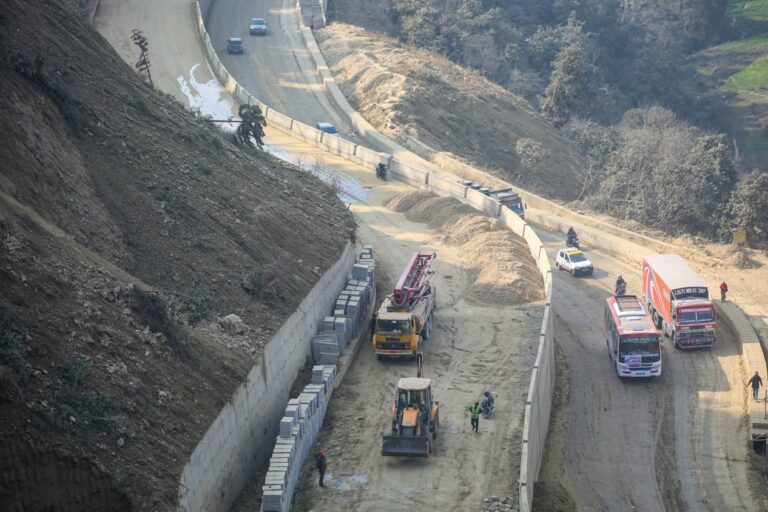
Under-construction Suryabinayak–Dhulikhel Road Project. Photo: Bijen Amatya / Nepal Photo Library
The contract deadline for the 7.5-km Suryabinayak-Sanga section expired on 11 January 2026 and has been extended to 13 March 2027, while the deadline for the 8.3-km Sanga-Dhulikhel section expired on 13 December 2025 and has been extended to 9 December 2026. Progress to date stands at 48 percent on the Suryabinayak-Sanga section and 68 percent on the Sanga-Dhulikhel section. The contract for the Suryabinayak-Dhulikhel section was awarded to Ashish-Kumar Shrestha-Bandhan Bhagwati JV on 8 January 2023 for Rs 3.8893 billion, while the Sanga-Dhulikhel section was contracted to Lama Construction on 13 December 2022 BS for Rs 4.0564 billion. Three years since the project began, total budget released for both sections amounts to approximately Rs 4 billion, according to project chief Mahato.
Economist and senior researcher Kalpana Khanal says the government keeps falling short by drawing up five-year and three-year plans without adequate prior study. “Annual budgets must align with five-year plan implementation, but some national pride projects have been under construction for 20 years because work was started without settling how much budget was needed and whether the capacity to implement was in place,” she says. She argues that the tendency to go through the motions of prioritizing plans and allocating budgets, then scattering funds like sesame seeds thrown for votes, is why development targets are not being met.
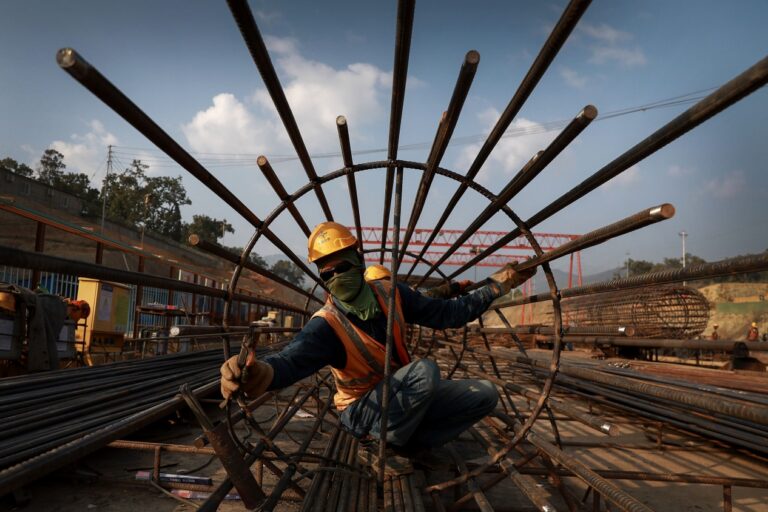
A worker constructing the pillar frame at the Terai/Madhesh Fast Track Highway construction site. Photo: Nepal Photo Library
Meanwhile, the Chuhar Motorable Bridge over the Dudh Koshi River, bordering Mainamaini in Belka Municipality-7, Udayapur, which is meant to connect the southern part of Bhojpur with the Terai and Kathmandu, has also been left incomplete because construction was not finished on time. This bridge’s foundation stone was laid on 12 October 2020 by the then Chief Minister of Koshi Province, Sher Dhan Rai. The Chuhar Bridge, part of the Koshi Province government’s flagship projects, currently has two pillars erected and left unfinished. The construction company Kalika Pacific JV had signed a contract worth Rs 212.3 million to complete the bridge by mid-November 2022. According to the plan, the budget equivalent to the project cost was supposed to be allocated between FY 2019/20 and FY 2021/22. However, due to insufficient budget allocation, the contractor delayed the work.
During the March 5 House of Representatives election, the UML candidate Sher Dhan Rai expressed that the bridge could not be completed because the new government, which came after he left the provincial government, did not prioritize it. He campaigned on the promise that if elected this time, he would complete the unfinished bridge.
Meanwhile, according to the program booklet of the Koshi Province Ministry of Physical Infrastructure Development, Rs 95 million was allocated within the specified period (FY 2019/20 to FY 2021/22) to complete the bridge. Budget allocations for this bridge had started from FY 2018/19, with Rs 10 million allocated in the first year. Since the foundation stone was laid, the budget has been allocated at a rate of Rs 20–45 million per year, and for the current fiscal year, Rs 42 million has been allocated.
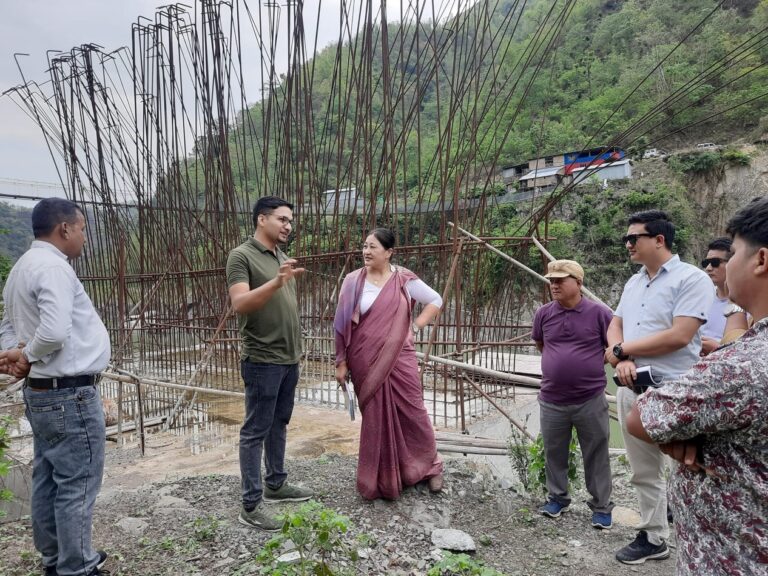
Shrijana Rai, UML member of the Koshi Provincial Assembly from Bhojpur, inspecting the abandoned Chuhar Bridge on 4 May 2023. Photo: Milan Rai’s Facebook
Senior engineer Lalit Kumar Chaudhary of the Koshi Province Ministry of Physical Infrastructure Development stated that after the October 2024 damaged the pillars of the bridge, construction can only proceed after redesigning the bridge. “Due to flood damage, we had to redesign it, and consultants are currently conducting the final study,” he said. According to the redesign, the cost of the bridge has increased to nearly Rs 260 million.
Former vice-chairman of the National Planning Commission, Govinda Raj Pokharel, also said that plans made under political influence without ensuring budget availability and assessing implementation capacity are extremely difficult to achieve. “There is a tendency to plan according to the political agenda of the ruling party rather than reality,” he explained. “Those who are meant to include the party’s literal agenda are put in charge of planning. Employees are not consulted about implementation capacity, resources, or existing policies and regulations, which creates challenges during execution.”
Pokhrel says that shifting priorities with each change of government and international market and trade policy developments have also prevented periodic plans from achieving targeted progress. During the Fifteenth Plan period, for instance, the Russia-Ukraine conflict disrupted international supply chains, causing shortages and price rises in petroleum and other imported goods that weighed on Nepal’s economy. The ongoing Iran-Israel war is now deepening a petroleum crisis across the Middle East and West Asia, including Nepal.
Seven decades of development plans
Nepal launched its First Plan (mid-July 1956 to mid-July 1961) seven decades ago, setting economic growth and social development as its principal objectives to boost production and promote employment. Implementation of this five-year plan laid the foundations of basic infrastructure in agriculture, roads, and electricity.
The Second Plan (mid-July 1962 to mid-July 1965) made economic development, employment growth, and an equitable social order its main objectives. The NPC’s review report notes that implementation of this three-year plan played an important role in economic development.
The Third Plan (mid-July 1965 to mid-July 1970) aimed to advance public welfare by establishing and protecting a just social order. Its implementation marked the beginning of a planned development system in agriculture, transport, industry, and electricity.
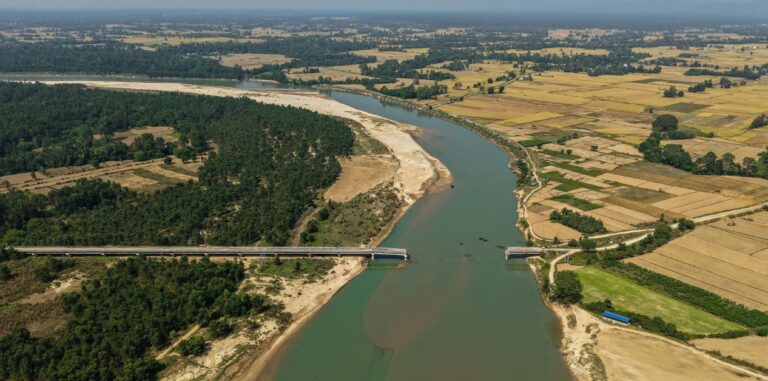
The broken Jabdi Ghat Bridge over the Babai River, connecting Gulariya and Barbardiya Municipality in Bardiya. Photo: Prakash Chandra Timilsena / Nepal Photo Library
The Fourth Plan (mid-July 1970 to mid-July 1975) carried targets of boosting production, laying the groundwork for transport, communications, and electricity development, strengthening agriculture and industry, diversifying and expanding international trade, and controlling inflation. This period saw the beginning of balanced development and the national education system.
The Fifth Plan (mid-July 1975 to mid-July 1980) similarly aimed to increase production, maximize use of the workforce, and achieve regional balance. The Sixth Plan (mid-July 1980 to mid-July 1985) set targets of rapid economic growth, creating productive employment, and meeting the minimum needs of the population.
The Seventh Plan (mid-July 1985 to mid-July 1990) also set increasing production and productive employment and meeting minimum public needs as its main objectives. The Eighth Plan (mid-July 1992 to mid-July 1997) advanced economic reform and was the first periodic plan introduced after the restoration of multiparty democracy.
The Ninth Plan (mid-July 1997 to mid-July 2002) put forward a 20-year long-term development framework with the single objective of poverty alleviation. The Tenth Plan (mid-July 2002 to mid-July 2007) committed to reducing poverty while implementing the Millennium Development Goals (MDGs).
The Eleventh Plan (mid-July 2007 to mid-July 2010) aimed at establishing peace, social cohesion, and post-conflict infrastructure reconstruction to build a prosperous, modern, and just Nepal. The Twelfth Plan (mid-July 2010 to mid-July 2013) sought poverty alleviation, lasting peace, and tangible improvements in ordinary people’s lives. During this period, MDG social indicator targets were met, and achievements were recorded in the balance of payments and revenue growth. The Thirteenth Plan (mid-July 2013 to mid-July 2016) set the target of graduating Nepal from least developed to developing country status. This period saw a new constitution promulgated, advances in inclusion and proportional representation, increased telephone and mobile penetration, expansion of the road network, and growth in forest cover.
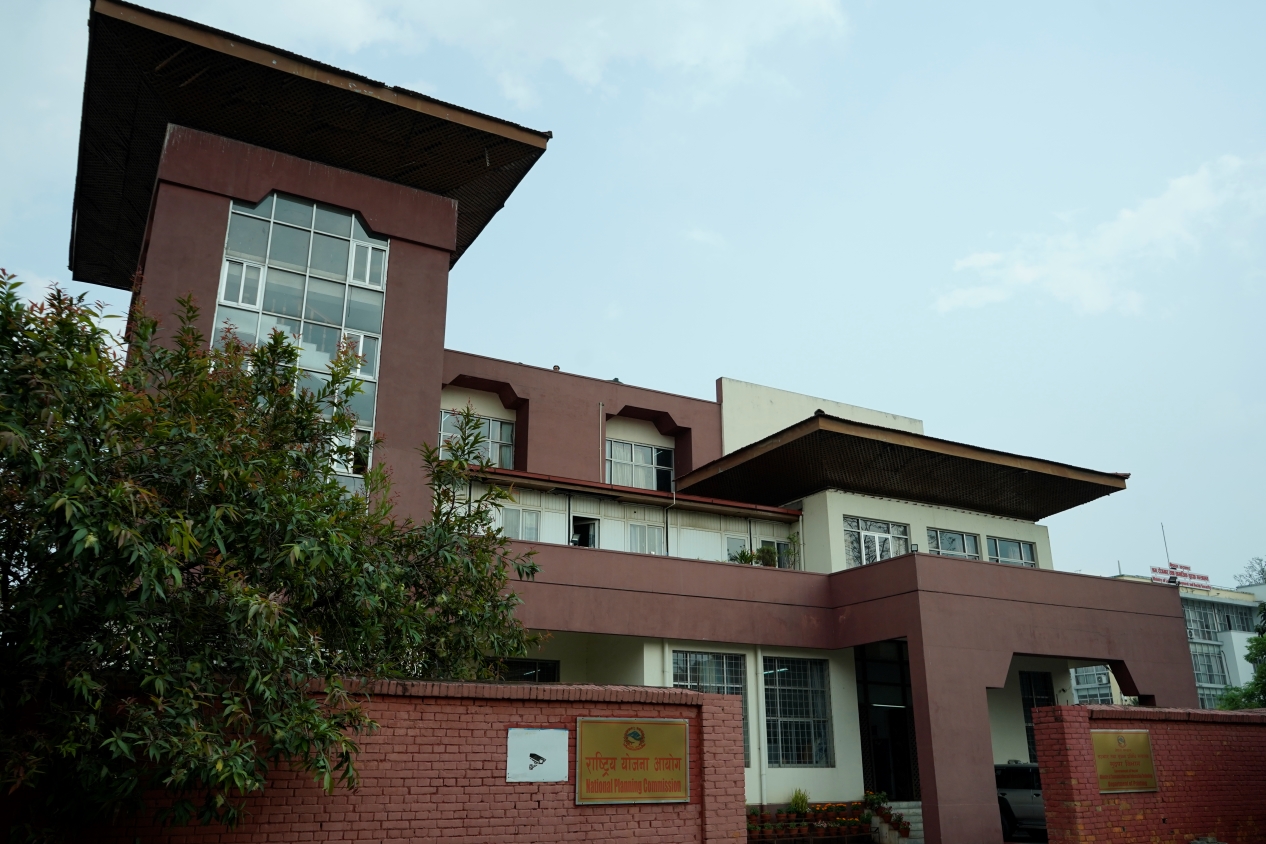
The Singha Durbar-based National Planning Commission office building. Photo: Bikram Rai/Nepal News
The Fourteenth Plan (mid-July 2016 to mid-July 2019) aimed to guide federalism implementation, build a welfare state, and achieve middle-income country status. During this period, the economic growth rate exceeded its target by 0.2 percentage points, reaching 7.4 percent. Human Development Index and social sector targets were met. Plans from the Eleventh through the Fourteenth were all three-year plans.
The Fifteenth Plan (mid-July 2019 to mid-July 2024) was introduced at a time of improved economic growth from the Fourteenth Plan, political stability, and reduced power cuts and strikes. Under the 25-year long-term vision from mid-July 2019 to mid-July 2043 carrying the slogan ‘Prosperous Nepal, Happy Nepalis’, it set the target of laying the foundations of prosperity in the first five years. But the Covid pandemic struck from the very first year of implementation. The review report notes that lockdowns and social distancing requirements had a negative effect on the economy, resulting in GDP losses of Rs 289 billion in FY 2019/20 and Rs 333 billion in FY 2020/21.
The Sixteenth Plan (mid-July 2024 to mid-July 2029) has set the targets of graduating Nepal from least developed to developing country status in 2026, and of reaching middle-income country status by 2030 while achieving the Sustainable Development Goals.