Kathmandu
Thursday, July 9, 2026





Once a staple born of necessity, Dhido is now drawing tourists and earning a place on restaurant menus. Yet the indigenous crops used to make it are becoming increasingly scarce.
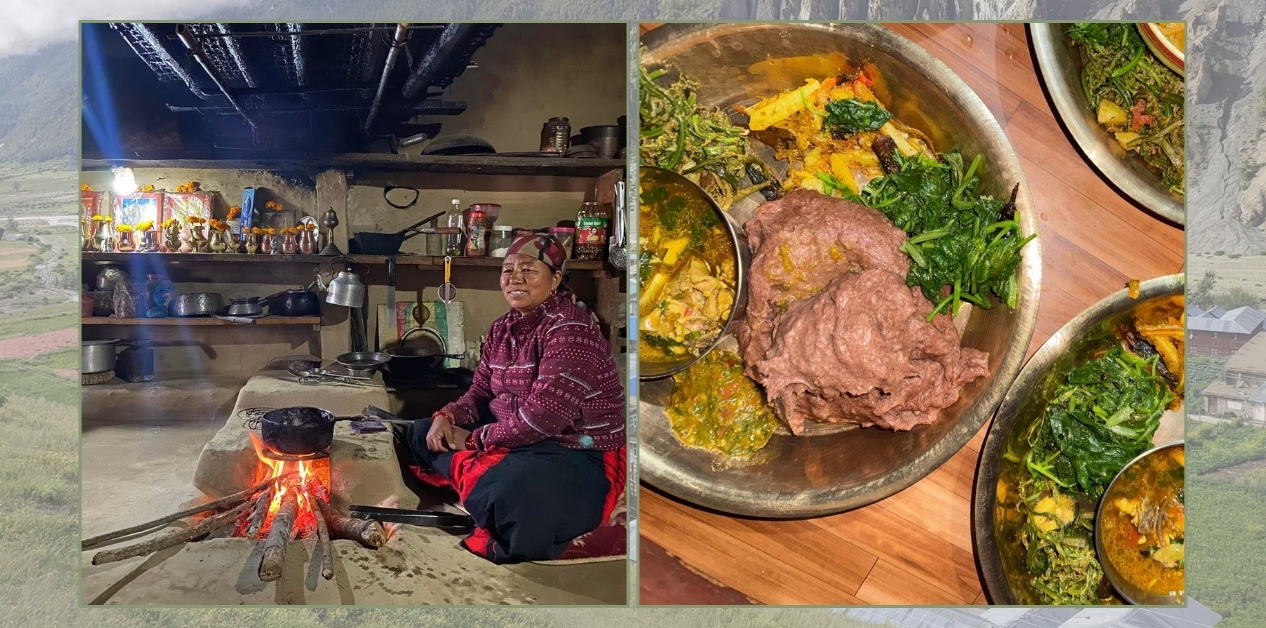
POKHARA: Bishnu Gurung, a Gurung movie actor from Marsyangdi Rural Municipality-6 in Lamjung, still vividly remembers hastily hiding Dhido (cornmeal/millet porridge) to cook rice whenever guests visited his home. “We grew up eating Dhido for both breakfast and dinner. Back then, it was looked down upon as food for the poor,” Gurung says. “Time has brought such a massive change. Now, people search far and wide just to eat that very Dhido.”
“In the past, eating Dhido was a compulsion; now, it has become a desire. During times when rice production was low in the village, we had to rely on Dhido for our morning and evening meals,” says Ashish Tamang, the Ward Chairman of Dordi Rural Municipality-9 in Lamjung. “The dish that people didn’t even want to look at back then has now become something they pay high prices to eat.”
According to him, until about a decade and a half ago, Dhido was the daily staple in village households, while rice was a dish cooked only on special occasions. Today, the situation has reversed. Both domestic and foreign tourists have started visiting villages and tourist homestays just to eat Dhido.

Gurung movie artists eating Dhido. Photo: Aas Gurung
Punam Gurung, the operator of Tangting Community Homestay in Kaski, shares that the majority of domestic and foreign tourists demand Dhido, Gundruk (fermented leafy green vegetable), and local chicken meat. She says, “Today, Dhido has become a symbol of authentic Nepali cuisine and a special attraction for hospitality.”
The popularity of Dhido has also surged recently because doctors have started advising that Dhido made from millet, maize, and buckwheat is healthier than rice, explains Vishnu Rana, President of the Nepal Federation of Indigenous Nationalities (NEFIN) in Gorkha. Consequently, Dhido is increasingly being included in restaurant and hotel menus.
Rising demand, declining production
Although the popularity of Dhido is growing, the production of finger millet, buckwheat, and maize is on the decline. Even though millet and maize are primarily grown in the hilly regions and buckwheat in the mountainous areas, both the cultivation area and total production have shrunk in recent years.
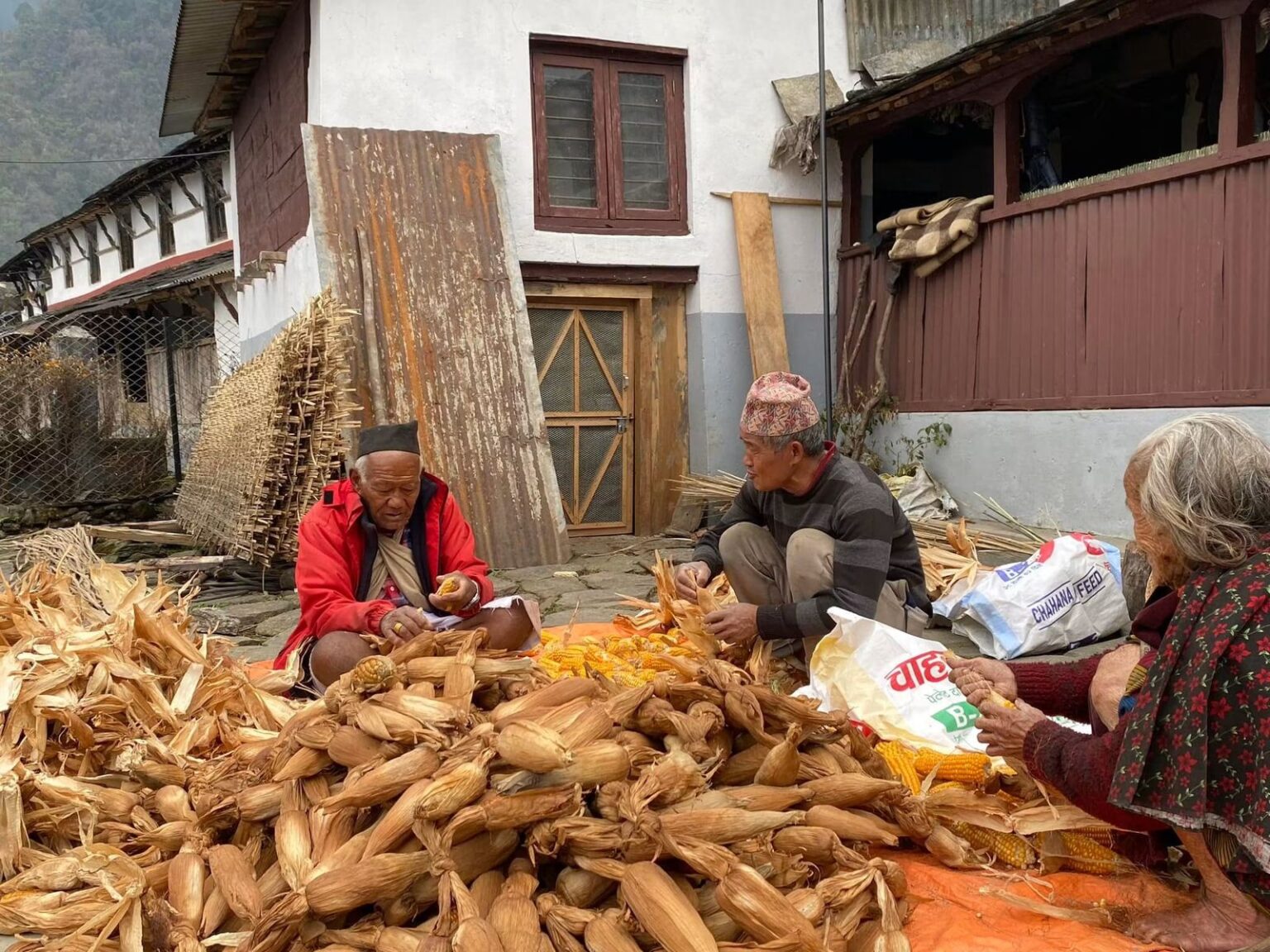
Locals shelling corn in the tourist village of Tangting, Kaski. Photo: Punam Gurung
According to data from the Ministry of Agriculture, Land Management, and Cooperatives of Gandaki Province, millet production, which stood at 110,151 metric tons in the fiscal year 2021/22, dropped to 79,619 metric tons in the fiscal year 2022/23. Although it saw a slight recovery to 81,584 metric tons in the fiscal year 2023/24, production has still not returned to its previous levels.
Buckwheat production was 3,598 metric tons in the fiscal year 2020/21. It plummeted to 1,477 metric tons in the fiscal year 2022/23. Even though 1,575 metric tons were produced in the fiscal year 2023/24, it has failed to reach its former status.
Maize production has faced a similar decline. From 454,265 metric tons in the fiscal year 2021/22, production fell to 387,904 metric tons in the fiscal year 2022/23. It further decreased to limit itself to 377,800 metric tons in the fiscal year 2023/24.
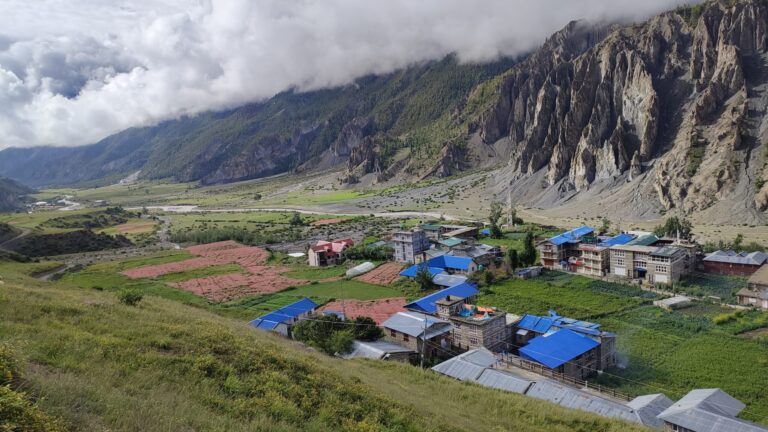
Buckwheat in bloom in Upper Manang. Photo: Aas Gurung
According to Ram Maya Kadariya, the Agriculture Extension Officer of the Ministry, the latest data is currently being collected and has not been made public yet.
Despite the rising demand for Dhido, the number of farmers cultivating the necessary crops is dwindling. As the youth workforce migrates abroad for employment, more and more arable land is being left barren. This has directly impacted the production of indigenous crops like millet, maize, and buckwheat, explains agricultural economist Madan Regmi.
According to him, the primary reasons for the decline in production include rising crop damage caused by wildlife, a lack of adequate research and improved seeds for indigenous crops, and low investment in production. “The demand for Dhido is increasing, but the number of farmers producing the required raw materials is decreasing,” Regmi says.
Conservation efforts
To boost the production and utilization of indigenous crops, the government has been running various conservation and promotion programs. Government officials state that initiatives are underway to expand production and provide seeds, technology, and subsidies to farmers cultivating millet, maize, and buckwheat.
According to Shashi Adhikari, Senior Agricultural Economist at the Ministry of Agriculture, Land Management, and Cooperatives of Gandaki Province, the Ministry has emphasized the protection and marketing of local products through schemes like the Indigenous Crop Promotion Program and the Agro-Tourism Promotion Program.
However, experts argue that subsidies and promotional programs alone are not enough. They point out that unless there is an emphasis on farmer-friendly policies, improved seeds, research, mechanization, and guaranteed market management to scale up production according to market demand, achieving a significant improvement in indigenous crop production will remain difficult.