Kathmandu
Thursday, June 25, 2026





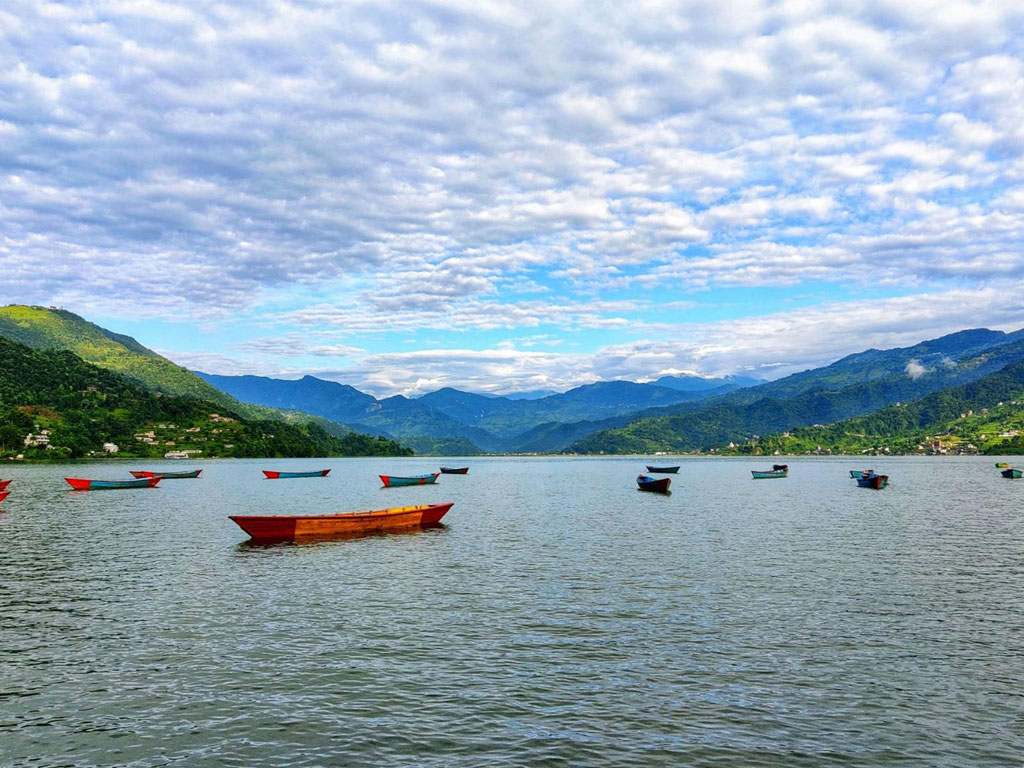
KATHMANDU: Phewa Lake (Phewa Tal), Nepal’s second-largest natural lake in Pokhara, Gandaki Province, faces severe encroachment from hotels, restaurants, and illegal constructions within its 65-metre buffer zone. Decades of sedimentation from Harpan Khola, combined with post-1974 dam failure land grabs and weak enforcement, have shrunk the lake from 10.35 sq km in 1962 to about 5.987 sq km total area (water-covered: 3.96 sq km) by 2024.
Supreme Court orders since 2018 remain partially unimplemented until PM Balendra Shah’s 100-point reform agenda pushed for removal within three months. As of April 1, 2026, boundary pillars are installed, but full clearance, compensation, and restoration face legal, financial, and political hurdles.
What is Phewa Lake and why is it significant to Pokhara?
Phewa Lake, also known as Phewa Tal, is Nepal’s second-largest natural freshwater lake, located in the heart of Pokhara Valley in Gandaki Province. Formed naturally but enhanced by a dam constructed in 1961 under the Nepal-India Cooperation Mission, it spans historically up to 10.35 square kilometres and currently measures approximately 5.987 square kilometres in total area with only 3.96 square kilometres covered by water as per 2024 topographic surveys.
Its significance is immense: it supports tourism through iconic boating, paragliding views of the Annapurna range, and cultural sites like Tal Barahi Temple; provides irrigation for 320 hectares of farmland; generates 500 kW of hydropower; and serves as a Ramsar-listed wetland since 2016, hosting biodiversity including migratory birds, fish, and aquatic plants. Economically, Lakeside area drives Pokhara’s tourism economy, employing thousands in hotels and restaurants.
Environmentally, it regulates local climate and acts as a natural reservoir. Encroachment threatens its very existence, risking loss of this heritage for future generations and impacting Nepal’s image as a tourism powerhouse. Without conservation, experts warn it could functionally disappear in 75-100 years due to combined human and natural pressures.
The lake symbolizes Pokhara’s identity and Nepal’s commitment to sustainable development under constitutional rights to a clean environment (Article 30). Recent government focus under PM Balendra Shah underscores its national priority.
What is the historical background of Phewa Lake’s formation, dam construction, and early management?
Phewa Lake’s modern form traces back to geological processes in the Pokhara Valley, but its current reservoir status began with the 1961 dam built by the Nepal-India Cooperation Mission on the eastern outlet, creating a larger water body recorded at 10.35 sq km in 1962 surveys.
A government gazette on November 30, 1973, declared it a protected area under the Pokhara Town Plan, banning construction within 200 feet (about 61 metres) of the perimeter.
In 1974-75, the original dam collapsed during floods, draining much of the lake and exposing lakebed land that locals cultivated and later registered as private property during the 1976-1977 cadastral survey. This led to fraudulent registrations of approximately 1,692 ropani (roughly 86 hectares).
A new dam rebuilt by 1981 restored water levels to about 5.8 sq km by 1982-83 surveys. Early management involved the Irrigation Department and later the Phewa Lake Conservation Office, but poor enforcement allowed illegal fillings and constructions. By the 2000s, urbanization accelerated. These events set the stage for ongoing encroachment disputes, as pre- and post-dam land claims clashed with conservation needs.
The 2007 Kaski District Council decision formalized the 65-metre buffer, building on the 1973 notification. This history highlights how natural disasters and weak governance enabled systematic land grabs that courts later deemed illegal.
How did the 1974 dam failure specifically contribute to long-term encroachment around Phewa Lake?
The 1974-75 dam failure was a pivotal trigger for encroachment. When the structure collapsed, water levels receded dramatically, exposing vast lakebed areas that turned into marshland and were quickly cultivated by locals.
During the 1976-1977 land survey by First Fort Napi, residents successfully registered these exposed plots as private property, with officials reportedly allocating plots ranging from 150 to 750 metres in some cases. This created a legal grey area: about 1,692 ropani were illegally titled to individuals.
When the new dam was completed around 1981 and water levels rose again, many of these “private” lands were submerged, leading to compensation claims that were initially denied as the government aimed to restore pre-failure boundaries. However, fraudulent registrations persisted, with roughly 500 ropani (held by 950 individuals) remaining contested or underwater in later assessments.
This episode allowed real estate speculators and businesses to claim ownership, filling lake edges with soil and building structures.
The Lamichhane Committee report (2012) later recommended quashing these certificates under the Land Revenue Act 1977. The failure exposed governance gaps—lack of immediate boundary enforcement post-disaster—enabling decades of shoreline conversion into commercial and residential use.
As of 2026, courts rule post-1976 registrations void without compensation, directly addressing this historical injustice while complicating removals.
What are the primary causes of human encroachment on Phewa Lake?
Human encroachment on Phewa Lake stems from multiple interconnected factors. Rapid urbanization and population growth in Pokhara turned the lakeside into prime real estate for hotels, restaurants, and residential plots, driven by booming tourism.
Post-1974 dam failure, exposed lands were illegally registered and filled with soil using tipper trucks, converting wetlands into saleable property—over 50 acres were filled in one recent year alone near Pame. Weak enforcement of the 65-metre buffer zone (formalized in 2007) allowed structures to proliferate, with complicit or corrupt local officials overlooking violations.
Economic incentives are huge: lakeside land fetches high prices, leading to “land mafia” activities. Unplanned development, including road construction and real estate speculation, exacerbated the issue. Political patronage and delays in court order implementation since 2018 further enabled it.
Natural causes like sedimentation from Harpan Khola (80%+ of 339,118 tons annual soil erosion) created new land that was then encroached upon. Studies show 2.026 sq km of delta formation from silt, which encroachers exploited.
Lack of integrated watershed management, deforestation in the 122.53 sq km catchment, and climate-driven heavy monsoons intensified vulnerability. By 2026, around 4,800 plots and 1,000+ structures sit in the buffer, reflecting decades of unchecked greed over environmental protection.
What legal protections and frameworks have governed Phewa Lake conservation historically?
Legal protections for Phewa Lake evolved over decades but suffered from poor implementation. The 1973 government gazette designated it a protected watershed, prohibiting construction within 200 feet. The 2007 Kaski District Council decision refined this to a strict 65-metre “green zone” from the high flood line.
Key laws include the Environmental Protection Act, Forest Act, and Land Acquisition Act, plus constitutional Article 30 (right to clean environment).
The lake’s 2016 Ramsar designation added international obligations for wetland conservation. A 2012 high-level committee under Bishwa Prakash Lamichhane documented 1,692 ropani of illegal registrations and recommended annulments.
The 2020 Punya Paudel committee proposed a 5.726 sq km lake area, later gazetted. Supreme Court interventions became central: a 2011 writ by advocates Khagendra Subedi and Ramesh Ghimire led to the landmark 2018 order.
By 2023, the apex court mandated full enforcement. The 2026 government’s 100-point reform agenda (Point 76) integrates this into national policy, emphasizing stakeholder coordination.
Local bodies like Pokhara Metropolitan City hold implementation responsibility, while the federal government handles boundary demarcation. Despite these, challenges like contempt petitions and protests highlight enforcement gaps. As of April 2026, a facilitation committee under Gandaki CM Surendra Raj Pandey oversees compliance.
What were the key details and outcomes of the 2018 Supreme Court order on Phewa Lake?
On April 29, 2018, Supreme Court Justices Om Prakash Mishra and Sapana Pradhan Malla issued a landmark order in response to the 2011 writ petition. Based on the 2012 Lamichhane Committee report, the court directed the government to: (1) demarcate the lake’s exact boundaries within six months using scientific methods; (2) remove all structures—private and government—within the 65-metre buffer zone from the high flood point; and (3) acquire any necessary private land through legal compensation processes.
It emphasized maintaining the area as a green zone for conservation, prohibiting business activities. The order also called for controlling silt from tributaries like Harpan Khola and preventing further pollution. Non-compliance led to contempt proceedings.
This verdict was hailed as historic but faced immediate legal challenges and implementation delays due to political changes, budget constraints, and protests. It laid the foundation for later rulings by affirming the lake and surrounding deltas as public property, invalidating post-1976 fraudulent registrations.
By 2026, it remains the baseline for ongoing demarcation, with 1,055 digital pillars now installed. The 2018 order shifted focus from tolerance of encroachments to active restoration, influencing national policy under PM Balendra Shah’s administration.
What did the June 2023 Supreme Court verdict specifically mandate regarding Phewa Lake encroachments?
On June 20, 2023, the Supreme Court delivered a decisive final verdict, with the full text released on September 25, 2023. It upheld and expanded the 65-metre buffer as a mandatory “green zone,” ordering the immediate removal of all unauthorized structures—including approximately 500 hotels, restaurants, resorts, and businesses—within six months.
The court ruled that Phewa Lake, its ponds, deltas, and surrounding areas are government property; any private registrations within the zone (especially post-1976 survey) are fraudulent and void under the Land Revenue Act 1977, requiring annulment without compensation. Pre-1976 valid titles with consistent tax records may qualify for compensation if land is acquired.
It issued a writ of mandamus to all three government levels for enforcement, including plantation in the buffer and no business activities. The verdict quashed attempts to reduce the buffer (e.g., 2021 mayor proposal to 30 metres) and criticized delays in earlier orders. It mandated coordination between federal, provincial, and local bodies.
By 2026, this remains binding; Pokhara Metropolitan City has begun public land clearances and pillar installations. The ruling balanced conservation with fairness but highlighted financial burdens, estimating costs at Rs 10-40 billion. It set a precedent against “colorable exercise of power” in environmental cases.
How has Pokhara Metropolitan City historically responded to Supreme Court orders on lake conservation?
Pokhara Metropolitan City’s response has been inconsistent and slow despite legal mandates. After the 2018 SC order, limited actions occurred, with some notices issued but minimal demolitions due to political pressure from business lobbies and fears of economic backlash.
In 2021, then-Mayor Man Bahadur GC attempted to shrink the buffer to 30 metres, sparking legal challenges and public criticism. Post-2023 verdict, the city included SC compliance in its 2080/81 policy program under Mayor Dhanraj Acharya. However, implementation lagged until 2026. By early 2026, the city demolished 270 illegal housing plots near Pame (announced June 2023 context, but scaled up later).
As of April 1, 2026, Mayor Acharya reports completing boundary demarcation with 1,055 pillars based on 75.95m high flood level and initiating classification of 4,800 plots into public, fraudulent, and compensable categories. Removals have started on government and public land, with a 15-day ultimatum issued for violators.
A joint facilitation committee with Gandaki Province oversees progress. Challenges include budget shortages for compensation and protests (e.g., Gen Z actions destroying documents). The city has allocated funds for technical surveys using DGPS and drones but faces criticism for past inaction. Under PM Balendra Shah’s push, coordination has improved, signaling a shift toward accountability.
What is the current status of Phewa Lake boundary demarcation and encroachment removal as of April 1, 2026?
As of April 1, 2026, significant progress has been made on demarcation but full removal remains in early stages. The technical sub-committee under Chief Survey Officer Gangalal Pokharel completed an 18-month DGPS/drone survey, identifying 1,055 digital points and installing 611 pillars marking the 65-metre buffer from the high flood point (75.95m elevation).
The lake area is now surveyed at 6.343 sq km (exceeding the 2020 gazetted 5.726 sq km). Pokhara Metropolitan City has begun removing structures on public and government land, following earlier demolition of 270 illegal plots. Classification of nearly 4,800 affected land plots is underway to separate public/fraudulent registrations (no compensation) from legitimate pre-1976 private titles (eligible for compensation).
A detailed report is expected in 1-2 months, after which illegal certificates will be annulled and demolitions scaled. About 1,000 structures are targeted overall. PM Balendra Shah’s March 2026 call to Mayor Dhanraj Acharya accelerated the 90-day (three-month) timeline under the 100-point reform agenda.
No major private demolitions have started yet due to ongoing compensation assessments and pending legal petitions (e.g., May 2024 writ by 22 residents). Environmental restoration, including plantation, is planned post-clearance.
What specific actions has the Nepali government taken in 2026 to address Phewa Lake encroachments?
In 2026, the government under newly sworn-in PM Balendra Shah (March 27) integrated Phewa Lake conservation into its 100-point administrative reform agenda (Point 76). This mandates initiating encroachment removal, watershed restoration, landslide management, spring protection, and climate adaptation within three months via stakeholder participation.
PM Shah personally telephoned Mayor Dhanraj Acharya to review progress and directed coordination with the federal tourism minister. A facilitation committee, formed in November 2023 and led by Gandaki Province CM Surendra Raj Pandey, has accelerated work with Pokhara Metropolitan City and the Chief District Officer. Actions include completing pillar-based boundary demarcation, classifying land for compensation, and starting removals on public structures.
The government emphasizes that both private and public encroachments will be cleared per the 2023 SC verdict, with invalid registrations annulled. Budget allocation for technical studies and initial clearances has been made, though full compensation funding (potentially Rs 40 billion at market rates) remains a challenge.
The initiative aligns with broader Gen Z-driven reforms against corruption and environmental neglect. As of April 1, 2026, the process is in the planning-to-execution transition, with a sub-committee report imminent. This marks the most decisive federal push in decades.
Who are the key stakeholders and figures driving or opposing the 2026 Phewa Lake cleanup?
Key drivers include PM Balendra Shah (Balen), who prioritized the issue in his 100-point agenda and personally intervened with Mayor Dhanraj Acharya; Gandaki CM Surendra Raj Pandey, heading the facilitation committee; Pokhara Mayor Dhanraj Acharya, overseeing local implementation and land classification; and technical lead Chief Survey Officer Gangalal Pokhrel for demarcation. Supporting stakeholders are environmental NGOs, tourism operators favoring long-term sustainability, and the Supreme Court through binding verdicts.
Opposing or cautious figures include affected hoteliers and landowners (e.g., Surya Bhujel, who filed a 2024 writ seeking fair compensation and citing a 30-metre alternative), real estate interests, and some local businesses fearing economic loss.
Past mayors like Man Bahadur GC faced criticism for buffer reduction attempts. Broader civil society, including Gen Z activists (who protested earlier but some documents were lost in fires), and the Commission for Investigation of Abuse of Authority (CIAA, concerned since 2017) push for transparency.
International Ramsar obligations indirectly support conservation. Coordination among federal, provincial, and local levels is crucial, with the 2026 government emphasizing inclusive stakeholder dialogue to balance conservation with livelihoods.
How many structures, hotels, and land plots are affected by the 65-metre buffer zone around Phewa Lake?
Approximately 500 permanent structures—primarily hotels, restaurants, and resorts—are targeted for removal if fully enforcing the 65-metre rule, per 2019 studies and the 2023 SC verdict. Pokhara Metropolitan City has identified around 1,000 structures overall in the encroached zone for clearance.
Nearly 4,800 land plots fall within the buffer, requiring classification into public, fraudulent post-1976 registrations (to be annulled), and legitimate pre-1976 private holdings eligible for compensation. Earlier, 1,692 ropani (about 86 hectares) of lake land were illegally registered, with roughly 500 ropani still contested or submerged.
The 2026 technical survey using 1,055 points and pillars covers the entire perimeter. These figures stem from Lamichhane (2012) and Paudel (2020) reports, updated by recent DGPS surveys showing 6.343 sq km lake area. Removals have begun on public land (e.g., 270 plots demolished near Pame), but private ones await compensation resolution.
The scale underscores the commercial value: billions in hotel investments versus environmental cost. Full implementation could reclaim significant shoreline for green zones and public access.
What are the compensation policies and financial challenges for affected landowners in the Phewa Lake buffer zone?
Compensation follows the 2023 Supreme Court ruling: no payment for fraudulent post-1976 registrations, which are deemed void and annulled. Only pre-1976 valid titles with consistent tax payments qualify for legal acquisition compensation.
Government valuation estimates total Rs 10 billion, but market rates for prime lakeside property could exceed Rs 40 billion for 500 structures alone. Pokhara Metropolitan City is currently distinguishing plots via a sub-committee, with a report due in 1-2 months. Challenges include massive budget requirements—beyond immediate 2026 allocations—and disputes over valuation.
Affected parties argue for fair market compensation, citing billions in built infrastructure. Protests and a 2024 writ petition highlight fears of uncompensated losses. The government plans phased removals starting with public/government structures to minimize costs.
Historical precedents (post-1981 dam) show compensation was limited. Under PM Balendra Shah’s reforms, transparency is emphasized, but delays risk legal battles. Restoration funding may draw from tourism levies or central grants.
This policy aims to deter future encroachments while addressing genuine claims, though financial reality may extend timelines beyond the initial three-month target.
What are the major environmental impacts of encroachment and sedimentation on Phewa Lake?
Encroachment and sedimentation have drastically degraded Phewa Lake. From 1962-2024, it lost 5.62 sq km of surface area—primarily via 339,118 tons of annual soil erosion (Harpan Khola contributing 80%+, or 272,583 tons), yielding ~71,407 m³ sediment volume yearly. This formed 2.026 sq km of deltas, reducing water volume and depth.
Human encroachments converted shorelines into built-up areas, destroying wetlands and habitats. Pollution from untreated sewage, urban runoff, agricultural chemicals, and microplastics (2.96 particles/L dry season) causes eutrophication, algal blooms, and fish kills.
Invasive weeds like water hyacinth choke the lake. Fecal contamination spikes post-rainfall, posing health risks. Biodiversity loss affects birds, fish, and aquatic life; the lake’s Ramsar status is threatened. Siltation could render it unusable in 75-100 years at current rates.
Encroachment blocks natural water flow, worsens flooding, and reduces irrigation/hydropower capacity. Climate change amplifies erosion via intense monsoons. 2026 restoration plans include silt traps and watershed reforestation. Without action, Pokhara’s ecological jewel risks irreversible collapse, affecting tourism, livelihoods, and the valley’s microclimate.
How has pollution from urban activities specifically affected Phewa Lake’s water quality and ecosystem?
Urban pollution has severely compromised Phewa Lake’s water quality. Untreated sewage and wastewater from hotels, homes, and restaurants discharge directly via drains, causing high fecal coliform levels that spike after rainfall, creating health hazards for swimmers and boaters.
Urban runoff carries fertilizers, pesticides, and plastics, leading to eutrophication—evident in 1990s algal blooms that killed fish en masse. Microplastic concentrations reach 2.96 particles per litre in dry seasons.
Invasive species like water hyacinth thrive in nutrient-rich waters, forming mats that block sunlight and oxygen. Water chemistry shows dominance of calcium and bicarbonate, but pH and dissolved oxygen fluctuate dangerously.
Sedimentation from catchment erosion (exacerbated by deforestation and roads) adds turbidity, smothering benthic habitats.
Biodiversity declines: fewer migratory birds, reduced fish stocks, and loss of native plants. The 2024 Singh et al. study highlights these as interconnected with encroachment.
Tourism suffers from foul odors and unsafe boating. 2026 efforts include waste management upgrades and buffer plantations to filter runoff. Without intervention, the lake risks becoming a polluted pond, undermining its Ramsar and UNESCO potential.
What are the economic and tourism-related implications of the Phewa Lake encroachment crisis?
Encroachment threatens Pokhara’s tourism economy, which relies on the lake for boating, lakeside cafes, and scenic views attracting millions annually. Short-term, removal of 500+ hotels could disrupt jobs and revenue, with businesses claiming billions in investments. However, long-term benefits include a pristine green zone boosting eco-tourism, paragliding appeal, and international branding as a sustainable destination.
Unchecked degradation risks lake disappearance, collapsing the sector entirely—similar to other shrinking wetlands. Irrigation for 320 hectares and 500 kW hydropower support local agriculture and energy. Compensation costs (Rs 10-40 billion) strain budgets but are investments in public assets. Fraudulent land deals highlight corruption losses. The 2026 cleanup, per PM Shah’s agenda, signals governance reform, potentially attracting foreign aid and investors.
Protests reflect fears of livelihood loss, but sustainable models (e.g., regulated buffer businesses) could mitigate. Overall, preserving the lake safeguards Pokhara’s identity and Nepal’s tourism GDP contribution, outweighing short-term pains if managed equitably.
What are the main challenges preventing full implementation of Phewa Lake encroachment removal?
Key challenges include massive compensation costs (up to Rs 40 billion at market rates) versus limited budgets, delaying private structure removals. Legal hurdles persist, with ongoing writs (e.g., 2024 petition by 22 residents) and past contempt cases.
Distinguishing 4,800 plots requires time-intensive surveys, with reports pending as of April 2026. Political and business resistance from powerful hotel lobbies has historically stalled action, including document destruction in Gen Z protests.
Technical issues like accurate high-flood demarcation and silt management add complexity. Coordination between three government tiers remains imperfect despite the facilitation committee.
Public awareness and stakeholder buy-in vary, with some viewing conservation as anti-development. Environmental urgency clashes with economic realities in a tourism-dependent area.
PM Shah’s three-month timeline is ambitious; historical delays since 2018 show enforcement gaps. Overcoming these requires transparent funding, legal finality, and community-inclusive planning.
Have there been any successful or partial encroachment removal efforts around Phewa Lake in the past?
Yes, partial successes occurred. In one notable 2023 effort, Pokhara Metropolitan City demolished 270 illegal housing plots and structures near Pame built on non-sellable lake land, after over 50 acres were illegally filled. Post-2023 SC verdict, some public structures were removed, and notices issued.
Earlier, minor clearances followed the 2018 order, but scale was limited. The 2020 Paudel committee and 2012 Lamichhane report led to some registration reviews, though most encroachments persisted. By April 2026, removals on government land have resumed under the new administration. These demonstrate feasibility when political will aligns but highlight inconsistency—full buffer clearance never materialized until the current push.
Lessons include need for compensation frameworks and anti-protest measures. While not comprehensive, these efforts reclaimed small shoreline sections for public use and set precedents for 2026 scaling.
What do scientific studies reveal about the shrinkage of Phewa Lake and its causes?
The 2025-published study by Avimanyu Lal Singh, Bharat Raj Pahari, and Narendra Man Shakya (Sustainability journal) provides the most comprehensive data: Phewa Lake lost 5.62 sq km from 1962 (10.35 sq km) to 2024 (5.987 sq km total, 3.96 sq km water-covered).
Sedimentation dominates (Harpan Khola: 80%+ of 339,118 tons/year erosion, 71,407 m³ sediment inflow), forming deltas while human encroachment via illegal filling compounds it.
Earlier surveys (1976: 4.43 sq km post-dam failure; 1982: 5.80 sq km) show fluctuations tied to disasters and poor management. RUSLE modeling confirms steep, deforested catchment slopes as erosion hotspots.
Additional degradation includes pollution and weeds. The study proposes silt traps, buffer enforcement, and watershed reforestation for revitalization.
These findings validate SC orders and 2026 actions, warning of potential functional loss in decades without intervention. Data discrepancies arose from survey methods, but 2024 topographic/GPS updates provide clarity.
What is the future outlook for Phewa Lake conservation, including potential revitalization plans?
The outlook is cautiously optimistic as of April 2026. PM Balendra Shah’s government has injected urgency with a three-month encroachment removal target, boundary work completed, and stakeholder committees active.
Successful implementation could restore the 65-metre green zone, enabling plantation, silt management, and pollution controls as per the Singh et al. revitalization roadmap: sediment traps on Harpan Khola, sewage treatment, invasive weed removal, and climate-adaptive watershed measures.
Long-term, UNESCO listing and sustainable tourism models could secure funding. Challenges like compensation and protests may extend timelines, but public pressure and judicial oversight favor progress. If sustained, the lake could stabilize, supporting biodiversity, tourism, and local livelihoods for generations.
Failure risks irreversible shrinkage. Revitalization demands integrated planning—beyond removal—to address root causes like catchment deforestation.
Nepal’s commitment to Ramsar and constitutional environmental rights positions Phewa as a national test case for conservation amid urbanization. With continued momentum, Phewa Lake can endure as Pokhara’s pride.