Kathmandu
Thursday, June 25, 2026





Task Force Conducting Study, Seeking Suggestions Nationwide

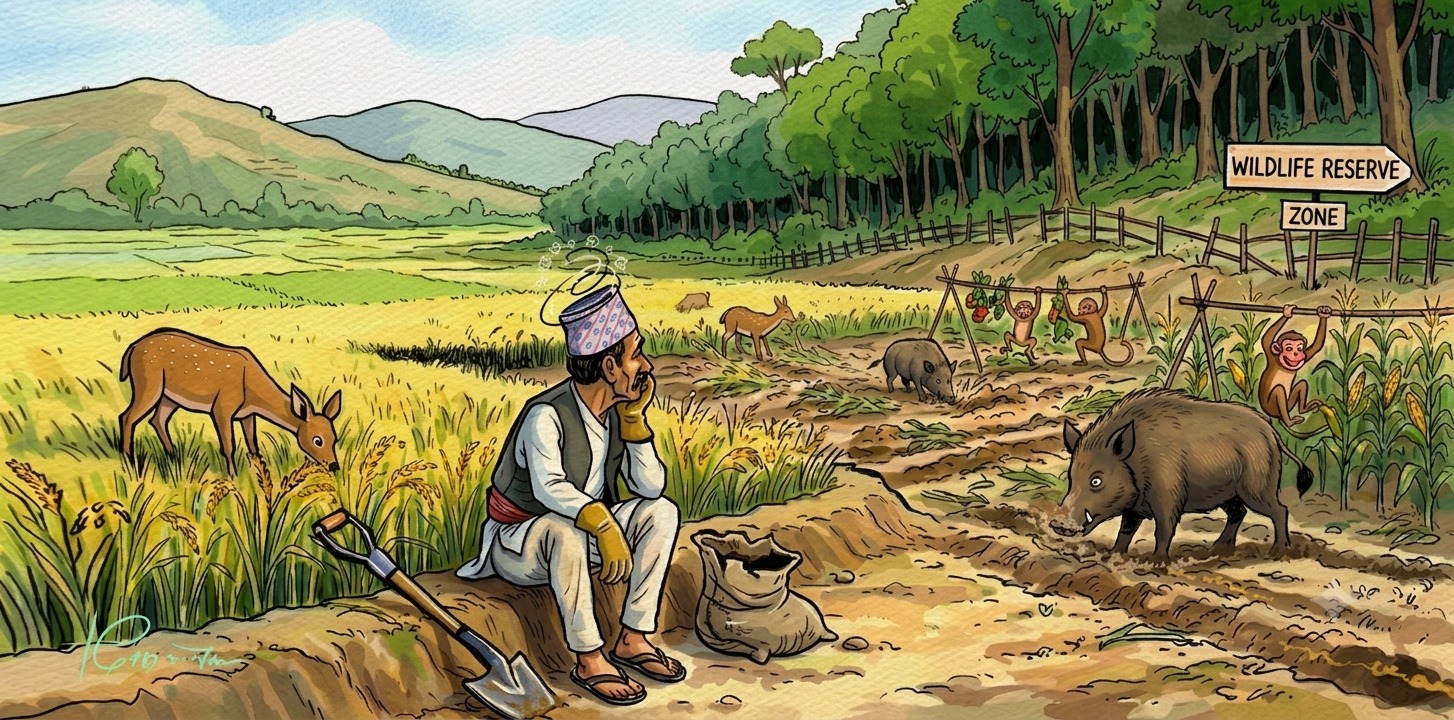
KATHMANDU: The government has initiated a study to mitigate and manage human-wildlife conflict. Specifically, a government task force is conducting research to minimize crop damage caused to farmers by monkeys, wild boars, blue bulls (nilgai), and porcupines, and to resolve the conflict.
On May 18, Gita Chaudhary, Minister for Agriculture, Forestry, and Environment, formed a 15-member technical task force comprising representatives from various government agencies, conservationists, and researchers, assigning them responsibilities. The task force is required to review and analyze past studies, existing policy and institutional frameworks, relief and compensation systems, and management efforts to date, and then recommend short-term, medium-term, and long-term measures for conflict mitigation and management. Based on the task force’s recommendations, the government aims to launch a ‘pilot program’ for human-wildlife conflict mitigation and management.
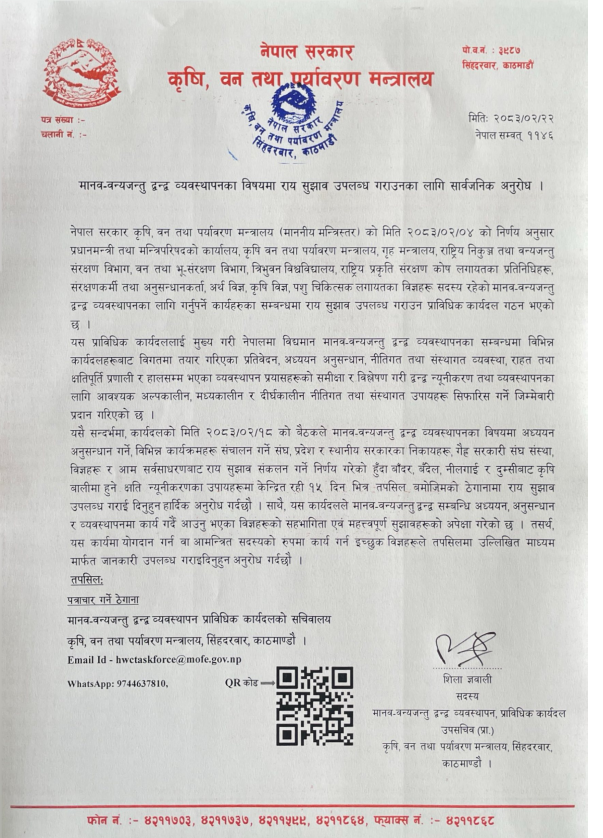
Ashok Subedi, Senior Conservation Officer at the National Trust for Nature Conservation (NTNC) and Member Secretary of the task force, states that suggestions are being collected from farmers, subject experts, and stakeholders to reduce wildlife damage. The task force issued a notice on June 5, 2026, making a public appeal for feedback and suggestions. Although asked to submit suggestions within 15 days, only a small number were received, so Subedi mentions that collection will continue throughout the task force’s tenure. Out of the three-month tenure assigned to the task force, about two months remain. Subedi says, “Although the task force aims to collect as many suggestions as possible to present a universally acceptable recommendation to the government, they are not coming in expected numbers.”
Suggestions have been requested by sending forms to all 753 local levels across the country, subject experts, and stakeholders. Furthermore, the general public, farmers, and anyone else can send suggestions via email, Google Forms, WhatsApp, and correspondence. “We will also include suggestions written on paper, photographed, and sent via WhatsApp,” says Member Secretary Subedi. According to him, problems shared by farmers on social media are also being collected and analyzed.
The task force has received fewer than 50 suggestions so far. Among them, the majority are related to the distress caused by monkeys.
“People have reported that monkeys destroyed crops, creating situations where they are being displaced from villages and settlements,” he says. “There are also demands for compensation for agricultural losses and for wildlife to be kept far away from farming fields and settlements.”
Members of Parliament have also been raising their voices in the House, stating that monkeys have troubled farmers across the country and calling for a solution.
The task force includes representatives from the Office of the Prime Minister and Council of Ministers, the Ministry of Agriculture, Forestry, and Environment, the Ministry of Home Affairs, the Department of National Parks and Wildlife Conservation, the Department of Forests and Soil Conservation, Tribhuvan University, and the National Trust for Nature Conservation, along with conservationists, researchers, economic experts, agricultural experts, and veterinarians. Additionally, two Master’s level students from Tribhuvan University, who conducted their thesis research on human-monkey conflict, are serving as assistants. These researchers assist in compiling the feedback received, conducting necessary further research, and writing the report.
The task force is also collecting suggestions by inviting farmers’ representatives, experts, animal rights activists, and stakeholders. Member Secretary Subedi shares plans to hold discussions with parliamentary committees and the Ministry of Forests. According to him, a national-level discussion will be organized by inviting wildlife-affected farmers, experts, animal rights activists, and stakeholders.
Madan Paudel, an expert member of the task force, states that implementable recommendations will be submitted to the government. “We are mindful that the measures should be economically sustainable and feasible to implement,” he says.
The task force will study changing social dynamics and farming patterns, the status of wildlife habitat and food availability, and forest utilization practices. Furthermore, ‘hotspot mapping’ will be carried out after studying aspects such as the population, habits, and behavior of monkeys, wild boars, blue bulls, and porcupines, and the scale of damage caused to crops. The task force is preparing to recommend alternative crops and income-generating methods that are not damaged by monkeys, wild boars, blue bulls, and porcupines, emphasizing that the government must ensure a market for alternative agricultural produce and encourage the private sector.
Expert member Paudel states that the task force is engaged in a deep study to provide concrete suggestions for solving the problem. He says, “Crop damage occurs based on wildlife species and geographical location. Therefore, our intention is to avoid repeating the past, where haphazard conflict mitigation and management without knowing the wildlife population, habits, and behavior failed to yield the expected results.”
Since a single type of measure will not solve the problem nationwide, the task force is preparing to suggest a range of measures from habitat improvement to control. The task force will also incorporate measures adopted by communities using locally available knowledge and skills to mitigate conflict.
Paudel points out that human-wildlife conflict has increased also because human interaction with forests and natural resources has decreased. “The forest has reached people’s doorsteps, and because of this, wildlife damage to crops has increased,” he says.
Studies on wildlife damage to crops have been conducted in the past as well. Although studies were carried out on issues in the buffer zones of national parks, such reports have ended up gathering dust in cabinets.
The National Trust for Nature Conservation, in collaboration with Tribhuvan University, has conducted a study on the nuisance caused by monkeys in 44 municipalities. That study report is in the final stages of publication. Subedi, Senior Conservation Officer of the Trust and Member Secretary of the task force, says, “It’s not that work wasn’t done in the past; some initiatives were started but not sustained. This time, to ensure comprehensive work, it has been prioritized by the government under new leadership.”
The government has allocated Rs 411.1 million for the upcoming fiscal year 2026/27 to mitigate human-wildlife conflict and improve the livelihoods of affected communities.