Kathmandu
Tuesday, July 21, 2026





Scarred by political crisis and revived through elections, the 2015 Constitution now faces long-delayed review as the government begins consultations on sweeping amendments.

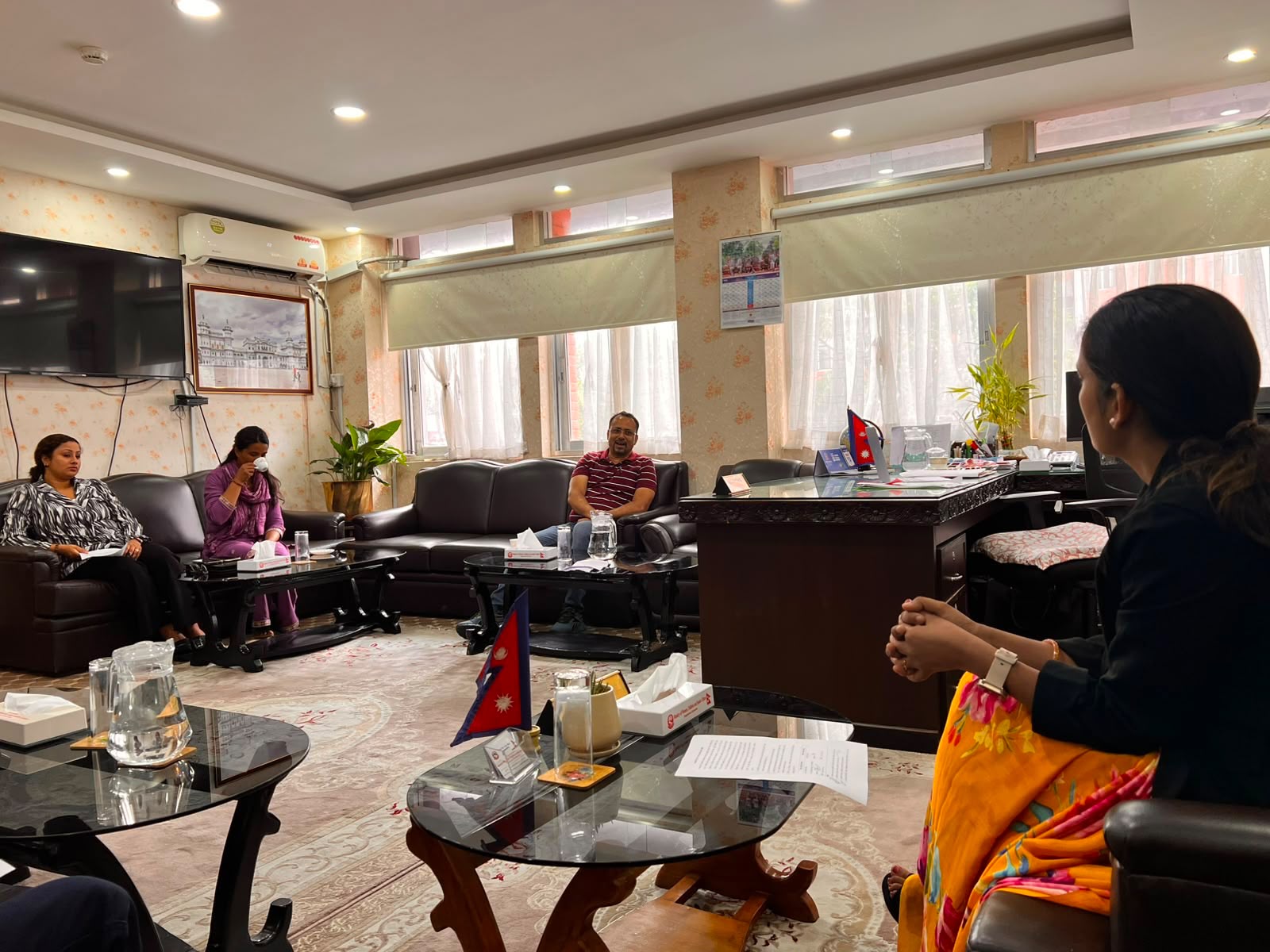
KATHMANDU: The working group formed by the Balendra Shah government to prepare a discussion paper on constitutional amendment held its first meeting at the Office of the Prime Minister and Council of Ministers in Singha Durbar on April 8. The task force, formed on 30 March under the convenorship of Prime Minister Shah’s political adviser Asim Shah, is planned to include all political parties represented in the Federal Parliament.
All parties except the Nepali Congress have sent representatives to the constitutional amendment discussion paper task force. The Nepali Congress has yet to send anyone, having set the condition that the task force’s mandate and working procedures must first be clarified. Nepali Congress acting chief secretary Krishna Prasad Dulal says the party will only participate once the task force publicly states its initial positions on constitutional objectives, the fundamental substance of the constitution, and the proposed amendments.
The task force’s member secretary is Liladhar Subedi, joint secretary of the Law and Decision Implementation Division of the Prime Minister’s Office. The first meeting assigned member secretary Subedi responsibility for collecting written positions from political parties, identifying the issues for constitutional amendment, and preparing the working group’s action plan.
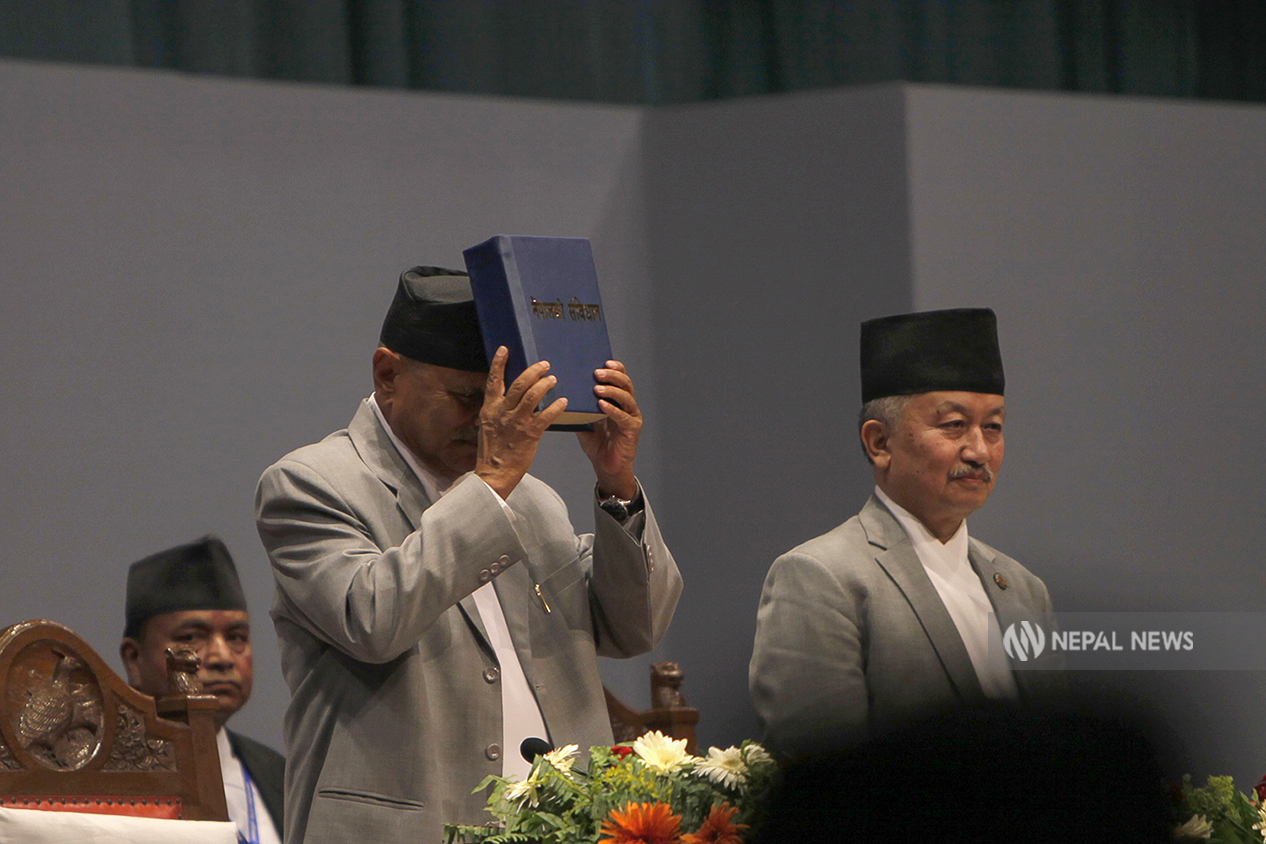
Then-President Ram Baran Yadav promulgates the Constitution of Nepal, 2015, with then-Speaker Subas Chandra Nembang. Photo: Bikram Rai/ Nepal News
The Nepali Congress and the UML, which had run the coalition government before being ousted by the Gen Z movement, had made constitutional amendment their primary agenda. On 1 July 2024, the first and second forces in parliament entered a seven-point understanding including constitutional amendment as the basis for their power-sharing arrangement, from which UML Chairman KP Sharma Oli became Prime Minister on 14 July of the same year.
They had sought to justify their coalition, widely seen as inappropriate in democratic parliamentary practice for being formed by the two largest parties, by putting constitutional amendment forward as their agenda. But they never focused on amendment as their agreement had required.
The RSP, which claimed ownership of the change the Gen Z movement sought, had committed in its manifesto for the March 5 election to preparing a discussion paper on constitutional amendment through national consensus within three months of taking office. The manifesto also set out the topics the RSP would put forward for initial discussion: a directly elected executive, a fully proportional parliament, a provision barring MPs from becoming ministers, non-partisan local government, and a reformed provincial structure. This was the RSP’s initial bottom line on constitutional amendment.
From the moment Balendra’s government was formed on 27 March, work has begun, with a working group established, to advance the constitutional amendment groundwork as promised in the election manifesto.
Nepal’s Constitution of 2015 has now been in operation for more than ten years. With the completion of its first decade, questions of review and revision have come to the surface. Calls had been growing for an assessment of what complications had arisen during implementation, and what the constitution’s strengths and weaknesses were. Following the youth movement of September 8 and 9 last year, demands have also been made for constitutional reform in keeping with the spirit of that uprising and the changed circumstances. Against this backdrop, the RSP government has formed an all-party task force to prepare a discussion paper on constitutional amendment proposals.
Constitutional experts also say that periodic amendment is indispensable to keep the constitution alive and workable. Constitutionalist Chandrakant Gyawali argues that amendment is necessary to make the constitution functional and that a high-level commission on constitutional reform recommendations must be formed for a proper review. “The task force formed by the government alone cannot complete the groundwork for constitutional amendment,” he says. “To make the constitution alive, debate is needed on fundamental rights, the form of governance, and the powers of all three tiers of government. Federalism and inclusion also need to be restructured.”
What needs reviewing
Constitutional review and amendment are considered necessary to address political stability, good governance, the form of governance, electoral system reform, and the demands of the Gen Z movement.
The Nepal Law Commission (NLC) is conducting a study for constitutional review, covering the form of governance, the electoral system, inclusivity, government formation, the number of elected representatives, the Constitutional Council, the Judicial Council, the powers of all three tiers of government, the distribution of state power under Article 57 of the constitution, the structure of constitutional commissions, and related matters.
When the government was toppled by the Gen Z uprising on September 9 last year and the army headquarters began taking an active role in forming an interim government in the resulting vacuum, an emotionally charged debate even among the Gen Z protesters about whether to keep or discard the constitution had reached a peak, pushing the country into a fog of uncertainty.
NLC Secretary Indira Dahal says the study for review is being conducted on the basis of the practical difficulties that have emerged during constitutional implementation. “The study covers weaknesses visible within the constitution, the form of governance, the electoral system, the Constitutional Council, the Judicial Council, and related matters,” she says, adding that the schedules of concurrent powers shared by all three levels – federal, provincial, and local – are also being studied. At present, placing the same subject within the concurrent jurisdiction of all three tiers has created ongoing disputes and confusion about which tier does what.
The 2015 Constitution itself contains provisions for review of various matters after a decade. Article 265, for instance, stipulates that the Federal Parliament shall review the constitutional commissions ten years after the constitution comes into force. That deadline has now passed yet the review has not happened. Questions have been growing about the relevance of certain commissions due to the failure to appoint officials on time and the failure of commissions to work in accordance with their founding purpose.
Senior advocate Babu Ram Kunwar says there is much in the constitution that needs improvement. “A constitution or law seeking amendment is like a sick person seeking medicine; it must be addressed in time,” he says. “The main thing is to pay attention to whether the constitution is being implemented in accordance with the spirit of its preamble.” The preamble commits to “building an equitable society on the basis of the proportional inclusive and participatory principles to ensure social justice.”
The Constitution that returned to rhythm after a near accident
The Constitution of Nepal 2015, promulgated on 20 September 2015, reached its most difficult juncture within its first decade. It went through a dark period on the brink of accident. When the government was toppled by the Gen Z uprising on September 9 last year and the army headquarters became increasingly active in the vacuum over forming an interim government, even among the Gen Z protesters an emotionally charged debate peaked over whether to keep or discard the constitution, pushing the entire country into a fog of uncertainty.
Unable to contain the intense protests and destruction that followed the human losses of September 8 last year, then-Prime Minister KP Sharma Oli resigned on September 9. Following his resignation, President Ram Chandra Paudel came under pressure to dissolve parliament and form a new government as the movement demanded. The President, as guardian of the constitution, was unwilling to carry the burden of exercising powers the constitution did not grant for dissolving an elected parliament.
Sometimes society tries to override the constitution; sometimes the constitution tries to override the people. The work must be done in a way that balances both.
Senior advocate Kunwar, who also served as a legal expert to the President, claims that President Paudel held firm and protected the constitution in those circumstances. On 12 September last year, President Paudel appointed former Chief Justice Sushila Karki as Prime Minister of the interim government under Article 61 of the constitution, and on the same day dissolved parliament on the Prime Minister’s recommendation. Legal expert Kunwar says: “The head of state upheld his duty with unyielding resolve. Imagine if he had not held firm and activated Article 61 at that moment; we would not be where we are today.”
In the days after September 9 last year, before a government was formed, almost all organs of the state were inactive and paralyzed. According to Kunwar, society had overridden the constitution.
Constitutionalist and former law minister Nilambar Acharya, who participated in writing the 2015 Constitution, says the constitution did not anticipate that such an extreme and transitional situation could arise. “When the constitution was being written, no one imagined the country would face this level of constitutional complexity,” he says. “You cannot imagine while writing a constitution that someone will set fire across the country and topple an elected government.” He regards 2082 BS as the year the constitution was hijacked, and the constitutional order itself was shaken.
Another constitutionalist, senior advocate Chandrakant Gyawali, also says the constitution reached the cremation ground in 2025 and came back to life.
Senior advocate Kunwar analyzes that although the existing constitution is complete in its text and provisions, the country experienced the Gen Z movement and a period of constitutional vacuum because the constitution could not carry the weight of public aspiration in the spirit of constitutionalism. “However excellent a constitution may be, it was that failure to meet the people’s sentiments that brought about that situation,” he says. “Sometimes society tries to override the constitution; sometimes the constitution tries to override the people. The work must be done in a way that balances both.”
In the constitutional vacuum following the Gen-Z movement, the President summoned six constitutionalists on September 11 last year to discuss the country’s extreme situation. The President consulted senior advocates Surya Dhungel, Bipin Acharya, Purna Man Shakya, Chandrakant Gyawali, Lalit Basnet, and Bhimarjun Acharya, seeking their advice on the path forward. While calls were coming from the army headquarters to form a government, the constitutionalists advised the President to proceed in a manner that would protect the constitution.
Constitutionalist Gyawali recalls advising that work be done to minimize damage to the constitution, given that it provided no mechanism for forming an interim government and the President had no power to directly dissolve parliament. “A situation had come upon the country in which calls were coming from the army headquarters for selecting a prime minister and young people were queuing up to go there – a situation the constitution simply did not know,” he says. “Parliament was dissolved through the interim government in accordance with the Gen Z demands, in a way that preserved the constitution, and the date for House of Representatives elections was set.”
When the constitution had reached a vacuum, President Paudel appointed Sushila Karki — chosen by the Gen Z protesters via the Discord app — as Prime Minister, and on her recommendation dissolved the House of Representatives with effect from 11 p.m. on 12 September 2025. Within the constitutional constraints placed on the President, Paudel appointed Karki as Prime Minister of the interim government to hold House elections within six months.
The President dissolved the House without citing any constitutional article because the constitution had made no provision for such a complex situation. On the same day, by setting March 5 as the election date on the Prime Minister’s recommendation, hope was offered that the constitution would find its footing again, making citizens cautiously optimistic. Elections ultimately took place on schedule and with the arrival of new elected representatives the country’s constitution returned to rhythm. Constitutionalist Gyawali says, “After the September movement the constitution had reached a vacuum. With elections held peacefully on time and a government formed, the constitution has come back to life and returned to its previous state.”
Patching up the constitution
Unconstitutional action had already begun when the civilian government was formed on 12 September 2025. Because Sushila Karki was a former Chief Justice, the constitution itself placed an obstacle in the path of making her the executive head. Article 132(2) of the constitution states: “A person who has been the Chief Justice or a judge of the Supreme Court shall not be eligible for appointment to any government position except as otherwise provided in this constitution.”
Despite what was clearly written in the constitution, Karki, who had herself been the head of the court considered the interpreter of the law, accepted the Prime Minister’s position. Not only was her appointment as Prime Minister criticized at the time; writ petitions were also filed at the Supreme Court raising constitutional questions about it. Those petitions remain unresolved to this day.
Had the President, political parties, and Gen Z protesters not moved forward in a way that preserved the constitution, the country could have faced any manner of disaster.
Constitutionalist Acharya argues that toppling an elected government and forming an unelected one was itself a constitutional violation. “A rebellion is not recognized or legitimized by a constitution,” he says. “Many constitutional provisions were violated. An elected parliament was dissolved. People who were not even legislators and whom the constitution did not recognize came to power. A government forming under the leadership of a former Chief Justice whom the constitution itself prohibited was a constitutional violation.”
He says that although the constitution was shaken and violated from September 8, 2025, to March 5, 2026, it returned to rhythm after all parties participated in elections, accepted the results, and a new government was formed. “Had the President, political parties, and Gen Z protesters not moved forward in a way that preserved the constitution, the country could have faced any manner of disaster,” he says.
The elections not only freed the country from the transitional state; for the first time since the constitution was enacted, a single party won a clear majority, and a majority government was formed under Article 76(1). This RSP government is now working to prepare a discussion paper on constitutional improvements with the support of all parties, taking the initiative to identify the constitution’s problems and apply a remedy.
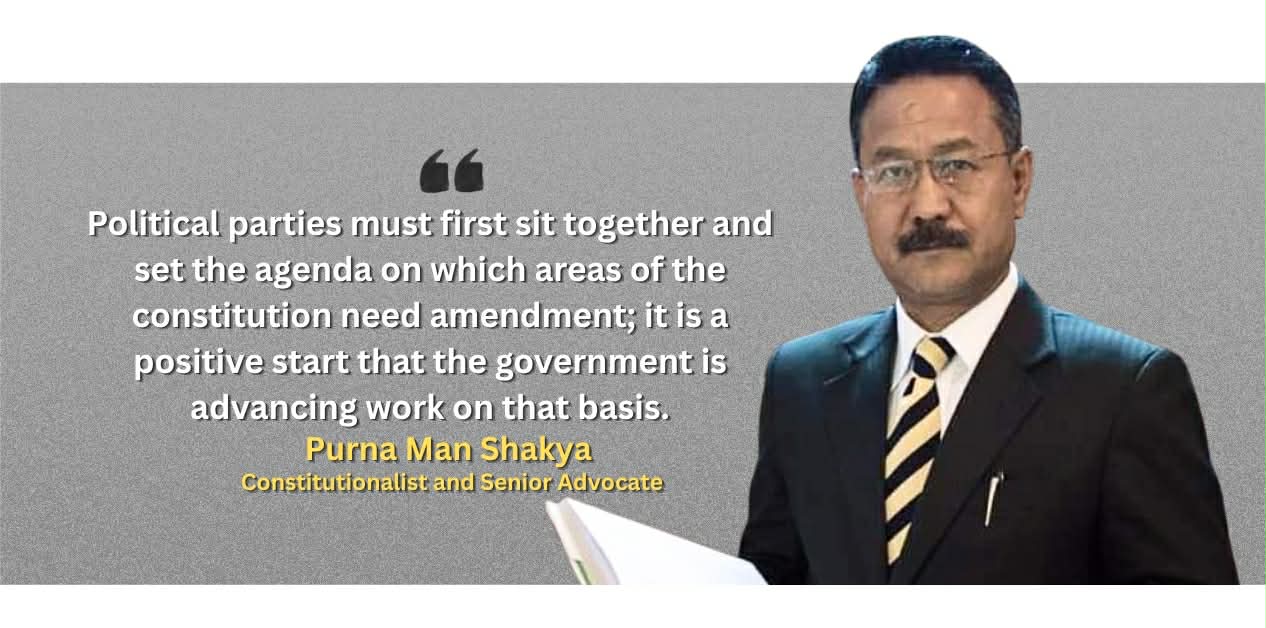
Constitutionalist and senior advocate Purna Man Shakya says the government’s discussions with parties on constitutional amendment are on the right path. Even though the RSP holds close to a two-thirds majority in the House of Representatives, amending the constitution requires the National Assembly’s agreement, making all-party consensus on amendment necessary. “Political parties must first sit together and set the agenda on which areas of the constitution need amendment; it is a positive start that the government is advancing work on that basis,” he says.
Shakya argues that because constitutional amendment is a highly sensitive and technical matter, it would not be appropriate for experts to give opinions on what needs to change at this stage. “The amendment agenda with its report from all-party discussions should first be taken to the people for consultation. Only after that should experts be consulted,” he says.