Kathmandu
Friday, June 26, 2026





Weak oversight has allowed illegal deposit-taking schemes to thrive, costing hundreds of people their life savings
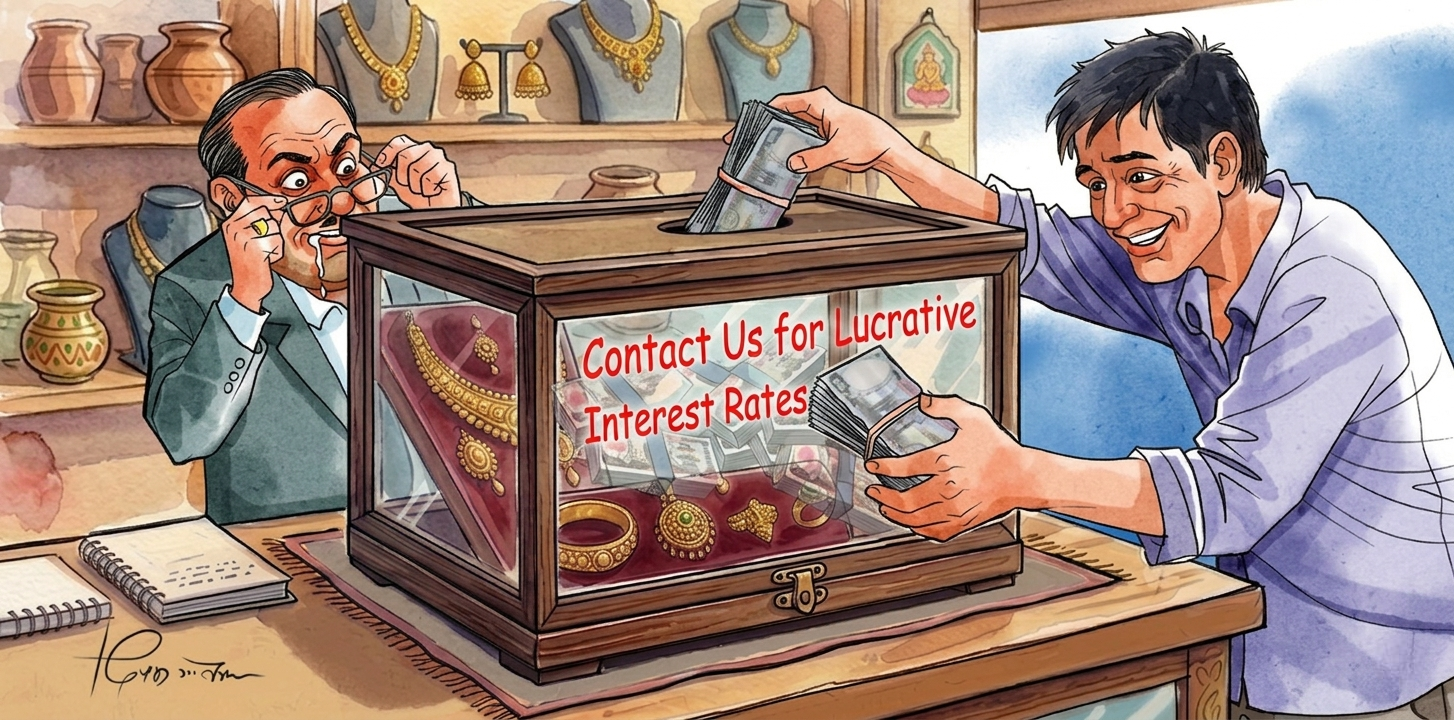
MORANG: Padam Bhandari, a 45-year-old man of Urlabari Municipality-1 in Morang, had worked as a laborer until six years ago, steadily saving for the future. Today, his life has taken a different turn. He now spends most of his time shuttling between the Municipal Judicial Committee, the District Administration Office, and the police, seeking justice for the Rs 1.4 million he deposited at Gautam Gold and Silver Shop in Urlabari-6.
He had entrusted his hard-earned savings, including Rs 150,000 set aside from his elderly mother’s social security allowance, to the shop’s owner, Gopal Gautam, also known as Rajesh. Enticed by a promised 2 percent monthly interest and a sense of trust in a neighbor, he says he never imagined it would end in loss. After Gautam went missing on January 12, 2023, Padam’s aspirations collapsed. “Not only mine, but my sister Manju’s Rs 225,000 was also lost,” he says. “I am ruined. When I seek justice, no one listens.”
Following Gautam’s disappearance, hundreds of individuals were similarly defrauded. Victims claim that over 300 people were cheated out of more than Rs 120 million. They subsequently formed the ‘Rajesh Gautam Victim Initiative Group’ under the leadership of Gajendra Dangal and have been pursuing legal remedies through multiple state authorities, including local administration bodies and elected representatives. A case was initially registered with the Morang Police and later reached the Morang District Court on August 21, 2023.
However, the court verdict has deepened confusion rather than delivering closure. On April 21, 2024, a bench led by then Judge Baburam Subedi ruled that victims could pursue recovery through a settlement process previously recorded at the Urlabari Municipality Judicial Committee. The judgment stated, “As the prosecution claim of the government could not be established, the defendants are acquitted of the charges.” By interpreting the case as a civil financial dispute rather than criminal fraud, the ruling left victims without immediate remedy.

Padam Bhandari at the District Administration Office, Morang, demanding justice and the return of his savings from Gautam Gold and Silver Shop
A similar pattern has emerged in Ramailo Bazar of Ward 6 in Kanepokhari Rural Municipality, where Manoj Adhikari and Homnath Adhikari, owners of Adhikari Gold and Silver Shop, have been absconding for over a year with deposits totaling Rs 120 million collected from around 250 individuals. They have been out of contact since mid-2025. Homnath is Manoj’s father and is reportedly in the United States, while Manoj remains unreachable.
Among the victims was 83-year-old Chakra Bahadur Gurung of Kanepokhari, who had deposited Rs 900,000 in the same shop, attracted by promises of attractive returns. He had invested his life savings, including his social security allowance and proceeds from selling ancestral land, with the hope of secure returns. He visited the shop regularly, holding on to the belief that his money would be safe.
Gurung passed away a year ago without recovering his deposit. Although he is no longer alive, more than 250 victims like him continue to search for their lost savings, caught in prolonged uncertainty and financial distress.
The scheme’s appeal lay in its calculated simplicity. Offering returns higher than banks, promising on-demand withdrawals, and even collecting deposits door to door, owner Manoj Adhikari drew in a wide cross-section of savers. The elderly, daily wage laborers, small traders, and families safeguarding remittances from abroad all found his assurances convincing.

Victims voicing their grievances regarding the gold shop scam at the DSP office of the District Police Office, Morang
At the outset, depositors were issued stamped passbooks, lending the operation an air of legitimacy. But as the network expanded, the documentation quietly changed. “He first gave us passbooks under the name Sun-Chandi (Gold-Silver) Adhikari,” recalls victim Umesh Bista. “Later, saying he would reconcile the accounts, he collected them all and began recording transactions in an ordinary diary. It was a deliberate move to avoid legal consequences, but we did not realize it at the time.”
Those ensnared were not speculative investors but largely ordinary individuals setting aside small sums from strenuous, daily labor. Bishnu Maya Giri stands as one such example. She and her relatives lost nearly Rs 3 million, savings built gradually over years. “This is not stolen money,” she says. “It was earned through hardship. If you look at the records, it will make you cry. These are savings of Rs 10 and Rs 20 at a time, meant for our children’s future, raised by rearing and selling goats.”
Within her group, Rs 2.6 million had been placed in a fixed deposit for 15 months at 15 percent interest, while the remainder sat in a current account. She has not recovered a single rupee.
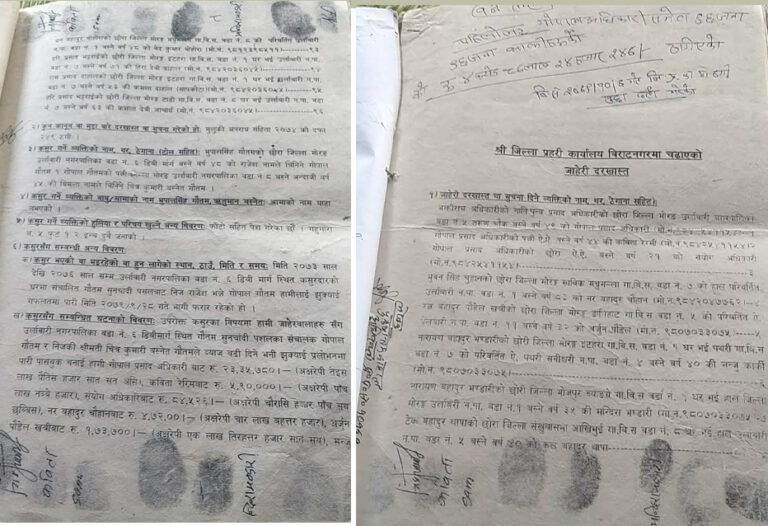
The formal complaints registered by the victims against the gold shop operators at the District Police Office
Bhola Prasad Adhikari, vice chairperson of Kanepokhari Rural Municipality, says he accompanied victims to both the District Police Office and the court. However, he stresses the limits of local authority. “Fraud cases fall under police jurisdiction, not the Municipality’s Judicial Committee. We have clearly advised victims to approach law enforcement,” he says, adding that hesitation among victims themselves to formally file complaints has also delayed action.
A parallel case in Sundarharaicha Municipality-10 reveals a similar pattern. Tika Bahadur Koirala, 78, deposited Rs 300,000 at Kamala Gold and Silver Shop in late 2021 before traveling abroad to visit his daughter. He had agreed with owner Raju Bishwakarma that the funds, with interest, would be returned immediately upon his return. But after coming back on August 12, 2022, his calls went unanswered. “He promised repayment within ten days, then stopped answering,” Koirala says. “We had saved this money from our old-age allowance.”
Likewise, Manmaya Rai invested Rs 1.2 million on December 27, 2021, lured by a promised 18 percent return within six months. Although she received partial interest payments, the principal was never returned. “I had placed Rs 1.2 million for six months,” she says. “He disappeared without settling the amount.”
In total, more than 80 individuals were defrauded by Bishwakarma. Of them, 55 victims formally lodged complaints with the District Police Office in Morang, collectively alleging losses of around Rs 180 million.
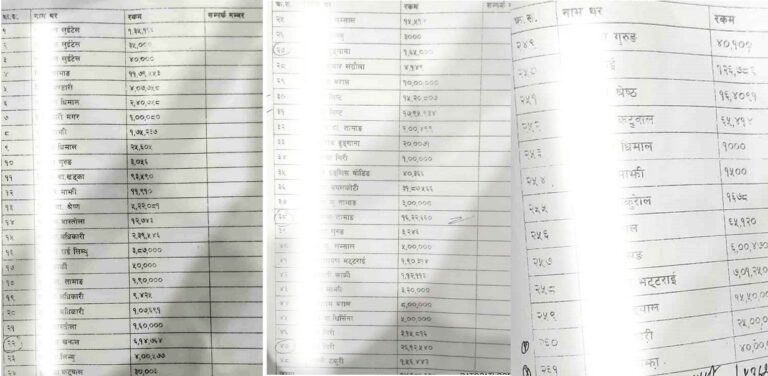
List of the victims currently wandering in search of justice after their savings were stolen under the guise of high-interest deposits
Authorities arrested Raju Bishwakarma and his wife Kamala on fraud charges on November 13, 2022. During the investigation, police froze two houses and parcels of land registered in the couple’s name, as part of efforts to secure potential restitution.
Illegal transactions lured by high interest rate
These cases underscore a troubling pattern: illegal financial operations conducted under the veneer of legitimate gold and silver businesses. By offering returns higher than formal banking channels, assuring instant withdrawals, and even collecting deposits at customers’ doorsteps, operators have crafted a model designed to win trust quickly. In reality, this very appeal has drawn ordinary citizens into unregulated schemes, ultimately exposing them to systematic fraud.
Official data reflects the scale of the problem. In the four years and nine months between July 16, 2021, and April 13, 2026, of the current fiscal cycle, a total of 888 fraud cases have been registered across Koshi Province. According to the Koshi Province Police Office in Biratnagar, around half a dozen of these involve scams executed through gold shops. The breakdown shows two cases in fiscal year 2021/22, three cases in 2022/23, and one case in 2023/24, indicating a persistent, if underreported, trend.
Deputy Inspector General (DIG) Binod Ghimire of the Koshi Province Police Office attributes this pattern largely to unrealistic return expectations.
“The public are drawn into such illegal schemes by the promise of high interest,” DIG Ghimire says. “In most cases, they approach the police only after the fraud has occurred. We then investigate and take action within the legal framework.”
Legal loopholes and silence of regulators
The Nepal Rastra Bank Act, 2002, mandates that approval must be obtained from the Nepal Rastra Bank (NRB) to collect deposits and invest in loans. Section 76 (Subsection 1) of the Act states, ‘Any individual, firm, company, or institution must obtain approval as prescribed by the Bank to take any kind of deposit or provide loans.’ However, as the NRB and the police administration have not shown proactivity in implementing the Act, gold and silver traders have been carrying out the work of collecting deposits illegally and providing loans to commoners by taking gold as collateral without hindrance. Consequently, incidents of fraud come to light.

Homnath Adhikari, the father of the absconding gold shop owner Manoj Adhikari
Khil Bahadur Shrestha, information officer of NRB, Koshi Province, Biratnagar, says that collecting savings or deposits from the public by gold shops in the style of cooperatives is completely illegal. He states that such activities are not within the knowledge of the NRB and the primary responsibility for controlling and taking action against this lies with the police administration.
According to Shrestha, the NRB limits its oversight to institutions it formally licenses, including banks, financial institutions, hotels, and money changers. “In the case of cooperatives, the Department of Cooperatives or other relevant bodies are responsible,” he explains. “However, when it comes to illegal financial transactions carried out through gold shops, the police administration must take the lead.” He emphasizes that any financial activity conducted without NRB authorization is legally punishable.
Meanwhile, the exposure of ordinary citizens to risk has grown steadily. Superintendent of Police Kabita Katuwal of Morang notes that many victims were drawn in by the promise of unusually high returns. “Gold shops have been operating by issuing passbooks illegally, and victims typically approach the police only after they have been defrauded,” she says. “Once complaints are filed, we register fraud cases and proceed with investigation.” In Biratnagar alone, the provincial capital, there are more than 100 gold and silver shops, underscoring the scale of the sector.

Absconding Manoj Adhikari
Regulatory gaps have further compounded the issue. Previously, licenses for gold and silver shops were issued by the Department of Commerce, Supplies and Consumer Protection. At present, such approvals fall under the Office of Cottage and Small Industries, says Hitesh Basnet, acting chief of the Department of Commerce, Supplies and Consumer Protection in Koshi Province. “Financial transactions by gold shops are outright illegal, yet there has been no effective monitoring to date,” he says, adding that the responsibility to oversee and curb such activities ultimately rests with the administrative authorities.
Consumers caught in double trouble
Gold and silver shops operating in Biratnagar have been extending loans against gold collateral at monthly interest rates ranging from 24 percent to 30 percent, far exceeding formal banking norms. According to Krishna Prasad Bhandari, chairperson of the Consumer Awareness Campaign Nepal, traders further capitalize on this system by pledging the same collateralized gold in banks to secure loans at comparatively lower rates, effectively leveraging consumers’ assets for additional profit.
Bhandari warns that weak regulatory oversight has placed the property of ordinary citizens at significant risk. “Traders are effectively profiting off both the public’s gold and the banks’ money,” he says. “There are even instances where individuals cannot immediately reclaim their pledged gold.” He notes that, in many cases, shops return collateral only a day after full loan repayment, creating additional inconvenience and uncertainty for borrowers. He argues that the government must introduce a clear regulatory framework to bring such practices under control.
Echoing concerns over legality, Shashi Bhushan Sah, vice chairperson of the Federation of Nepal Gold and Silver Dealers Association in Koshi Province and its Morang chair, says the association has repeatedly warned members against engaging in unlawful financial activities. “No financial transaction is permitted in gold and silver shops without authorization from the Nepal Rastra Bank,” he says. “Providing informal assistance during emergencies may be understandable, but institutionalized deposit collection through printed passbooks is entirely illegal. We have consistently urged our members to refrain from such practices.”