Kathmandu
Friday, July 24, 2026






KATHMANDU: President Ramchandra Paudel administered the oath of office and secrecy to the newly appointed Chief Justice, Manoj Kumar Sharma, during a special ceremony organized at the Presidential Residence, Sheetal Niwas, on Tuesday evening.
Following the swearing-in ceremony, Chief Justice Sharma reached the Supreme Court to formally assume his office, where he was warmly welcomed by apex court judges and judicial staff.
The high-profile ceremony at Sheetal Niwas was attended by top state officials, including Vice President Ram Sahaya Prasad Yadav, Prime Minister Balendra Shah, Speaker of the House of Representatives Dol Prasad Aryal, and National Assembly Chairperson Narayan Prasad Dahal, alongside other senior government dignitaries.
President Paudel had appointed Sharma to the top judicial post earlier in the day, acting on the recommendation of the Constitutional Council and in accordance with Clause 2 of Article 129 of the Constitution of Nepal.
Prior to the appointment, a meeting of the Parliamentary Hearing Committee held at Singha Durbar had unanimously endorsed Sharma’s name.
Under Nepal’s constitutional framework, the President appoints the Chief Justice only after the nominee successfully clears the parliamentary hearing process following the Constitutional Council’s recommendation.
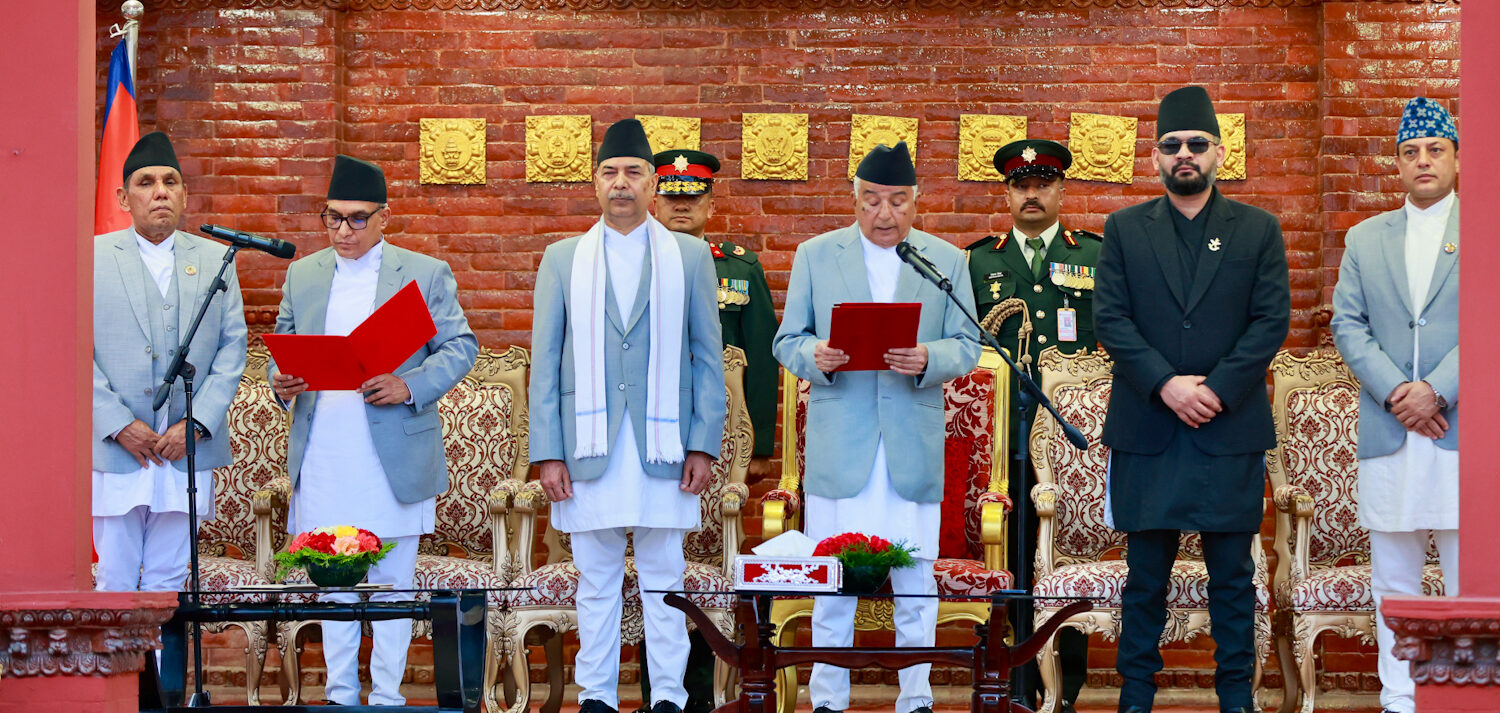
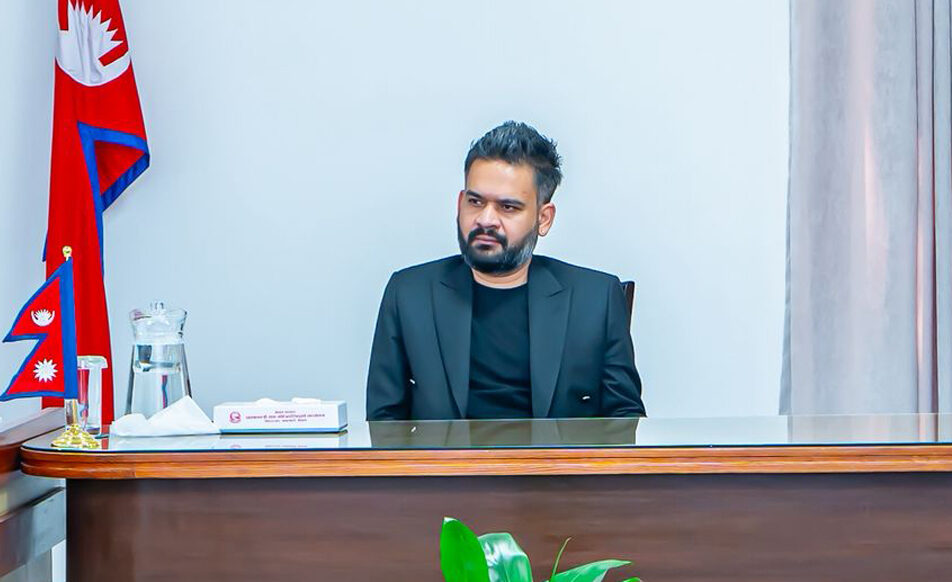
Newly appointed Chief Justice Manoj Kumar Sharma taking the oath of office and secrecy before President Ramchandra Paudel.
The Constitutional Council had selected Sharma from a pool of six names forwarded by the Judicial Council.
Notably, Judge Sharma was serving as the fourth in seniority at the Supreme Court before being elevated to the position of Chief Justice.
Upon taking charge of the judiciary, Chief Justice Sharma expressed an unwavering commitment to safeguarding the autonomy of the courts, declaring that he will not tolerate any external influence on the legal process.
“No form of interference will be accepted in the institutional independence of the judiciary, the professional impartiality of judges, and the dignity of the justice delivery process,” Sharma asserted.
He added that he views his new role not merely as a position of power, but as a profound duty to further strengthen the Constitution, uphold the rule of law, maintain judicial independence, and deepen the citizens’ trust in the justice system.
Full text of the address by the newly appointed Chief Justice after assuming office:
Respected media friends,
I express my heartfelt gratitude for your presence. In accordance with the Constitution of Nepal, I have received the opportunity to assume this proud responsibility by taking the oath of office of Chief Justice today. I have accepted this responsibility not merely as a position, but as a duty to further strengthen the Constitution, the rule of law, judicial independence, and citizens’ trust in justice.
The judiciary is the guardian of the Constitution of Nepal, the guarantor of fundamental rights, and a major pillar of the democratic system of governance. Therefore, the creation and preservation of an independent, impartial, competent, and public-trusted judiciary will be the core objective of my tenure.
The indpendence and impartiality of the judiciary is the backbone of democracy.
My first and highest priority is to keep the independent judiciary completely intact. No compromise will be made with this principle under any circumstances. No form of interference will be accepted in the institutional independence of the judiciary, the professional impartiality of judges, and the dignity of the justice delivery process. I want to fully assure that there will be no situation for anyone to have any doubt regarding this matter, and no such action that generates such doubt will be committed by me, nor will it be allowed to happen.
Use of Information Technology
Through the effective use of information technology, I will make the judiciary technology-friendly and institutionally advance the overall digital transformation of the court. I will make the ‘virtual hearing’ system more effective and accessible.
Judicial good governance
To maintain judicial good governance, by firmly adopting a zero-tolerance policy, strict control will be maintained against any form of irregularities, delays, lack of transparency, or any kind of undesirable activities occurring in the judicial sector.
Additionally, I will take necessary concrete steps for the effective control and eradication of the middleman tendency.
Service delivery
To make service delivery fast, agile, transparent, and effective, necessary legal amendments and simplification of procedures will be carried out, and for that purpose, I will form a high-level committee to identify which laws need improvement and provide recommendations.
For the convenience of service seekers, a ‘helpline desk’ will be efficiently managed in each court.
Enhancing access to justice
Adopting the principles of participation, cooperation, and coordination as the core basis of performance, I will place special emphasis on operations according to the same ethos. Through this medium, I will strive to make judicial performance more effective and enhance access to justice.
Effectiveness of the Judicial Council
By making the Judicial Council more effective and active, I will develop the institutional practice of holding regular meetings.
Settlement of old backlog cases
I will formulate a special action plan for the speedy settlement of old backlog cases and bring it into effective implementation.
Execution of judgments
I will take the necessary initiatives toward making the issue of judgment execution more strengthened, effective, and result-oriented.
In conclusion,
I have deeply realized that the trust of the general citizens in the judiciary is our greatest strength. I will always remain committed to the protection and promotion of the Constitution, the rule of law, human rights, and the universal values and principles of justice.
In fulfilling this great responsibility, I trust that I will receive constructive cooperation from honorable judges across the country, including the Supreme Court, employees of the judicial service, learned legal practitioners, scholars working in the field of justice and law, the media sector, and the general citizens.
As Chief Justice, I express my commitment to occasionally provide information through the media regarding the progress and reform efforts made during my tenure.
As per the need, I will personally converse with media professionals. Furthermore, if any journalist friend wishes to meet with the Chief Justice, they can coordinate with my secretariat to fix a time.
Saying this, I conclude my remarks here for now. We shall continue our conversations in the coming days after I begin my work.
Thank you!