Kathmandu
Tuesday, July 21, 2026





AI is emerging as a transformative force that converts information and research into meaningful wisdom.

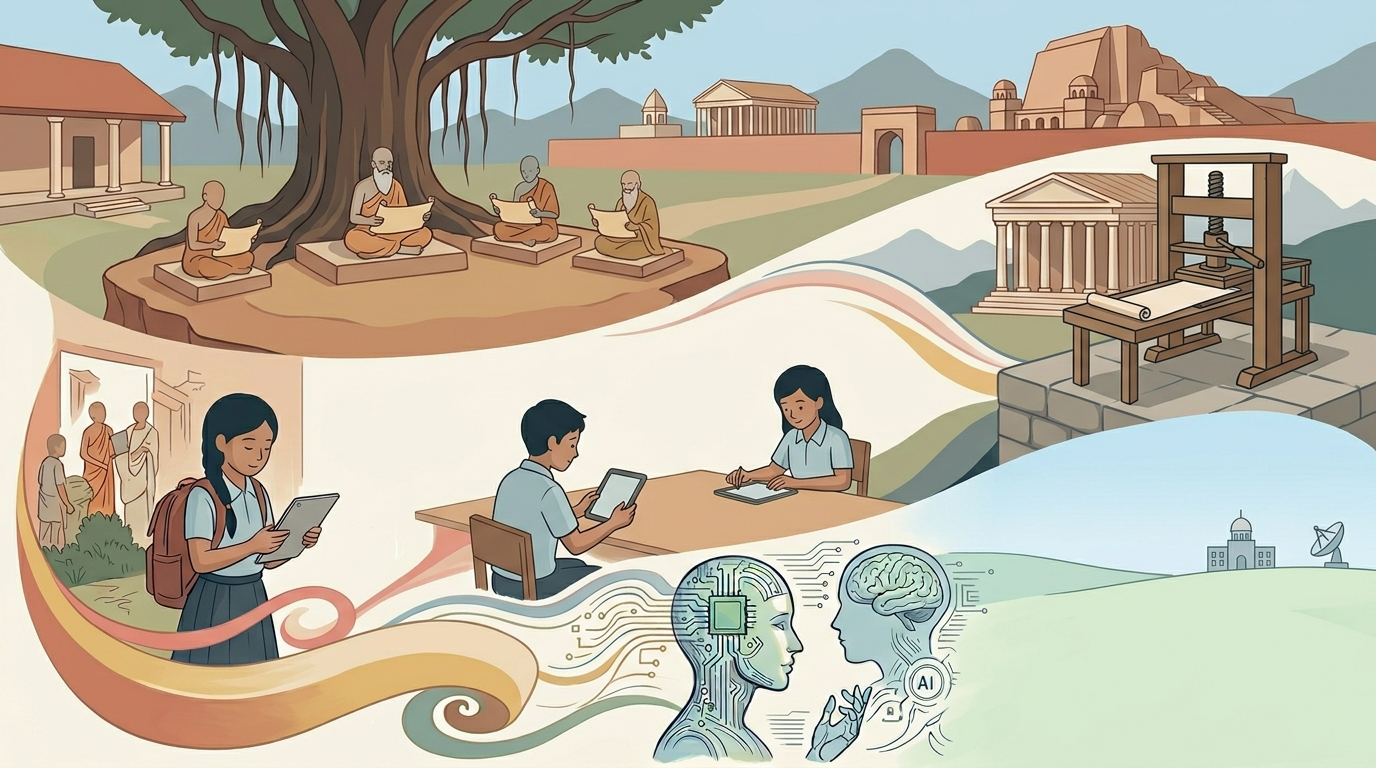
KATHMANDU: In the seventh century, Nalanda University was at its intellectual zenith. Students from countries like China, Korea, and Persia would travel there to study with the scholars. At that time, the dissemination of knowledge was inextricably linked to personal presence.
Today, a student attending a rural public school can ask an Artificial Intelligence (AI) system to explain ‘quantum mechanics’ and receive a response more detailed than most textbooks within seconds.
This shift in the learning paradigm is not just a chronological history; it is a story of transformation in the methodology of knowledge transfer alongside technology. It has deeply redefined the meaning of learning and education. AI is not only accelerating learning; it is challenging the very fundamental assumptions built by modern universities.
From Gurukul to Algorithm
In his book Understanding Media (1964), Marshall McLuhan wrote that the dominant technology of every era reshapes the structure of knowledge. The Gurukul tradition rendered education intimate and hierarchical, where knowledge was transmitted orally from teacher (Guru) to disciple (Shishya). It was not merely an intellectual exercise but was integrally tied to character building and spiritual discipline.
The invention of writing transformed knowledge from a live presentation into a securely preserved commodity. To acquire knowledge, one no longer needed to be near a teacher; having access to manuscripts became sufficient.
AI-generated.
In the history of knowledge revolutions, the invention of writing did not immediately displace human memory; rather, it transformed the process of how memory is developed and preserved. Books in the ancient world were vastly different from today’s modern books—there was no punctuation, no page division, no index, and not even spaces between words. Therefore, reading was not merely a process of consuming information, but an intellectual exercise deeply connected to memory. For much of the Middle Ages, manuscripts were used not as a substitute for memory, but as a means to reinforce it.
Before Gutenberg’s invention of the printing press, books were rare, expensive, and handwritten, often taking months to prepare. Medieval libraries frequently held only a few dozen books. Many of them were chained to desks to protect them from theft. Because access to books was limited and texts lacked modern conveniences like page numbers, indexes, and tables of contents, scholars relied heavily on memory. Thus, reading was not a casual act of reference but a profound intellectual exercise that required careful study and memorization, because the reader might likely never see that book again.
With the arrival and expansion of the printing press, a fundamental transformation occurred in the process of transmitting knowledge. Printing democratized access to knowledge on an unprecedented scale. Texts that were previously confined to priests or court elites began to reach the wider masses, literacy expanded, and a massive community of readers emerged. Alongside this shift, the modern university was born—an institution whose authority was based on the systematic organization, verification, and transmission of printed knowledge.
If the education system teaches students merely to seek answers from machines instead of developing independent judgment, it risks producing individuals who are technically informed but devoid of intellectual confidence and moral reasoning—which is also a serious challenge for democratic leadership.
The internet brought the third major disruption. Suddenly, the university’s monopoly on knowledge ended. The massive wave of Massachusetts Institute of Technology’s OpenCourseWare, Khan Academy, and later, Massive Open Online Courses (MOOCs), made curricula, lectures, and study materials available for free to anyone with an internet connection. Yet, degrees maintained their social authority. Employers still valued credentials; institutions sought proof not just of knowledge, but of evaluation, discipline, and a personality shaped by a community of scholars.
AI presents a fourth and qualitatively different kind of disruption. Previous technologies changed where knowledge resides. AI, however, is changing what knowledge does. It does not merely store or transmit information; it synthesizes, interprets, creates, and even reasons. This poses not just a managerial question for our higher education, but an existential one: If a machine can do more than a university, why do we need a university at all?
Today, knowledge and technical skills are more easily accessible than ever before. A motivated individual can learn programming, software development, financial accounting, or data analysis through online platforms and AI-assisted learning without studying at a university or obtaining a formal degree. Consequently, the traditional link between learning and certificates is weakening.
Distribution of knowledge and its discontents
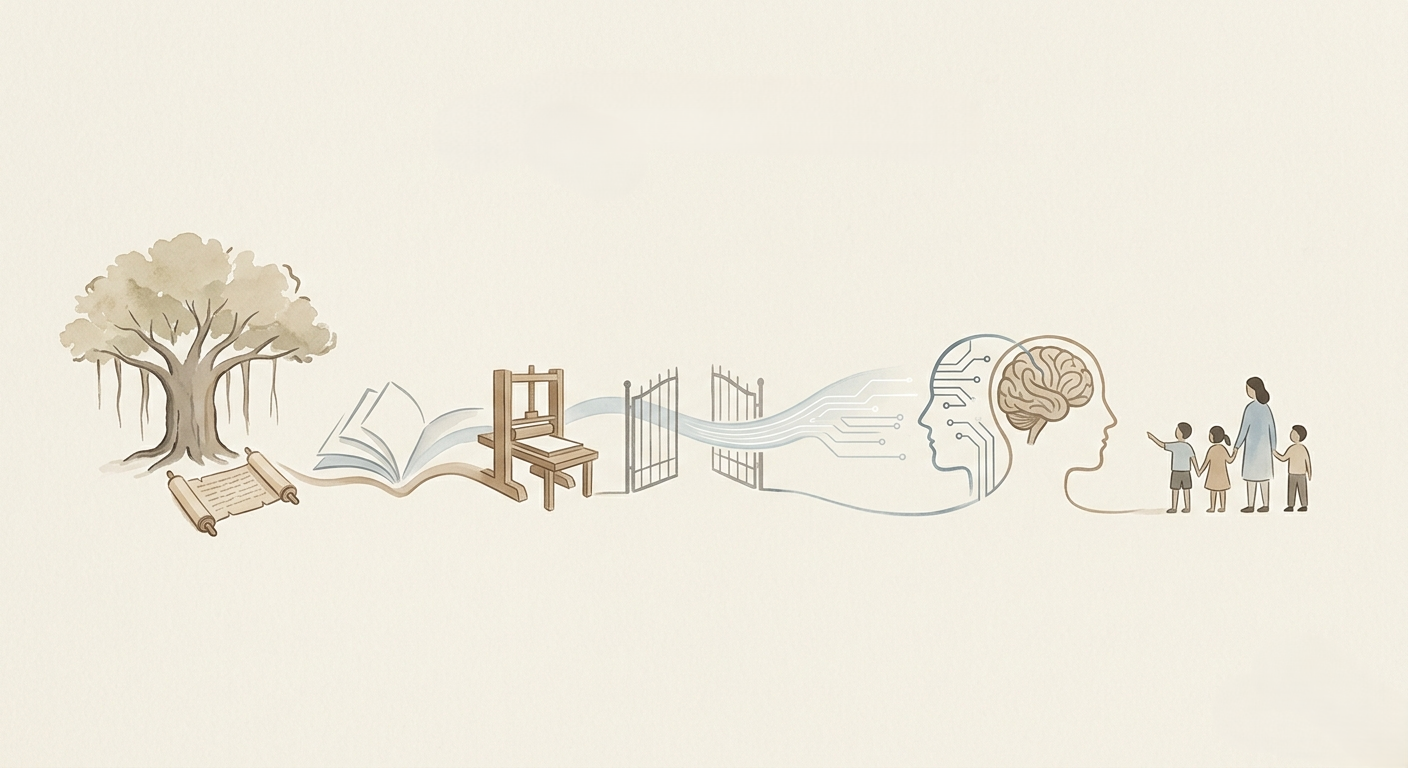
AI is fundamentally restructuring the process of how knowledge is distributed and consumed. Traditionally, universities played the role of ‘gatekeepers’. Professors delivered lectures, libraries preserved information, and degrees provided proof of expertise. Today, AI-powered systems can provide explanations, tutoring, and content creation instantly and at an extremely low cost. A college student in Karnali can receive personalized feedback on her writing from a system that never sleeps, never condescends, and adapts itself to her pace.
This is indeed a liberating possibility, though it carries a risk. If information is available to everyone upon demand, questions may arise about the necessity of institutions that distribute information. When any curious person can learn anything at any time from their phone, why go to university? Such a conclusion creates a confusion between information and education. Knowledge (in its full sense) is not a downloadable commodity.
AI-generated.
It is the capacity to question; the ability to understand context; the capacity to connect different subjects; and the ability to make prudent decisions amidst uncertainty. These capabilities develop through practice within communities—such as through debates, mentorship, failures, and genuine intellectual encounters. No matter how advanced, no AI system can yet replicate the transformative experience of a brilliant teacher who changes a student’s worldview.
An even more serious danger arises when AI begins to replace human judgment instead of assisting it. A notable example of this was the recent public discussion regarding the use of OpenAI’s ChatGPT in evaluating candidates for the appointment of the Chief Justice. Whether symbolic or practical, this incident points to a worrying trend: the tendency to outsource critical thinking and moral responsibility to algorithmic systems. For decisions of such constitutional importance, information alone is insufficient; they require wisdom, ethical self-reflection, institutional understanding, and personal accountability. If the education system teaches students merely to seek answers from machines instead of developing independent judgment, it risks producing individuals who are technically informed but devoid of intellectual confidence and moral reasoning—a serious challenge for democratic leadership.
The latest challenge relates to pedagogy. If students can use AI tools to write essays, summarize study materials, or solve problems, universities must immediately rethink the true meaning of learning. Exams that reward memorization or the reproduction of established arguments have practically turned into tests of how well a student knows how to prompt a machine. Now, the emphasis must shift from the reproduction of information to understanding—through oral defense, collaborative projects, field research, creative synthesis, and ethical reasoning.
It was said that calculators would destroy mathematical reasoning; it was said that the internet would end the capacity to focus. Each time, technology altered the nature of intellectual work, but did not eliminate it. AI will likely follow a similar path.
An even more subtle and concerning question is the risk of deepening inequality. Our digital divide is vast. According to recent government data, internet access in rural areas lags far behind urban centers, and device ownership is unequal across class, caste, and gender. Without conscious policy intervention, AI could exacerbate educational inequality instead of reducing it. A student with better devices, reliable internet, and the time to utilize AI tools will accumulate advantages throughout their career. The one who cannot will fall further behind.
Alongside this, a cultural and linguistic reconsideration is also necessary. Most leading AI systems are trained primarily on English language and Western-centric datasets. They perform unequally in languages like Nepali, Newari, Maithili, or Bhojpuri; they overlook knowledge traditions such as our Vedic philosophy, Ayurvedic science, or classical music theory. If the education system adopts these tools uncritically, the risk will not just be technical incompetence; it could also lead to ‘epistemic colonialism’.
Ultimately, there is a moral dimension here, perhaps the most important one. Universities are not just places to train for employment; they are institutions that build democratic citizens—people capable of critical inquiry, ethical judgment, and social responsibility. An AI that completes an assignment on demand does not teach a student how to reason; it teaches them to outsource the act of reasoning. If higher education is reduced to a mere process of obtaining certificates instead of building an intellectual community, the loss will not be felt in quarterly economic reports, but in the quality of public debate, the health of democratic institutions, and the collective fabric of society.
Creative horizons
Every previous technological revolution raised concerns about the displacement of human intelligence. It was said that the printing press would render memory unnecessary; that calculators would destroy mathematical reasoning; that the internet would end the capacity to focus. Each time, technology altered the nature of intellectual work, but did not eliminate it. AI will likely follow a similar path, but only if educators adopt it with a clear purpose.
Its potential in the field of research is already becoming visible. AI can process and synthesize massive data at a speed human teams cannot match, identify connections between disparate fields, assist in simulation and modeling, and quickly uncover interdisciplinary links that might otherwise take decades. For our universities, many of which are struggling with a lack of resources, AI-assisted research frameworks can truly be transformative. It enables smaller institutions to participate in scientific discovery that was previously accessible only to elite research universities.
In terms of skill development, its impact is extremely significant. The future economy will reward skills, interdisciplinary thinking, digital literacy, ethical decision-making, and creative problem-solving far more than rote knowledge. AI can act as a personalized learning partner: identifying gaps in a student’s understanding, providing explanations as needed, and freeing up classroom time for higher-order tasks.
AI should not replace the university; rather, it should inspire the university to transform into a more thoughtful, research-oriented, and human-centric institution.
For a linguistically diverse country like ours, AI also presents extraordinary possibilities for inclusion. If high-quality, AI-based translation and speech technologies are developed with our languages at the center, quality educational content can be delivered to students who have been historically marginalized due to the dominance of the English medium. A medical student in Sarlahi, a law student in Birgunj, or a teacher-trainee in Bhaktapur will be able to access quality explanatory material in their own language and at their own pace, on par with students from elite metropolitan colleges.
However, this vision will not realize itself. It requires digital infrastructure reaching the last village, the development of AI tools based on local language datasets, and training that transforms teachers from information providers into guides and critical facilitators. It also requires good governance, such as clear institutional policies regarding academic integrity in the age of generative AI and ethical standards for data usage. And it requires imagination—the courage to rethink what a university exam should look like, why a curriculum is necessary, and what our obligation is toward students who will live and work in an entirely unpredictable future.
Reform in higher education
John Dewey’s quote becomes relevant here: “If we teach today’s students as we taught yesterday’s, we rob them of tomorrow.”
Our higher education system cannot reap the full benefits of AI unless it addresses its own structural weaknesses. Long before the arrival of AI, universities were operating under the weight of administrative inertia, political interference, a weak research culture, and outdated pedagogical methods. The era of AI has exposed these problems even more starkly.
The first priority must be teacher reform. Universities must move away from appointment systems based on access, protectionism, and personal connections, and adopt transparent, merit-based recruitment processes. This requires strict implementation of peer review for research, evaluation by external experts, and conflict-of-interest declarations. Furthermore, teachers must be provided with continuous professional development, research support, and academic freedom so that they remain relevant in a rapidly changing world of knowledge. In the age of AI, students can instantly compare classroom teaching with global knowledge systems, which easily exposes outdated and irrelevant instruction.
Second, our universities must shift from a quantity-based research culture to a quality-based one. The pressure to publish numerous research papers has fueled low-tier journals, artificial citation networks, and impactful-less research. The evaluation of research should be based on originality, global impact, interdisciplinary collaboration, and its contribution to solving our social and developmental problems. AI tools can help make research more effective by analyzing vast data, identifying research gaps, and expanding collaboration.
Third, curriculum reform. A traditional education system based solely on lectures and rote learning cannot prepare students for an AI-driven economy. Universities must emphasize skill capability, critical thinking, ethical decision-making, research skills, collaboration, and digital literacy through project-based and interdisciplinary learning.
Finally, the examination system must also change. In a world where AI can write essays and solve routine problems, education must evaluate understanding over memorization. Oral examinations, portfolios, field research, collaborative projects, and exercises that solve real-world problems can better evaluate human reasoning and creativity. AI should not replace the university; rather, it should inspire the university to transform into a more thoughtful, research-oriented, and human-centric institution.
Seoul, South Korea