Kathmandu
Tuesday, July 21, 2026





Manoj Kumar Sharma, appointed as Chief Justice by bypassing the tradition of seniority, bears the responsibility of restoring trust in the judiciary.

KATHMANDU: In contrast to the tradition of appointing the senior-most judge as Chief Justice, Manoj Kumar Sharma has assumed leadership of the Supreme Court, bringing with him the duty to both prove his capabilities and elevate the judiciary’s reputation. After the Constitutional Council recommended Sharma, who was fourth in seniority, he underwent a parliamentary hearing, unanimous endorsement, oath-taking, and assumption of office all on a single day on May 19, taking over the ‘command’ of the judiciary.
With his appointment as the 33rd Chief Justice, the responsibility for judicial reform has fallen upon his shoulders. On May 7, a meeting of the Constitutional Council chaired by Prime Minister Balendra Shah recommended Sharma, who stood fourth in seniority, for the appointment of Chief Justice, bypassing Acting Chief Justice Sapana Pradhan Malla, Judge Kumar Regmi, and Judge Hari Phuyal.
Chief Justice Sharma has assumed the leadership of the judiciary at a time when the morale of justices is weak, the public’s trust in the courts has dwindled, and a sensitive situation exists where the judiciary must be kept free from political interference and shadows. In particular, during the Gen Z protest, arson at the Supreme Court caused not only physical damage but also weakened the morale of the judges. It has emerged recently that due to various threats and intimidation, judges have been operating under a state of fear while settling cases and delivering verdicts.
Amid these circumstances, the introduction of an ordinance to appoint a judge fourth in seniority as Chief Justice has drawn criticism, with commentators stating that the RSP-led government has planted another seed of politicization under the guise of breaking the old parties’ grip on the judiciary. Sharma bears the responsibility to dispel such suspicions by maintaining impartiality in the administration of justice. In this regard, while assuming office on May 19, Sharma stated that there would be no compromise on the institutional independence of the judiciary and the professional impartiality of judges. He remarked, “No interference of any kind in the dignity of the justice administration process will be accepted. No action that creates such suspicion will be taken by me, nor will it be allowed to happen.”

Newly appointed Chief Justice Manoj Kumar Sharma assuming office on May 19. Photo: Nepal Photo Library
The government had introduced the ‘Constitutional Council (Functions, Duties, Powers, and Procedures) (First Amendment) Ordinance, 2026’ specifically for the appointment of the Chief Justice, which was issued by President Ram Chandra Paudel on May 5). The ordinance specifies that in a meeting attended by the Chairperson and five or four members, a decision supported by at least three members, including the Chairperson’s vote, shall be considered a majority decision of the Council. The Constitutional Council, chaired by the Prime Minister, includes the Speaker of the House of Representatives, the Deputy Speaker, the Chairperson of the National Assembly, the Leader of the Main Opposition Party, and the Minister for Law at the time of recommending the Chief Justice. Recommending a name by bypassing seniority through a convenient ordinance, followed by endorsement via an expedited parliamentary hearing process, is being criticized as a starting point for interference in the judiciary.
Appointed as a Supreme Court judge on April 19, 2019, Sharma will serve a full six-year term as Chief Justice. Following the appointment of the new Chief Justice, Acting Chief Justice Malla has gone on a 15-day leave starting May 20. It remains to be seen whom Chief Justice Sharma, who also heads the Judicial Council, will appoint as members of the Council based on seniority. The position of senior judge in the Judicial Council has been kept vacant since May 20.
The Supreme Court administration’s refusal to register a writ petition challenging the Constitutional Council’s decision to recommend the Chief Justice laid bare the internal rifts within the supreme court. Just a day after Acting Chief Justice Malla ordered the registration of the rejected writ petition, the parliamentary hearing process was rushed through, and Sharma was hastily appointed Chief Justice. Under these conditions, Chief Justice Sharma faces the challenge of managing the judges within the judicial hierarchy while clearing approximately 27,000 pending cases.
Former Supreme Court Judge Girish Chandra Lal said that Sharma took leadership at a time when the judiciary had weakened after the Gen Z protest. He says, “Right now, it appears as though things are disrupted. The newly appointed Chief Justice faces both an opportunity and a challenge to handle a weakened judiciary.”
Reforms missing from the action plan
Following the Constitutional Council’s recommendation for appointment, the proposed Chief Justice submitted a detailed work plan to the Parliamentary Hearing Committee outlining future actions and reforms. Appearing before the committee on May 19, Sharma presented an 18-page action plan detailing judicial reforms to be undertaken during his tenure.
Gopal Prasad Mishra, President of the Nepal Bar Association, comments that Chief Justice’s action plan lacked concrete details regarding case clearance, the lottery system, and transitioning to automation. He states that there is little room for enthusiasm, given that action plans submitted to the Parliamentary Hearing Committee have historically not been fully implemented. “The action plan has become like the policies, programs, and budget—presented by the individual but never implemented,” he says. “Since the presenters themselves defy it, we do not view the action plan with great significance.”
To discourage the trend of failing to implement action plan commitments, a new clause has been added to Section 29 of the Parliamentary Hearing Committee Procedures, 2026. This clause provides for the evaluation of action plans submitted to the committee by individuals recommended by the Constitutional Council for positions such as Chief Justice, Supreme Court Judges, and heads of constitutional bodies. It mandates that a progress report on the commitments made before the hearing committee be prepared every four months and published on the website of the respective institution. According to Bodh Narayan Shrestha, Chairperson of the Hearing Committee, this provision was added because individuals tend to forget their action plans once approved and appointed, and no subsequent evaluations were being conducted. Sharma submitted his action plan in accordance with this new procedure.
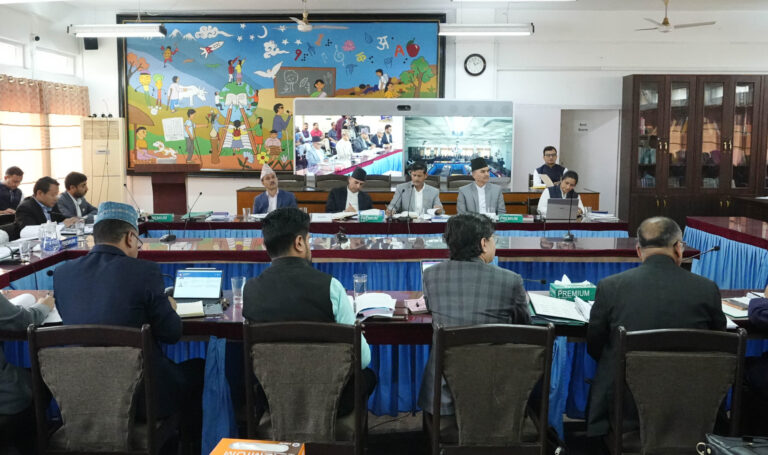
Meeting of the Parliamentary Hearing Committee held on May 19. Photo: Nepal Photo Library
In his action plan, Chief Justice Sharma has proposed a plan to review the jurisdiction of courts, including the Supreme Court. For this, he has committed to forming a high-level study committee within one month. The committee is expected to study and submit recommendations on modifying the structure of specialized courts, case flow management, and cause-list management. Furthermore, it is mentioned that the committee will identify obstacles within laws related to judicial administration to make judicial proceedings swift, efficient, simplified, predictable, accessible, transparent, accountable, and effective.
Sharma has specifically committed to the swift disposal of cases. This commitment is not new. Previous Chief Justices have also consistently presented similar action plans before the Parliamentary Hearing Committee.
However, Chief Justice Sharma’s action plan does not include the implementation of past judiciary reform reports. Various study committees have been formed at different times to reform the judiciary, yielding several reports. Most recently, in April 2021, a study report for judiciary reform was prepared under the coordination of the then-Judge (now retired Chief Justice) Hari Krishna Karki and submitted to then-Chief Justice Cholendra Shumsher Rana.
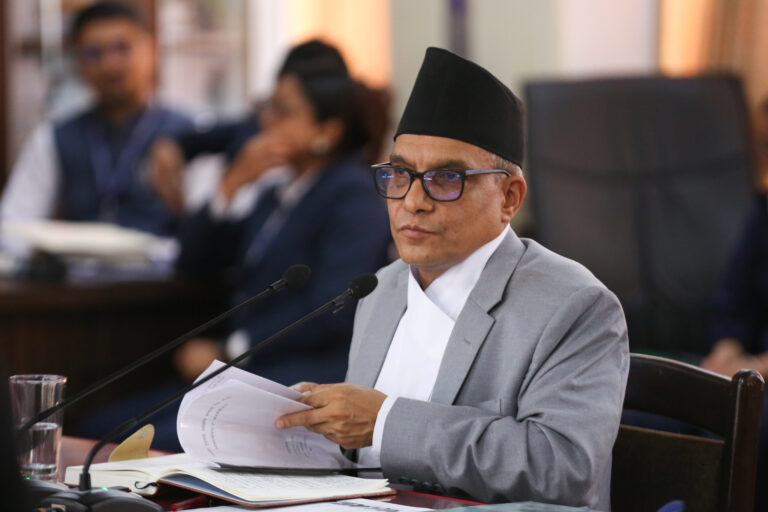
Chief Justice Manoj Kumar Sharma. Photo: Nepal Photo Library
Bar President Mishra notes that the newly appointed Chief Justice Sharma has shown no clear inclination toward implementing the report submitted by the Karki-led committee. The Nepal Bar has been demanding the implementation of this study report since 2020.
Since Sharma will lead the judiciary for a full six-year term, he will not face time constraints to execute the reforms he desires.
Former Judge Lal believes one should remain hopeful about the implementation of the action plan. “We cannot say that 100 percent of the commitments will be implemented. We always want the judiciary to improve,” he says. “The judiciary should be able to function independently. Judicial outcomes must be achieved.”
He adds that plans presented by Chief Justice Sharma, such as live broadcasting of hearings and swift case clearance, are feasible. “When cases are not settled on time, questions are raised about the relevance of the court. Alongside this, the court cannot refuse to register or hear any case; that must be guaranteed,” he states.
Live broadcasting of hearings
Until now, case hearings in court have taken place strictly inside the courtrooms. Chief Justice Sharma has included a plan to broadcast hearings live in his action plan. However, no timeline has been specified for when this arrangement will be completed. It states, ‘Arrangements will be made to broadcast court hearings live using information technology.’ If live broadcasting is implemented, everyone will be able to listen to arguments made in the courtroom. However, not all cases will be broadcast live, as laws require closed-bench hearings for certain cases, such as rape.
The action plan also includes upgrading existing information technology to reform the judiciary. ‘Software will be created and modules developed within one year to integrate processes from case registration to judgment writing and execution into an IT system,’ the action plan states. ‘Within one year, case registration, summons serving, case flow management, witness examination, stages of case proceedings and hearings, as well as order and judgment writing, will be integrated into the IT system.’
The Supreme Court began its work in 2014 by formulating a 10-year master plan regarding information technology. The Supreme Court currently has a separate Information Technology Division.
Appointment of judges
The 2021 report by the study committee led by former Chief Justice Karki noted that judge appointments have consistently been the primary driver of anomalies, corruption, and middleman activities within the judiciary. The appointment of judges has almost always been controversial.
Making judge appointments transparent and free from controversy is another challenge for the newly appointed Chief Justice. Every Chief Justice includes the timely and transparent appointment of judges in their action plan. Following suit, Chief Justice Sharma has committed to making judge appointment recommendations from the Judicial Council merit-based, objectively reflecting that the criteria set by the Constitution and law have been met.
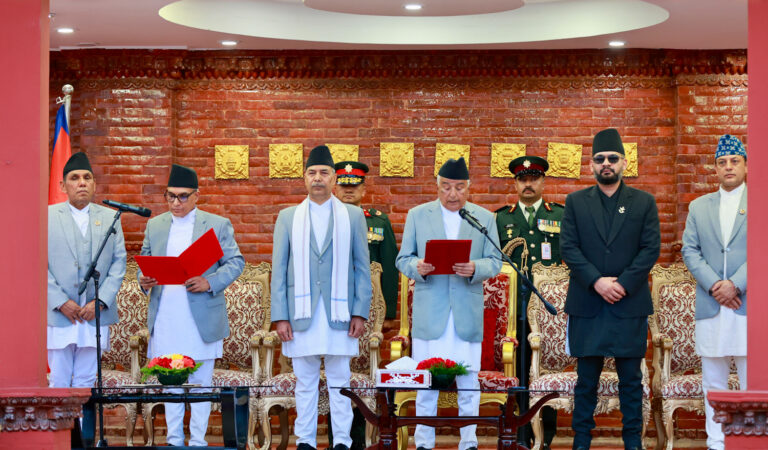
Chief Justice Manoj Kumar Sharma taking the oath of office and secrecy from President Ram Chandra Paudel. Photo: Nepal Photo Library
The ‘National Commitment’ made public by the government on April 14 also mentions the basis for judge appointments. The commitment paper states, ‘A method for testing integrity and morality will be adopted in appointments. Judge appointments will be made on the basis of meritocracy and a competitive system.’ However, the government has not disclosed what the criteria and framework of meritocracy will be, nor has it initiated any discussion or public debate on the matter.
Sharma’s action plan states, ‘An objective basis for measuring qualifications, capability, experience, and judicial integrity in accordance with the Constitution and law will be identified and developed to establish a system that makes appointments non-controversial, transparent, and predictable.’ The action plan also notes that vacancies for judges will be filled within the period specified by law, and regular meetings of the Judicial Council will be held by creating a schedule for this purpose.
Three positions for judges are currently vacant in the Supreme Court. The action plan states that when appointing judges to the Supreme Court in the future, appointments will generally be made from among High Court judges, except in essential circumstances requiring subject-matter expertise. Even though appointments are to be made from the High Court, he has planned to give due space to subject-matter expertise.
When appointing judges to the High Court, Sharma plans to prioritize judges working in District Courts and serving officers. It is stated that special initiatives will be taken to modify the District Court judge appointment process, giving primary priority to those who have worked as bench officers when filling vacant positions. Until now, District Court judges have been appointed based on examinations conducted under set criteria. Inclusive representation in judge appointments will be continued in line with the spirit of the Constitution. The action plan notes that the judge appointment process will be non-controversial, transparent, and predictable.
Chief Justice Sharma expressed his commitment before the Parliamentary Hearing Committee that the use of information technology following the implementation of the action plan will improve judicial service delivery and minimize the current backlog of cases. He stated that judicial good governance, accountability, responsibility, judicial integrity, and propriety will be maintained in the judiciary.
Restricting judges to settling cases only
Currently, Supreme Court judges not only settle cases but also head various committees within the court. The Chief Justice assigns judges to lead committees such as the Mediation Committee, Case Management Committee, Editing and Publication Committee, Court Management Committee, and Information Technology Committee, among others. Getting entangled in the work of such committees seems to affect case disposal rates. Keeping this in mind, Chief Justice Sharma has committed to amending the regulations so that judges are not engaged in tasks that distract them from their core duties.
He has committed to modifying the current system where judges must fulfill responsibilities within administrative and managerial committees alongside their judicial work. He noted that the Supreme Court Regulations will be amended to restructure committees to ensure minimal involvement of judges. The Supreme Court Regulations, 2017 contain provisions for forming committees that involve judges in tasks outside the administration of justice.
Disposal of complaints against judges
Complaints have frequently risen regarding the delayed disposal of grievances filed against judges at the Judicial Council. To remedy this situation, Chief Justice Sharma’s action plan mentions developing a system for swift disposal by holding regular meetings based on a fixed schedule. The Chief Justice serves as the chairperson of the Judicial Council. Although complaints regarding judges are filed at the Judicial Council, timely investigations into them have been lacking.
The action plan states that regular monitoring will be conducted to check whether the code of conduct for judges and staff is being followed, and if violations are found, legal proceedings for action will be initiated.
Complaints are filed at the Judicial Council raising questions about judges’ lack of competence, bad conduct, serious violations of the code of conduct, or failure to perform duties honestly. According to a bulletin published by the Council on December 18, 2025, during the current fiscal year 2025/26, 255 complaints have been filed, including 175 against district judges and 80 against High Court judges. Among these, 197 complaints are yet to be cleared. It is noted that some complaints of differing natures exist against the same judge.
Effectiveness in judgment execution
Another problem following delays in case disposal is the non-execution of court verdicts. Due to judgments remaining unexecuted for years, piles of fines and property recovery amounts have accumulated.
Because judgment execution is ineffective, service seekers have not been able to experience real justice. The Supreme Court’s annual report for 2024/25 itself notes that several decisions, directive orders, and verdicts issued by the court have remained unexecuted for years.
According to the Supreme Court report, up to July 2025, unrecovered fines from court verdicts across the country totaled 31 billion 83 million 94 lakh 64 thousand rupees. Regarding imprisonment, 121,156 years and 11 months remain unserved. Out of applications registered for judgment execution, 38,071 units are pending clearance. This number clearly indicates the state of judgment execution. “Since the responsibility for judgment execution lies with the executive, necessary steps must be taken to ensure this function is carried out by the executive instead of the judiciary in the long run,” the Supreme Court’s annual report states.
Chief Justice Sharma has also mentioned updating records related to judgment execution and entering them into integrated judgment execution software in his action plan. He noted that in courts with high backlogs of prison sentences, fines, and government property recovery records, execution teams comprising police, court staff, and local level representatives as required will be formed to collect them through dedicated campaigns.
Plan to increase public trust
Sharma plans to implement a zero-tolerance policy to control anomalies and aberrations that may occur in court. The plan also mentions conducting ‘real-time surveys’ regarding service-seeker satisfaction to bring regular improvements based on feedback, alongside making interim relief and compensation delivery swift, smooth, and convenient to ensure justice accompanied by compensation.
“Necessary arrangements, including designating specialized tribunals and dedicated benches, will be made to ensure swift hearings for infrastructure development works and tax revenue-related cases,” the action plan states. Regarding this, the Ministry of Law, Justice, and Parliamentary Affairs has also made public a study report on reforms required to swiftly resolve court cases related to infrastructure construction and development projects.
Delays also occur in judgment writing by the courts. Sharma plans to adopt special strategies including managing and deploying human resources to write judgments within the specified time, creating a conducive work environment, providing training on judgment writing, and introducing incentives and motivation. The action plan notes that measures will be identified and implemented to make the mediation system—which has been adopted as an important medium for sustainable dispute resolution—more effective.
Given the history where previous Chief Justices also brought forward many of these plans but failed to implement them, how Sharma fulfills his commitments and keeps himself clean, effective, and the judiciary independent will remain a test throughout his six-year tenure.