Kathmandu
Tuesday, July 21, 2026





Kathmandu Valley Crime Investigation Office, a unit designated for high-profile criminal cases, holds and interrogates sitting Secretary Krishna Hari Pushkar for four hours at its Teku facility over a mobile text message sent to Prime Minister Balen requesting an ambassadorial appointment

KATHMANDU: On Thursday (June 4), the police held Krishna Hari Pushkar, the Secretary of the Office of the Vice President, in custody for four hours. The Kathmandu Valley Crime Investigation Office, located in Teku, Kathmandu, illegally ‘interrogated’ Pushkar. The reason was a message he had sent to the mobile phone of Prime Minister Balendra Shah (Balen). It has been found that he sent the mobile message seeking help to be appointed as an ambassador.
According to the officers of the office, following an order from ‘above,’ Pushkar was taken into custody from his residence in Kapan at 4:30 PM. After being interrogated for four hours at the Teku-based office, Pushkar was released at 8:30 PM at night. The police have refused to state why Pushkar was summoned and why he was released.
The chief and officers of the investigation office have not provided official information regarding the Pushkar incident. “An order came to summon him, so he was summoned. In the end, an order came to release him, so we released him,” an officer says.
The incident of taking a high-ranking official working in the special class of the government into custody without any clear reason has raised questions about the exercise of police authority, administrative accountability, and the rule of law. Although the law prescribes specific grounds and procedures for arrest or custody, it is not clear whether those procedures were followed in Pushkar’s case.
According to the officer of the office, however, Pushkar was not given an ’emergency arrest warrant. ‘It is understood that the police were directed by the Prime Minister’s Office itself to investigate him. “Some questioning was done regarding the matter of him messaging the Honorable Prime Minister,” an officer from the Police Headquarters says.
However, the Information Officer of the Central Police, Senior Superintendent of Police Deep Shamsher Rana, states that even he does not have official information regarding the incident of Secretary Pushkar being taken into custody. “I have received information that an investigation is ongoing on some subject matter,” he says.
It is understood that the police took Pushkar into custody to investigate the matter of him writing the message to Prime Minister Balen. Pushkar, on his part, has refused to speak about this.
According to the officer of the investigation office, the message sent by Pushkar to the Prime Minister was as follows: ‘Honorable Prime Minister, Namaskar. There is a provision that the tenure of a secretary of the government of Nepal is five years. Honorable Sir, looking at it this way, unless there is your special attention toward the Chief Secretary post, there is no possibility, Sir. Because of this, my retirement is ensured for this coming July 8. In the meantime, I saw the advertisement for the post of ambassador, Sir. I politely request your information, guidance, and necessary assistance regarding this matter.’
It is not clear on which day Pushkar had sent this message to Prime Minister Balen. It is understood that the Prime Minister’s Office itself directed the arrest to investigate, stating that the message was sent for personal interest.
Misuse of the police force
The law does not provide the facility to take a special class officer of the government into custody and ‘interrogate’ them merely for messaging the Prime Minister. Former Deputy Inspector General of Police Ramesh Kharel states that there was no situation where he had to be arrested and brought in just because he sought help from the prime minister. “They could have just called and asked him,” he says. “The police did not do a good job here; it is not appropriate even from a human rights perspective.”
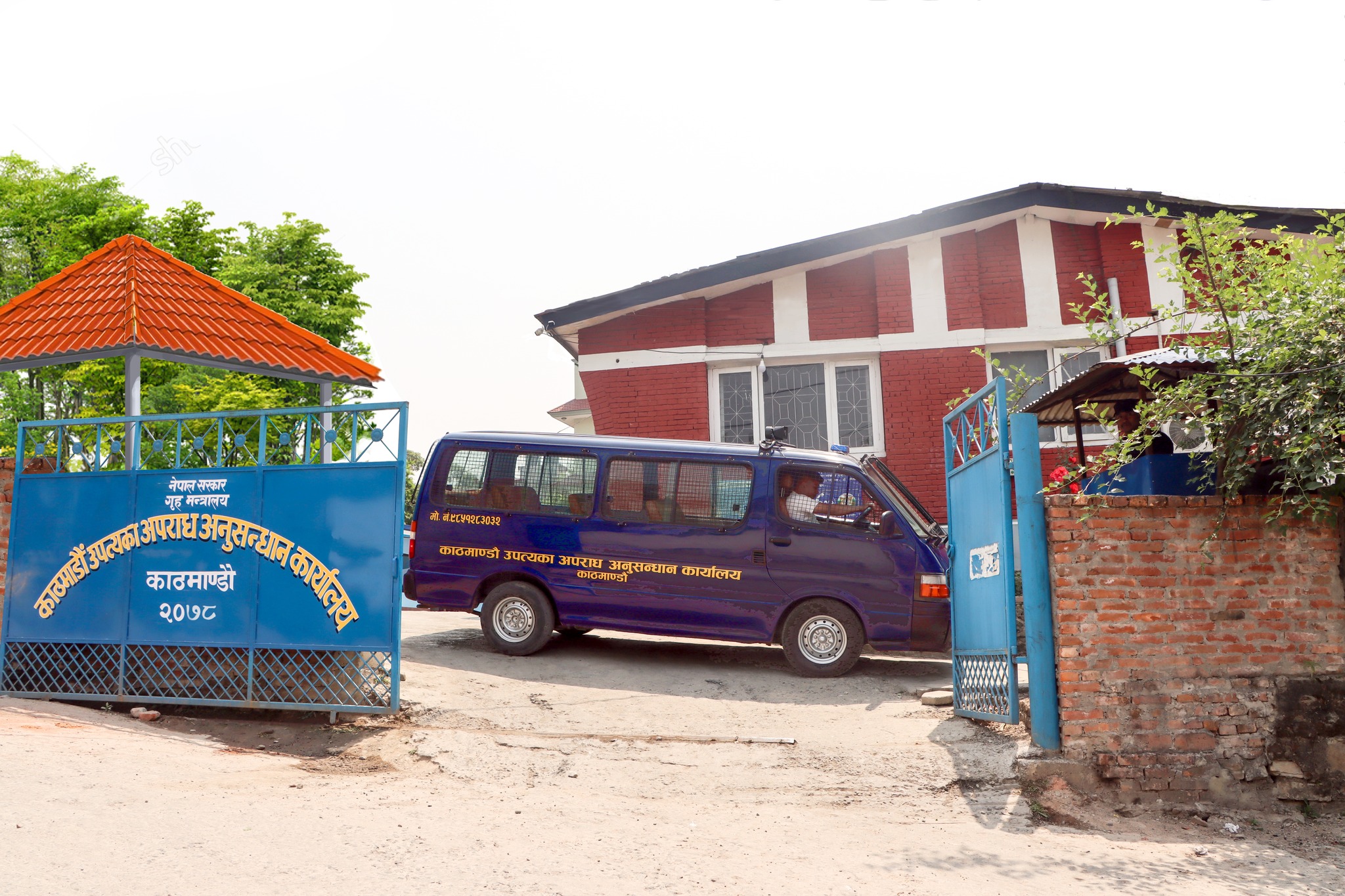
Kathmandu Valley Crime Investigation Office
Questions have been raised that the police organization itself was misused in the incident where the secretary was taken into custody over the message case. Indeed, the agency mobilized to take Pushkar into custody (Kathmandu Valley Crime Investigation Office) is a body that investigates major criminal incidents. It does not have the authority to prosecute cases. After catching any accused, it must have their remand extended within 24 hours and hand them over to another nearby agency. A police body of this nature was used to interrogate an incident of sending a mobile message.
Legal practitioners have also raised questions regarding the matter of the secretary being arrested. Former General Secretary of the Nepal Bar Association, Lila Mani Paudel, says, “An arrest is not warranted merely on the basis of writing a message. However, disciplinary action regarding the chain of command or the Secretary writing a message to the Prime Minister that could be interpreted otherwise would be appropriate.”
Senior Advocate and expert on human rights law, Raju Chapagai, states that a person in a high position like a secretary can clarify by themselves whether injustice has been done to them or not. “First of all, since he can say by himself whether injustice was done to him or not, I did not feel like we needed to advocate for it. Being a conscious citizen, he will speak out himself,” he says.
The Kathmandu Valley Crime Investigation Office, which is mobilized in major crime incidents, investigates heinous crimes in Kathmandu, Bhaktapur, and Lalitpur. When it was located in Hanuman Dhoka, this unit was known as the ‘interrogation’ body of the police. The Prime Minister’s Office has involved an agency that should focus on the investigation of major criminal incidents into a minor incident involving Pushkar.
In addition to this, concerns are also being expressed that if high-ranking government officials are taken into custody without any clear legal basis, what would be the state of constitutional security for ordinary citizens? Mihir Thakur, a member of the National Human Rights Commission, says, “What exactly happened in the incident has not come out clearly; we can talk after having information on the subject matter.”