Kathmandu
Saturday, June 13, 2026





Existing since the dinosaur era, the turtles face critical threats from human activities, making their conservation essential for the survival of freshwater ecosystems and human civilization.

Turtles are creatures that do not make loud noises. They do not possess bright colors that attract attention, nor are they famous wildlife like tigers or rhinos. However, their role in keeping freshwater ecosystems healthy is extraordinary.
Turtles are the “silent cleaners” of rivers, lakes, ponds, and wetlands. They continuously maintain nature’s cleanliness, balance, and life cycle.
Most turtles found in Nepal are freshwater species. Their primary habitats are river systems like the Narayani, Karnali, Koshi, Rapti, and Kankai, as well as the wetland areas of the Terai. To date, 18 species of turtles have been recorded in Nepal. Among them, many species are globally endangered. Some species have become so rare that many people have not even heard their names.
Why are they called silent cleaners?
To understand why turtles are called silent cleaners, one must understand their lifestyle. Most freshwater turtles are omnivorous. They eat the remains of decayed fish or other animals in the water, organic waste, small insects, snails, aquatic plants, and various organic matters.
When a creature dies in a river, it begins to rot, bacteria increase in the water, and there is a possibility of disease spreading. By eating such organic matter, turtles naturally help keep the water clean. Therefore, scientists describe turtles as nature’s cleaners in the aquatic ecosystem.

An elongated tortoise found in its natural habitat. Photo: Parmanand Rajbanshi
Various studies have shown that their presence leads to the rapid decomposition of dead organic matter in rivers, maintains oxygen balance in the water, and reduces the impact of pollution. Thus, a healthy population of turtles in a river is also a sign that the river is still alive.
The role of turtles is not limited only to cleaning. They are also controllers of the river’s biological balance. By eating small aquatic creatures, insects, and in some cases even small fish, they prevent any single species from multiplying excessively. This helps keep the food chain stable. Some terrestrial turtles disperse seeds far and wide when they consume fruits and vegetation, which also contributes to plant regeneration.
Creatures from the era of dinosaurs
The history of turtles dates back to the era of dinosaurs. According to scientists’ estimates, turtles have existed on Earth for about 200 million years. They survived numerous climate changes, natural disasters, and extinction events on Earth. Ironically, the last few decades of human civilization have brought their existence into the greatest crisis.
Softshell species found particularly in the rivers of Nepal and South Asia are currently at risk. Most species found in Nepal have been listed as endangered, critically endangered, or vulnerable by the International Union for Conservation of Nature (IUCN). Various studies have shown that river pollution, illegal hunting, sand mining, dam construction, plastic pollution, and wetland encroachment are rapidly decreasing the number of turtles.
A study conducted in the Kankai River area of eastern Nepal showed that the presence of turtles decreases significantly with the increase in the level of human activities. Specifically, uncontrolled sand mining, microplastic pollution, and wetland encroachment have been identified as the main challenges.
Increasing pressure on habitat
When sand is mined from riverbanks, the natural places where turtles lay eggs are destroyed. Building dams in rivers alters the flow of water, which disrupts their feeding, breeding, and movement systems. In some cases, turtles also die after getting caught in nets used for fishing.
In rural areas, some communities still use turtles for meat, traditional medicine, or trade as pets. Various reports have shown that the smuggling of freshwater turtles has now become a major part of international wildlife crime in South Asia.
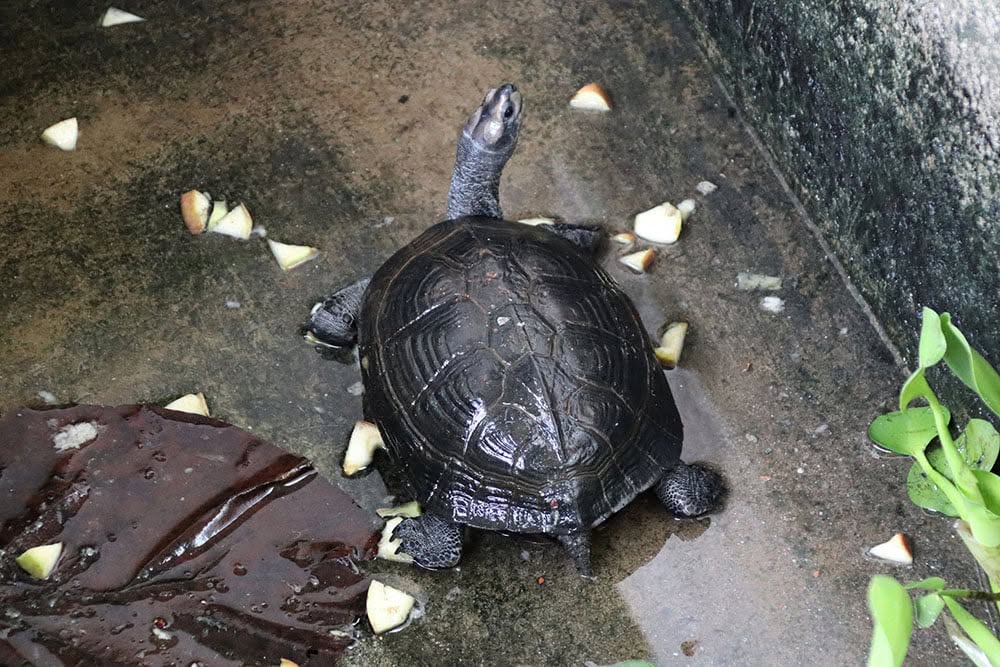
Indian black turtle. Photo source: ARCO-Nepal
However, not all stories are discouraging. Local communities in some areas of Nepal have started coming forward for conservation. Community-based conservation programs are being conducted in Chitwan and some river areas of the Terai. In such programs, local fishing communities are trained on the importance of turtles. In some places, efforts are also being made to raise turtles by moving eggs found on riverbanks to safe locations.
The understanding that saving turtles is not just about saving a single creature, but about saving the entire river, is the core reason behind this change.
The strength of the river
If turtles disappear from rivers, its impact will gradually begin to appear across the entire water system. Dead organic matter will increase, water quality will deteriorate, the population of certain organisms will increase in an unbalanced manner, and ultimately the entire ecosystem will become weak.
Therefore, scientists also view turtles as important biological indicators to measure the ecological health of rivers and wetlands. Today, aquatic ecosystems are among the most rapidly degrading systems worldwide. Rivers are not just places where water flows; they are homes to thousands of creatures. Turtles are the cleaners, balancers, and silent protectors of those homes.
Saving turtles is not just about saving one species; it is about saving future rivers, wetlands, and the entire aquatic life system. Human civilization will remain alive only as long as rivers stay alive.
However, the tragic aspect is that they are often overshadowed in conservation debates. Tigers, rhinos, or elephants easily draw attention. But turtles do not receive publicity. They just keep working to keep the rivers alive.
Perhaps there is a greater need to tell people the story of turtles. Turtles walk slowly; they do not hurry. Their contribution to nature is similarly deep and continuous. They keep the water clean, maintain biological balance, and keep the rivers alive.
Therefore, saving turtles is not just about saving one species; it is about saving future rivers, wetlands, and the entire aquatic life system.
Human civilization will remain alive only as long as rivers stay alive. And rivers are continuously being saved by turtles.

![Doctors protest at Maitighar, demand fair pay and labor rights for young medics [Photo feature]](https://english.nepalnews.com/wp-content/uploads/2026/06/Doctor-Protest_-1858-scaled-1.jpg)