Kathmandu
Saturday, June 13, 2026





Death is not a subject for "celebration," but the grand departure of a legendary poet like Bashir Badr deserves to be deeply remembered.
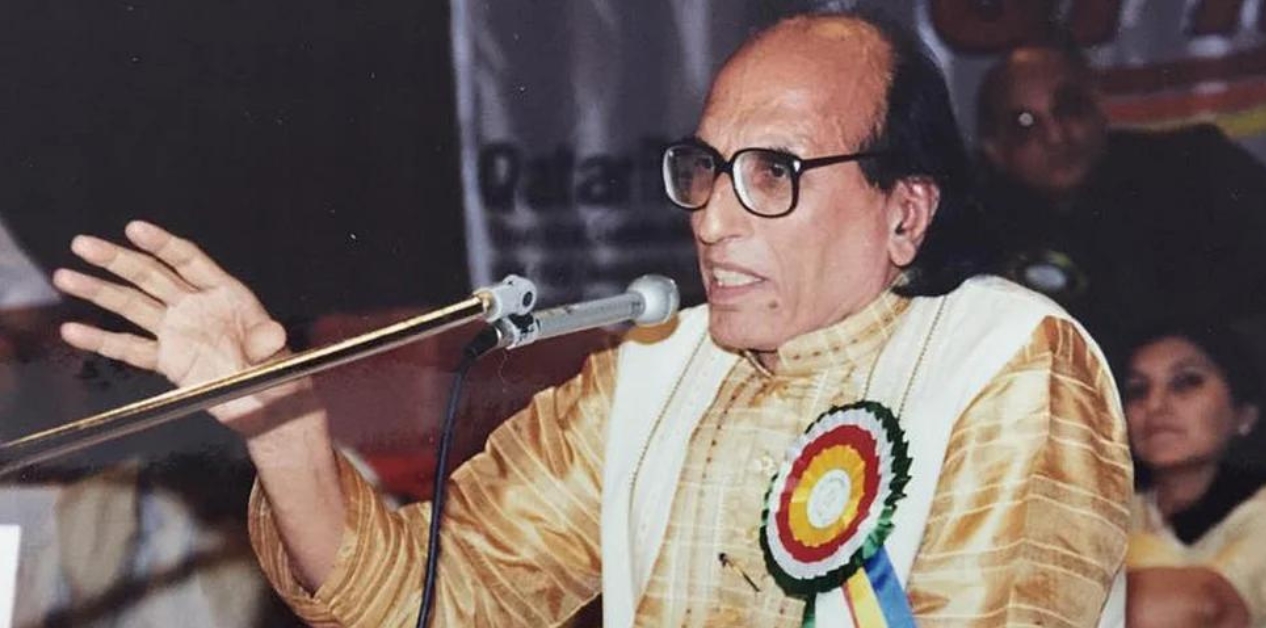
Saat sandookon mein bhar kar dafn kar do nafratein
Aaj insaan ko mohabbat ki zaroorat hai bahut.
(Lock away all hatred into seven heavy chests and bury it deep,
For humanity today is in desperate need of love.)
It was a time when the heat of the civil conflict was intensifying in Lamki Bazar. Almost every day, people from the hills were descending upon Maluwar, seeking a safe haven.
Right next to our house stood a boarding school, standing tall like a silent witness to the war. Though the school had shut down, its structures remained intact. My mischievous childhood unfolded amidst its peeling paint and crumbling walls.
Occasionally, the nomadic Raute people would wander into our village, carrying beautifully crafted wooden vessels carved by their own hands. They would camp, cook, and eat in the school courtyard, taking rest under the shade of the jackfruit tree. They believed that touching money was a sin, harboring absolutely no desire for paper notes. Instead, they would barter their craftsmanship for lentils and rice from our kitchen. One particular year, after our fields lost a generous share of green vegetables and cucumbers to barter, my mother brought home a wooden chest (mudhus) crafted by them. On its exterior, right beneath my name, I scribbled: Class 2, Roll Number 84.
While my identity was carved on the outside, the inside of that chest held a beautiful, sprawling universe of Hindi and Urdu literature. My father possessed a profound love for religious texts, nazms, and ghazals. Whenever he returned home with a Panasonic radio blaring on his shoulder, his bags would be stuffed with these books. He would constantly jot down thoughts in his diaries and sit out on the balcony, reciting couplets. Back then, I had no idea who had written them or who these poets were.
It was only much later, when I fondly ran my fingers over those old pages, that I realized the rhythmic verses my father used to recite belonged to Bashir Badr.
As time passed, Western Nepal became deeply enchanted by the world of ghazals. Older siblings and youth in the neighborhood began pouring their emotions into verses. Hearing their names echoing over the radio sparked a fierce desire in me to become a ghazalkar (ghazal writer) too. Soon, I found myself placing a title like a tika at the top of my notebook pages, trying hard to rhyme couplets.
In school, the older boys—just beginning to sprout the wings of youth—harbored a sweet delusion and firm belief: writing ghazals was the ultimate way to woo girls. I would recite my hybrid couplets during school cultural programs, and these older boys would beg me to ghostwrite for them. In those days, the era of the love letter was heavily overshadowed by the era of the ghazal.
A bit later, I crossed paths with MP Careless and his circle. They used to travel to Lucknow and bring back Hindi ghazal books by the kilogram. This deepened my intimacy with Hindi and Urdu poetry even further, allowing me to truly absorb the written words of Bashir Badr.
Log toot jaate hain ek ghar banane mein
Tum taras nahi khaate bastiyaan jalane in?
(People shatter into pieces just trying to build a single home,
Do you feel no mercy when you set entire neighborhoods ablaze?)
Today, burning down homes seems to have become a habit for us. We look at bulldozers tearing through slum settlements and view it as a prime example of good governance. But a home is never built merely of four walls and a roof. The soil beneath it holds decades of sweat, interwoven with dreams and memories.
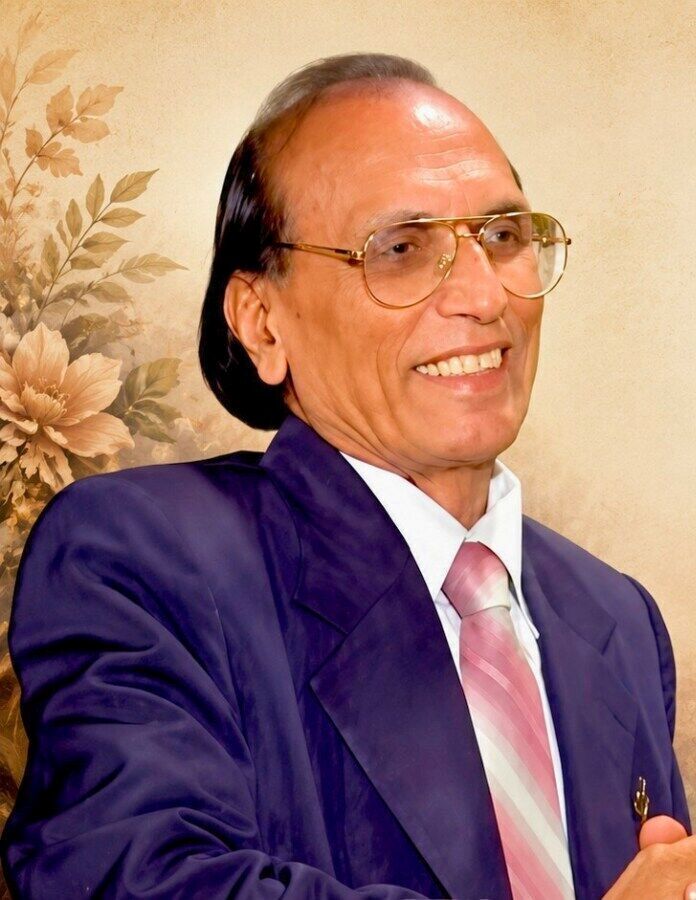
Bashir Badr. Photo Source: Radiance News
Only those whose homes have been reduced to ashes truly understand this agony. A home is never just a physical structure or a mere shelter to shield one’s head. A pillar, a beam, a courtyard, a wall, a room—a home is far greater than the sum of these parts. A home is a repository of collective memories. It is a sacred convergence of countless narratives of sorrow and joy, laughter and tears, agony and ecstasy. A home is also a living history, with bitter and sweet life experiences meticulously recorded upon every single page.
Bashir Badr understood this agony intimately. On February 15, 1935, during the communal riots in Meerut (then Faizabad), he lost his home. It was torched right before his eyes. Along with it, he lost his priceless manuscripts and a library of books collected over a lifetime of hard work. Whether he ever truly broke free from that trauma remained buried in the depths of his soul, but he once told his contemporaries: “I didn’t just see my house burning; I saw my entire past go up in flames.”
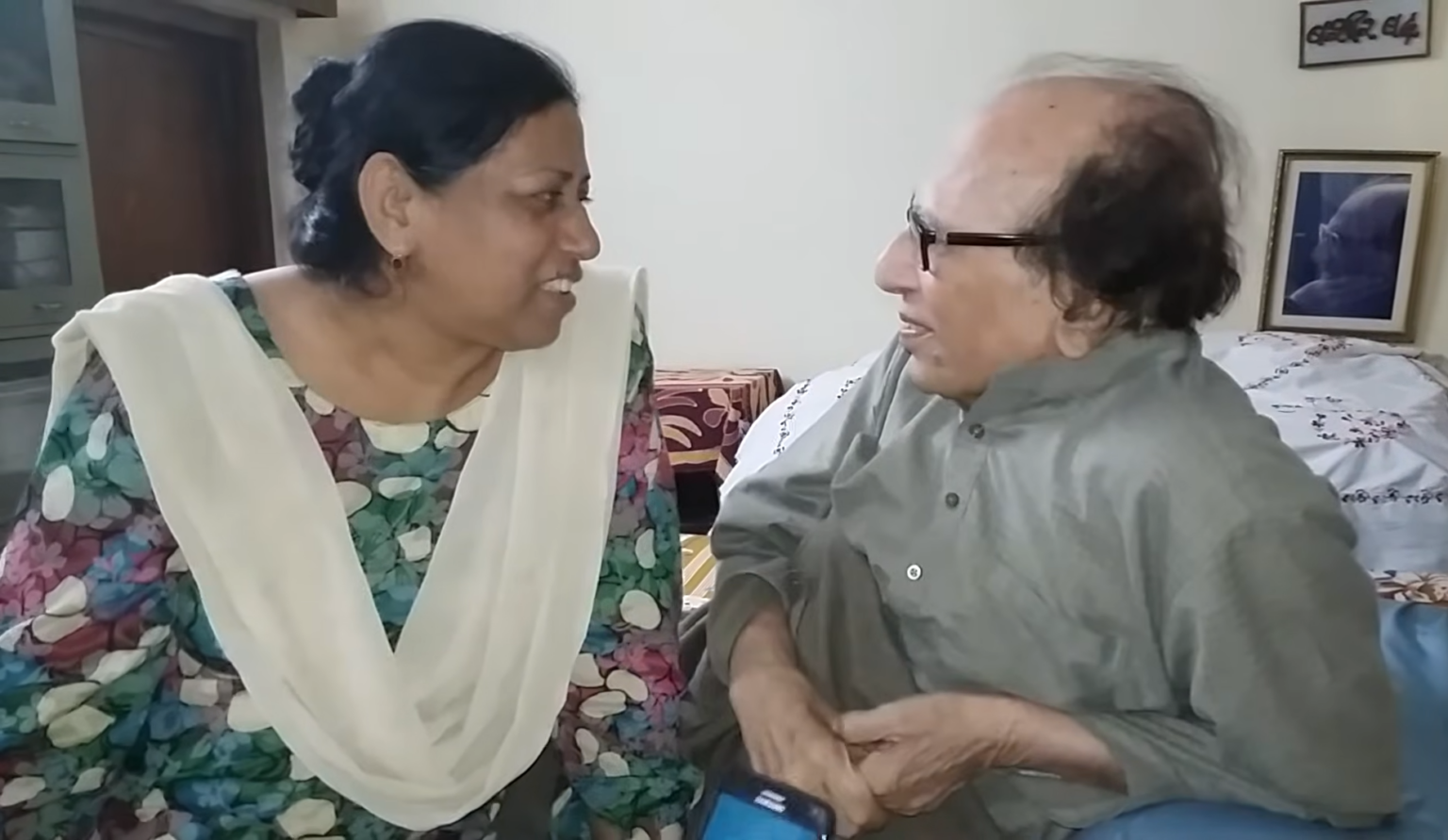
Bashir Badr with wife. Photo: YouTube
The poet Nida Fazli once remarked, “Bashir brought the ghazal to the courtyards of the common people, but he never imagined that very courtyard would be consumed by conflict.”
Yet, despite losing everything, Bashir taught the world humanity. He taught the world that even war and revolution must retain a sense of dignity, writing:
Dushmani jamkar karo, lekin ye gunjaish rahe
Jab kabhi hum dost ho jaayen to sharminda na hon.
(Carry out your enmity fiercely, but leave just enough room,
So that if we ever become friends again, we do not have to blush with shame.)
In truth, Bashir was a poet of the masses, a bard for the ordinary person, and a disciple of love. He took the ghazal—which had long been relegated to an aristocratic luxury and courtly entertainment—and brought it directly into the living rooms of ordinary people. Despite holding a PhD in Urdu, he never burdened his couplets with academic pretentiousness. Instead, he wrote simple yet incredibly potent verses that the common man could feel and claim ownership over. He composed poetry using everyday words that previous traditional poets would have flatly rejected. Replacing complex Arabic and Persian vocabulary with accessible Urdu, he captured the human psychology and lived experience. It is precisely why, after Ghalib, he became perhaps one of the most widely popular poets among the masses.
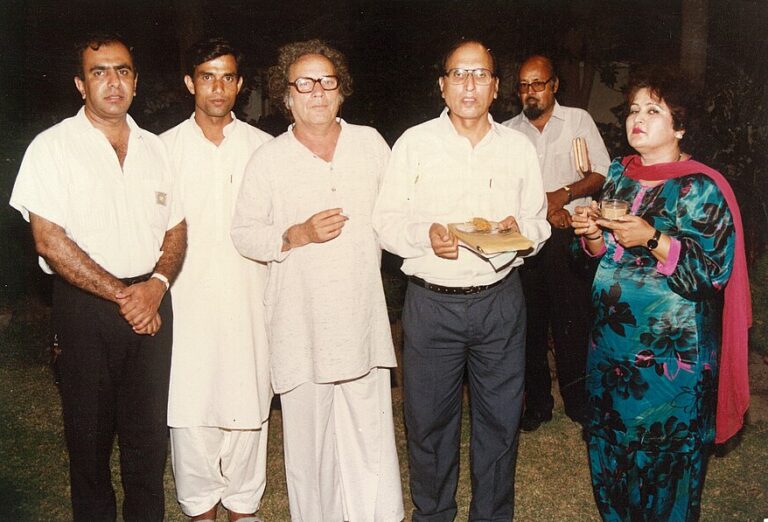
Bashir Badr with fellow writers (second from the right in the front). Photo Source: Wikimedia Commons
In his writings, he fluidly shifted personas—appearing at times as a fierce rebel, at others as a refined professor, or a tender lover.
Unhi raaston ne jin par kabhi tum the saath mere
Mujhe rok rok poocha tira hamsafar kahaan hai?
(The very paths where you once walked by my side,
Keep stopping me to ask: ‘Where is your companion now?’)
Yet, kindling hope within himself, he would reply:
Musafir ho tum bhi, musafir hain hum bhi
Kisi mod par phir mulaqat hogi.
(You are a traveler, and so am I;
Perhaps at some crossroads, our paths will cross again.)
Bashir was drawn to poetry since childhood. While still in the seventh grade, his ghazal was published in Nigar, a highly prestigious literary magazine of the era, bringing him instant recognition. By the time he was 20 years old, he was already famous across both India and Pakistan.
Possessing a masterful command over Persian, Hindi, Urdu, and English, he believed literature was an deeply personal matter. He argued that poetry should not be dissected by professors using their brains, but felt through the hearts of the readers. There is an interesting anecdote tied to his life, which some have dismissed as mere literary gossip.
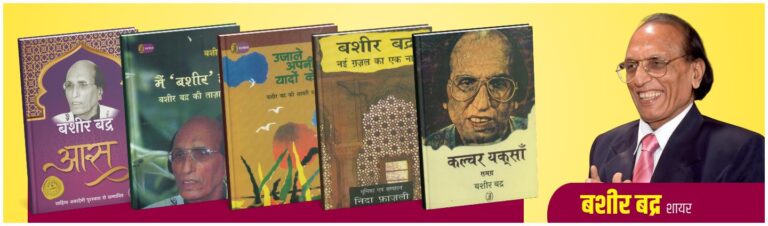
Books authored by Bashir Badr. Photo Source: Social Media
While studying at Aligarh Muslim University, Bashir sat for his viva exam. During the evaluation, the professor asked him to analyze a specific couplet. Unbeknownst to the professor, the couplet had actually been written by Bashir himself. When Bashir offered his interpretation, the professor strongly disagreed with the explanation and failed him.
As beautifully simple as Bashir’s poetry was, his life was equally complex and turbulent. His father served in the police force, meaning his childhood was scattered across various cities. He completed his primary education in Kanpur and Etawah. Shortly after finishing high school, his father passed away, thrusting the entire weight of the family responsibilities onto his young shoulders. He was forced to take up a police job for a meager monthly salary of 85 Indian Rupees.
However, his hunger for education never died. Many years into his job, he resumed his studies. After earning his BA, MA, and PhD from Aligarh Muslim University, he went on to serve as a Professor of Urdu at Meerut College.
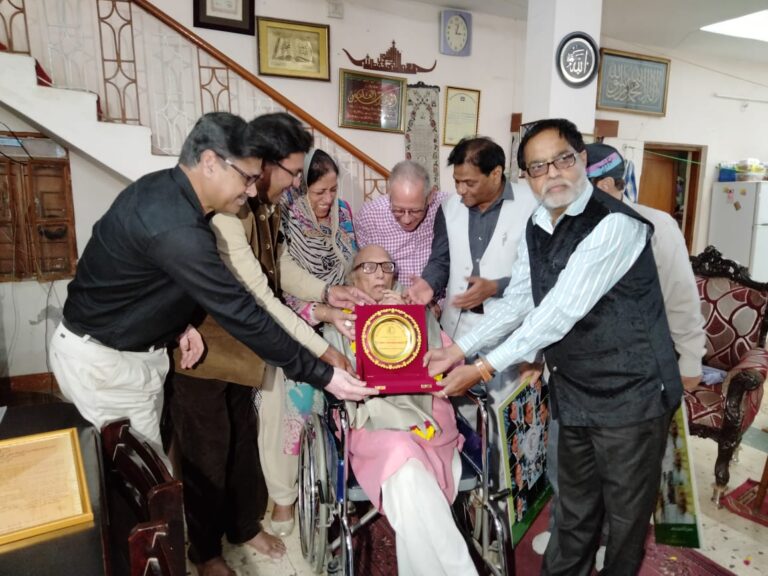
Bashir Badr at his residence with fellow writers. Photo: Newsbits
During the isolation of the COVID-19 lockdowns in Kathmandu, my friends and I—Kushal Neupane, Bilas Rokaya, Hemant Shishir, and others—spent our days reading and “celebrating” Bashir.
Khuda ki itni badi kaenat mein maine
Bas ek shakhs ko maanga, mujhe wahi na mila.
(In this massive universe created by God,
I asked for just one person, and that is the only one I didn’t get.)
Tum mohabbat ko khel kehte ho?
Humne barbaad zindagi kar li.
(You call love a game?
Look at me, I ruined my entire life for it.)
Shohrat ki bulandi bhi pal bhar ka tamasha hai
Jis daal pe baithe ho wo toot bhi sakti hai.
(The pinnacle of fame is but a momentary spectacle;
The very branch you are perched upon could snap at any second.)
Sar jhukaoge to patthar devta ho jayega
Itna mat chaho use wo bewafa ho jayega.
(If you bow your head, even a stone will turn into a god;
Do not love them so blindly, or they will turn unfaithful.)
It was around this time that we learned of the heartbreaking reality of Bashir’s final years. He had once addressed his readers in his collection Aamad, writing: “Today, there is no poet more popular than me, and whatever new direction the ghazal takes in the future, it will ignite from the lamp of my words.”
Yet, the final chapter of his life was incredibly cruel. Suffering from Alzheimer’s disease, he eventually forgot that he was a legendary poet. The maestro whose presence was absolutely vital for any mushaira (poetry symposium) to be deemed complete could no longer remember that he was that very poet. When his son would recite his own iconic couplets to him, Bashir would clap from his sickbed and ask, “Who wrote this? It’s beautiful.”
Gharon pe naam the, naamon ke saath ohde the
Bahut talaash kiya koi aadmi nahi mila.
(There were names on the houses, and titles alongside those names;
I searched far and wide, but could not find a single true human being.)
Ultimately, his life’s journey quietly ended in the fog of forgetfulness. On May 28, 2026, after battling dementia for 14 long years, the great poet made his final departure.
Bashir is no longer with us in physical form. Yet, he remains vibrantly alive inside my old wooden chest. He is remembered as effortlessly as those simple, artfully carved vessels made by the Raute people. His passing is not merely the end of a physical body; it is the end of an entire era.
Politics, it seems, is a deeply distracting affair. Due to the recent political turbulence in Nepal, the grand departure of this master poet did not receive the discourse it truly deserved. It feels as though even those who loved his poetry failed to notice his quiet exit. The light of Bashir’s memory did not spread as wide as his genius merited. But as he himself once wrote:
Ujaale apni yaadon ke hamare paas rehne do
Na jaane kis gali mein zindagi ki shaam ho jaye.
(Leave the bright glow of your memories with me,
For who knows in which lonely alley life’s twilight will catch up to me.)
Goodbye, Bashir Sahab!