Kathmandu
Monday, June 29, 2026





As passport stocks dwindle, Nepal’s passport crisis has become a collision of politics, justice and diplomacy.

KATHMANDU: Nepal’s passport controversy has evolved far beyond a procurement dispute. It has become a stress test of the state’s commitment to the rule of law, institutional independence and international credibility. At a time when the country has fewer than 45,000 passport booklets remaining-barely enough for days of demand as 5,000 to 6,000 Nepalis apply daily-the government finds itself trapped between legal uncertainty, administrative paralysis and diplomatic pressure.
The dilemma is unusually stark. Around 550,000 electronic passports supplied by Germany’s Veridos remain locked inside government vaults, effectively unusable after the anti-corruption commission filed charges against officials and company representatives involved in the procurement process. Yet the alternative is hardly reassuring. Nepal’s long-time supplier, France’s IDEMIA-now operating as IN Group-is preparing to leave Nepal, leaving the country with no immediate replacement. The result is a governance failure where every available option carries significant legal, financial and political costs.
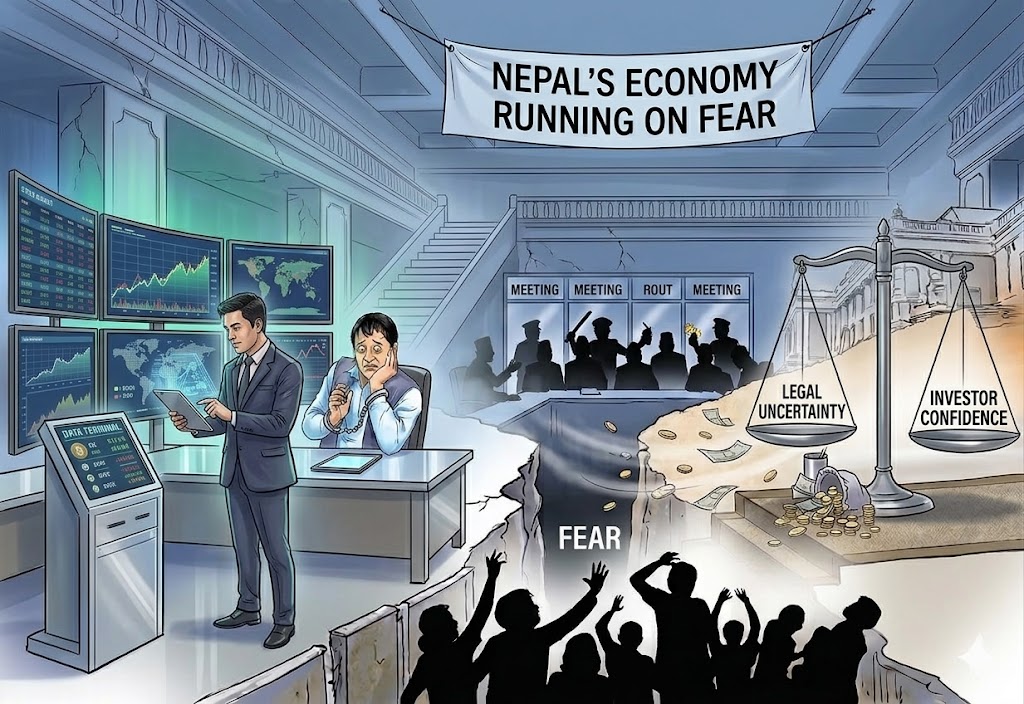
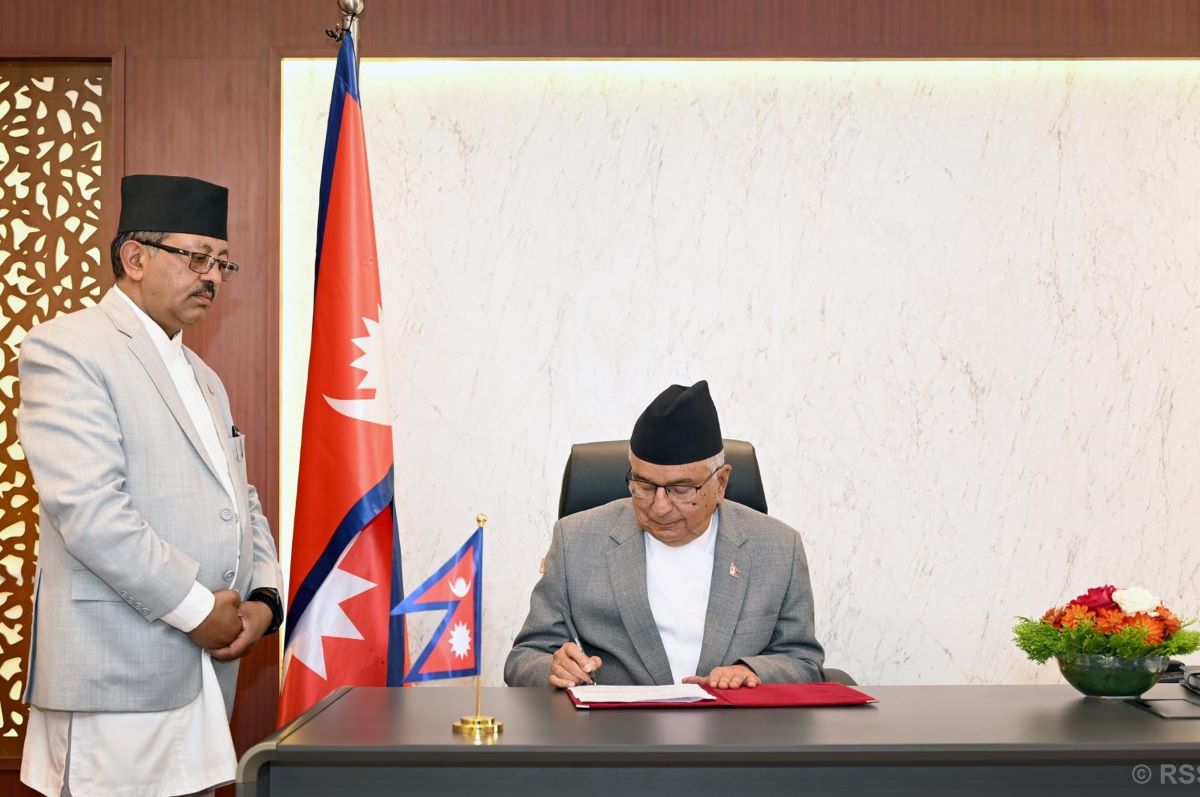
Nepal’s e-passport procurement has exposed an increasingly visible fault line at the heart of government, with the Prime Minister’s Secretariat reportedly pushing for the immediate termination of a contract with two German companies while the Ministry of Foreign Affairs insists the agreement must remain in force until due legal processes are exhausted. The standoff is no longer merely about passport booklets; it has become a contest between political expediency and institutional procedure, raising uncomfortable questions over who ultimately governs Nepal’s international commitments and whether executive pressure can override legal obligations in contracts carrying significant diplomatic and financial consequences.
The deeper concern is that Nepal now appears unable to distinguish between allegations and legal conclusions. Filing corruption charges is not equivalent to proving corruption. In every constitutional democracy, criminal allegations require judicial examination and evidentiary scrutiny before guilt is established. Treating an accusation as a final verdict risks undermining one of the most fundamental principles of justice: due process.
If government institutions refuse to use products solely because criminal proceedings have begun-before courts determine liability-they risk replacing the rule of law with the rule of accusation. Such a precedent would extend well beyond passports, creating uncertainty across every major public procurement project.
Equally troubling are allegations that the Prime Minister’s Secretariat may have verbally pressured officials to cancel the contract by bypassing the responsible ministry. If such intervention occurred, it would represent more than an administrative irregularity. It would raise difficult questions about whether executive influence displaced established procurement procedures and institutional decision-making.
Governments undoubtedly possess both the authority and responsibility to investigate corruption. But investigation and contract termination are not synonymous. International procurement agreements are governed by legal obligations, contractual safeguards and dispute-resolution mechanisms. Cancelling an international contract without completing due legal processes exposes Nepal not only to financial compensation claims but also to international arbitration, reputational damage and long-term procurement uncertainty.
The diplomatic dimension makes the crisis even more consequential. Germany has been one of Nepal’s most enduring development partners, supporting infrastructure, renewable energy, vocational education and governance reforms for decades. When German authorities formally summoned Nepal’s acting ambassador following complaints from the companies involved, the dispute crossed the boundary between domestic law enforcement and international diplomacy.
Although officials describe the diplomatic exchange as constructive, the episode nevertheless sends an uncomfortable signal. Foreign investors are less concerned with whether governments investigate corruption-they expect that. Their greater concern is whether investigations remain predictable, evidence-based and legally consistent. Investors seek confidence that contracts will be governed by institutions rather than political uncertainty.
This distinction matters because national interest cannot be reduced to either fighting corruption or protecting contracts. It requires balancing both. A state committed to good governance must simultaneously investigate wrongdoing, respect judicial independence, preserve contractual obligations and maintain international confidence. Sacrificing one objective for another ultimately weakens them all.
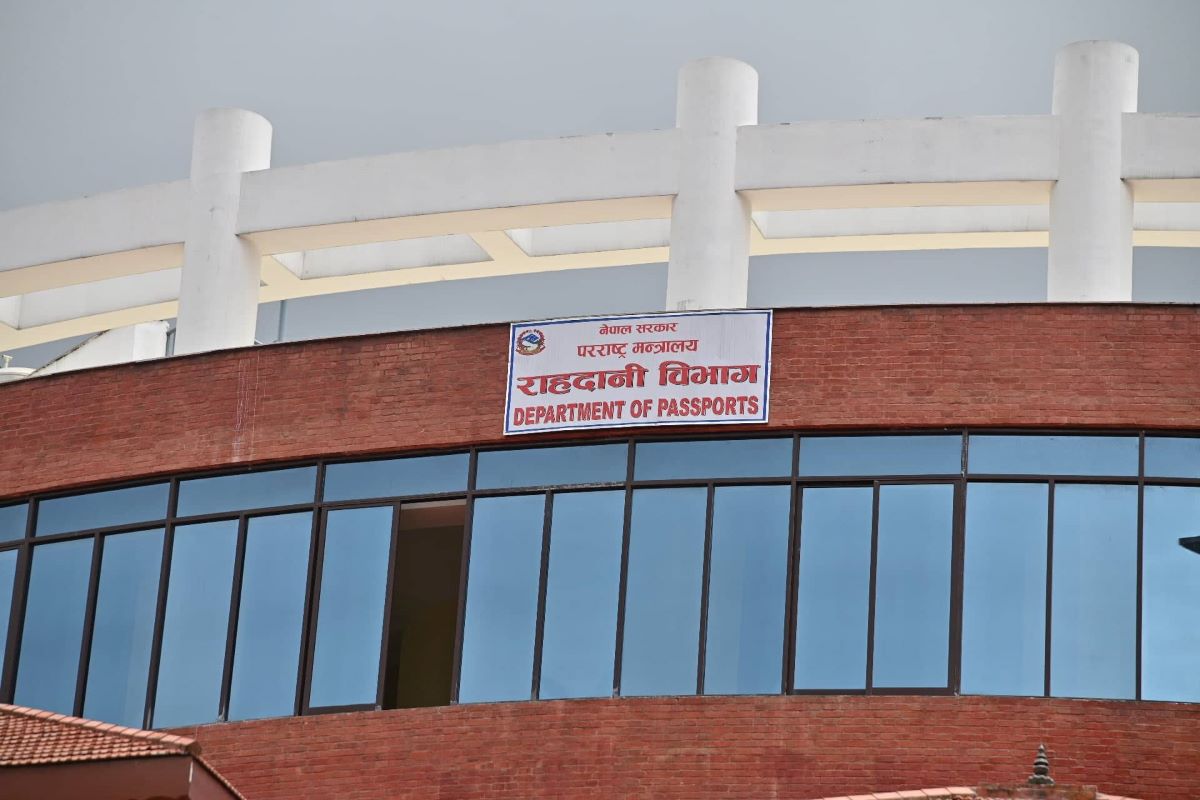
The immediate administrative challenge is equally severe. With the Department of Passports consuming thousands of booklets every day, time itself has become a strategic constraint. Every day spent in legal and political deadlock narrows the government’s remaining options. The incoming leadership at the passport department now inherits not merely an operational shortage but a governance crisis created by overlapping legal, political and diplomatic pressures.
Perhaps the most revealing feature of this episode is that the passport shortage itself is no longer the central story. The real issue is whether Nepal’s institutions can manage allegations of corruption without paralysing the machinery of the state. Democracies are ultimately judged not by whether accusations arise, but by how institutions respond to them.
Strong governments are not defined by the speed with which they cancel contracts or announce anti-corruption actions. They are defined by their ability to uphold evidence, due process, institutional integrity and international commitments simultaneously. Leadership is measured not by instantaneous decisions made under political pressure, but by the discipline to protect the rule of law even when doing so is politically inconvenient.
Until the courts establish the facts through evidence, the passport controversy should remain precisely what it is: a serious allegation under judicial consideration-not a predetermined verdict. Whether Nepal emerges from this crisis with stronger institutions or diminished credibility will depend less on the procurement itself than on whether its leaders choose law over expediency, process over politics, and long-term national interest over short-term administrative reactions.
An investigation rich in allegations, poor in evidence?
The strength of any corruption case is measured not by the number of allegations it contains, but by the quality of the evidence that supports them. The Commission for Investigation of Abuse of Authority (CIAA) indictment against German firms and officials relies on 37 separate grounds to support allegations that contracts were improperly awarded to Mühlbauer and Veridos despite alleged deficiencies in qualification and intent.
A careful reading of the charge sheet of passport case suggests that the prosecution has built an extensive narrative of alleged procurement irregularities. It identifies dozens of legal grounds, cites numerous provisions of procurement law and raises questions over the qualification of bidders, the design of the tender process and the decisions taken by public officials.
Case file reveals numerous legal and methodological inconsistencies that deserve careful scrutiny. Perhaps the most striking issue is the CIAA’s calculation of the alleged loss. Rather than treating the amount actually paid by the government as the basis for determining financial damage, investigators appear to have equated the entire contract value with the amount allegedly lost through corruption. This approach departs from a long line of judicial precedents, which generally hold that corruption-related financial loss should correspond to the actual damage suffered by the state treasury, not the nominal value of a contract. By adopting the full contract price as the alleged loss, the prosecution appears to have substantially magnified both the monetary scale and the perceived gravity of the case.
The agency has collectively sought restitution of approximately Rs10.13 billion from all defendants. Yet the indictment itself indicates that only around Rs184.4 million had actually been paid to the contractors, and that this is the amount recoverable and subject to equivalent financial penalties. The charge sheet provides no convincing explanation for this discrepancy. If accurate, such a methodology risks conflating contractual value with fiscal loss-two concepts that are neither legally nor economically identical.
Yet legal allegations are not themselves proof
Much of the indictment appears to rely on inferences drawn from procurement documents rather than on direct evidence demonstrating criminal intent, collusion, illicit financial benefit or conspiracy. The distinction is crucial. Procurement disputes often involve differences in interpretation, flawed administrative judgment or policy failures. Criminal convictions, however, require evidence proving beyond reasonable doubt that public officials knowingly abused their authority for unlawful gain.
That evidentiary burden is particularly important because corruption cases carry consequences far beyond financial penalties. They destroy reputations, shape public opinion and influence international commercial confidence. Such cases therefore demand investigations that are both exhaustive and demonstrably impartial.
The chronology of the investigation also raises legitimate questions. According to available accounts, the original complaint remained largely inactive for nearly a year before investigators moved rapidly in the days after pressure from the prime minister office preceding the filing of the case. Such an abrupt acceleration inevitably invites scrutiny over whether investigative urgency arose from newly discovered evidence or from external political developments. Only the investigating agency can fully answer that question.
Equally notable is what appears to be missing. The charge sheet presents extensive allegations but comparatively limited publicly available evidence demonstrating bribery, illicit payments, personal enrichment or coordinated criminal conspiracy. Whether such evidence exists will ultimately emerge during trial. Until then, many of the prosecution’s most serious assertions remain allegations rather than established facts.
This distinction is fundamental to the rule of law
Anti-corruption agencies strengthen democracy when they prosecute corruption supported by compelling evidence. They weaken public confidence when sweeping accusations appear to outrun the investigative record. The objective of a criminal investigation is not simply to produce an indictment; it is to produce evidence capable of surviving judicial scrutiny.
Another central allegation concerns the government’s failure to utilise existing passport-printing infrastructure at the Department of Passports. Prosecutors argue that authorities should have valued existing equipment and procured only the additional goods and services required, rather than initiating an entirely new procurement process. Critics, however, contend that this interpretation oversimplifies the commercial structure of the bidding process, arguing that bidders submitted proposals based on the government’s procurement specifications rather than independently determining the scope of procurement. Whether the procurement design itself was flawed remains a separate policy question from whether criminal intent can be established.
Ultimately, the passport case extends beyond a dispute over procurement procedures. It raises broader questions about how anti-corruption investigations are initiated, how financial loss is calculated, and whether criminal prosecutions are insulated from political influence.
If institutions responsible for investigating corruption are themselves shaped by political patronage or partisan appointments, corruption ceases to be merely the misconduct of individuals. It risks becoming an institutional characteristic of the system itself-where legal processes are vulnerable to political incentives, public confidence erodes, and accountability becomes increasingly difficult to distinguish from power politics.
If Special Court ultimately conclude that the investigation relied more heavily on assumptions than proof, the damage will extend well beyond this procurement dispute. It will undermine confidence not only in one prosecution but also in Nepal’s broader anti-corruption architecture.
The fight against corruption requires fearless investigators. But it also requires disciplined investigators. A weak case against the wrong people can be almost as damaging as no case against the guilty.
When a passport becomes a test of the state
What should have been an ordinary transition from one passport supplier to another has instead exposed the fragility of Nepal’s administrative state.
For more than a decade, Nepal relied on the French company IDEMIA to print its passports under a new contract signed in 2020. That procurement itself attracted controversy, yet the state continued to implement the agreement without the dispute escalating into a constitutional or diplomatic confrontation. Today’s crisis is fundamentally different. The debate is no longer over procurement preferences but over whether political intervention, criminal investigation and contractual obligations can coexist within the rule of law.
The June 15 meeting inside the Prime Minister’s Office illustrates this tension. Summoning both the Chief Commissioner of the anti-corruption commission and the Foreign Secretary to discuss a procurement already under investigation inevitably raises questions about institutional boundaries. Even if the discussion merely sought updates, the optics are difficult to ignore. Independent investigators must not only remain free from political influence-they must also be seen to remain free from it. Public confidence depends as much on institutional independence as on the investigations themselves.
The allegations surrounding technical evaluation deserve careful judicial scrutiny. If procurement rules were manipulated or contracts awarded improperly, accountability is essential. Yet allegations alone cannot determine the legal status of an international contract that has already entered implementation. Courts establish guilt; procurement disputes require evidence; contracts remain binding until lawfully suspended or terminated.
That distinction has become increasingly significant because the German project has largely moved beyond procurement. Hundreds of thousands of passport booklets have already been delivered. Software systems have reportedly passed acceptance testing. Infrastructure has been installed. Engineers are preparing final deployment. In commercial terms, the project is approaching completion rather than negotiation.
This dramatically alters Nepal’s legal exposure. Terminating an agreement after substantial performance differs fundamentally from cancelling an unexecuted tender. International procurement law generally protects contractors that have already fulfilled significant contractual obligations. Should Nepal attempt unilateral termination without clear contractual grounds, international arbitration becomes not merely a possibility but a foreseeable consequence. Compensation claims could extend well beyond the value of undelivered goods to include implementation costs, damages and contractual liabilities.
The diplomatic implications are equally consequential. Veridos is not simply another foreign vendor. Through its ownership structure under Germany’s state-owned Bundesdruckerei Group, the dispute inevitably attracts governmental attention in Berlin. Once the German Foreign Office formally sought clarification from Nepal, the issue ceased being a domestic procurement disagreement and became a matter affecting bilateral confidence.
Foreign investors rarely expect governments to ignore corruption allegations. They expect something more valuable: predictable institutions. Investors can accommodate investigations, audits and even prosecutions, provided they occur within transparent legal frameworks. What unsettles investment is uncertainty over whether contracts may become vulnerable to shifting political priorities after implementation has already begun.
The passport controversy therefore risks establishing a precedent extending far beyond identity documents. Nepal is seeking greater foreign participation in digital infrastructure, aviation, energy, telecommunications and public technology. Every future investor will study how this dispute concludes. They will ask whether sovereign contracts remain protected by law or become contingent upon political circumstances that emerge long after signatures are exchanged.
The irony is striking. A government elected on promises of strengthening governance now faces one of its most demanding governance tests. Fighting corruption and respecting contractual obligations are not competing objectives. Mature democracies pursue both simultaneously. Investigations must proceed independently. Evidence must determine criminal liability. Contracts must be managed according to law rather than political pressure. Institutions exist precisely to balance these competing responsibilities.
Ultimately, this controversy is no longer about passports. It is about whether Nepal’s institutions possess sufficient resilience to investigate corruption without undermining legal certainty, diplomatic trust and commercial credibility. States build reputations slowly but lose them quickly. The decision made in the coming weeks will resonate far beyond the Department of Passports. It will shape how Nepal is perceived by foreign governments, international investors and its own citizens for years to come.
The true measure of good governance is not how aggressively a government announces anti-corruption campaigns. It is whether it can uphold justice, due process, contractual integrity and institutional independence at the same time. That, more than any passport contract, is what is now on trial.