Kathmandu
Friday, July 17, 2026





The new Land Bank framework offers a practical way to match unused farmland with willing farmers, curb fallow land, and create rural jobs. But its success will depend on whether local governments can turn an ambitious policy into effective implementation.
KATHMANDU: If you own land but do not farm it, and wish for that land to be utilized, you no longer need to worry. Landowners who possess land but do not or cannot farm it can now register their land in the Land Bank of their local units (municipality) and lease it to others for utilization. Depositing land into the Land Bank generates rental income while ensuring the sustainable use of the land. The responsibility of supervising and managing the land also remains with the Land Bank Board of Directors at the local level.
On the other hand, if you do not own land, or if you only have a small plot that is insufficient to sustain your livelihood, but you possess the skill and enthusiasm for farming, you also do not need to worry. You can now apply to the local level’s Land Bank to lease land for utilization. A legal framework is now in place allowing people to lease and farm lands deposited (registered) by landowners who do not cultivate or utilize the plots themselves.
The Government of Nepal has issued the Land Bank Establishment and Operation Procedures, 2026. The Ministry of Land Management, Cooperatives, Federal Affairs, and General Administration issued and implemented these procedures on June 29. Following this, the Ministry issued a circular to all local levels on July 14, to establish and operate the Land Banks. Local levels will now operate Land Banks in their respective municipalities according to the provisions of these procedures.
Basis for agricultural employment
In the past, many landowners who could not or did not have the time to farm chose to leave their land barren rather than letting others cultivate it—a practice that remains common today. With the government introducing the concept and practice of Land Banks at the local level, landowners can now deposit their land just like depositing money in a bank. Furthermore, just as bank deposits earn interest, landowners will receive rent paid by those who utilize the registered land.
According to the procedures, one of the primary objectives of operating the Land Bank is to take initiative in implementing land-use classification regulations. Another objective is to support maximum land utilization and increase productivity. Currently, agricultural land is increasingly being left barren on one hand, while non-agricultural conversion of land is rising on the other. This has left the country dependent on imports from abroad for daily consumable goods. Though we call ourselves an agricultural country, agricultural production is declining, and people are increasingly abandoning the farming profession.
Although there are various reasons why people abandon farming, the core reason is rising investment costs and shrinking returns. Land fragmentation and traditional farming practices are also responsible. To gradually mitigate these issues, increase agricultural production, boost income through commercial agriculture, and create self-employment, the practice of Land Banks can be highly effective. It can also help facilitate commercialized farming, land pooling (plots consolidation), and agricultural diversification. However, for this to happen, the role of local levels must be highly effective.
The concept and implementation of the Land Bank also eliminates the landowner’s fear that letting others cultivate their land might lead to them demanding half of the property after a certain period. Through this system, leasing land remains completely secure. Local governments can designate special agricultural pocket areas in their municipalities, offering targeted subsidies and programs to initiate self-reliance in production, increase income, and create agricultural employment locally.
On the other side of the spectrum, the Land Bank Establishment and Operation Procedures provide a foundation to connect landless people, squatters, and small farmers in local communities with production tasks by offering them special relief. Section 27 of the procedures states that municipalities can run promotional programs, which says, “The local level may run promotional programs to inform or encourage individuals wishing to utilize or lease land through the Land Bank, particularly targeting groups placed on the prioritization list.” This will especially benefit economically vulnerable landless people, squatters, Dalits, marginalized groups, and small farmers within local areas.
Section 17 (1) of the procedures states, “If targeted groups express interest in utilizing the land, they must be prioritized.” The targeted groups are prioritized in the following order: landless people and squatters, Dalits possessing less than 1693.15 square meters of land, freed Kamaiya (bonded laborers) or freed Haliya families, families of martyrs, families holding state-issued identity cards for welfare benefits, and small farmers.
Recently, wild animals like monkeys and wild boars have been causing severe crop damage, leaving rural farmers deeply frustrated. Knowing they cannot recover their investment and that their crops are unsafe, many have stopped cultivating traditional crops altogether. High agricultural costs coupled with animal-inflicted damage have led people to abandon small-scale farming and migrate. This has heightened import pressures on daily staples like rice. Addressing this situation requires crop diversification and attracting youth to individual and collective farming through agricultural subsidies in coordination with various tiers of government.
While the Land Bank model represents a massive opportunity for everyone, it also offers a strong foundation for boosting production through cooperative farming, land pooling, and agricultural pocket programs, creating local agricultural employment opportunities for the younger generation through active municipal involvement.
How will It be implemented?
According to the procedures, every local level must establish a Land Bank within its municipality. This task will be spearheaded by the municipality’s Land Branch. Through the Land Bank operated by the Land Branch, landowners can register and hand over their land for utilization, while those wishing to farm or run commercial agricultural businesses can apply and sign a contract to lease the land. However, anyone wishing to acquire land for utilization must deposit an advance security deposit equivalent to 10% of the annual yield.
Once landowners register their land in the Land Bank for a specified period, they cannot sell that land during that period. This is because the municipality blocks the land transaction by writing a formal letter to the Land Administration Office (Land Revenue/Land Reform). Similarly, the lessee takes the land under a binding contract with a planned investment. Therefore, both parties must remain legally bound by specific conditions and timelines.
In exchange for taking custody of the land and leasing it out, the Land Bank is authorized to charge a service fee not exceeding 10% of the yield specified in the agreement.
The local level will deduct this service fee from the return due to the landowner and deposit the remaining amount directly into the landowner’s bank account, as detailed in the contract. The lessee must submit 10% of the annual contractual amount as a security deposit at the time of signing, with the remainder payable within the dates specified in the contract.
The procedures also state that local levels can provide regular programmatic support to those leasing land from the Land Bank—including seeds, fertilizers, technical assistance, and cash subsidies aimed at increasing production. When distributing subsidies, the mandatory priority order must be (a) those cultivating cereal, vegetable, or cash crops; (b) those engaged in animal husbandry, including fishery and poultry; (c) those doing fruit farming; (d) those purchasing and processing local produce; and (e) those running other related businesses, respectively. This framework will provide ease and motivation to those cultivating land through the Land Bank.
Land use law
Under the Land Use Act issued in 2019, all local levels have prepared and implemented land-use plans, while some are still in the process. The Land Use Act mandates that local levels hold the responsibility of classifying and managing land within their geography. However, because local levels still lack the necessary human resources and administrative coordination to perform the tasks of the Land Administration Office (Land Revenue/Land Reform) and the Survey Office, there have been delays in implementing the Land Use Act effectively.
Section 21 of the Land Use Act, 2019 contains the provision for the “Land Bank”. Section 21 (1) states, “To implement land-use classification regulations and increase productivity by maximizing land utilization, the Government of Nepal may establish Land Banks at local levels as necessary.” It is under this exact provision that the Land Bank Establishment and Operation Procedures, 2026 have been issued this year.
Furthermore, Section 24 (b) of the Land Use Act states, “Except in cases where uncontrollable circumstances arise and land must be left fallow, accompanied by a formal notification with sufficient reasons submitted to the respective local level, leaving land classified under the agricultural zone barren for three consecutive years shall attract a fine of up to Rs 100,000, determined on the basis of estimated production.”
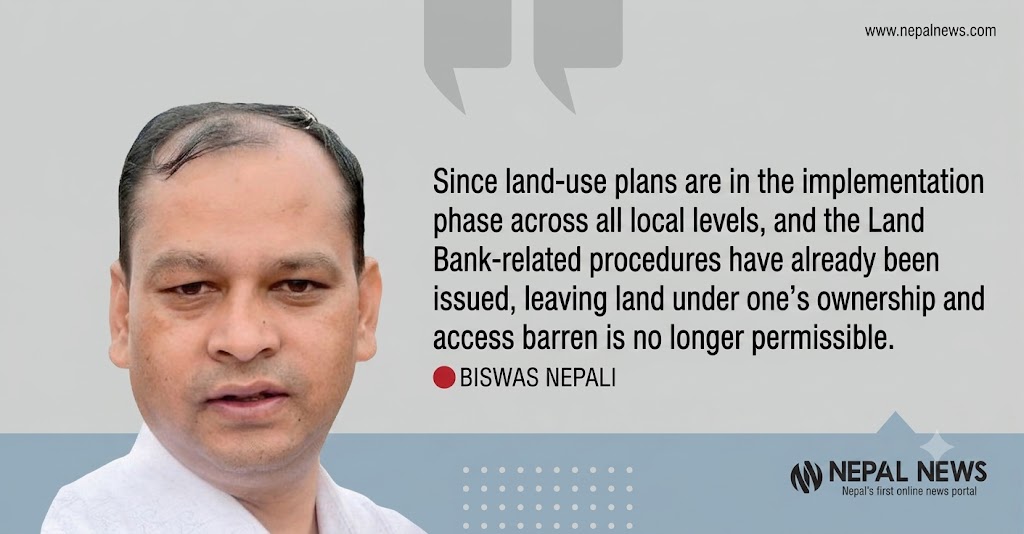
Now, no one can leave land under their ownership and access barren. Because land-use plans are in the implementation phase across all local levels, and the Land Bank Establishment and Operation Procedures, 2026 have been enacted, leaving land barren could make owners liable to fines and penalties. Leaving land barren directly reduces agricultural output, impacting food security and causing economic imbalances.
Land is a fundamental means of production. Yet, while some in the country own vast land resources, others do not own a single piece of land. Small farmers toil year-round on the field but still fail to produce enough food to feed their families for the year due to a lack of sufficient ownership and access to land. Landless people and squatters remain mere agricultural laborers, struggling daily for survival.
The Land Bank concept represents a crucial opportunity for youth and farmers who are detached from employment opportunities but possess farming skills, passion, and the desire to join commercial agriculture. Government support and active facilitation are equally vital here. Implementing this practice will highly motivate farmers.
Linking motivational measures like agricultural subsidies with the Land Bank will guarantee the sustainable use of land and boost overall production. It will directly and indirectly generate employment, helping the country take a step closer to self-reliance in agriculture.