Kathmandu
Tuesday, July 21, 2026





A draft bill would replace two six-decade-old laws, expand Nepal Rastra Bank's powers over foreign exchange, and introduce clearer rules on cryptocurrency, informal remittnce system, offshore investment and cross-border currency transactions

KATHMANDU: The Ministry of Finance issued a notice on July 13 inviting public comments on a draft bill titled the Foreign Exchange (Regulation and Management) Bill. It would repeal the Foreign Exchange (Regulation) Act of 1962 and the Act Restricting Investment Abroad of 1964, both still technically active despite being outdated.
The push follows a 2016 cabinet-endorsed financial sector strategy, recent budget commitments and Nepal Rastra Bank’s own strategic plan, all of which called for updated forex legislation.
What exactly is this bill and why is the government introducing it now?
The bill is formally called the Foreign Exchange (Regulation and Management) Bill, and once passed it would be known as the Foreign Exchange (Regulation and Management) Act, 2026. It is meant to replace two laws from the 1960s that the Finance Ministry says have stayed nearly unchanged for decades despite major shifts in Nepal’s economy, banking systems and financial technology.
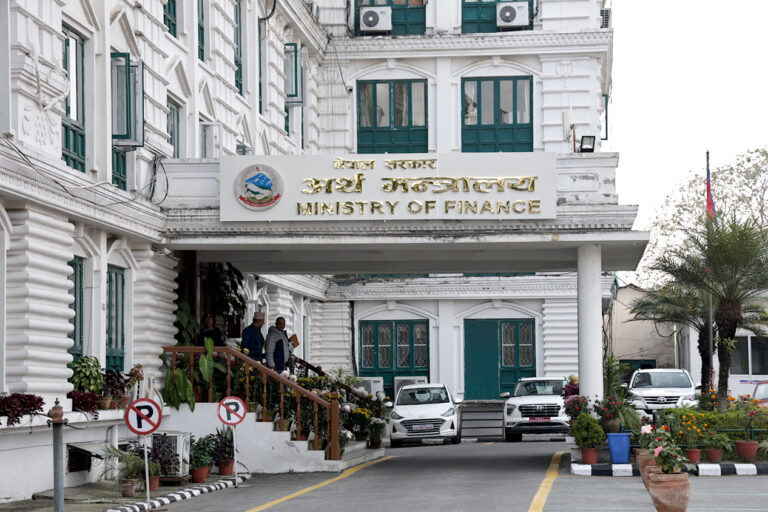
The Ministry of Finance inside Singha Durbar. Photo: Bikram Rai/Nepal News.
Officials argue the old framework does not adequately address modern issues such as digital payments, cryptocurrency, offshore investment structures or the scale of foreign exchange transactions handled by banks and licensed dealers today. The new law is meant to consolidate and modernize definitions, expand Nepal Rastra Bank’s supervisory reach, and tighten rules against misuse of foreign currency, while also making licensing procedures simpler for legitimate forex businesses.
The ministry published the draft for a fifteen-day public comment period, inviting feedback by email or through its website before finalizing the text for parliamentary submission.
Which existing laws would this bill repeal and why were they seen as outdated?
The bill would repeal the Foreign Exchange (Regulation) Act of 1962 and the Act Restricting Investment Abroad of 1964. Both laws have remained largely unchanged since they were first enacted more than six decades ago, even as Nepal’s foreign exchange regime, banking sector and international financial linkages have evolved considerably.
The government notes that these two laws were designed for a very different economic era, before liberalization, digital banking, cryptocurrency and today’s volume of foreign investment and remittance flows. Rather than making incremental amendments to two separate and aging statutes, the drafters chose to merge and rewrite the substance of both laws into a single, updated act.
This consolidation is meant to remove overlaps, modernize terminology such as “currency,” “foreign currency” and “foreign exchange misuse,” and give Nepal Rastra Bank clearer, broader legal tools to manage a foreign exchange system that looks very different from the one that existed when the original laws were written.
What triggered this specific reform effort?
According to the ministry’s explanatory note, three separate policy documents pushed for this change.
First, a financial sector development strategy covering fiscal years 2016/17 to 2020/21, approved by the Council of Ministers around January 2017, included a specific action item calling for a new law on foreign exchange management.
Second, the government’s budget for fiscal year 2024/25 contained a commitment to align financial sector laws with international standards, specifically naming the Nepal Rastra Bank Act and the foreign exchange regulation law as due for amendment.
Third, Nepal Rastra Bank’s own Strategic Plan for 2022 to 2026 lists strengthening legal infrastructure as an objective, with a specific strategy calling for review and timely amendment of the 1962 foreign exchange law.
Together, these three sources gave the Finance Ministry the mandate and timeline to draft this consolidated bill rather than pursue piecemeal amendments to the older acts.
Who will have authority over foreign exchange matters under the new law?
Nepal Rastra Bank remains the central authority, and the bill in fact expands its powers. Under the draft, the bank retains the power to formulate and implement foreign exchange policy, fix buying and selling rates, and issue licenses to persons, firms, companies or organizations wishing to conduct forex transactions.

Building of Nepal Rastra Bank in Baluwatar, Kathmandu/File photo
Beyond this, the bank would gain express authority to issue binding directives, procedures, guidelines, circulars, and orders, including through electronic means, and to fine licensees for violating them. It would also retain power to inspect, supervise and monitor licensed dealers, and to suspend or revoke licenses for repeated violations related to currency misuse.
The bill additionally preserves the government’s own emergency power, exercised through public notice in the Nepal Gazette, to require citizens or firms holding foreign exchange to sell it to the government during an external sector crisis, though it can grant exemptions for specific sectors or purposes.
What does the bill say about licensing requirements for foreign exchange businesses?
Anyone wishing to conduct foreign exchange transactions, including buying or selling foreign currency, lending or borrowing in foreign exchange, or dealing in related instruments, must obtain a license from Nepal Rastra Bank. Applicants must submit a prescribed application along with required documents and fees, after which the bank examines the application, may request additional information, and decides whether to grant a license.
Before issuing it, the bank can require payment of an annual fee, deposit or bank guarantee. Once granted, the license can specify the type, limit, duration, location and conditions of the permitted forex business, and the bank may also issue one-time or occasional licenses for specific transactions.
The stated intent is to simplify and standardize what has reportedly been an inconsistent licensing process, while still allowing the bank flexibility to deny or restrict permissions where it identifies risks tied to money laundering or fitness of the applicant.
How does the bill address cryptocurrency and other digital or virtual currencies?
The draft explicitly bars anyone from using electronic or virtual currency that has not been recognized as legal tender or as a valid foreign exchange instrument by Nepal Rastra Bank, whether for financial transactions or foreign exchange dealings, and whether the involvement is direct or indirect.
The bill defines virtual currency broadly to include any electronically created or produced value representation used in commercial activity, covering tokens, cryptocurrency, and similar instruments that can carry or store value. This provision effectively continues and formalizes Nepal’s existing stance against unauthorized cryptocurrency trading, since the central bank has not recognized any such instrument as legal currency.

Most popular cryptocurrencies around the world
Anyone found dealing in unrecognized digital or virtual currency for financial or forex purposes would be considered to have committed an offense under the Act, exposing them to fines and, depending on the amount involved, possible imprisonment under the bill’s tiered penalty structure described elsewhere in the law.
What changes are proposed regarding hundi, the informal money transfer system?
The bill maintains and reinforces a blanket prohibition on hundi (informal money transfer) transactions, meaning no one is allowed to conduct or facilitate hundi dealings. The draft defines hundi broadly as any transfer, settlement or payment of money or value between Nepal and a foreign country carried out through channels other than recognized institutions or authorized payment instruments under prevailing law.
This definition is designed to capture informal, undocumented transfer networks that bypass banks and licensed money transfer operators, regardless of the specific method or intermediary used.
By listing hundi trading explicitly among the practices considered foreign exchange misuse, alongside smuggling of currency, gold or silver and dealing in unrecognized digital currency, the bill signals an intent to widen enforcement against informal remittance and currency movement channels that current authorities view as facilitating capital flight, tax evasion or money laundering.
What would change for Nepali investors sending money abroad or bringing investment returns home?
The bill sets out detailed conditions for outward investment. Only certain categories of Nepali-based companies or institutions are permitted to invest abroad, including those specifically exempted through a Nepal Gazette notice, those receiving foreign currency as payment for technology transfer with the central bank’s permission, and industries classified as information technology businesses under prevailing industrial law.
Nepali citizens working abroad as experts, consultants or employees can also receive foreign company shares in lieu of cash payment.
Investors must follow conditions, sector-specific investment ceilings and other requirements set by Nepal Rastra Bank. On repatriation, the bill lists categories of returns that investors can legally bring back to Nepal in foreign currency, including proceeds from selling securities, dividends, profits, liquidation proceeds, technology transfer fees, lease rent, legal settlement amounts, and loan repayments with interest, all subject to procedures the central bank determines.
What penalties does the bill propose for violations?
The bill creates a tiered fine and imprisonment structure based on the monetary amount involved in an offense. For amounts up to Rs 100,000, the penalty is recovery of that amount plus a fine of up to Rs 10,000. For amounts between Rs 100,000 and 500,000, the fine equals the amount involved.
Between Rs 500,000 and 10 million, the fine doubles the amount involved. Beyond Rs 10 million, the bill adds prison terms on top of doubled fines, rising in three bands: up to one month for amounts between Rs 10 million and 50 million, up to two years between Rs 50 million and 100 million and up to three years for anything above Rs 100 million.
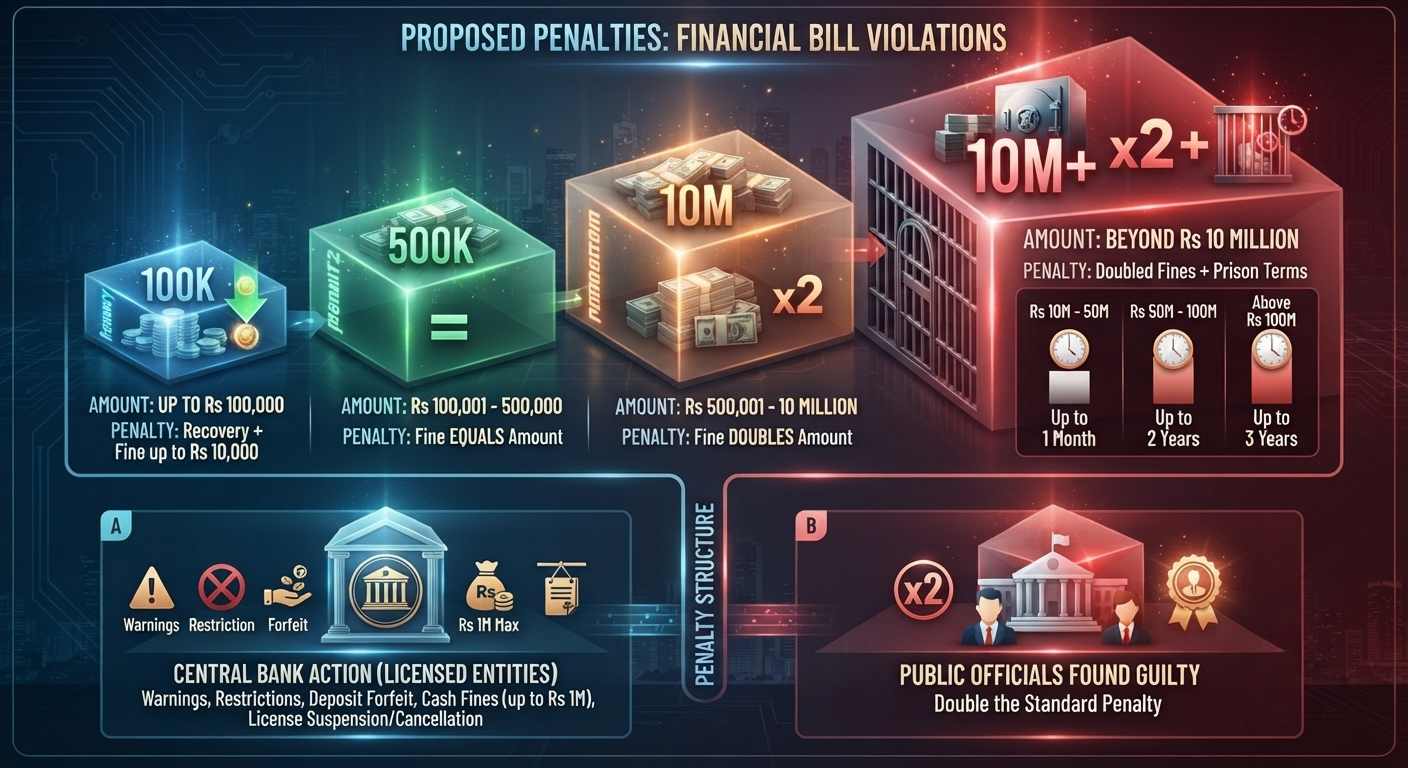
Separately, the central bank can take administrative action against licensed entities, including warnings, transaction restrictions, forfeiting deposits, cash fines up to Rs 1 million, or license suspension or cancellation. Public officials found guilty face double the standard penalty.
What happens procedurally when someone is investigated or wants to appeal?
The bill assigns investigation of offenses to an investigating officer appointed through a Nepal Gazette notice, who can seek cooperation from the central bank or other government bodies. This officer has powers to search premises, vehicles or individuals when there is reasonable suspicion of illegal foreign exchange holdings, and can seize suspected foreign exchange, currency instruments or related documents as evidence, following documented procedures involving witnesses.
Arrested individuals must be presented before the case-hearing authority, which under this bill is the concerned district court, within twenty-four hours excluding travel time, and can be held in custody for investigation for up to thirty-five days. After investigation, the officer must seek the government attorney’s opinion on whether to proceed, and the government of Nepal acts as the plaintiff in such cases.
Anyone unhappy with the district court’s final decision can appeal to the concerned High Court within thirty days of receiving notice of that decision.
Who exactly does this law apply to and does it reach beyond Nepal’s borders?
The bill states that it applies to any person, firm, company or institution located within Nepal, as well as Nepali citizens residing abroad. It also extends to firms, companies or institutions that are registered in Nepal but operate outside the country, including their branch offices, liaison offices or agencies abroad.
This wide scope means Nepali entities cannot simply relocate operations overseas to escape the law’s reach, since any organization with Nepali registration remains bound by these foreign exchange rules regardless of where it conducts business. The provision reflects a broader pattern in the bill of closing gaps that authorities believe existed under the older 1962 and 1964 laws, where enforcement against citizens or firms operating partly outside Nepal was reportedly harder to pursue.
Once enacted, the law would take effect thirty-one days after its authentication, giving institutions a short transition window before its provisions become legally binding.
What restrictions does the bill place on physically carrying currency, gold or silver in and out of Nepal?
Nepal Rastra Bank retains authority to issue public notices restricting or fully banning the movement of Nepali or foreign currency into Nepal, between locations within the country, or out of Nepal, whenever it deems necessary. A parallel provision allows the same restrictions specifically for gold and silver, whether refined or unrefined, in coin, bullion or ornament form.
Beyond these discretionary restrictions, the bill sets a general rule that no one except licensed banks or financial institutions may carry currency, gold, silver or foreign exchange exceeding limits set by the central bank between locations inside Nepal, out of the country, or into Nepal from abroad, without the bank’s prior approval.
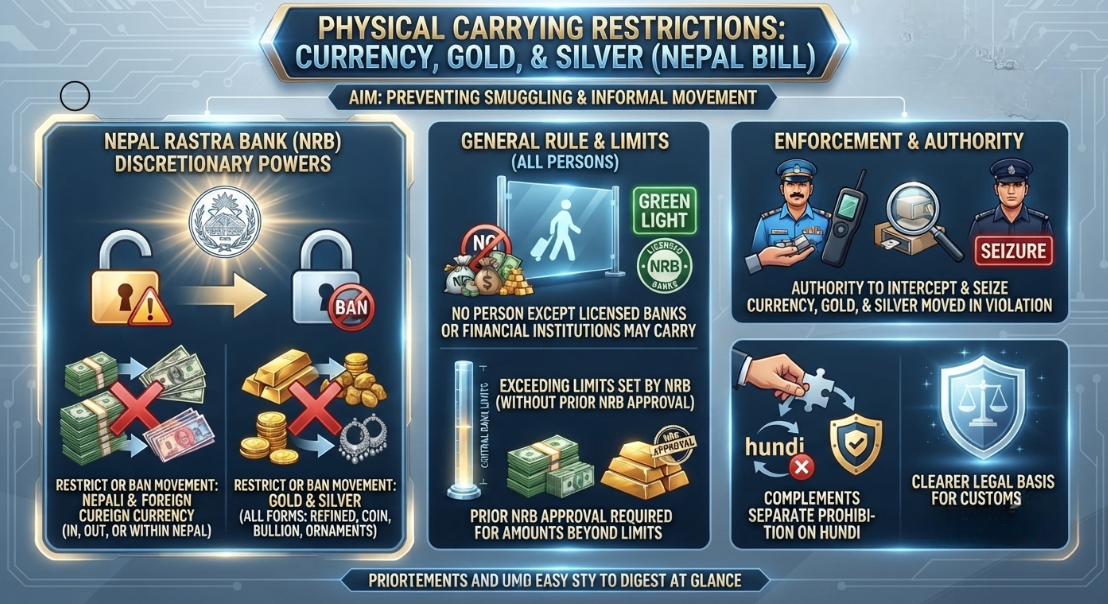
This provision is aimed squarely at physical smuggling and informal cross-border currency movement, complementing the bill’s separate prohibition on hundi transactions, and gives customs and enforcement authorities a clearer legal basis to intercept and seize currency, gold or silver moved in violation of these limits.
What does the bill require of Nepali citizens or firms wanting to open bank accounts abroad?
Any Nepali citizen residing in Nepal, or any firm, company or institution registered in Nepal, must obtain Nepal Rastra Bank’s approval before opening an account with a foreign bank or financial institution. When granting this approval, the bank can ask for necessary details and impose conditions on how the account may be used.
The bill also addresses a related scenario: if a Nepali citizen earned money while living abroad and deposited it into a foreign account, and later wants to keep that account active after returning to Nepal, they must inform the central bank about the account balance following procedures the bank prescribes.
Separately, any Nepali citizen or Nepal-registered firm wanting to open, operate or use a foreign currency account within Nepal itself must follow arrangements the central bank determines. Together these provisions aim to give the central bank visibility over offshore holdings by Nepali residents rather than leaving such accounts entirely outside its monitoring reach.
What does the bill say about contracts, agreements or hedging arrangements that conflict with the law?
The bill states plainly that no person, firm, company or institution may enter into any kind of contract, deed or agreement relating to foreign exchange that conflicts with the Act or with rules, directives, procedures, circulars or notices issued under it. Any such contract, deed or agreement found to have been made in violation of this rule is automatically void from the outset, meaning it carries no legal force even if both parties initially agreed to its terms.
Separately, the bill acknowledges hedging as a legitimate risk-management tool, stating that foreign exchange hedging transactions aimed at managing exposure to currency risk will be allowed according to procedures the central bank prescribes.
This dual approach, banning contracts that circumvent the law while explicitly permitting regulated hedging, reflects the bill’s broader intent to distinguish between legitimate financial risk management tools used by businesses and informal or unauthorized arrangements designed to bypass currency controls altogether.
What protections exist for officials enforcing this law and what confidentiality duties apply during investigations?
The bill includes a good-faith immunity clause stating that no lawsuit can be filed against any person for actions taken honestly while performing duties under the Act or its associated rules, directives, procedures or notices. This protection does not extend to negligent or malicious conduct, for which the responsible individual remains personally liable and subject to legal action under the Act.
Separately, the bill requires investigating officers, staff assigned to investigations, and bank employees to keep confidential any information, evidence, documents or records that come to their knowledge during the prescribed period, unless the officer hearing the case believes such information is necessary for another legal proceeding, in which case disclosure to an authorized official is permitted.
These provisions are meant to give officials enough legal cover to act decisively against suspected violations while still building in accountability for misconduct and safeguards against unnecessary leaking of sensitive financial information gathered during investigations.
What happens to licenses issued under the old law, and can vehicles used in smuggling be confiscated?
The bill includes transitional provisions ensuring continuity for existing license holders. Licenses granted under the 1962 Foreign Exchange Regulation Act remain valid under the new law until the central bank orders otherwise or until the license’s own expiry date, on the same terms and for the same duration originally granted.
Similarly, any approvals, permissions or exemptions the government previously granted under the 1964 Act restricting overseas investment continue to be treated as valid under the new law, unless the government decides otherwise.
On enforcement, the bill allows confiscation of any private or public vehicle found being used to illegally conceal and transport foreign currency, gold or silver requiring approval for such movement. However, if the vehicle owner did not consent to or know about this misuse, the vehicle cannot be confiscated.
This balances practical enforcement power against currency and gold smuggling with a safeguard protecting innocent vehicle owners whose property was used without their knowledge.