Kathmandu
Tuesday, July 21, 2026





Researchers found that incomplete organizational structures, poor inclusiveness, and broad nomination powers vested in the party chair overshadowed the RSP's inaugural general convention.
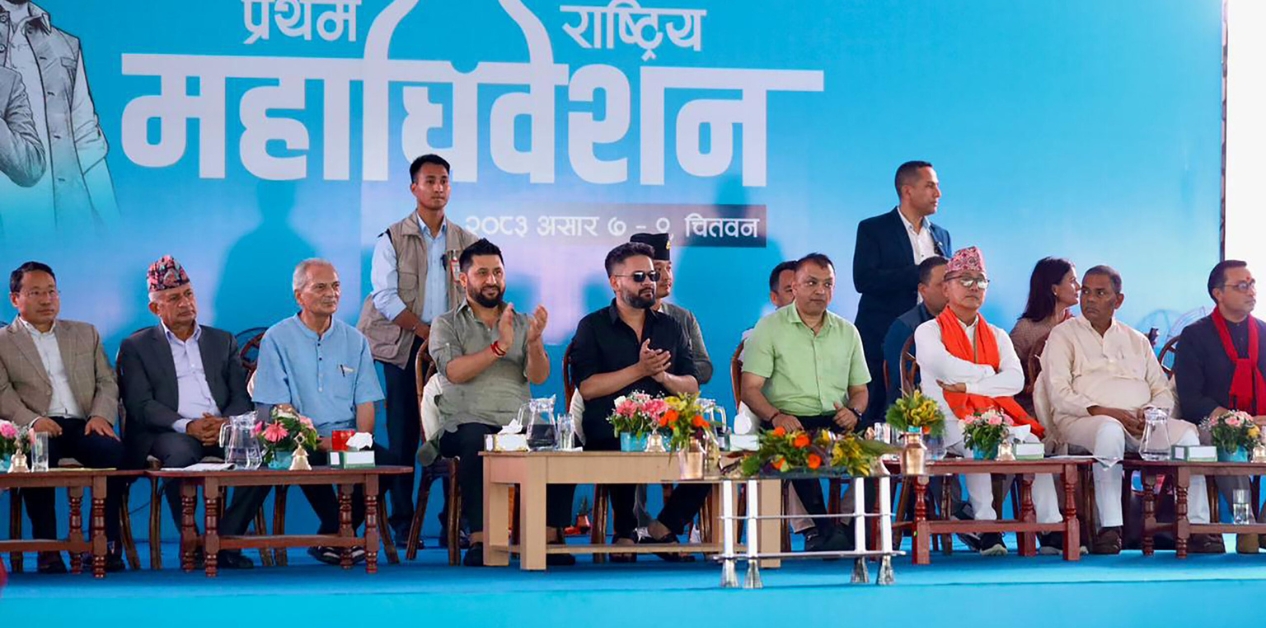
KATHMANDU: Although the first General Convention of the Rastriya Swatantra Party (RSP) in Chitwan was scheduled to begin on June 21 and conclude on June 23, it ended three days later than planned, on June 26.
Alongside party leaders, cadres, and invited guests, various researchers also arrived to observe the convention. Anbika Giri and Kunsang, researchers from the Democracy Resource Center, were among them. They stated that alongside chaotic management, they observed serious issues related to the party’s organization, inclusiveness, and internal democracy at the RSP General Convention.
Although it was stated that 4,019 delegates from across the country participated in the convention, the exact number of delegates was unclear. Even upon asking the party’s General Secretary, the researchers did not receive a definite answer.
Anbika had previously observed the 10th General Convention of the CPN (UML) in Chitwan as well. To her, the RSP convention felt vastly different from the UML convention. According to her, leaders at the UML convention had brought cadres from their respective regions in buses. However, people trailing behind leaders in that manner were not seen at the RSP convention.
Speaking at a discussion program titled “RSP General Convention in Direct Observation,” organized on Tuesday by the Democracy Resource Center and Martin Chautari, Anbika said, “We read in reports that hotels were full. But the markets were open, and extremely organic cadres participated.”
She had anticipated that a large number of people would turn up to hear speeches from Party Chairman Rabi Lamichhane and Senior Leader and Prime Minister Balendra Shah, who had been less visible in public programs relative to the mandate RSP received in the recent election. However, such attendance was not seen at the convention.
“This raised a question in mind whether the votes received in the recent election have been institutionalized or turned into formal party strength,” she said.
Instead, there were crowds blocking the way even in the scorching sun to take selfies with famous faces from social media. In Anbika’s view, this indicates that the party was built by politicizing Rabi Lamichhane’s popularity.
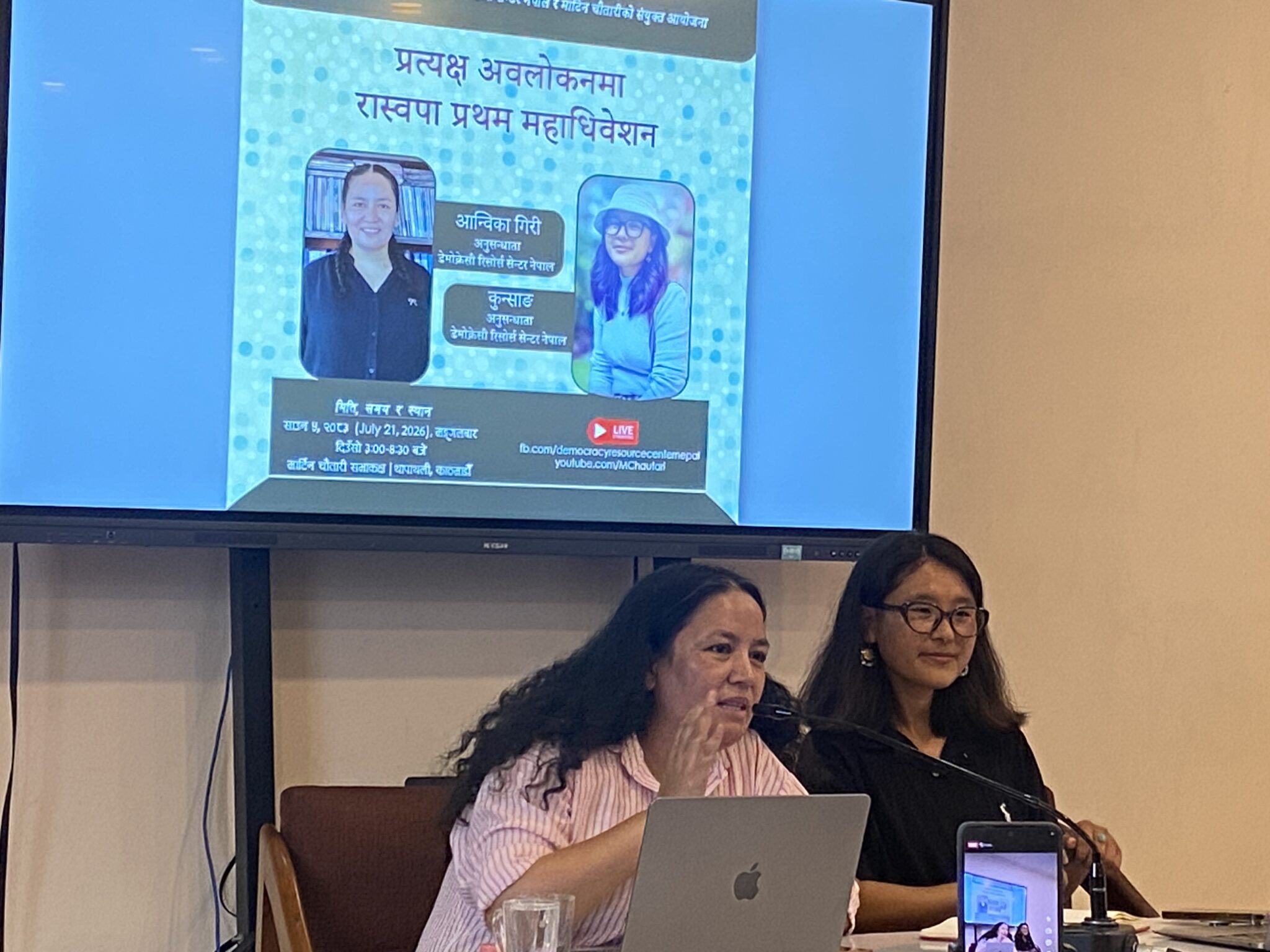
Researchers Anbika Giri and Kunsang speaking at the program. Photo: Gopal Dahal
The issue of the convention being disorganized had made headlines at the time. Neither the inauguration nor the closed sessions occurred on time, nor did the conclusion happen on the scheduled date.
Anbika argues that disputes regarding delegates were the main reason for this. “It was very clearly evident that there was no determination of how many delegates there should be, and there was struggle in integrating various factions,” she said.
Within the RSP, alongside Balendra Shah’s group, there are also individuals who came from Bibeksheel Sajha Party, the Tharuhat movement, as well as the Congress, UML, and Maoist parties. The researchers understand that the question of how to integrate them was what prolonged the convention.
Political parties generally hold their national general conventions after finishing ward, municipality, district, and provincial conventions. However, the RSP had not completed all lower-level conventions.
It had completed conventions in only 64 out of 77 districts and 609 out of 753 municipalities. Only about 65 percent of ward conventions were completed, while the convention for Madhesh Province could not take place at all.
The debate over “one person, one position” was widespread within the RSP. A circular was even issued from the central committee directing lawmakers not to stake claims for provincial or district presidency positions. However, incumbent lawmakers claimed presidency positions in four provinces. All of them were defeated.
Researchers expected debate on this issue during the national general convention. However, no such debate took place.
During informal tea chats, however, they heard plenty of dissatisfaction from delegates. Those grievances failed to become part of the agenda in the closed session.
They recounted that after the Prime Minister posted a picture of buttermilk on social media, sales of buttermilk boomed at the convention venue. Researchers also observed the activities of the RSP’s “Rapid Action Team,” which evoked memories of the UML’s Youth Force and the Maoists’ YCL.
During conversations, members of that team claimed that if the police or other security agencies failed to provide security to party delegates and leaders, they themselves would provide it.
Researcher Kunsang observed the convention’s election process and inclusiveness. The positions of Chairman and Senior Leader were predetermined well before the convention. Many who filed candidacies to contest for office-bearer positions withdrew their candidacies at the last minute.
Although the RSP claimed to have no factions or sub-factions, Kunsang stated that glimpses of them were visible at the convention.
The convention rules stipulate that 99 members, including the Chairman, are elected, while 51 members are nominated by the Chairman. Among those elected, 62.63 percent belong to the Khas-Arya community. Representation of the Dalit, indigenous, and Madhesi communities is weak. “The number of voters at the convention was low. This has raised questions regarding the legitimacy of the convention,” Kunsang said.
Researchers viewed the inclusion of 50 percent women among the elected members positively. However, they concluded that the convention made the Chairman extraordinarily powerful.
Since the Chairman has the authority to nominate everyone from office-bearers to members, they noted he could build a team favorable to himself. Researchers expressed concern over the impact this could have on the party’s internal democracy.
Upon studying the reports passed by the convention, they found that the reports of Chairman Lamichhane and Vice Chairman Swarnim Wagle contradicted each other on certain matters.
A dispute arose after Wagle included the abolition of the provincial structure in his report. Lamichhane, on the other hand, mentioned reforming the provincial structure. “It feels as though differing reports were presented by mutual consultation itself,” Anbika said.
The RSP set registration fees at Rs 51,000 for candidacy for the post of Chairman, Rs 41,000 for office-bearers, and Rs 21,000 for central members. Kunsang argued that such expensive fees create barriers for individuals from communities like women, Dalits, and indigenous to reach leadership positions. Researchers stated they were astonished by the response they received when questioning party leaders about this. “The response received was that people without money should not enter politics; they should focus on feeding themselves,” Anbika said.
Although a general convention is supposed to be a platform to discuss policy and leadership, researchers stated that Balen and Rabi were discussed far more at the RSP convention. They noted that without adequate discussion on reports, matters recited by leaders were passed by applause.
The RSP, which had been describing constitutional socialism as its political ideology, shifted toward social democracy after the general convention. Researchers stated that along with this, the party abandoned many promises made in the past.
Recalling how General Secretaries of the Nepali Congress previously complained that their party President was excessively powerful while they were General Secretaries in name only, Anbika said, “After observing the general convention, it appeared as though the RSP is also walking down the Nepali Congress model.”
Shekhar Chandra Parajuli, Executive Director of the Democracy Resource Center, stated that the center has been observing general conventions of various political parties, and the RSP convention was observed accordingly. “We will prepare a report based on the observation,” he said. “Our campaign is to make political parties democratic and transparent to strengthen democracy.”