Kathmandu
Wednesday, July 22, 2026





BP Koirala's policy of National Reconciliation sought to unite the nation in defense of both democracy and nationalism. As Nepal faces growing geopolitical pressures, debates over sovereignty, and deep political divisions, the ideas behind that policy remain as relevant today as when BP returned from exile in 1976.
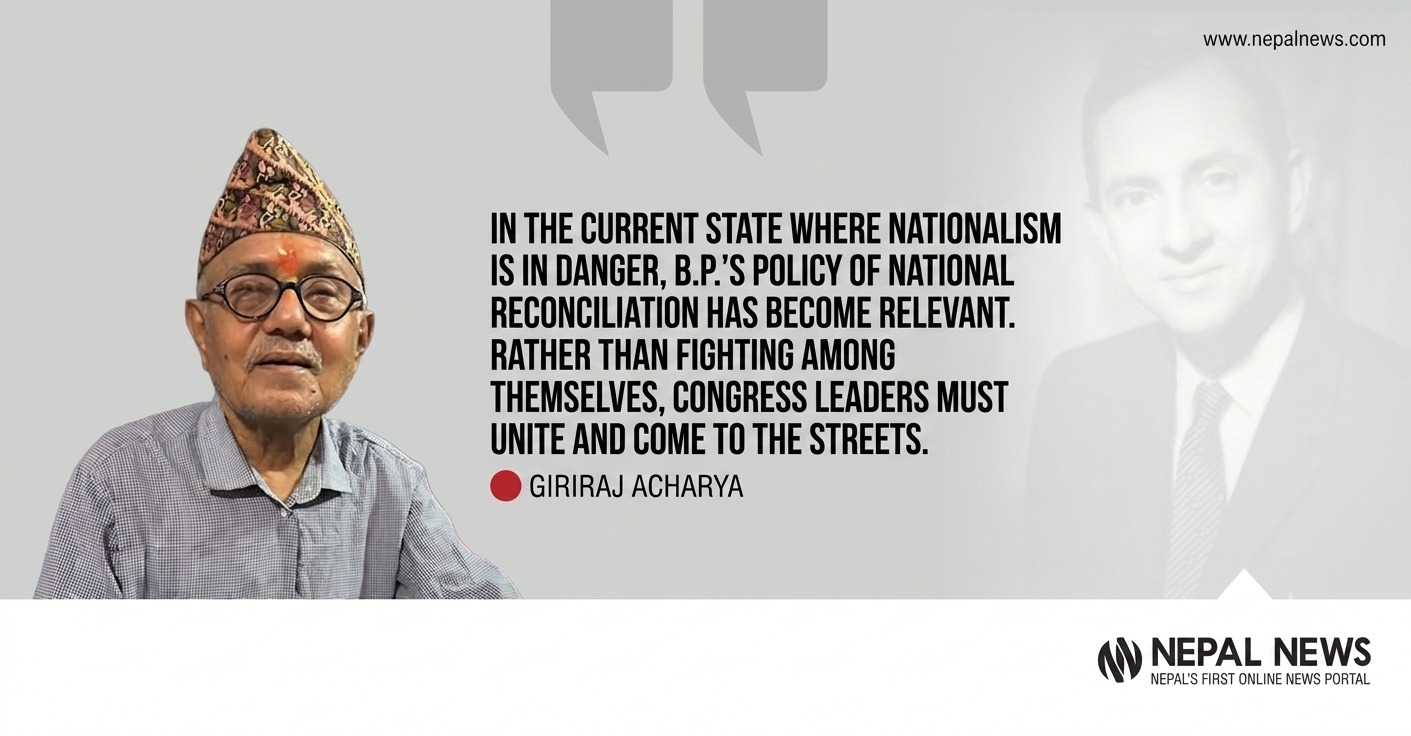
KATHMANDU: When BP Koirala was released from jail in 1968, he was scheduled to come to Biratnagar. To welcome him, two trucks of us students traveled from Dharan to the airport. That was where I met him for the very first time. In Dharan, we had an organization called the Friends Club. Its president, Kedarnath Shrestha, invited BP to Dharan.
Nagendra Prasad Rijal had a house on Ratna Road in Dharan. BP stayed in that house, which was known as Bishnukuti. We went there as a delegation. He addressed us and shared updates on the current situation. Congress leaders and cadres were lined up to meet BP. BP’s mother, Divya Koirala, and Nona Koirala, among others, had also arrived.
BP’s first mass rally after his release from jail took place in Dharan. On February 12, 1969, BP delivered a speech at Public High School in Dharan. BP stated that the day of Sankranti was a symbol of change.
After that, he went to Kathmandu for treatment and later to Delhi. After receiving treatment, when he returned from Mumbai in 1970, grand preparations were made to welcome him at the Jogbani railway station. At that time, too, two full trucks of us went from Dharan. Congress members gathered from all parts of the Eastern Region. BP delivered a speech at Biratnagar’s Hadatali Haat. Afterward, he was seated in an open jeep while we marched, chanting slogans like “Long Live BP, May Democracy Remain Immortal,” until we reached the Biratnagar Shahid Maidan, two to three kilometers away. A grand mass rally was held there. In this way, the frequency of meeting BP kept increasing.
On December 30, 1976, BP ended his eight-year-long exile in India and returned to Nepal carrying the policy of National Reconciliation. Along with him, Ganeshman Singh, Shailaja Acharya, Rambabu Prasai, Nilambar Panthi, and Khum Bahadur Khadka also arrived on the plane. Before his return to Nepal, the Nepali Congress had distributed an appeal to the nation titled “BP’s Call.” The pamphlet stated that nationalism was in danger. That appeal was distributed in Dharan by my friends from the Friends Club and me.
BP, who had returned to Nepal with the policy of reconciliation, was arrested. In 1977, seven cases were filed against him. He was held in custody at Sundarijal. As his condition in prison deteriorated, Dr. Mirendra Raj Pandey informed the Royal Palace, after which the Palace granted permission for him to go abroad for treatment. He then went to the United States. On his way back to Nepal from America, he organized a major conference in Patna, India.
I had also traveled from Dharan with friends to participate in that conference. We welcomed BP in Patna. This was in 1977. At that very conference, BP appointed Krishna Prasad Bhattarai as the acting president. Three days later, BP was set to leave for Kathmandu. We returned to Dharan from Patna and then went to Kathmandu to welcome BP. The Kathmandu airport was crowded. Police guards were everywhere. There were no CCTV cameras back then, but the police recorded videos showing the faces of everyone who went there.
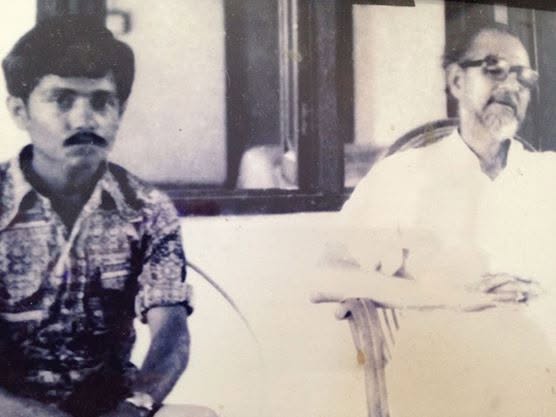
Author Acharya (left) with BP Koirala. Photo courtesy: Acharya
In 1979, a referendum was announced to choose between a multiparty system or an improved Panchayat system. Ten days before that announcement, Indra Bahadur Thapa, myself, and others were arrested from Chhata Chowk in Dharan on charges of inciting the student movement, and we were kept in Biratnagar jail. We were released the day before the referendum was announced.
At that time, everyone speculated that BP had convinced the King to announce the referendum. Once the referendum was announced, BP adopted the policy that it should be utilized. BP then embarked on a nationwide tour. Leftist leader Manmohan Adhikari proposed to BP, saying, “You should lead us as the leader of the multiparty camp.” However, BP replied, “We are demanding a multiparty system; all leaders must fight from their respective fronts.” After that, everyone campaigned in their own way.
Policy of national reconciliation
In the course of fighting for democracy, BP spent eight years living in exile. During that time, the plane hijacking incident took place in Nepal, as well as the Haripur incident in Sunsari. There were court cases against him. In such a situation, he held a gathering in Purnea, Bihar, to decide whether or not to return to Nepal. At that time, Ganeshman Singh said, “Do not go to Nepal; you will be arrested.” But BP said, “Nationalism is in danger, so we must go to Nepal at all costs.”
He returned to Nepal with the policy of National Reconciliation, stating that on the issue of nationalism he would stand with the King, but on the issue of democracy he would not bow before the King. In that context, he mentioned that on the matter of nationalism, his neck and the King’s were tied together. During the referendum, the campaign presented the King as the symbol of nationalism and BP Koirala as the symbol of democracy.
BP’s policy of National Reconciliation was not just about reconciling with the King. His policy also aimed at uniting with other political parties in Nepal on the issue of nationalism. He also worked in coordination with the communists.
BP had said nationalism was in danger because “Emergency” was imposed in India at that time. Socialist leaders were cracked down upon. Indian leaders were arrested when they came to Nepal. Anticipating that this would impact Nepal, he made those statements.
Democracy did arrive in Nepal. BP’s dream was fulfilled, but the threat to nationalism that BP spoke of still exists today. Nowadays, nationalism is openly under threat. For instance, during last year’s Gen Z protest in Kathmandu, “TOB” was openly displayed. Later, the Prime Minister was even congratulated by the Tibetan spiritual leader, the Dalai Lama.
Similarly, there are controversies surrounding MCC and BRI. If Nepal tries to get closer to China, India gets spooked. In such a scenario, the policy of National Reconciliation articulated by BP has become all the more relevant. At this juncture, leaders of the Nepali Congress should be actively promoting BP’s policy of National Reconciliation, yet they are busy fighting among themselves. At a time like this, the Congress needs to stand united and take to the streets. It needs to explain to the public the specific reasons why nationalism is in danger. Congress has fallen behind in this regard.
If BP were alive today…
If BP were alive today, he would unite the national forces and first lead a campaign to save the country. His influence would extend not just across Nepal, but throughout South Asian politics. Atal Bihari Bajpayee, a leader of the Bharatiya Janata Party (BJP), also respected BP. Chandra Shekhar, the Prime Minister at the time, held BP in equal regard. Therefore, the political landscape here today would have been entirely different.
The current government should have invited opposition parties to debate on the issue of nationalism. Instead of addressing nationalism, however, it is busy working on constitutional amendments. Rather than uniting all parties on the issue of nationalism, the government is playing political games with them. The parties themselves have failed to work unitedly. The Congress party is entangled in its own internal feuds. This is not the time for Congress to be caught up in such squabbles. In Congress, sacrifice is greater than position. Ganeshman Singh declined the post of Prime Minister offered by the King. Today’s Congress leaders fail to understand this.
Bhola Chattarji, an Indian writer, journalist, and friend of BP, once met BP and asked him, “You have spent so much of your life working for the country; in your final days, how would you like the Nepali people to remember you?”
BP replied, “If the Nepali people want to remember me, do not build any memorial halls or monuments in my name. If you want to remember me, plant trees.” This account is also mentioned in Chatterji’s book, Palace, People and Politics.
Congress needs to stop fighting among themselves, understand BP’s vision, and reform itself. It must move forward realizing that the nation is greater than any post or position. Those who call themselves top leaders must recognize the special general convention and work accordingly. Everyone must unite and work in the name of the Congress. Only then will it be a true tribute to BP and his ideas.
(Based on a conversation between Gopal Dahal and Acharya, an author and former editor of the Purbatimes Weekly.)