Kathmandu
Saturday, July 4, 2026





The first 100 days have produced a more disciplined foreign policy and a clearer strategic narrative. Whether that can translate into trust in New Delhi, Beijing and Washington remains the defining question. Government has sought to replace geopolitical rhetoric with economic diplomacy. Its greatest challenge now is convincing the wider world that Nepal’s strategic course is both credible and predictable.
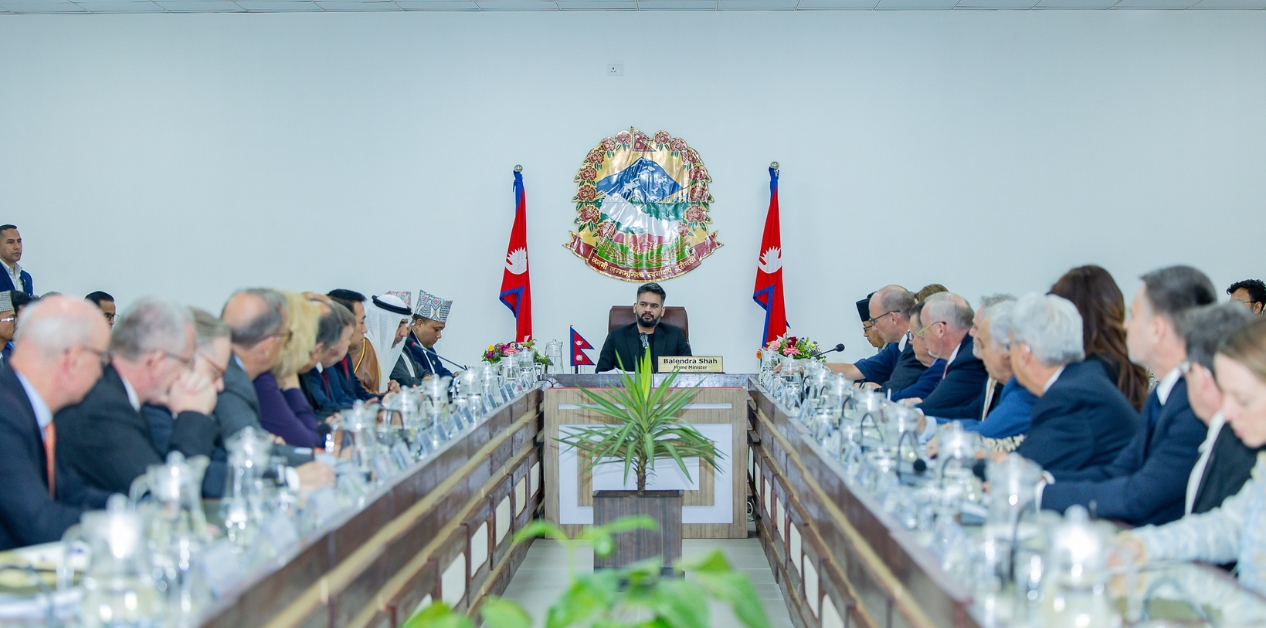
KATHMANDU: Foreign policy is often judged less by what governments announce than by how other capitals respond. In its first 100 days, the Shah administration has attempted to redefine Nepal’s external engagement around what it calls “development diplomacy”-a foreign policy that places economic transformation, investment, trade and technology transfer ahead of traditional geopolitical alignments. It is an ambitious concept for a country that has long struggled to navigate the competing interests of India, China and an increasingly active Western bloc.
Prime Minister Balendra Shah has moved quickly to reassert discipline over Nepal’s diplomacy, enforcing long-neglected protocol rules and tightening oversight of how ministers and senior officials engage with foreign diplomats. In a notable departure from convention, he met resident ambassadors once, Nepal-accredited envoys based in kathamdnu and New Delhi once in a single collective session, rather than holding the customary one-on-one courtesy meetings with each ambassador.
The move, presented as an effort to institutionalise diplomacy and place the state above personalities, received a largely positive response from diplomatic and policy circles. It also broke with a long-standing practice under which newly appointed prime ministers met ambassadors individually within days of taking office-a tradition that had increasingly drawn criticism from public intellectuals, who argued that it projected an image of diplomatic deference rather than sovereign confidence.
The government’s broader narrative has been clear. Nepal, it argues, should pursue development without becoming trapped in geopolitical rivalries. Rather than viewing diplomacy primarily through the lens of strategic competition, Kathmandu wants foreign relations to become an instrument for economic growth, infrastructure development and foreign investment. The administration has also emphasised institutional discipline by enforcing the Diplomatic Code of Conduct more rigorously, requiring ministers and senior officials to conduct foreign engagements through formal diplomatic channels.
Such efforts could strengthen institutional memory, improve transparency and reduce the scope for parallel diplomacy that has often characterised Nepal’s foreign relations.
Domestically, the government’s anti-corruption drive has also projected an image of a state attempting to restore accountability. Investigations involving former prime ministers, influential politicians and prominent business figures have reinforced the administration’s claim that no individual stands above the law. Parliament has simultaneously accelerated legislative reforms by passing amendments related to anti-money laundering, public procurement and cooperatives-changes that could strengthen Nepal’s financial governance and improve its standing with international financial institutions over time.
Yet foreign policy is ultimately measured by outcomes rather than intentions.
After its first hundred days, the government has articulated a new diplomatic philosophy but has yet to convince the region-or the wider international community-that Nepal’s strategic direction is fully understood.
One of the administration’s biggest foreign policy challenges has been creating certainty among Nepal’s most important partners. Despite repeated assurances that Kathmandu seeks balanced relations with all major powers, neither India nor China appears entirely convinced about the government’s long-term strategic orientation. Both capitals continue to watch the new administration carefully, each trying to assess whether Nepal’s foreign policy represents genuine strategic neutrality or merely another shift in political positioning.
For India, skepticism persists despite the government’s repeated emphasis on bilateral dialogue and its commitment to resolving long-standing boundary disputes peacefully. New Delhi remains cautious, not only because of Nepal’s complex domestic politics but also because successive governments have frequently altered foreign policy priorities. The new administration has reiterated Nepal’s claim over Kalapani, Lipulekh and Limpiyadhura while simultaneously expressing its preference for diplomatic negotiations. Although this reflects continuity rather than confrontation, it has not fundamentally altered India’s cautious assessment of the new government.
China’s response has been similarly measured. Beijing has welcomed the government’s emphasis on development but continues to closely observe Kathmandu’s approach towards connectivity, infrastructure cooperation and broader regional engagement. While the administration speaks of avoiding geopolitical alignment, China-like India-appears to be waiting for greater policy consistency before drawing long-term conclusions.
In effect, both of Nepal’s immediate neighbours remain in a period of strategic observation rather than strategic confidence.
Nor has the government yet secured a major diplomatic breakthrough with any leading global power. Despite the rhetoric surrounding development diplomacy, there has been no landmark bilateral agreement, transformational investment commitment or high-profile strategic partnership capable of signalling that Nepal’s international position has fundamentally strengthened during the government’s opening months.
Perhaps the greatest test of the government’s foreign policy has been its ability-or inability-to balance geopolitical competition without appearing uncertain. Nepal has historically sought to maintain equilibrium between India and China while simultaneously deepening ties with Western democracies, multilateral lenders and development partners. Maintaining such equilibrium requires not merely neutrality but clarity. Thus far, the administration has articulated neutrality but has not yet fully demonstrated how that balance will translate into practical diplomacy.
The challenge has become more complicated because foreign policy increasingly intersects with domestic governance. The government’s aggressive anti-corruption campaign has been welcomed by many international observers as evidence of stronger accountability. At the same time, frequent investigations involving high-profile political and business figures have generated questions among some foreign investors about regulatory predictability and institutional stability. Diplomatic credibility is increasingly influenced by perceptions of the domestic investment climate, judicial certainty and regulatory consistency.
Another unexpected complication has emerged through the recent passport controversy involving Germany. Allegations surrounding passport misuse and irregularities have created an avoidable diplomatic irritant with one of Nepal’s important European partners. Although the issue may ultimately prove manageable through normal diplomatic engagement, it illustrates how domestic administrative failures can quickly acquire international consequences, particularly in areas involving migration, identity management and border security.
Similarly, labour migration continues to shape Nepal’s bilateral relations with destination countries. Maintaining confidence in Nepal’s documentation systems and migration governance has become increasingly important, not only for protecting overseas workers but also for safeguarding the country’s broader diplomatic reputation.
The government’s stricter implementation of the Diplomatic Code of Conduct deserves recognition. Requiring ministers and senior officials to channel meetings through the Ministry of Foreign Affairs should reduce policy inconsistencies, strengthen institutional coordination and improve transparency in external engagements. For a country where informal diplomacy has often overshadowed institutional processes, this represents a meaningful governance reform.
However, diplomatic procedures alone do not constitute foreign policy.
Nepal’s external strategy ultimately depends on whether it can convert diplomatic engagement into measurable national gains—greater foreign direct investment, expanded export markets, improved connectivity, technology partnerships and stronger strategic trust with major powers.
That remains unfinished.
The administration has introduced the language of development diplomacy, but it has yet to produce the economic diplomacy that many expected to follow. Nepal still awaits major investment commitments from strategic partners. Large infrastructure partnerships remain limited. Trade diversification has yet to accelerate significantly.
Nor has the government demonstrated that it can simultaneously reassure India, deepen economic engagement with China and maintain robust partnerships with Western democracies without generating strategic ambiguity.
The first hundred days therefore present a mixed foreign policy picture. The government has attempted to institutionalise diplomacy, strengthen governance, reinforce anti-corruption measures and reposition foreign relations around economic development rather than geopolitical competition. These are significant shifts in emphasis.
Yet diplomacy ultimately depends on credibility, consistency and trust.
At present, Nepal’s partners appear willing to engage with the new government-but not yet ready to place full strategic confidence in it. India remains cautious, China continues to assess the administration’s long-term intentions, Western partners are closely watching governance reforms, and issues such as the German passport controversy have underscored how domestic governance can quickly spill into foreign relations.
The Shah government’s foreign policy has therefore succeeded in projecting a new vision. Its next challenge is far more demanding: transforming that vision into sustained international confidence, stronger geopolitical balance and tangible economic partnerships that convince the world Nepal has become not only a reliable diplomatic partner, but also a predictable strategic and investment destination.
![140 MW Tanhuna Hydropower Project under construction [Photo feature]](https://english.nepalnews.com/wp-content/uploads/2026/07/Tanahu-Hydropower-8.png)