Kathmandu
Monday, June 29, 2026





A proposed overhaul of Nepal’s bureaucracy is triggering resignations, unsettling senior officials and raising questions about the state’s administrative future.
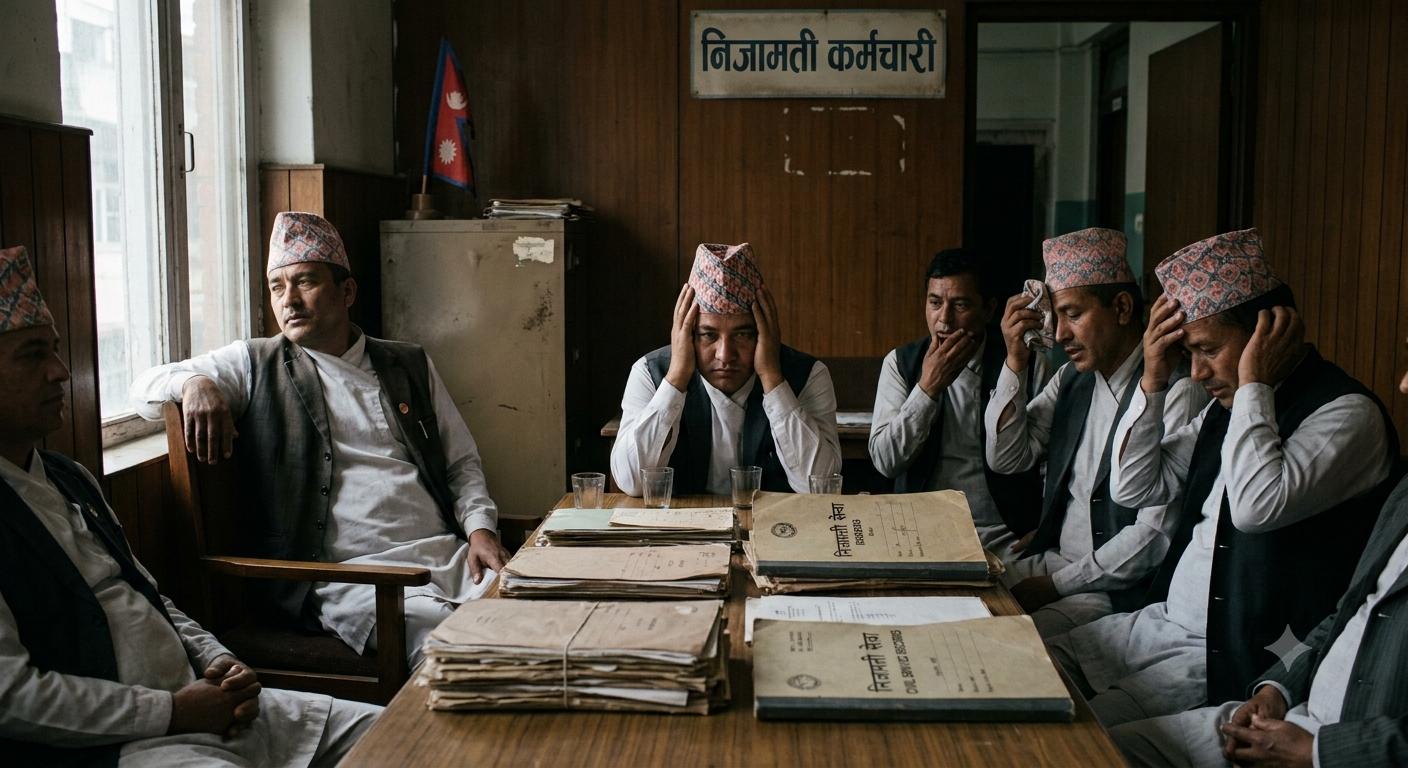
KATHMANDU: For decades, Nepal’s civil service has been described as the country’s “permanent government”-the institutional backbone expected to provide continuity regardless of which political party occupies power. Today, however, that bureaucracy appears to be confronting one of the deepest crises in its modern history.
Senior officials, administrative experts and civil servants describe a bureaucracy increasingly defined by policy uncertainty, political interference and declining morale. At the centre of the controversy lies the government’s proposed Federal Civil Service Act, 2026/27, a bill that many officials believe threatens both career security and institutional independence.
The result is an exodus that, while still in its early stages, has alarmed policymakers and administrative observers alike.
More than 600 civil servants have resigned since Prime Minister Balendra Shah took office on March 27, 2026, as anxiety mounts over the government’s proposed Civil Service Act and an increasingly contentious transfer policy. The departures include six joint secretaries and 17 undersecretaries, according to the National Book Archive.
Among those stepping down are Joint Secretary Raju Sapkota, Deputy Director General Uddhav Ghimire of the Department of Forests, Department of Roads Deputy Director General Prabhat Kumar Jha, former Melamchi Water Supply Development Board Executive Director Bal Mukunda Shrestha, and Joint Secretary Ujjwal Prajapati.
A wave of resignations
Official data from Nepal’s National Personnel Records Office (Rastriya Kitabkhana), the government’s central civil service record keeper, illustrates the scale of growing dissatisfaction.
According to Director-General Shrban Kumar Pokharel, between Asar 1 and Asar 12 (June 15- June 26, 2026)- a period of just twelve days-75 civil servants voluntarily resigned, while 101 officials retired after reaching the mandatory retirement age.
In a country where government employment has traditionally been regarded as one of the safest and most prestigious careers, seventy-five voluntary resignations within less than two weeks represent more than routine staff turnover. They suggest a growing erosion of confidence inside the state’s permanent administrative machinery.
Administrative analysts argue that such figures should not be viewed in isolation. Rather, they reflect mounting anxiety about the future direction of Nepal’s civil service reforms.
The proposed bill and growing anxiety
Much of that anxiety centres on the draft Federal Civil Service Bill currently undergoing inter-ministerial review before being tabled in Parliament.
Rather than strengthening career progression and institutional stability, many civil servants argue that the proposed legislation introduces uncertainty at precisely the moment when Nepal requires a more capable and confident bureaucracy.
One Joint Secretary, speaking on condition of anonymity because of the sensitivity of the issue, said the draft contains provisions requiring officials who have completed 30 years of service or reached the age of 55 to retire compulsorily, without any enhanced retirement package.
To many career bureaucrats, such provisions signal a fundamental shift in how the state values administrative experience.
“The government appears to be treating decades of institutional knowledge as expendable,” the official said. “Instead of recognising experienced officers as assets, the proposal effectively adopts a ‘use-and-discard’ approach.”
Whether or not Parliament ultimately retains these provisions, the uncertainty alone has already altered behaviour inside the bureaucracy.
Why officials are leaving before the law changes
For many officials approaching retirement, resigning under the current legal framework is increasingly viewed as a rational financial decision rather than an emotional one.
The proposed legislation reportedly introduces a 30-year pension cap, meaning pension calculations would no longer continue beyond thirty years of service regardless of additional years worked. Officials also fear that the cap could affect existing pension arrangements, although the final legal language has yet to be settled.
Resigning before the new law takes effect therefore allows eligible employees to preserve pension benefits calculated under the existing system.
Officials are also attempting to avoid compulsory retirement should the bill become law. Under the proposed framework, thousands of employees meeting either the service-year or age threshold could leave government service simultaneously without additional separation benefits.
For employees who have not yet completed the minimum qualifying service period, another government provision allowing service-period adjustments to qualify for pension eligibility provides an additional incentive to leave before any legislative changes are enacted.
Collectively, these financial calculations are accelerating departures even before Parliament has voted on the legislation.
Allegations of political interference
The proposed law is only one part of a broader institutional unease. Many senior bureaucrats also complain of increasing political intervention in day-to-day administration, particularly from individuals serving within Prime Minister Balen Shah’s Secretariat.
Several serving officials allege that political appointees and non-civil service advisers have bypassed established administrative hierarchies by directly instructing Joint Secretaries, Under Secretaries and even senior-ranking officials, while pressuring them to implement politically preferred decisions.
Administrative experts warn that when informal political authority begins to override formal bureaucratic chains of command, institutional accountability inevitably suffers.
The real exodus may still be ahead
Many analysts believe the current resignations represent only the beginning.
Nepal’s fiscal year concludes at the end of Asar, leaving many officials reluctant to resign before completing annual budget execution, performance evaluations and mandatory administrative reporting. Leaving before these responsibilities are formally concluded could complicate retirement documentation and pension processing.
Consequently, many officials are reportedly waiting until Shrawan 1 (July 17), the beginning of the new fiscal year, before formally submitting resignations.
Another factor is the government’s expected annual transfer cycle. Ministries are preparing extensive reshuffles of officials across federal ministries and local governments. Employees concerned about politically influenced transfers reportedly view voluntary retirement as preferable to accepting postings they perceive as arbitrary or punitive.
A bureaucratic shock in the making
If the bill is enacted in its current form, the consequences could extend well beyond individual careers.
According to National Personnel Records Office estimates, approximately 5,482 civil servants could become eligible for retirement simultaneously under the proposed provisions. That group reportedly includes a significant proportion of the government’s serving Secretaries and other senior administrators.
Such an abrupt loss of institutional memory would represent one of the largest personnel transitions in Nepal’s administrative history.
No bureaucracy can function effectively if experienced officials conclude that leaving has become more rational than staying. Governments naturally possess the authority to reform civil services, modernise retirement systems and improve administrative efficiency. But successful reforms depend as much on building confidence as on rewriting legislation.
Nepal’s civil service now appears caught between political ambition and institutional uncertainty. Whether the proposed reforms ultimately strengthen the state or weaken its administrative capacity will depend less on the rhetoric surrounding the legislation than on whether the government can reassure its own bureaucracy that experience remains an asset rather than a liability.
For a country that relies on its permanent civil service to provide continuity through frequent political change, that question has become one of governance itself.